
Research current through October 25, 2026.
Florida Amendment 3 is a proposed property-tax change on the November 3, 2026 ballot. For qualifying homeowners, it would raise the non-school homestead exemption to $150,000 in 2027 and $250,000 in 2028, with different treatment for newer Florida residents. For covered rental and other non-homestead property, it would lower the annual assessment-growth cap from 10% to 5% beginning January 1, 2027.
An existing rental could benefit when that lower cap limits its assessment. A buyer whose purchase triggers reassessment could see no cap-related reduction in the reset year. Neither provision guarantees a lower total bill.
The changes require approval by at least 60% of voters voting on the measure. They have not taken effect. See the official ballot booklet and Florida Constitution, Article XI, section 5(e). dos.fl.gov

Key takeaways
Classify each property first. An investment rental and your qualifying primary residence receive different forms of proposed relief.
Check the assessment gap. A lower cap matters when it constrains assessed value below just value, even if market prices are flat.
Underwrite a purchase using the buyer’s assessment. The seller’s tax bill can understate the cash you need after a qualifying ownership change.
Separate residence dates from exemption years. The proposal’s cutoff and fifth-exemption-year rule do not create a blanket requirement to buy before year-end.
What would Florida Amendment 3 change?
The proposal changes exemptions and assessment limits at different stages of the tax calculation. An exemption reduces taxable value; an assessment limit restricts certain annual increases in assessed value.
Its official ballot title is Increased Homestead Exemption; Lower Cap on Increases in Non-Homestead Property Assessments.
| Property or issue | Current baseline | Proposed treatment if approved |
|---|---|---|
| Qualifying homestead, non-school levies | Standard exemption up to $51,411 in 2026, subject to value bands | Up to $150,000 in 2027 and $250,000 in 2028 for qualifying persons who maintained permanent Florida residence as of December 31, 2026 |
| Homestead, school levies | Standard exemption up to $25,000 | Remains up to $25,000 |
| Covered rental, second-home and other non-homestead property | Generally a 10% annual assessment-growth cap for non-school levies | A 5% cap beginning January 1, 2027 |
| Qualifying homestead assessment growth | Generally the lower of 3% or the applicable CPI change | Save Our Homes framework retained |
| Special-benefit assessments and separate charges | Calculated separately from ordinary value-based taxes | No general exemption from these costs |
The proposed $250,000 is the standard non-school exemption amount, rather than an additional amount stacked on top of the first standard $25,000. School taxes are calculated separately. These mechanics follow the proposed constitutional text.
The current $51,411 maximum also has two bands: the first $25,000 of assessed value, plus an inflation-adjusted $26,411 above $50,000. At least $76,411 of assessed value is needed to use the full standard non-school exemption. See section 196.031 and the July 10 state fiscal analysis, page 1. www.flsenate.gov
Can rental investors benefit from Amendment 3?
An exclusively investment rental ordinarily does not satisfy the permanent-residence requirement for the enlarged homestead exemption. Its potential direct benefit comes from the lower non-homestead assessment cap.
Current rules distinguish residential property with nine or fewer dwelling units under section 193.1554 from other covered residential and nonresidential property under section 193.1555. Larger multifamily and commercial properties are not automatically excluded. Agricultural and other specially classified property require separate treatment.
Three rental situations produce different results
These illustrations assume 10 combined non-school mills, no exemption or special classification, and no improvement or reassessment event except where stated. Just value generally means market value before assessment limits and exemptions.
| Situation | Assessment under current rules | Assessment under the proposal | Non-school tax difference |
|---|---|---|---|
| Held rental: prior assessment $400,000; next just value $500,000 | $440,000 | $420,000 | $200 lower under the proposal |
| Held rental: prior assessment $400,000; next just value $410,000 | $410,000 | $410,000 | $0 |
| Qualifying purchase: seller’s assessment $400,000; assumed next reset value $600,000 | $600,000 | $600,000 | $0 in the reset year |
In the first case, the non-school component would be $4,200 rather than $4,400. It would still exceed the prior $4,000 component. A benefit compared with the no-amendment outcome can coexist with an increase over last year’s cost.
In the second case, neither cap binds because just value is below both capped amounts. In the third, the qualifying purchase reset controls. Increasing the seller’s old assessment by 5% would understate the assumed buyer assessment.
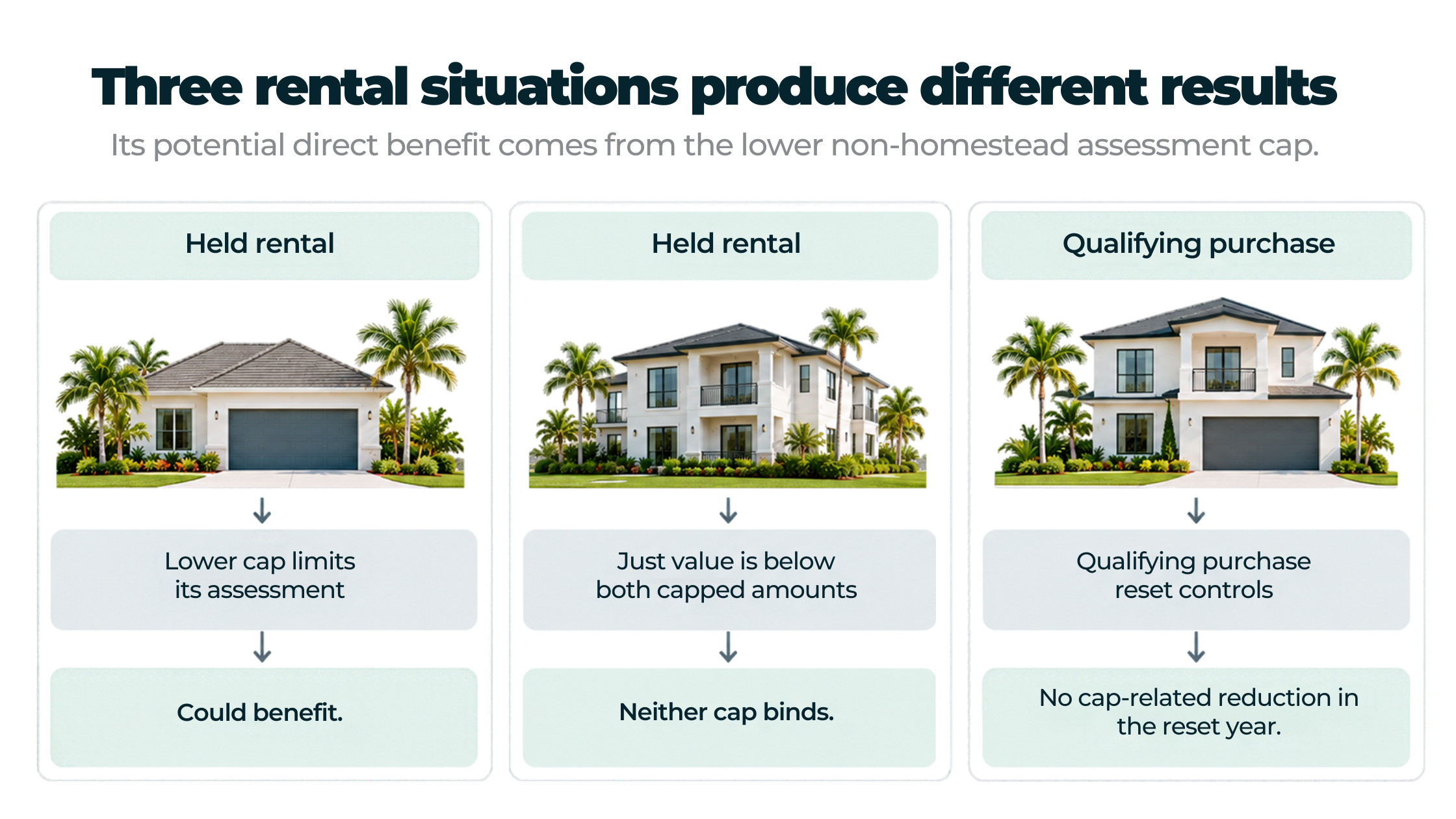
The comparison depends on whether the lower cap constrains the assessment or a qualifying purchase reset controls.
The comparisons exclude school taxes and separate charges. The assumed $600,000 reset value is not a rule that assessed value always equals purchase price.
Flat market prices do not necessarily eliminate the benefit. If the prior assessment remains well below just value, a cap can still constrain the next assessment. DOR’s assessment FAQ explains why assessments can rise even when market values do not. www.floridarevenue.com
Why a purchase, transfer or renovation can change the forecast
A qualifying change of ownership or control generally resets covered non-homestead property to just value on January 1 of the following year. The proposal retains reassessment provisions.
The statutory definitions reach more than deed transfers. They include a cumulative transfer of control or of more than 50% of the ownership of the entity that owned the property at its most recent just-value assessment. Exceptions exist, including certain title-correction and legal-to-equitable-title transfers, but their scope must be checked under the applicable section. See section 193.1554(5) and section 193.1555(5).
Renovations create a separate issue. Under section 193.1555, a substantially completed improvement that increases the property’s just value by at least 25% is a qualifying-improvement trigger for reassessment. The test concerns the value increase, not simply the construction budget. Changes and additions below that threshold can still receive just-value treatment; the 25% test is not a universal safe harbor for rental renovations. Section 193.1554(6) and section 193.1555(5)–(6) distinguish the applicable treatment. www.flsenate.gov
For underwriting, keep three figures separate: the seller’s bill, the buyer’s first post-transfer assessment and later annual assessments. If title or renovation assumptions could change the purchase, our guide to a CPA review before buying a Florida rental helps define the work while those decisions remain open.
How the rental assessment difference could develop over five years
A lower cap can produce a growing difference when both the current and proposed caps continue to bind.
Consider a hypothetical held rental with a $400,000 non-school assessment in 2026. Assume just value remains $900,000, both caps bind, the combined non-school rate stays at 10 mills, and there is no transfer, improvement, change of use, exemption or other law change.
| Tax-roll year | Assessment with 10% annual growth | Assessment with 5% annual growth | Annual non-school tax difference |
|---|---|---|---|
| 2027 | $440,000.00 | $420,000.00 | $200.00 |
| 2028 | $484,000.00 | $441,000.00 | $430.00 |
| 2029 | $532,400.00 | $463,050.00 | $693.50 |
| 2030 | $585,640.00 | $486,202.50 | $994.38 |
| 2031 | $644,204.00 | $510,512.63 | $1,336.91 |
The cumulative modeled difference is $3,654.79, before school taxes, separate charges and federal income-tax effects. Calculations retain full precision before rounding for display.
This is a sensitivity analysis, not a forecast. A just-value ceiling, reassessment event or rate change requires new calculations. Use only the years you expect to own the property when evaluating the benefit against acquisition costs and reserves.
What the larger homestead exemption could mean for a homeowner
The larger exemption would reduce taxable value on an eligible homestead. Its dollar benefit depends on the assessed value available to exempt and the applicable rates.
Consider a hypothetical qualifying homestead in 2028 with $400,000 of assessed value, 10 combined non-school mills and 6 school mills. Assume eligibility for the larger exemption and no other exemptions. Ten mills means $10 of tax per $1,000 of taxable value.
| Component | Illustrative calculation | Tax |
|---|---|---|
| Non-school | ($400,000 − $250,000) × 0.010 | $1,500 |
| School | ($400,000 − $25,000) × 0.006 | $2,250 |
| Combined ad valorem tax | $1,500 + $2,250 | $3,750 |
These rates are assumptions. The example excludes non-ad valorem assessments, payment discounts and other charges. The $3,750 is illustrative tax, not a verified saving.
To isolate the exemption’s effect, calculate each non-school levy with and without the proposal using the same assessed value and rate, then subtract. The no-amendment calculation must use the exemption applicable to that future year, including indexing. Freezing the 2026 exemption would distort the comparison. Separately test rate changes to assess the total carrying cost. The DOR calculation guide explains the value and levy calculations.
Use the property’s assessment records, rather than its sale price, to estimate the benefit. Similar market values can sit above very different assessed values because of assessment histories.
Residency timing is separate from the purchase date
The larger initial exemption turns on whether the qualifying person maintained permanent Florida residence as of December 31, 2026. The text does not require everyone in that group already to own a home by that date. A resident renter who later buys still needs to establish an eligible homestead.
For qualifying persons outside that group, the proposed non-school exemption starts at up to $50,000, with positive-inflation adjustments beginning in 2028. The larger indexed exemption starts in the fifth year of exemption.
For example, assume a person moves to Florida during 2027, first qualifies in 2028 and remains eligible continuously. Their fifth exemption year would be 2032. The larger dollar amount then would depend on indexing. The $250,000 amount would receive positive-inflation adjustments beginning in 2029.
Starting in 2030, a county or municipality could shorten the five-year requirement for a critical local need through a two-thirds vote of its governing body’s membership. That discretionary action should not be built into a forecast before it occurs. See proposed Article VII, section 6(a). www.flsenate.gov
The revised ballot summary also qualifies the residency distinction by what the US Constitution permits. Returning residents, interrupted exemption histories and unusual ownership arrangements require the applicable legal interpretation and administrative procedures to be checked before relying on a specific result.
Could local rates or charges offset part of the relief?
Yes. A 5% assessment-growth cap would not cap the total bill at 5%. Taxable value and millage determine each value-based tax component; school taxes and non-ad valorem assessments need separate treatment. DOR’s taxpayer overview explains these components.
Using the first rental example, an assumed 10.5 non-school mills on $420,000 produces $4,410. That slightly exceeds $4,400 at 10 mills on $440,000. This illustrates a rate offset, without predicting that a locality will adopt that rate or have authority to do so.
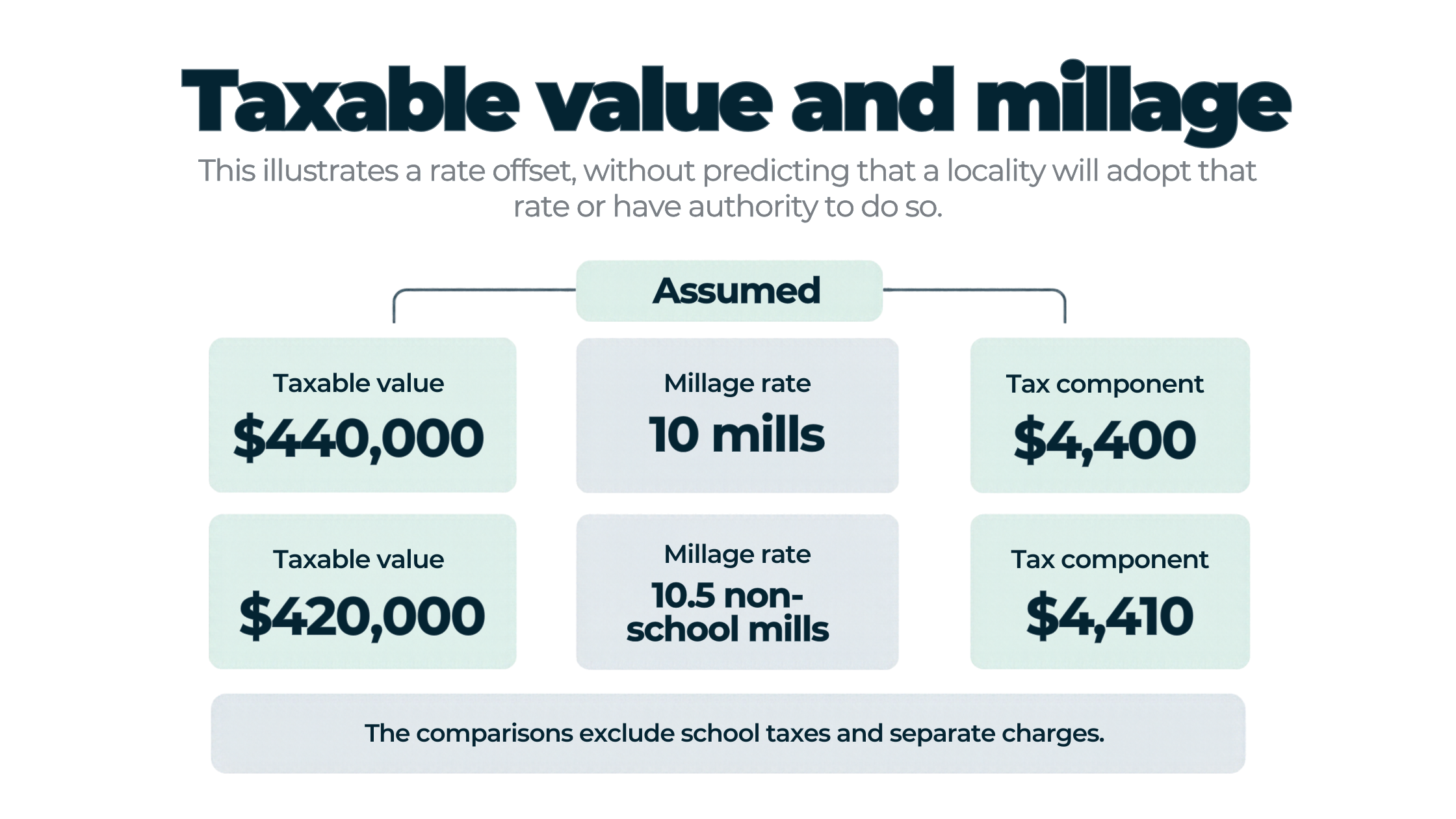
The article’s assumed rate comparison shows why a lower assessment does not establish a lower tax component.
The current millage law is separate from the ballot measure
Chapter 2026-240 became law separately from Amendment 3. It uses a rolled-back-rate baseline for the affected local millage limits. That computed rate aims to generate prior-year levy revenue after statutory adjustments. A smaller taxable base can therefore correspond to a higher rolled-back rate.
Under section 200.065(5), a rate above the baseline but no more than 110% generally requires a two-thirds membership vote. Above 110%, the routes include unanimity, a three-fourths membership vote for bodies with nine or more members, or referendum. Statutory exceptions and other legal ceilings still apply. The benchmark is the computed rolled-back rate, rather than automatically last year’s adopted rate. laws.flrules.org
Fiscal estimates do not predict a property’s bill
The July 10 Revenue Estimating Conference analysis, page 4 models non-school local cash revenue reductions of approximately $4.93 billion in FY2027–28 and $8.71 billion in FY2028–29 if the amendment passes. These conditional estimates are not adopted spending cuts or taxpayer savings. edr.state.fl.us
The proposal’s spending provisions also allow other approved county and municipal expenditures unless prohibited by general law. Listing public safety does not guarantee unchanged funding. Its additional-relief provisions require a uniform procedure for further local homestead exemptions, potentially up to full assessed value, but do not establish automatic statewide elimination on a fixed timetable. See proposed Article VII, sections 6(a)(4) and 9(a). www.flsenate.gov
How to use the proposal in a purchase or portfolio decision
We recommend comparing three cases using the same property facts and holding period:
Current-law case: Apply the property’s assessment and reset rules, ordinary exemptions and supported operating costs. For a purchase, use a buyer-specific assessment.
Approval case: Change only the exemptions or assessment cap that would actually apply to that property. Identify the years in which the lower cap changes the calculation.
Local-cost sensitivity: Test explicitly assumed rate or separate-charge changes. Keep these assumptions distinct from adopted local policy.
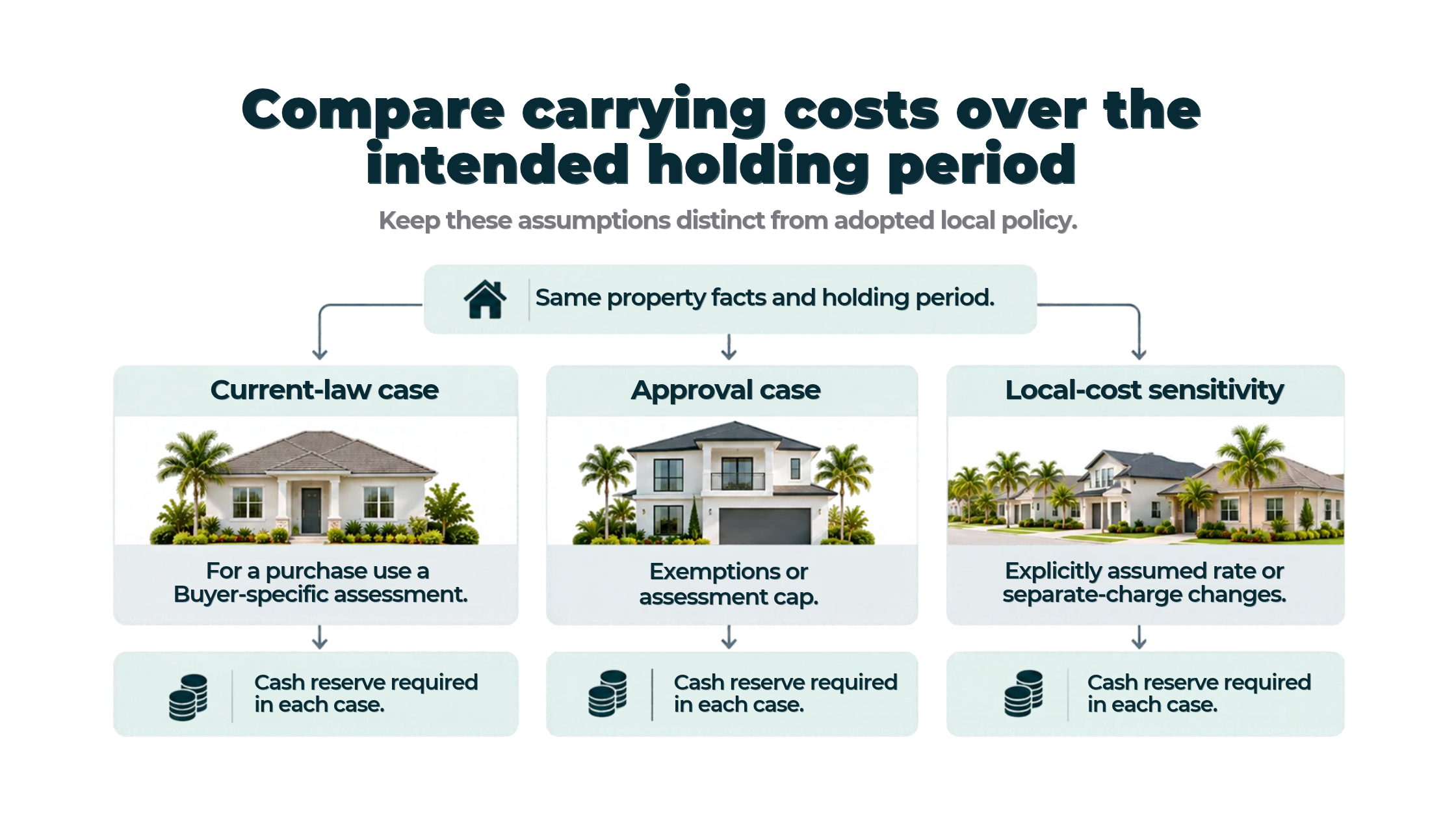
Comparing cases on the same property facts makes funding dependence visible while purchase and financing decisions remain open.
Show the cash reserve required in each case. If a purchase needs amendment-related relief to cover ordinary carrying costs, resolve that funding dependence before diligence or financing commitments become binding.
An existing owner may need only a focused assessment comparison. A purchase involving an entity transfer and renovation may call for input from the appraiser, CPA, attorney and lender. Where your current CPA already has a supported buyer projection, update the affected inputs and agree on any additional scope before commissioning more work.
What to bring to the appraiser and CPA
Bring the current bill and TRIM notice, prior assessments, acquisition and ownership records, exemptions, relevant permanent-residence evidence, and planned improvements or use changes. Identify school and non-school values and rates, plus non-ad valorem charges.
Ordinary homestead administration tests ownership and residence as of January 1 and generally requires an application by March 1. Check late-filing, renewal and amendment-specific procedures separately. DOR’s homestead guidance directs applications to the county property appraiser.
For a duplex or partly rented home, confirm the eligible owner-occupied portion before applying an exemption. Section 196.031(4) limits the exemption to property, or the portion, classified and assessed as owner-occupied residential property.
Renting all or substantially all of a claimed homestead generally constitutes abandonment until the owner physically reoccupies it. Abandonment after January 1 ordinarily does not affect that year’s exemption unless the property is rented for more than 30 days per calendar year for two consecutive years. Specified military and federal overseas-service exceptions also apply. Have the appraiser evaluate the actual occupancy and rental dates before relying on continued homestead treatment. Section 196.061. www.floridarevenue.com
The property appraiser administers assessments and determines homestead eligibility. For planning, ask your CPA to connect the supported property costs with your broader cash-flow forecast and agree on the work required.
What to Bring to a Tax Strategy Review: A Checklist
Plan around the property’s actual tax position
Florida Amendment 3’s 2026 property-tax proposal could affect a qualifying residence and a rental portfolio very differently. Establish classification, identify any reset, test whether the proposed relief changes taxable value, then compare carrying costs over the intended holding period.
For buyers, do that work while price, financing and reserves can still change. Existing owners can concentrate on parcels with material assessment gaps or planned transactions.
Frequently Asked Questions
How can I reconcile two tax projections for the same rental property?
Compare their inputs and comparison years before comparing their totals. Check whether both use a buyer-specific assessment, whether the assessment cap binds, and whether the figures include the same school taxes and separate charges.
Then compare millage assumptions, holding periods and planned ownership or improvement changes. A projection based on the seller’s existing bill can differ materially from one incorporating a qualifying purchase reset. Keep current-law and approval scenarios separate so that differences in the proposed rules are not confused with differences in the underlying assumptions.
Which forecast inputs should I treat as documented facts, and which should remain assumptions?
Use property records to document the starting position, and identify future outcomes separately. Current bills, prior assessments and ownership records support the existing tax position. Planned transfers, improvements and changes of use need to be identified when preparing the forecast.
An approval case remains conditional. Future indexed exemptions, local rates and separate charges should not be treated as established merely because a model includes them. Preserve that distinction when translating a comparison into acquisition reserves: an illustrative tax difference does not establish the property’s future carrying cost.
How should I coordinate the analysis when a homesteaded property is becoming a rental?
For planning, have the property appraiser address homestead eligibility and the relevant property classification before your CPA relies on those inputs in a cash-flow forecast. The eligible owner-occupied portion, occupancy dates, rental dates and applicable abandonment provisions need separate attention.
The forecast can then incorporate the supported assessment and exemption treatment, school and non-school components, separate charges, and any planned transfer or improvement. This separates the appraiser’s eligibility and assessment work from the CPA’s planning analysis of carrying costs and reserves.

Inzamam ur Rahman
Content & Marketing Strategist
Inzamam manages content and advises on marketing strategy for Square Accounting. He works with Stevan Franeta, CPA, to create clear, practical articles for business owners, high-income professionals, and real estate investors.
Reviewed for tax accuracy by Stevan Franeta, CPA
