What to Bring to a Tax Strategy Review
Bring five essentials to a tax strategy review: your latest complete personal and business tax returns, current-year financial reports, payroll and withholding records, proof of estimated tax payments, and a short list of upcoming decisions. Add ownership, investment, rental property, and retirement documents where relevant.
For a service-business owner, deciding what to bring to a tax strategy review means connecting the last filed return with current results and choices still open. Label gaps clearly so the advisor can distinguish confirmed figures, estimates, and unresolved facts.
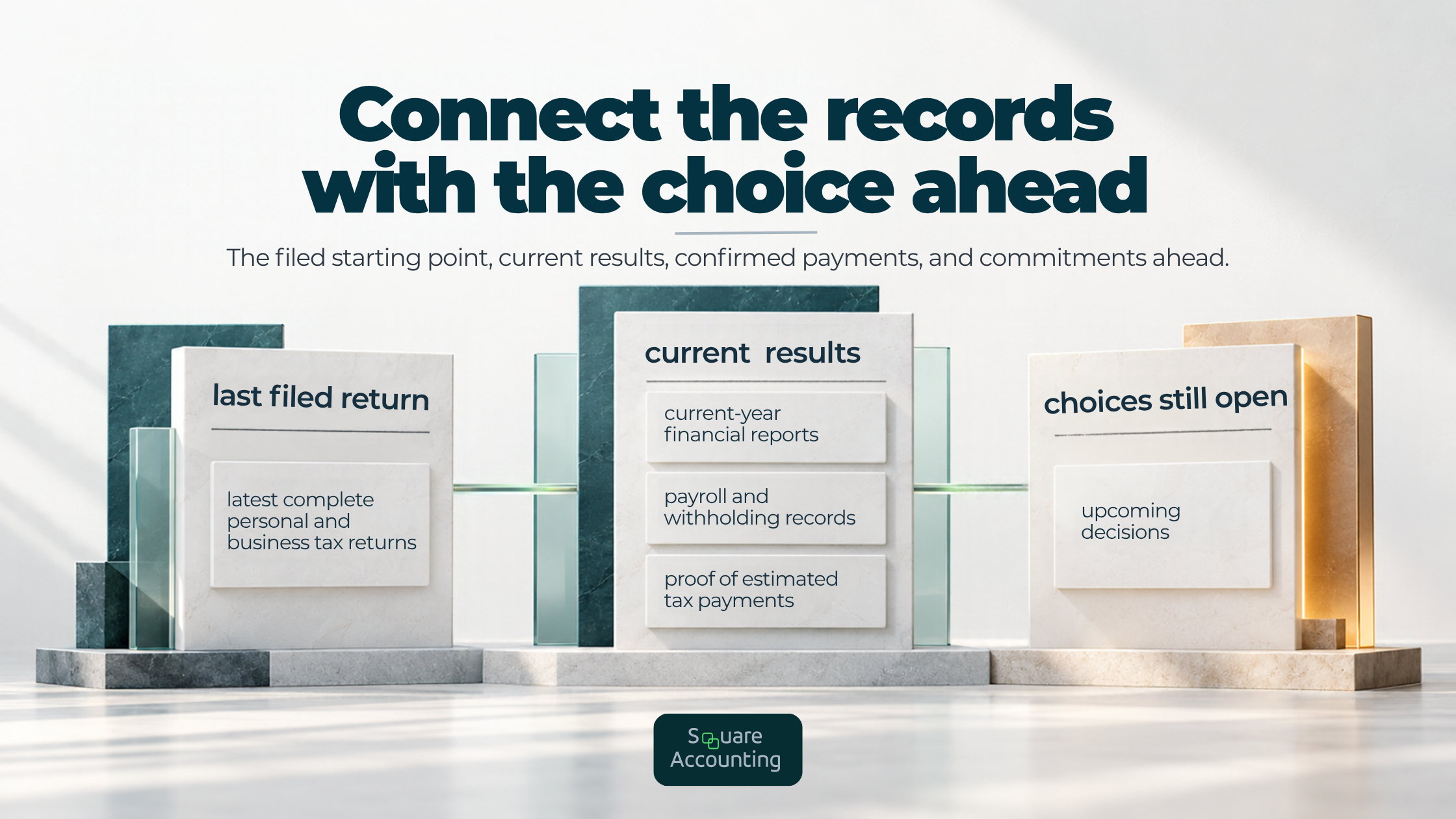
Preparing the filed starting point alongside current information helps connect the records with decisions that remain open.
Tax strategy review checklist: Start with these records
We recommend the following starting package. Follow the advisor’s specific request and confirm which records the firm already holds.
| Bring or prepare | What it helps clarify |
|---|---|
| Latest complete personal and business returns, including schedules, K-1 attachments, and available carryforward worksheets | The filed starting point and items needing follow-through |
| Current-year profit and loss statement and balance sheet for each business | Results through a stated date, assets, debts, and bookkeeping questions |
| Year-to-date payroll reports and recent household pay statements | Owner compensation, wages, withholding, and expected changes |
| Estimated-payment confirmations and records of prior-year overpayments applied forward | What was paid or credited, for which taxpayer and year |
| Remaining-year income estimate with its assumptions | How expected collections, expenses, and other income differ from results to date |
| Major decisions with expected dates and funding needs | What remains open and when analysis would be useful |
| Relevant ownership agreements, property schedules, investment statements, retirement information, and prior planning memos | Supporting facts for the questions on your agenda |
Include every page of any IRS or state notice and flag its response date when scheduling. The advisor can determine whether it needs attention outside the planned review.
If time is limited, prioritize the latest complete return, usable current-year reports, payment records, and the next important decision. Ask which missing item could prevent that decision from being evaluated.
Prepare current-year numbers your CPA can use
A prior-year return provides context. Current-year planning also needs a dated picture of what has changed.
The IRS estimated-tax guidance explains that the calculation involves expected income, deductions, credits, and tax. Prior-year information can serve as a guide, but changes in circumstances need to be reflected. Internal Revenue Service
Provide reports through the most recent usable month and identify whether the books use cash or accrual accounting. Note which accounts have been reconciled and what adjustments remain outstanding. For an in-year meeting, use current statements and estimates rather than treating last year’s income documents as current results.
Explain unusual items such as a major client gained or lost, delayed collections, an insurance payment, a large professional fee, or staffing changes. Separate signed work from uncertain pipeline. Those distinctions help the advisor evaluate the forecast assumptions.
Separate confirmed figures, estimates, and unresolved facts
For planning purposes, we recommend labeling important inputs this way:
Confirmed: Recorded through a stated date and supported by available records.
Estimated: Expected income, expenses, or events, with the assumption identified.
Unresolved: A factual or classification question that still needs review.
An expected collection can be modeled as an estimate. An owner transfer whose purpose is unclear needs supporting facts before its treatment is settled.
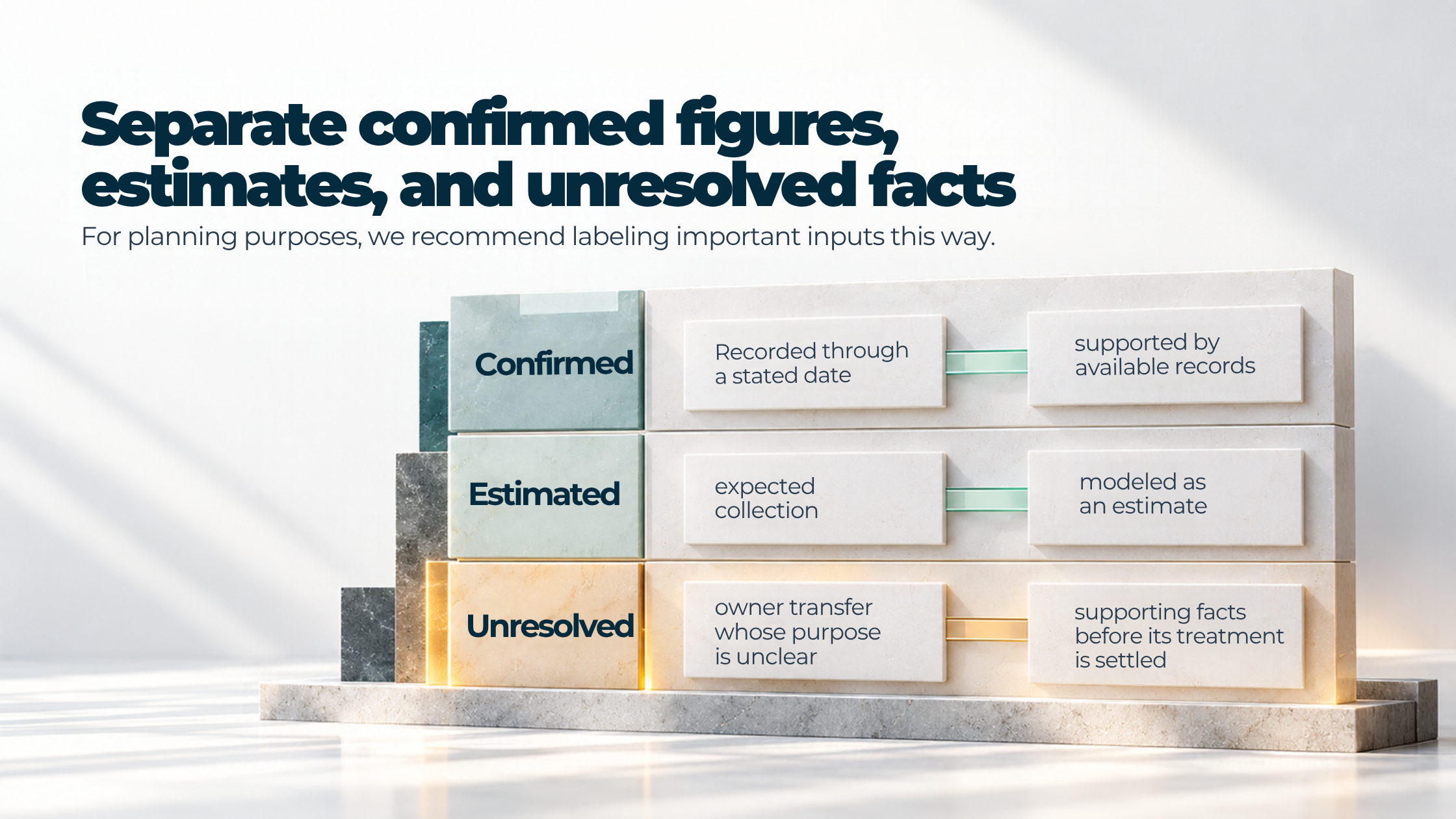
An expected collection can be modeled as an estimate, while an unclear owner transfer needs supporting facts before its treatment is settled.
For unusual transactions, include the relevant invoice, agreement, and payment evidence. The IRS recordkeeping guidance identifies supporting documents as evidence behind entries in books and returns. A summary report does not replace that support. Internal Revenue Service
Tax Prep + Advisory Review
Define a useful review scope.
Discuss which current-year figures and unresolved items need attention before evaluating your next decision.
Show how the business is owned and how you are paid
Prepare a list of entities, owners, ownership percentages, and each entity’s purpose. Include available election confirmations and relevant ownership agreements, especially where circumstances changed after the last filing.
Keep owner wages, distributions, reimbursements, contributions, and loans separately identifiable. If the books combine them, flag the uncertainty and provide the supporting records instead of assigning new labels before the meeting.
For an S corporation, add payroll reports, distribution records, and a description of the shareholder-employee’s duties and time spent working. The IRS compensation guidance identifies responsibilities, time, experience, and other circumstances as factors in reasonable-compensation analysis. We would review those facts before drawing a conclusion from the salary and distribution amounts. Internal Revenue Service
If employee benefits or retirement planning is on the agenda, provide available plan documents, contribution records, requested employee information, and funding capacity. Ask whether a plan administrator or another specialist needs to participate.
For a possible business sale, bring available letters of intent, draft agreements, proposed payment terms, and ownership records. Identify signed documents and negotiable terms, your expected use of the proceeds, and the advisors already involved.
Tax Prep + Advisory Review
Choose the priority for your review.
Discuss whether owner compensation, ownership records, or an upcoming transaction should lead the review.
Add relevant household, investment, and property records
Business funding decisions affect how much cash an owner can commit to household needs and investments. Prepare an estimate of living costs, debt payments, planned investments, and reserves. For a joint household review, include your spouse’s relevant income and withholding information.
Investments, bonuses, and equity compensation
Provide current brokerage reports, realized gains and losses, available cost-basis information, and details of proposed sales. For significant bonuses or equity awards, include current statements, award documents, and expected payment or vesting dates. Mark uncertain events as estimates.
Share planned charitable gifts or retirement-account transactions when they are part of the discussion. Include prior planning memos and explain what has already been implemented so the advisor can identify assumptions that need revisiting.
If you own or plan to buy rental property
Add property-level income and expense reports, closing statements, improvement records, depreciation schedules, financing information, and available suspended-loss worksheets. Include the intended holding period and any planned sale or change in use.
If cost segregation is being discussed, provide the existing study, if any, and the asset schedules used on filed returns. Identify whether the property has already appeared on earlier returns.
Depreciation history matters to later decisions. IRS Publication 551 explains that depreciation generally reduces basis, including allowable amounts under applicable rules even when not claimed. Purchase price alone may therefore be an incomplete starting point. Internal Revenue Service
A projected rental loss also needs a usability assessment. IRS Publication 925 explains that passive-activity and at-risk rules can limit deductions, with applicable basis and at-risk limitations considered before the passive-activity limits. Bring the schedules and activity facts needed for that analysis rather than assuming the loss will immediately offset household income. Internal Revenue Service
Reconcile payments before deciding how much cash is available
List each estimated payment by taxing authority, taxpayer or entity, tax year, amount, and date. Include confirmations and identify prior-year overpayments applied forward separately.
The payment-record worksheet in 2026 Form 1040-ES separates amounts paid, payment dates, confirmation information, and prior-year overpayment credits. It is a useful organizational model for your federal records.
Keep future instructions separate from completed payments. A voucher or reminder does not establish that money was paid. If bank records and tax-account records disagree, identify the difference for reconciliation.
The IRS estimated-tax guidance explains that an individual online account can show payment history. It also notes that late or insufficient payments may create underpayment exposure even when the eventual return shows a refund. Dates matter alongside annual totals. Internal Revenue Service
For the cash discussion, distinguish:
Projected total tax.
Amounts already paid or credited.
Cash still needed and its expected payment dates.
Then show what remains available for operating needs, household commitments, and proposed investments. A lower projected filing balance should be reconciled with the full payment picture before it becomes part of another spending plan.
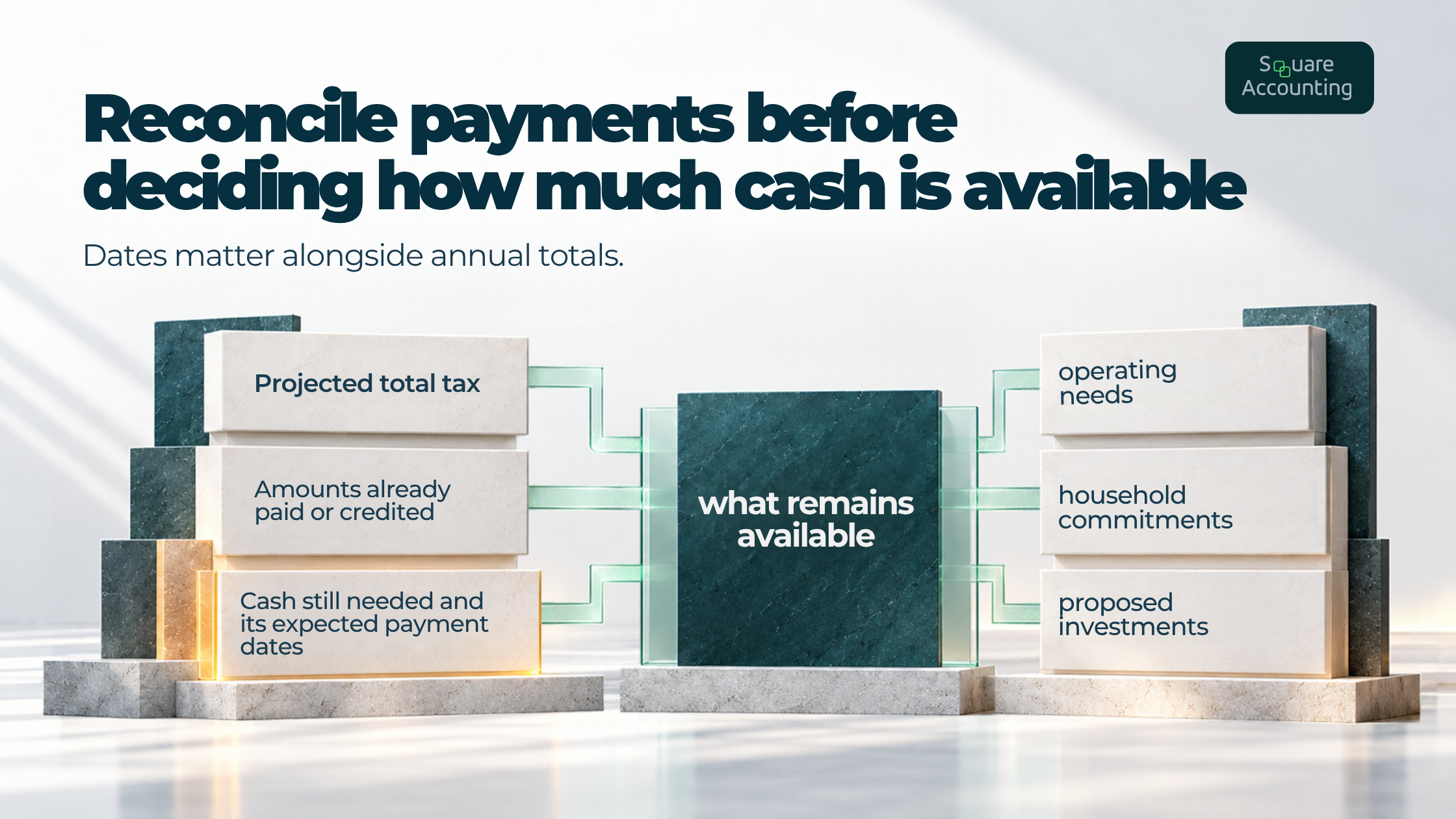
The full payment picture should be reconciled before a lower projected filing balance becomes part of another spending plan.
Tax Prep + Advisory Review
Connect the tax picture with cash needs.
Discuss how projected tax, confirmed payments, and upcoming funding needs should be considered together.
Prepare a decision brief while choices are still open
Choose the decisions that matter most and prepare a short note for each:
Purpose: What are you considering, and what business or personal goal does it serve?
Timing: When might you sign, fund, close, or otherwise commit?
Cash: What must be paid, financed, or reserved?
Uncertainty: Which facts are confirmed, estimated, or unresolved?
Coordination: Who else needs to be involved?
Include commercially realistic alternatives, including postponing or declining the action. Tell the advisor the earliest expected commitment date and ask what analysis needs to happen before it.
We recommend tracking when you expect to commit to terms or funding, alongside any tax deadlines the advisor identifies. This gives the review a practical decision calendar.
Same profit, different next-year commitments
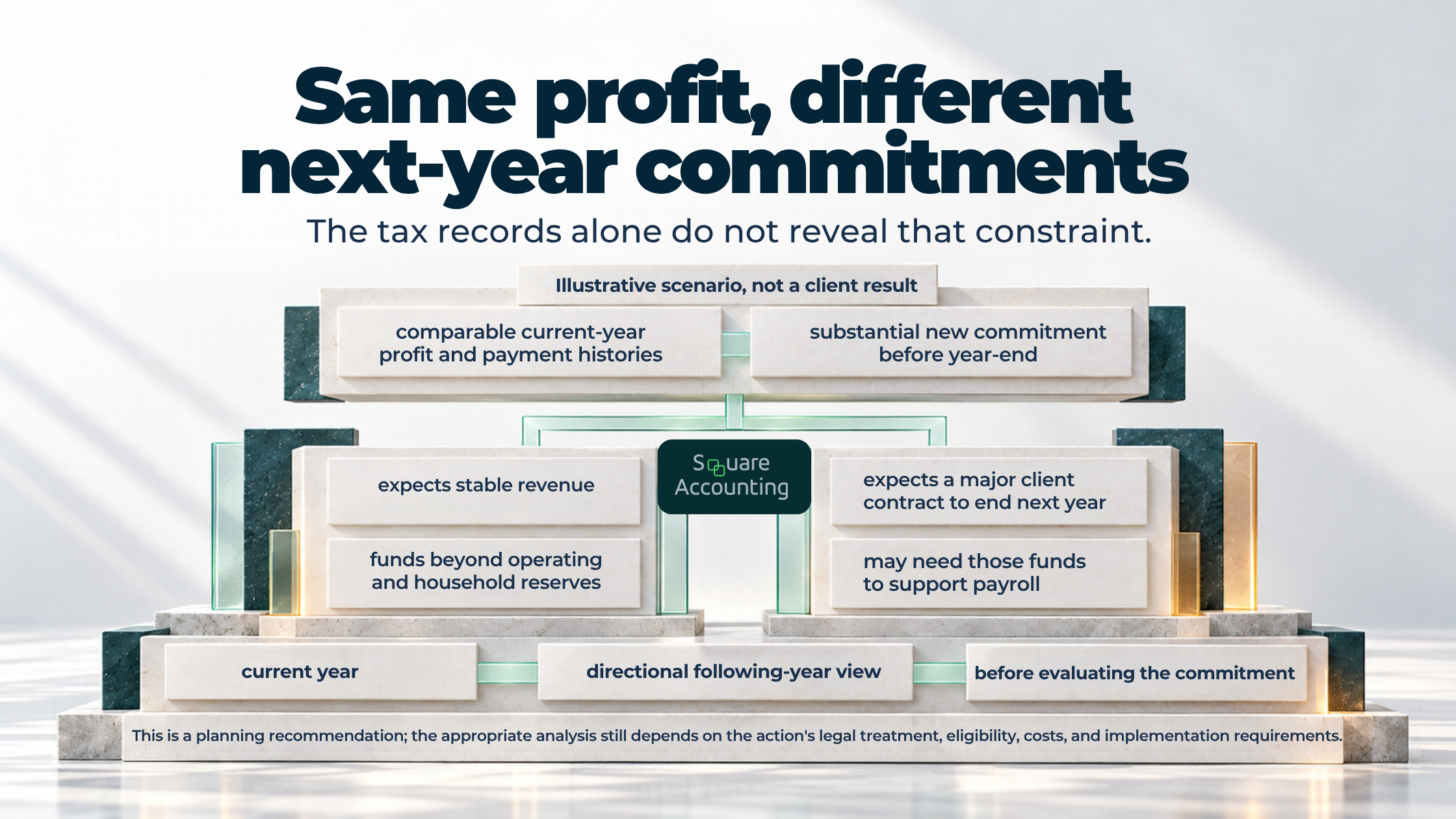
Example: Two service-business owners have comparable current-year profit and payment histories. Both are considering a substantial new commitment before year-end.
One expects stable revenue and has funds beyond operating and household reserves. The other expects a major client contract to end next year and may need those funds to support payroll.
The second owner should bring the contract end date, expected collections, staffing commitments, and a lower-revenue cash forecast. The tax records alone do not reveal that constraint.
We would compare the current year with a directional following-year view before evaluating the commitment. For a longer-term investment, we would also want the expected funding and exit assumptions. This is a planning recommendation; the appropriate analysis still depends on the action’s legal treatment, eligibility, costs, and implementation requirements.
Tax Prep + Advisory Review
Bring the next commitment into focus.
Discuss what needs to be clarified or modeled before committing business or household cash.
What if your records are incomplete?
Tell the advisor before the meeting. Ask whether the discussion can proceed preliminarily, should focus on a narrower question, or needs specific records first.
Prepare a gap list identifying what is missing, who can obtain it, when it is expected, and which decision depends on it. A missing minor receipt and a missing ownership agreement may have different consequences for the planned work.
Agree on which conclusions can be discussed and which must wait. Preliminary figures may help frame options without being sufficient for a reliable payment calculation, implementation recommendation, or filing position.
The meeting package is a preparation recommendation. Separately, Treasury Regulation 1.6001-1 requires records sufficient to establish relevant return items. A preliminary consultation does not replace that substantiation. ecfr.gov
Flag activity outside Florida
If your work, employees, properties, ownership interests, or household circumstances extend beyond Florida, include the locations, relevant dates, state returns, state K-1s, and payment records.
A Florida address does not resolve every other-state tax question. New York’s official nonresident guidance, for example, identifies work performed in New York and income from real property there as potential New York-source income. Actual obligations depend on the applicable state’s rules and your facts. tax.ny.gov
The preparation task is to reveal that footprint so the advisor can determine which jurisdictions need analysis.
Before the meeting: document delivery and scope
Agree on a protected delivery method
Ask for the firm’s approved upload method and submission date. Organize files by tax year, entity, and document type, and identify the period-end date on current-year reports.
Use the agreed secure channel for sensitive documents. If email is proposed, confirm the encryption process. The IRS security guidance for tax professionals recommends password-protected, encrypted document transmission. Internal Revenue Service
Ask which identity documents are requested and how to provide them. If accounting access is needed, confirm the approved access process with the firm.
Confirm what the review includes
Establish whether the appointment is an introductory discussion, a return-and-advisory review, or a separately scoped modeling engagement. Confirm the allotted time, fee, records to be reviewed, and whether a written projection or implementation plan is included.
Ask who should attend. Where appropriate, identify the spouse, bookkeeper, attorney, payroll provider, investment advisor, or plan administrator whose information or decisions the review requires.
Questions to resolve before you leave
Use the review to connect the records with the choice ahead:
Which assumptions could change the recommendation?
Does the proposed benefit reduce total tax, defer tax, or change payment timing?
When could it affect cash, and what must be funded first?
What changes if revenue falls, a transaction is delayed, or the holding period changes?
What documentation, analysis, or other advisor input is needed before implementation?
Confirm the next action, responsible person, target date, and event that should trigger another review. Ask which conclusions remain preliminary. A proposal to model an option is different from a completed recommendation to implement it.
For the broader meeting experience, read what happens during a Tax Prep + Advisory Review.
When deciding what to bring to a tax strategy review, prioritize the information that could change the next decision: the filed starting point, current results, confirmed payments, and commitments ahead.
If your review is already booked, use this checklist to confirm the document request and agenda. If you are evaluating coordinated help with business and household decisions, book a Tax Prep + Advisory Review to discuss what needs to be clarified or modeled before your next commitment.
Tax Prep + Advisory Review
Clarify your next decision.
Discuss the records, assumptions, and coordination needed before your next business or household commitment.
Your next step
Book an Advisory ReviewBring your current income picture and the decisions you want to discuss.
Already booked? Confirm your document request and agenda.
Frequently Asked Questions
What should take priority if a business commitment is approaching before the books are complete?
Start with the approaching decision and identify which missing information could prevent it from being evaluated. Give the advisor the expected commitment date, funding needs, available alternatives, and a gap list showing who can obtain each outstanding record.
The meeting may still help frame options, but its scope should reflect the information available. Separate estimates that can be modeled from unresolved facts or classifications that need supporting records. Agree which conclusions remain preliminary before relying on the discussion for a payment calculation or implementation decision.
How should I prepare when business and household plans compete for the same cash?
Present the competing commitments together, including their expected dates and funding needs. Bring operating requirements, household costs, debt payments, reserves, and proposed investments alongside the tax-payment picture.
The useful comparison includes projected total tax, amounts already paid or credited, and cash still needed. Then identify commercially realistic alternatives, including postponing or declining a proposed action. This connects the business and household information to the actual choice, while giving the advisor a clear view of what must be funded before another commitment is evaluated.
Can I treat a projected rental loss as cash available for another commitment?
A projected rental loss needs a usability assessment before you assume it will offset household income. Separately, the cash discussion needs to establish when any proposed benefit could affect cash and what must be funded first.
Bring the property schedules, available suspended-loss worksheets, relevant activity facts, and the funding requirements for the other commitment. The review can then address the deduction question alongside the payment and reserve questions. A projected loss alone does not resolve the amount or timing of cash available for another decision.
If a tax payment is confirmed, what could still need clarification before using it in the cash forecast?
The payment still needs to be connected to the relevant taxing authority, taxpayer or entity, tax year, amount, and date. Confirmation of a payment and reconciliation of the full payment picture are different preparation tasks.
Identify any disagreement between bank records and tax-account records, and show prior-year overpayments applied forward separately from payments made. Those details connect the payment evidence with projected total tax and cash still needed. Flag unresolved differences before treating the remaining balance as settled for another spending decision.