
County Property Tax Estimate vs. CPA Tax Forecast: Which Do You Need?
Use a county property tax estimate to budget a Florida property’s local tax cost. Use a CPA tax forecast to determine how the purchase could affect your income taxes, usable deductions, payment timing, and cash reserves.
For a rental investment, the county estimate is an input to the forecast. It cannot establish whether a deduction reduces your personal tax bill. A CPA projection, in turn, needs a buyer-specific property-tax figure and a clearly defined scope.
Start with the county tool if the unresolved question is the property’s tax budget. Add taxpayer-specific forecasting if the purchase depends on tax relief or could change how much cash you can safely commit.
Sources reviewed October 7, 2026.
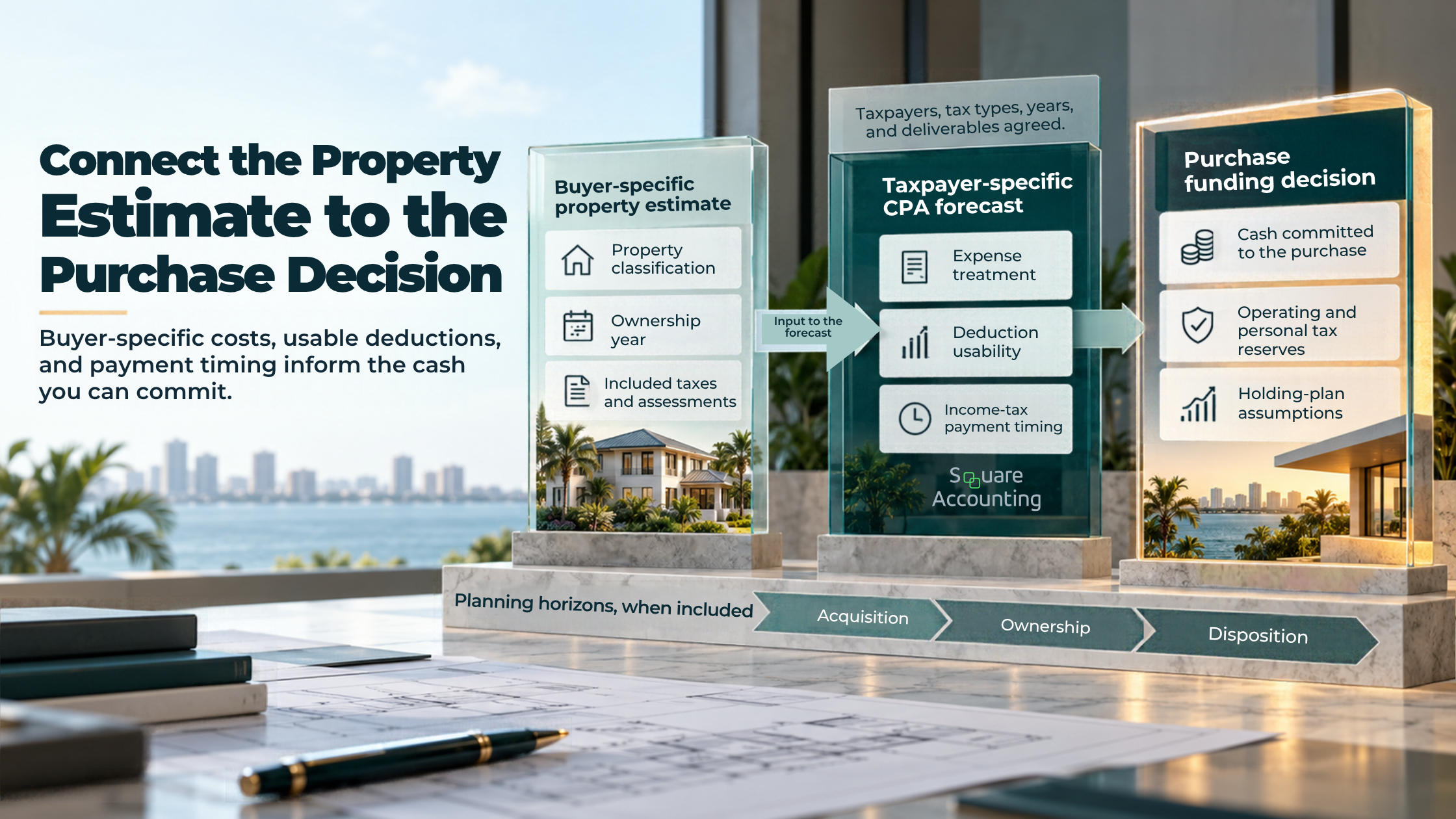
The county estimate supplies a property-cost input, while a scoped forecast connects that input with the investor’s tax position and funding decisions.
County property tax estimate vs. CPA tax forecast: the practical difference
| Decision | County property tax estimate | CPA tax forecast |
|---|---|---|
| Budget the property’s local taxes | Estimates taxes using property inputs and the tool’s assumptions | Uses that estimate in the investment model |
| Determine the purchase’s income-tax effect | Does not evaluate your income-tax return | Compares your tax position with and without the purchase |
| Test a projected deduction | Does not establish income-tax deductibility or loss usability | Evaluates treatment, limitations, and timing |
| Plan cash for tax payments | Addresses property taxes within the tool’s scope | Reconciles projected income-tax liability with payments |
| Evaluate later ownership and sale | Does not supply a complete investment forecast | Can model these years if the engagement includes them |
Duval County’s tool expressly provides an approximation rather than an official tax bill. A CPA forecast is also conditional on its inputs. Before commissioning one, agree on the taxpayers, entities, tax types, years, and deliverables it will cover. Duval County estimator
For an investor with substantial income outside the property, the useful question is whether the purchase remains adequately funded after its tax assumptions have been tested.
Tax Prep + Advisory Review
Start with the unanswered question.
Use the initial conversation to clarify which purchase assumptions need analysis beyond the county estimate.
Build the county estimate around your purchase
A buyer-specific estimate should identify the parcel, intended use, purchase assumptions, taxing districts, and relevant benefits. Save the output with its date.
Duval requests the expected arm’s-length purchase price. Its assumptions exclude physical additions during the purchase year and warn against using pre-construction contract prices. A renovation or new-build purchase therefore needs closer input review before you rely on the result. Duval County estimator
Separate the acquisition year from the following year
The seller’s bill may reflect assessment limits and exemptions that will not describe your ongoing expense. Florida DOR explains that an ordinary home purchase can retain the previous owner’s benefits for the acquisition year, with reassessment taking effect on January 1 after purchase. Florida DOR homebuyer guidance
For covered non homestead residential property, assessment generally resets to just value on January 1 following a change of ownership or control, subject to statutory exceptions. Florida Statutes §193.1554(5)
Keep three figures distinct: acquisition-year taxes and closing adjustments, the first full year after purchase, and later ownership-year assumptions. A low acquisition-year bill should not become the recurring expense in your operating budget.
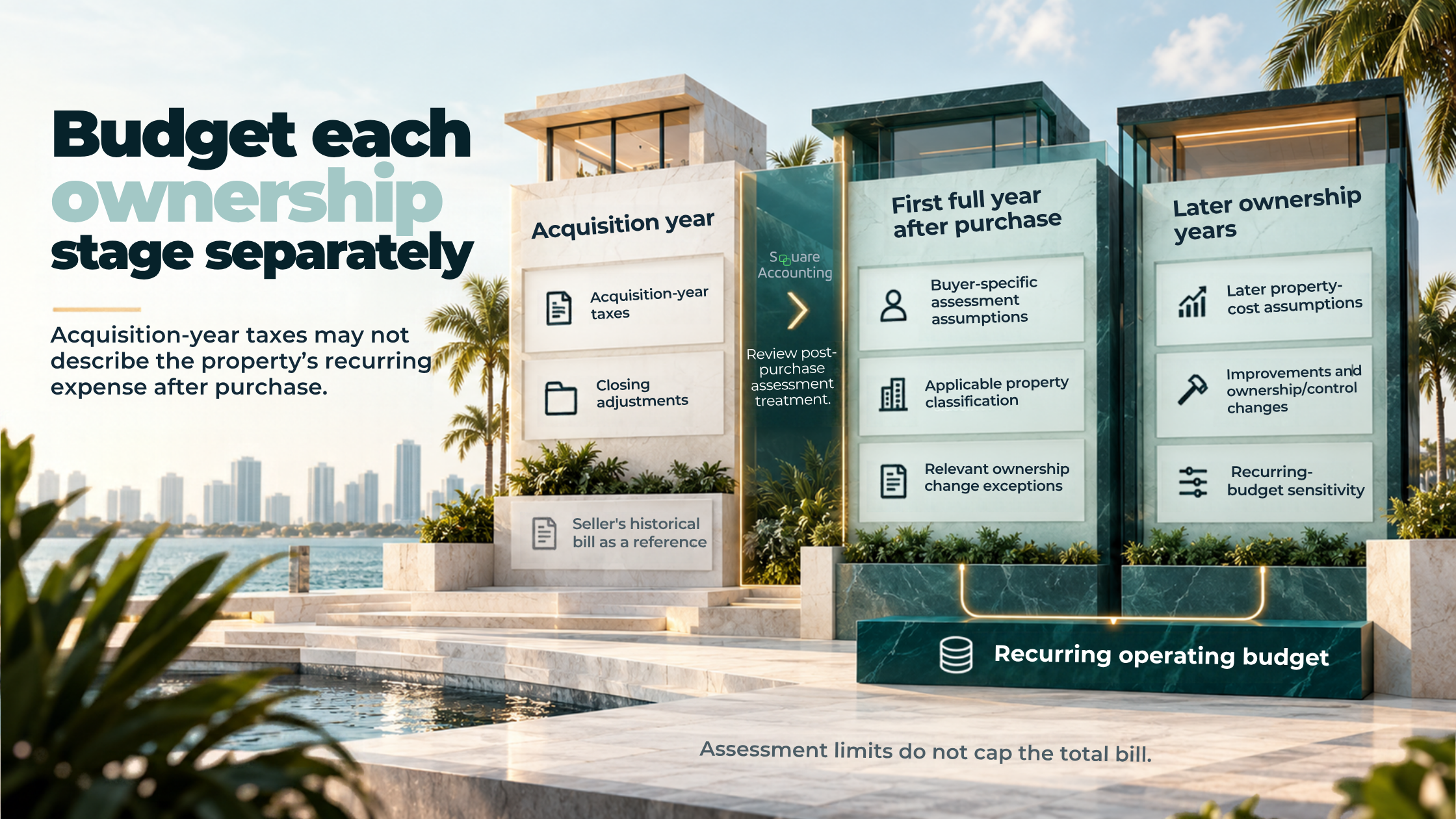
Separating acquisition, first-full-year, and later ownership assumptions helps keep the recurring budget tied to the buyer’s circumstances.
Apply the correct property classification
Florida distinguishes just value, meaning market value; assessed value, reflecting applicable assessment limitations; and taxable value, reflecting exemptions. They can differ, so the value entered into a calculation matters. Florida DOR homebuyer guidance
Save Our Homes generally limits qualifying homestead assessed-value increases to the lower of 3% or the applicable CPI change. Ownership-change exceptions and portability can affect the result. Do not assume owner-occupied benefits apply to an investment rental. Florida Statutes §193.155
For nonhomestead residential property covered by §193.1554, including residential property with nine or fewer dwelling units, the annual assessment limitation generally is 10% and excludes school district levies. Improvements and ownership/control changes have separate provisions. These limits govern assessed value, not the total bill. Florida Statutes §193.1554
Other covered residential and nonresidential properties follow a separate regime. A larger apartment property should not automatically use single-family rental assumptions. Florida Statutes §193.1555
Check excluded charges and rate assumptions
Duval uses the most recently certified millage rates, typically from the preceding year, and excludes non-ad valorem assessments. Sarasota also warns that its municipality-selection option excludes applicable non-ad valorem assessments. Duval County estimator, Sarasota County estimator
Confirm the parcel’s additional assessments and whether the modeled rates suit the ownership year being budgeted.
For valuation and exemption questions, start with the property appraiser. The tax collector handles billing and collection; taxing authorities set local millage. A disagreement about assessed value calls for valuation work rather than an income-tax projection alone. Florida DOR homebuyer guidance
Use the CPA forecast to separate deductions, savings, and payments
We recommend comparing your expected tax position with the purchase against the same assumptions without it. This isolates the transaction’s projected effect.
A refund or small filing balance does not measure that effect by itself. Nor does the size of a depreciation deduction.
Which costs receive which tax treatment?
Rental property taxes and ordinary rental expenses generally enter the rental-income calculation. Local-benefit assessments that increase property value generally require capitalization, while qualifying maintenance, repair, or interest charges can receive different treatment. Land is not depreciable. IRS Publication 527
Ask the model to distinguish cash paid, current deductions, capitalized costs, noncash depreciation, and limited or deferred deductions. Those categories explain why the investment’s cash result can differ from its taxable result.
Can the deduction reduce your tax this year?
Rental activities generally are passive even when the owner participates. Real estate professional treatment requires qualifying status and material participation in the rental activity; other classification exceptions may also apply. Disallowed passive losses generally carry forward, and applicable basis and at-risk limits operate before passive-loss limits. IRS Publication 925
Have the forecast identify which income a projected loss can offset and when. If it relies on an exception, ask which facts support that conclusion and which remain unconfirmed.
An ownership label or depreciation schedule alone does not settle loss usability. For purchase budgeting, our approach is to keep an unverified tax benefit out of available cash until its treatment and timing are supported.
When does the benefit affect cash payments?
A forecast should show projected income-tax liability, withholding, estimated payments already made, remaining payments, and expected filing balance. Federal payment rules address tax paid during the year and possible underpayment exposure. IRS estimated-tax guidance
A liability reduction may affect a future installment, a filing payment, or a later refund. Identify the cash date before relying on it to fund the purchase.
Investors who also own a business can connect this work with the guide to quarterly estimated tax payments.
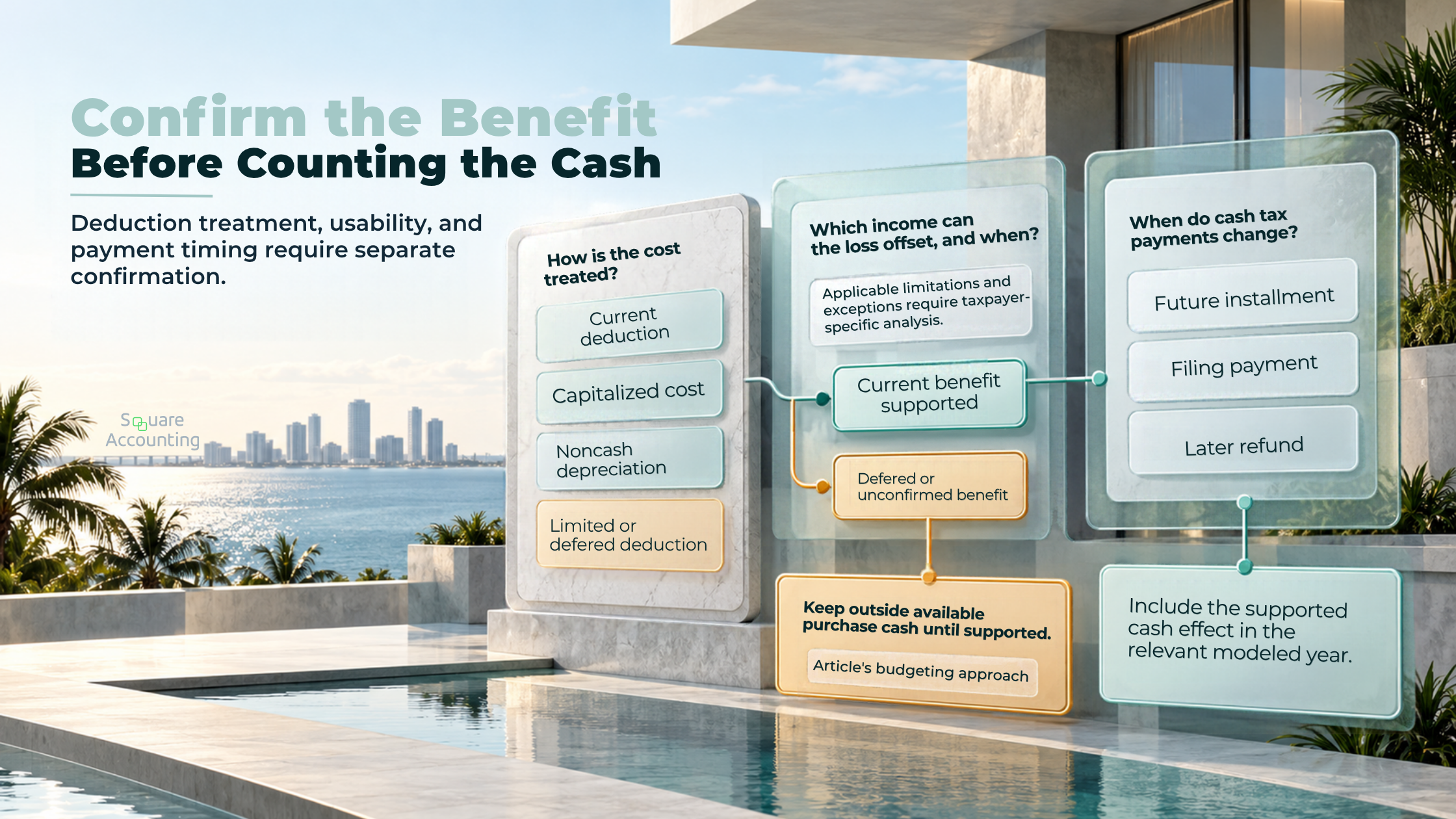
The article’s budgeting approach separates a supported tax benefit from confirmation of when that benefit affects available cash.
Tax Prep + Advisory Review
Make the planning gap specific.
Discuss whether unresolved deduction treatment or payment timing warrants taxpayer-specific forecasting.
Decide how much additional analysis you need
The following sequence is our planning framework, rather than a legal requirement.
Identify the open question. Use the county tool for a preliminary property-tax budget. Use the property appraiser and appropriate valuation specialist for an assessment dispute.
Test reliance on tax relief. If the investment only meets your cash requirements after an assumed income-tax benefit, obtain taxpayer-specific analysis.
Check existing CPA work. Ask for the assumptions and results already prepared. Additional analysis may add little if those cover buyer-specific taxes, current income, loss limitations, and payment timing.
Define the decisions still open. Match the scope to price, financing, ownership, renovation spending, reserves, or holding period that the analysis could change.
A focused current-year projection may suit a straightforward purchase. Later improvements, income changes, ownership transfers, or an uncertain holding period can justify extending the model.
If you are deciding which work is still needed, request a Tax Prep + Advisory Review. Use the initial conversation to establish whether a focused projection or broader engagement would address the unresolved purchase assumptions.
Tax Prep + Advisory Review
Match the analysis to your next decision.
Clarify whether a focused projection or broader engagement fits the purchase decisions still open.
Model cash across acquisition, ownership, and disposition
We recommend three planning horizons so an attractive current-year tax result does not obscure later cash demands.
Acquisition year: fund the purchase and its setup
Include the down payment, closing costs, initial work, operating reserve, and personal tax reserve.
Keep closing separate from rental readiness. Depreciation generally begins when the property is ready and available for rental use. IRS Publication 527
For advice that could change the purchase, arrange the work while contract terms, financing, and title decisions remain open. That is a practical planning point, not a new filing deadline.
Stabilized ownership: test the recurring budget
Illustrative assumptions only: A fully reassessed rental has taxable value of $850,000 for every modeled levy, no exemptions, combined millage of 18, and $900 in additional annual assessments. These are hypothetical figures, not a county quote.
The assumed annual property expense is:
$850,000 × 18 ÷ 1,000 + $900 = $16,200.
Assume the seller’s historical total was $9,400. Using it would understate the modeled recurring expense by $6,800.
| Annual item | Using seller’s bill | Buyer-specific budget |
|---|---|---|
| Collected rent | $84,000 | $84,000 |
| Other operating cash costs | ($22,000) | ($22,000) |
| Debt service, including principal | ($30,000) | ($30,000) |
| Property taxes and assessments | ($9,400) | ($16,200) |
| Cash before income-tax effects | $22,600 | $15,800 |
This table is a cash budget. It does not calculate taxable income, depreciation, or the deductible portion of debt service.
Now assume a separate taxpayer-specific model establishes a $4,000 reduction in federal liability relative to the no-purchase case. Also assume that cash tax payments fall by that amount during the modeled year. The incremental cash result after that assumed income-tax effect becomes $19,800.
If the benefit is deferred, or the payment reduction does not occur that year, the table’s current-year cash figure remains $15,800 before any other income-tax effects. The timing of a usable deduction and the timing of available cash require separate confirmation.
For a later ownership-year stress case, increase total property taxes and assessments to $18,000. Holding all other cash inputs constant solely to isolate this change, cash before income-tax effects falls to $14,000. This is a sensitivity test, not a prediction of future rates or values.
The decision is whether the return and reserves remain acceptable under the buyer-specific budget and less favorable assumptions.
Tax Prep + Advisory Review
Connect the forecast to available cash.
Use the initial discussion to identify forecasting work needed to connect recurring property costs, tax-payment timing, and reserves.
Disposition: estimate the cash remaining after sale
Depreciation allowed or allowable generally reduces adjusted basis. A sale can involve depreciation recapture or unrecaptured §1250 gain, depending on the assets and transaction. IRS Publication 551, IRS Publication 544
When the holding period is uncertain, ask for a directional sale model alongside the intended hold. Include sale proceeds, selling costs, loan payoff, and tax.
This connects any current benefit to later consequences and separates tax deferral from an improvement in the overall investment result.
Reconcile the inputs before relying on the forecast
Use one dated set of assumptions across the county output, lender figures, operating budget, and CPA model.
Explain different tax figures. Two documents may describe different ownership years or exclude different charges. Resolve that difference before choosing the recurring expense.
Avoid double-counting escrow. If the modeled mortgage cash payment already includes tax escrow, do not subtract the same tax funding again. Reconcile the payment components and any additional reserve requirement.
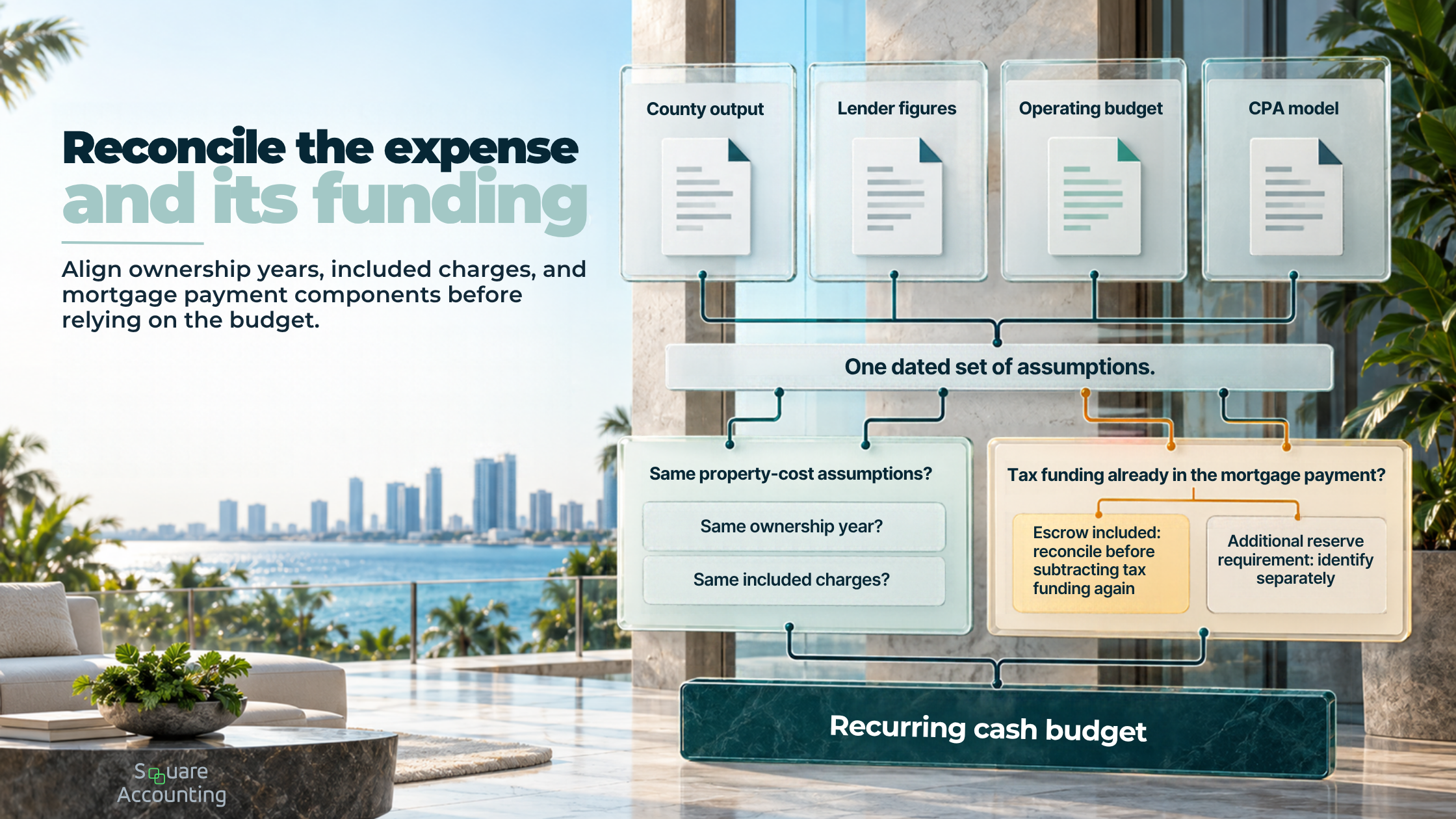
Reconciling the documents helps distinguish different property-cost assumptions from tax funding already included in mortgage cash payments.
Identify the purpose of each charge. A bill can include items requiring different income-tax treatment; its combined total does not establish one deduction classification. IRS Publication 527
Keep intended use consistent. Personal use of a rental can alter allocation and deduction limits. A personal residence’s property-tax deduction instead follows itemized-deduction rules and applicable limitations. IRS Publication 527, IRS Topic 503
Review ownership changes before signing. Covered nonhomestead rules address title transfers and specified entity ownership/control changes, with exceptions including certain transfers between spouses. Our coordination recommendation is to have the CPA and attorney assess the actual transaction before treating it as routine cleanup. Florida Statutes §193.1554(5)
Bring the records that connect the estimate to implementation
For the forecasting discussion, provide:
Parcel details, current bill, saved county estimate, and additional assessments
Purchase price, contract dates, financing, and proposed ownership
Intended use, renovation schedule, and expected rental-ready date
Rent, operating costs, debt-service components, and required reserves
Recent returns, current income, depreciation schedules, and loss carryforwards
Withholding, estimated payments, and expected holding period
Keep the forecast assumptions separate from evidence supporting the eventual return. IRS guidance calls for records supporting rental income and expenses, such as receipts, canceled checks, or bills. IRS rental recordkeeping guidance
As a planning practice, also retain the dated estimator output and evidence supporting rental readiness. Agree on who resolves missing facts, who implements ownership and accounting decisions, and who updates the projection when those facts change.
Ask which written comparisons and implementation instructions are included in the quoted scope. For a broader pre-purchase engagement, the guide to when a CPA rental-purchase review is worth it develops that fee-and-scope decision.
Choose the next step around the remaining decision
Choosing between a county property tax estimate and a CPA tax forecast starts with the question you still need answered. A county estimate supplies the local property-tax budget. A properly scoped forecast connects that budget to your income-tax position, payment dates, reserves, and holding plan.
If your existing CPA has completed that analysis with current facts, a focused update may be sufficient.
If the purchase still depends on unresolved tax or cash assumptions, request a Tax Prep + Advisory Review with Square Accounting. Bring the county estimate and purchase figures so the initial discussion can define the appropriate forecasting scope and coordination with your existing advisors.
Tax Prep + Advisory Review
Bring the remaining decision into focus.
Bring the county estimate and purchase figures to define the forecasting scope and coordination needed with your existing advisors.
Frequently Asked Questions
-
What needs to be revisited if the renovation schedule changes after the forecast is prepared?
Revisit the rental-ready date, acquisition cash requirements, and assumptions used in the county estimate. Depreciation generally begins when the property is ready and available for rental use, while Duval’s estimator assumptions exclude physical additions during the purchase year. A revised renovation schedule therefore calls for checking both models against the changed facts. As a planning practice, agree on who updates the projection and retain evidence supporting rental readiness alongside the dated estimate.
-
Why could two investors buying comparable rentals receive different income-tax forecasts?
Comparable property-tax budgets do not establish comparable income-tax outcomes. Each forecast depends on the investor’s current income, applicable loss limitations, carryforwards, withholding, and estimated payments. A projected rental loss also requires analysis of which income it can offset and when. Even where both investors have a usable deduction, the resulting liability reduction may affect cash payments at different times. The property assumptions and the taxpayer assumptions need separate review before comparing results.
-
Can the proposed ownership arrangement settle both property-tax treatment and rental-loss usability?
The ownership arrangement needs separate analysis for each question. Florida’s covered nonhomestead rules address title transfers and specified ownership or control changes, subject to exceptions. Income-tax loss usability depends on the applicable classification and limitations; an ownership label alone does not settle it. Our planning recommendation is to coordinate the CPA and attorney’s review before signing, so the property-tax assumptions, proposed ownership, and taxpayer-specific forecast describe the same transaction.
-
Should the purchase comparison and the stress test use the same assumptions?
They serve different purposes. The with-purchase versus without-purchase comparison holds the surrounding assumptions consistent to isolate the transaction’s projected tax effect. A stress test deliberately changes a selected input to examine whether cash and reserves remain acceptable under less favorable conditions. In the article’s ownership-year stress case, other cash inputs remain constant to isolate the property-cost change. Keep these comparisons distinct so a changed assumption is not mistaken for a benefit attributable to the purchase.
