
Before Buying a Florida Rental: When Is a CPA Tax Review Worth It?
Consulting a CPA before buying rental property is worth considering when a tax assumption could change the purchase, ownership, operating plan, or cash you need to retain.
For a Florida investor, the strongest reasons include relying on rental losses to offset wages or business income, planning short stays or personal use, buying with partners, and expecting substantial renovations or an early sale. Obtain the review while purchase terms, title, financing, and spending decisions can still change.
A straightforward rental already evaluated by your existing CPA may need only a focused confirmation. Our practical test is whether the proposed work could improve a material decision enough to justify its fee. Purchase price alone does not answer that question.
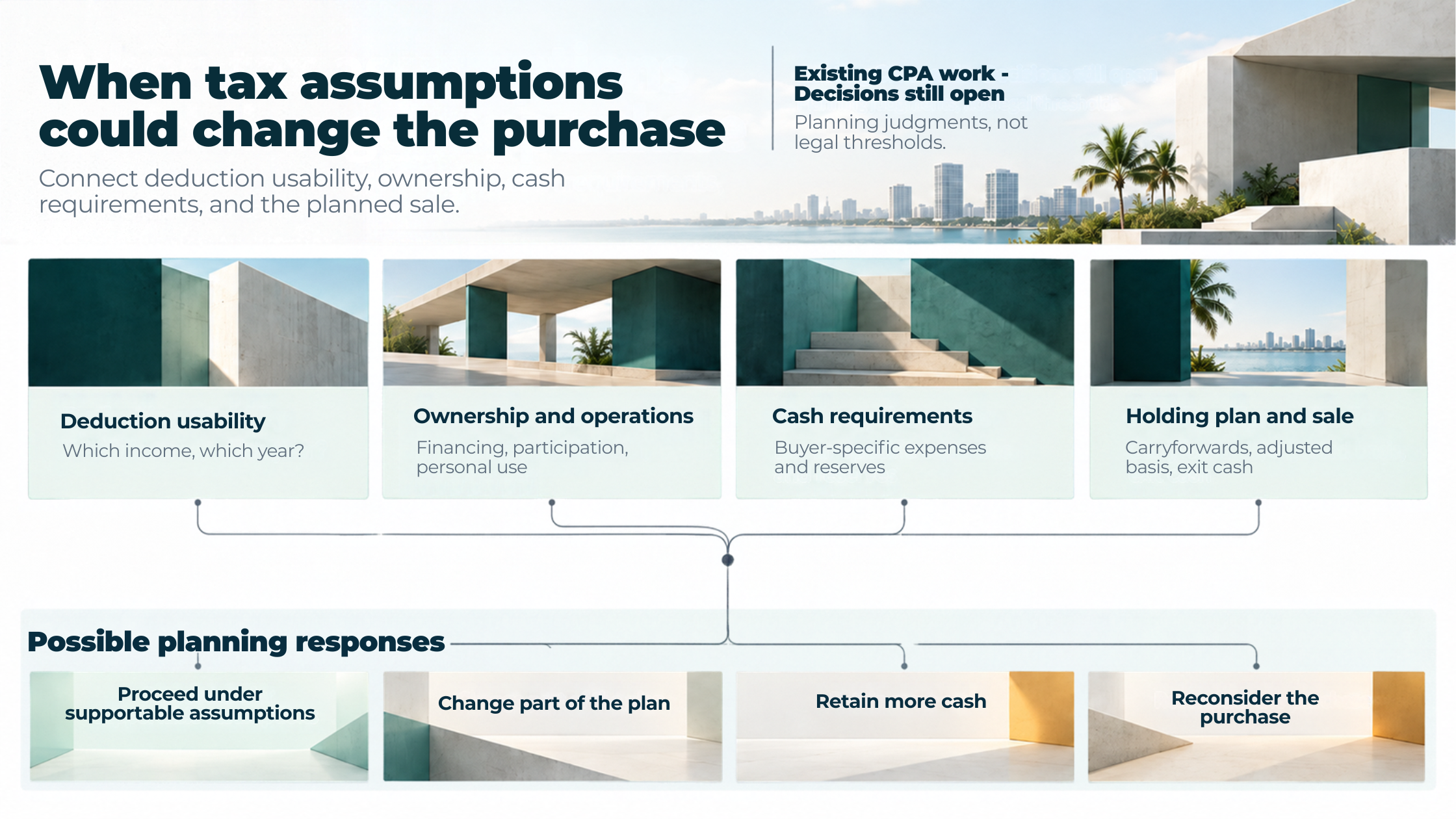
The review’s scope follows the decisions it could change across the purchase, operations, and eventual sale.
“Our practical test is whether the proposed work could improve a material decision enough to justify its fee. Purchase price alone does not answer that question.”
Key takeaways
Test whether deductions are usable on your return before including a tax benefit in the purchase forecast.
Match the engagement to decisions still open, including work your existing CPA has already completed.
Compare ordinary and accelerated depreciation across the holding period and sale, including implementation costs.
Build reserves from buyer-specific expenses and supported cash projections.
Agree on written outputs, missing facts, and implementation responsibilities before commissioning the work.
When should you consult a CPA before buying rental property?
A substantial review makes the most sense when the purchase depends on a tax position that has not been tested against your facts. The following scope criteria are professional planning judgments, not legal thresholds.
| Your purchase situation | What needs to be resolved | Starting scope |
|---|---|---|
| The deal depends on a reduction in your personal tax bill | Whether projected deductions reach your return in the expected year | A transaction-specific tax projection |
| You have substantial wages or business income and expect a rental loss | Which loss rules apply and when the deduction could be used | A loss-usability review |
| You plan short stays, family use, or a property manager | Classification, services, participation, personal use, and supporting evidence | An operating-model review |
| You are buying with partners or through an existing entity | Ownership economics, tax classification, financing, and later transfers | Coordinated CPA, attorney, and lender input |
| Renovations or year-end timing drive the projected benefit | Capital spending and the realistic rental-ready date | An acquisition and implementation review |
| Your existing CPA has tested a conventional rental purchase | Whether the facts or assumptions have materially changed | A focused pre-closing confirmation |
If the purchase only works after including an unverified tax benefit, establish its timing and eligibility before treating it as available cash.
Discuss whether your purchase needs a focused confirmation or a broader review.
What should you receive for the review fee?
When comparing proposals, ask which of these outputs the quoted scope includes:
Controlling facts: Ownership, intended operations, household income, participation, and the rules governing loss use.
Financial comparisons: Property cash flow and tax projections, including a version without an assumed immediate tax benefit.
Multi-year effects: Usable deductions, carryforwards, adjusted basis, and sale consequences.
Implementation instructions: Ownership coordination, asset records, rental-ready timing, and filing responsibilities.
An open-item list: Missing facts, who will resolve them, and the relevant transaction dates.
These are criteria for defining an engagement, rather than a promise that every review includes every item. Compare the quoted fee plus study, legal, entity, and implementation costs with the decisions the analysis could improve. A finding that you need larger reserves can matter even when no additional tax savings are identified.
If your current CPA can provide the required transaction analysis, continuity may be appropriate. Confirm whether that work is included in the existing relationship or needs a separate scope. Our guide to evaluating whether tax planning is worth it develops the broader fee-and-value question.
Compare the proposed work with what your existing CPA has already addressed before commissioning another engagement.
Can the rental loss actually reduce your tax bill now?
Rental real estate is generally passive for federal income-tax purposes, even when the owner is involved. Passive losses generally cannot offset wages or income from a business in which you materially participate. Disallowed passive losses generally carry forward under IRC §469.
Eligible owners who actively participate may qualify for a special allowance up to $25,000. For eligible single and joint filers, the allowance begins phasing out above $100,000 of modified adjusted gross income and is generally unavailable at $150,000 or more. Married-filing-separately rules differ: living with a spouse at any time during the year generally prevents the allowance; living apart all year involves reduced limits. See IRS Publication 925.
For a high-income household, the review needs to answer: Which income can this property's loss offset, and in which year?
Real estate professional status requires annual qualification and participation
An individual generally must perform more than 750 hours, and more than half of their trade-or-business personal services, in qualifying real property trades or businesses in which they materially participate. On a joint return, one spouse must separately satisfy those annual status tests. See IRC §469(c)(7).
Rental material participation is a separate step. Spousal participation can count toward that step, although spouses cannot simply combine their hours to meet the professional-status tests. Activity treatment and any valid rental aggregation election also matter. See Treas. Reg. §1.469-9 and §1.469-5T(f)(3).
Test projected hours against the household's actual work schedule before relying on a wage offset. Owning more properties does not replace qualification. Our real estate professional status guide addresses the broader implementation questions.
A short-term rental requires separate classification and participation tests
Average customer use of seven days or less excludes an activity from the rental-activity definition for passive-loss purposes. Another exception can apply at an average of 30 days or less when significant personal services are provided. These are classification rules, not automatic permission to deduct a loss against wages. See Treas. Reg. §1.469-1T(e)(3).
Material participation must still be established. One test requires more than 100 hours and participation at least equal to every other individual's; another requires more than 500 hours. A manager's hours can affect which test is supportable. See Treas. Reg. §1.469-5T.
Schedule E versus Schedule C reporting involves a separate services question. Substantial services primarily for occupants' convenience can change reporting; the seven-day average alone does not settle it. See IRS Topic 414.
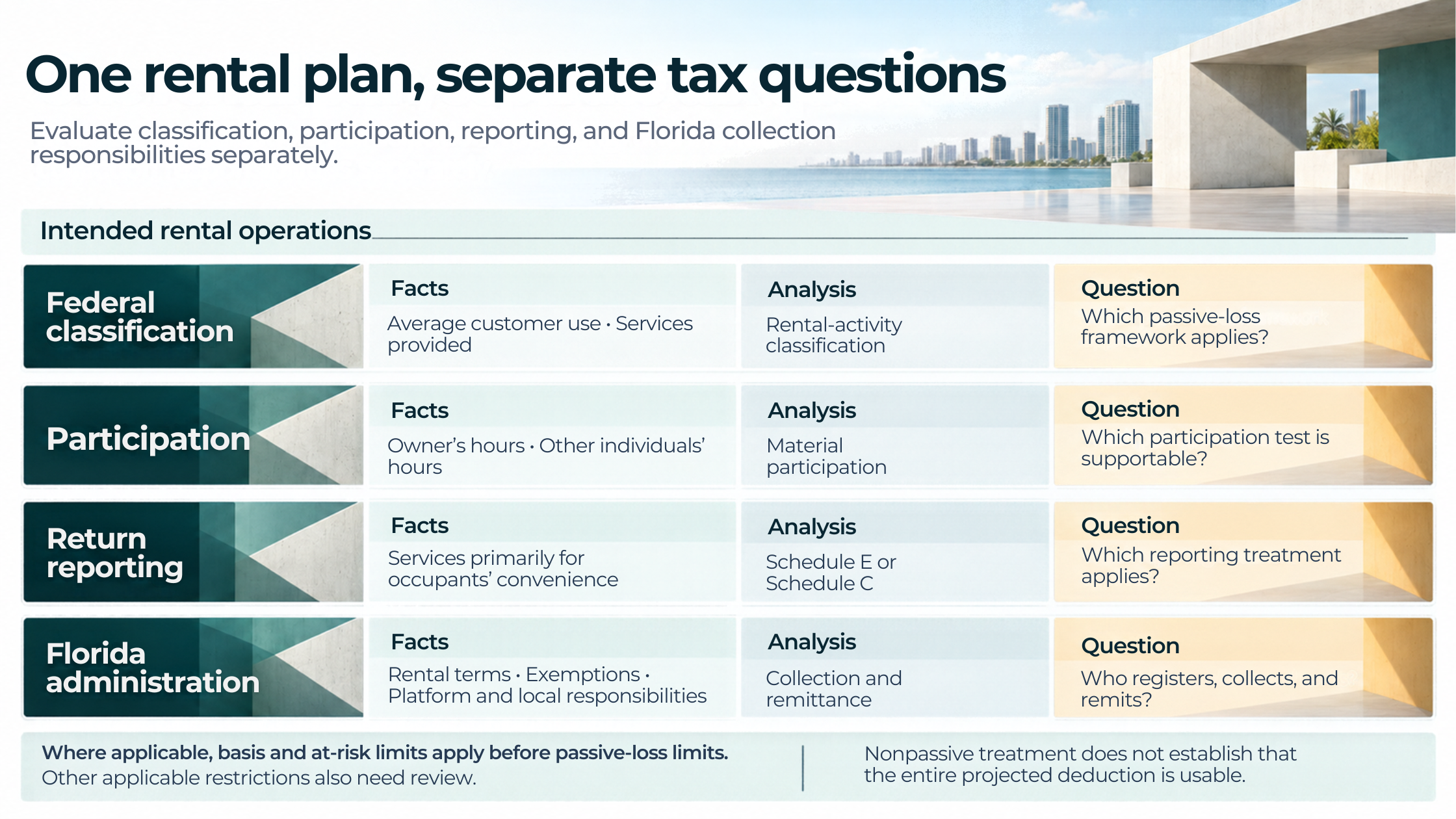
The intended operating model needs separate analyses before its tax and administrative consequences enter the purchase forecast.
Where applicable, basis and at-risk limits apply before passive-loss limits. Other applicable restrictions also need review. Nonpassive treatment does not establish that the entire projected deduction is usable. Publication 925 explains that ordering.
Evaluate depreciation through its usable year and your expected holding period
Depreciation creates value through the deduction that is allowable, usable, and relevant to your holding plan.
Land is not depreciable. A conventional residential rental building generally uses a 27.5-year recovery period under the general depreciation system. Alternative-system treatment requires separate analysis, and transient lodging can require a different building classification. See IRC §168 and Publication 527.
A cost segregation study identifies assets and allocates costs to their appropriate classifications and recovery periods. Its conclusions need supporting records. The IRS's cost segregation examination guide discusses study methods and documentation; it is nonbinding and is not legal authority.
Under Public Law 119-21, §70301, qualifying property acquired and placed in service after January 19, 2025 generally qualifies for 100% bonus depreciation. Eligible shorter-life components may qualify, but the rule does not make land or the entire residential building purchase price deductible. Classification, used-property restrictions, alternative-system exclusions, and elections matter. Acquisition timing can depend on written binding contract rules, so closing date alone is insufficient. See IRC §168(k) and the IRS's interim Notice 2026-11.
Before commissioning a study, compare:
Ordinary depreciation under the appropriate system.
Additional deductions from a supported accelerated-depreciation analysis.
Deductions usable now versus those carried into later years.
Study and implementation costs, adjusted basis, and the projected sale result.
Accelerated depreciation changes when costs are deducted. Whether that improves the after-tax result depends on usable losses, tax rates, fees, and sale treatment. If acceleration mainly enlarges a suspended loss, its current-year cash benefit remains unestablished.
Compare ordinary and accelerated depreciation with loss usability, implementation costs, and the planned sale.
A five-year example: future loss value without a purchase-year wage offset
Illustrative assumptions: In Years 1 through 4, a married couple files jointly with $350,000 of modified adjusted gross income before the rental. Their conventional long-term rental is a separate passive activity. Neither spouse qualifies as a real estate professional, there are no other passive activities, and applicable basis, at-risk, and other loss limits do not prevent the treatment shown. Tax rules and activity classification are held constant.
Assume a valid $36,000 first-year rental tax loss and $8,000 of first-year cash after operating costs and debt service, before income taxes and capital reserves. The illustration assumes these tax and cash figures; it does not estimate them from a purchase price or cost segregation study.
| Period | Assumed tax result | Loss use and remaining carryforward |
|---|---|---|
| Year 1 | $36,000 rental loss | No wage offset under these facts; $36,000 carries forward |
| Years 2 through 4 | $6,000 of net passive rental income each year | $18,000 offsets that income over three years; $18,000 remains |
| Year 5 | Fully taxable cash sale of the entire separate activity to an unrelated buyer | Apply the remaining losses under the qualifying disposition rules, together with the sale's gain and loss effects |
The arithmetic is $36,000 minus three years of $6,000, leaving $18,000. The illustration assumes no new losses, grouping changes, or installment sale. Carryforward and disposition treatment follow IRC §469(b) and (g).
The $36,000 deduction is not a $36,000 refund. It provides no Year 1 wage-tax savings under these assumptions, and the $8,000 cash figure still excludes taxes and capital reserves. No sale gain, sale-year tax savings, or net proceeds have been calculated.
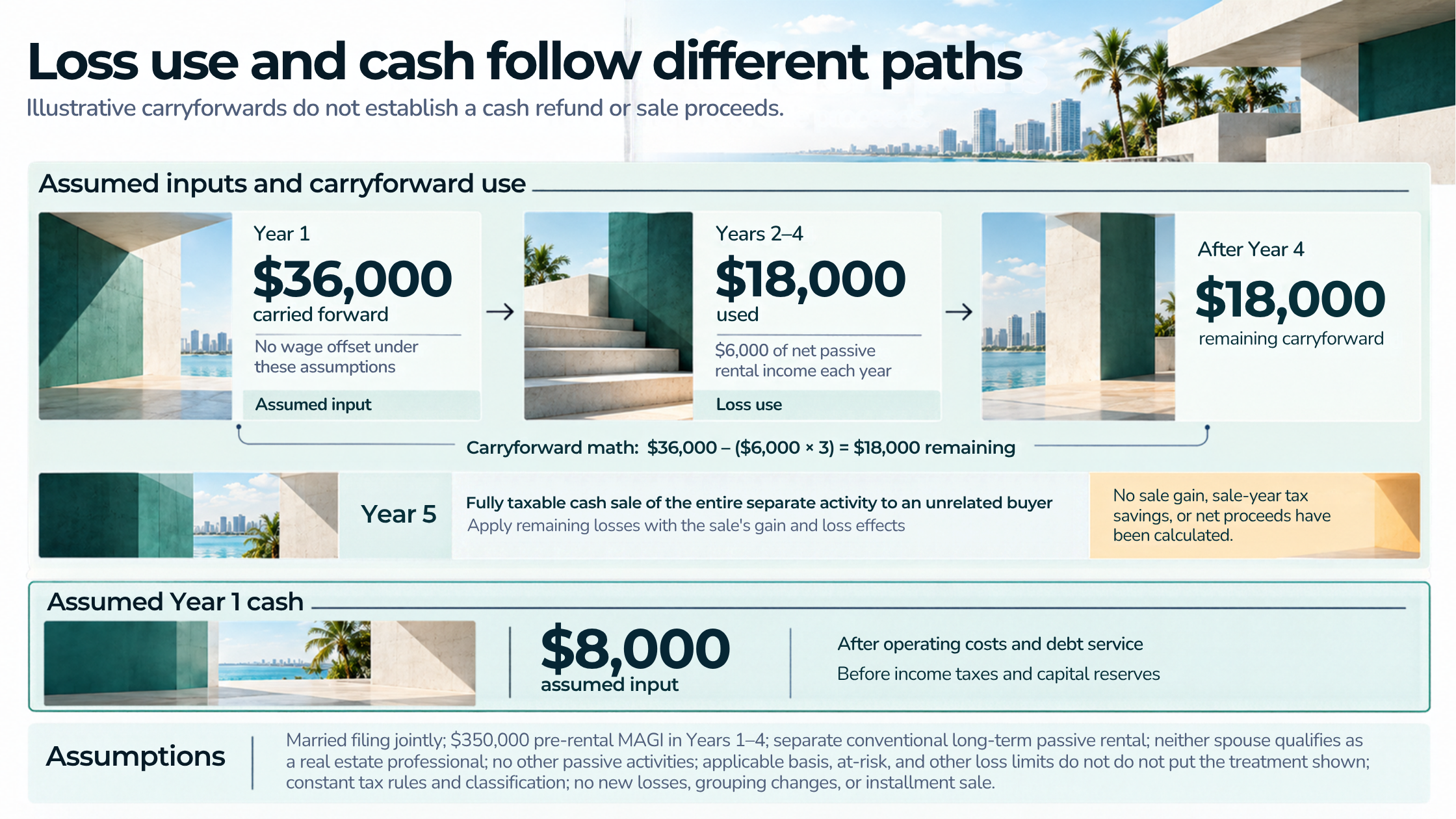
The example tracks suspended deductions separately from first-year cash before income taxes and capital reserves.
“It provides no Year 1 wage-tax savings under these assumptions, and the $8,000 cash figure still excludes taxes and capital reserves. No sale gain, sale-year tax savings, or net proceeds have been calculated.”
Two changes could alter the planning conclusion:
Other usable passive income: Some loss might be usable sooner, subject to applicable loss and activity-specific rules.
Later nonpassive treatment: Old suspended losses do not automatically become wage offsets. Former-passive-activity rules govern their use, including against income from that same activity. See IRC §469(f).
If the acquisition needs an immediate tax benefit to fund renovations or reserves, the review may change whether the deal is adequately funded.
If tax assumptions could change your Florida rental purchase, request a Real Estate Planning Review to clarify deduction usability before treating it as available cash.
Examine which income projected rental losses could offset and when the deduction might be usable.
Ownership and intended use belong in the review before title is settled
Ownership should fit the financing, operating plan, tax classification, and eventual sale.
A domestic single-member LLC generally defaults to disregarded income-tax treatment; a domestic LLC with two or more members generally defaults to partnership treatment unless corporate treatment is elected. Legal form does not itself overcome passive-loss limits. See the IRS LLC classification guidance and IRC §469.
Coordinate the CPA's tax analysis with counsel's ownership and liability advice, lender requirements, and insurance. Evaluate an existing service-business entity against the rental's needs before using it for convenience. Buying with partners also calls for agreement on ownership economics and implementation responsibilities.
Personal use belongs in this review. A dwelling is treated as a residence when personal use exceeds the greater of 14 days or 10% of days rented at fair rental. That can limit rental deductions. Family and below-market use can count as personal use; a qualifying fair-rental arrangement for a family member's principal residence can receive different treatment. Review the statutory conditions and expense allocation under IRC §280A.
A forecast built around exclusive investment use needs reconsideration if the intended calendar includes family vacations.
Florida can change the cash requirement even without an individual income tax
Florida's lack of a personal income tax does not eliminate federal tax or the property's Florida costs and administrative obligations.
Recalculate property taxes for the buyer
The seller's tax bill may reflect assessment limits and exemptions you will not retain.
For non-homestead residential property covered by Florida Statutes §193.1554, generally residential property with nine or fewer dwelling units, a qualifying ownership or control change generally triggers assessment at just value on January 1 of the following year, subject to statutory exceptions. Homestead exemption requires qualifying permanent residence; an exclusively investment rental ordinarily does not satisfy that requirement under §196.031.
Use a county property appraiser's buyer-specific estimate and current insurance quotes in the forecast. Higher recurring expenses can change the reserve requirement even when a deduction is available.
Separate transient rental tax administration from federal loss treatment
Florida accommodations rented for terms of six months or less can involve state sales tax, county surtax, and local transient rental taxes, subject to exemptions. See Florida Statutes §212.03 and Florida DOR's transient rental guidance.
Confirm registrations, collection, and remittance responsibilities, including what the platform handles and which local taxes are administered separately. This state framework answers a different question from the federal average-seven-day classification test.
Evaluate later transfers before assuming they are simple cleanup
Florida documentary stamp tax can apply to deeds and financing documents. Mortgage debt can count as consideration in a transfer even without a cash payment. Review later transfers before recording them, using §201.02 and Florida DOR's documentary stamp guidance.
Florida entity-level filing duties can also depend on tax classification and owners. They cannot be inferred from the LLC label alone. See Florida DOR's corporate income-tax guidance.
Test the eventual sale before choosing the purchase-year tax strategy
The sale projection should show what accelerated deductions change across the holding period and how much cash remains after exit.
Depreciation allowed or allowable generally reduces adjusted basis under IRC §1016. Gain related to building depreciation and recapture on other assets require different calculations. Unrecaptured §1250 gain has a maximum federal rate of 25%; gains on certain §1245 assets can generate ordinary-income recapture, generally limited by the applicable depreciation and gain on those assets. See IRC §1(h) and §1245.
Rental income and taxable gains may also enter the 3.8% net investment income tax calculation. For individuals, NIIT applies to the lesser of net investment income or MAGI above the applicable threshold, including $250,000 for joint filers and $200,000 for single filers. See IRC §1411.
Nonpassive treatment alone does not settle NIIT. The rental trade-or-business analysis and applicable exceptions or safe harbors also matter; real estate professional status does not by itself establish the exclusion. See Treas. Reg. §1.1411-4 and the Form 8960 instructions.
Check how rentals are grouped before assuming that selling one property disposes of an entire activity. A rental aggregation election can affect that conclusion. A related-party transaction, installment sale, or disposition that is not fully taxable also requires separate passive-loss analysis under §469(g) and §1.469-9(e).
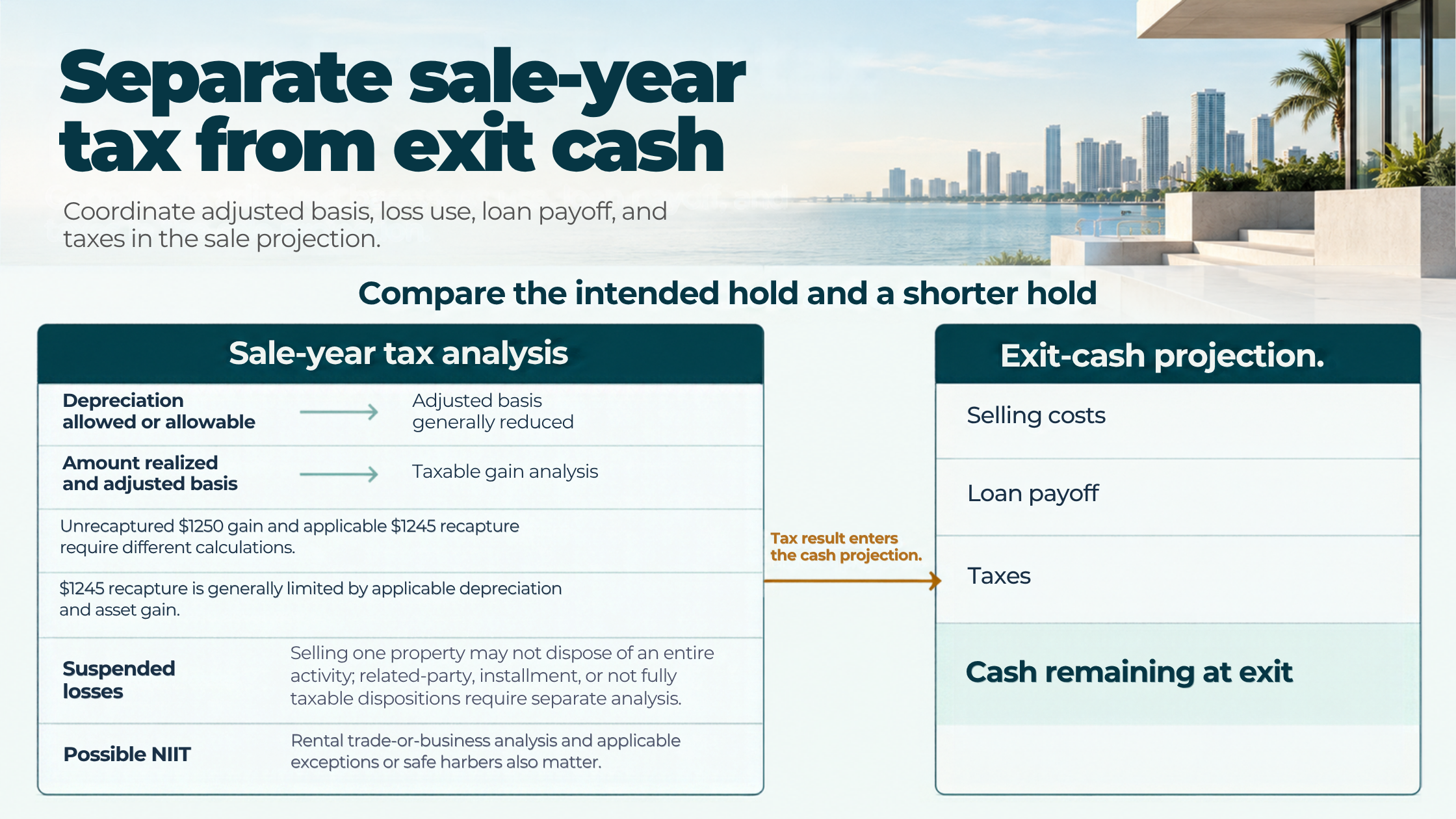
Taxable gain and cash remaining at exit require separate calculations, with loan payoff included in the cash analysis.
Model a shorter hold alongside the intended hold. Include selling costs, loan payoff, taxes, and usable losses. Loan payoff belongs in the cash calculation; taxable gain uses amount realized and adjusted basis. Publication 544 explains those sale mechanics.
When to involve the CPA and what to bring
Start when enough property information exists to model the purchase and meaningful choices remain. For advice that could change whether you buy, the practical deadline may be the contract's diligence expiration rather than closing. Give the CPA the actual diligence, financing, and closing dates. These are planning points, not a new federal filing deadline.
Bring the purchase agreement or property details, loan terms, rent and operating assumptions, renovation budget and schedule, intended use calendar, proposed ownership, recent returns, and existing depreciation and loss-carryforward schedules.
Confirm two implementation issues before relying on a purchase-year deduction:
Rental-ready timing: Depreciation generally begins when the property is ready and available for its rental use, rather than simply on closing. Preserve supporting evidence. See Publication 527.
Renovation treatment: Betterments, restorations, and adaptations generally require capitalization, subject to applicable exceptions and safe harbors. A paid invoice alone does not establish a current repair deduction. See Treas. Reg. §1.263(a)-3.
For participation-based positions, identify the services, hours, and supporting records. Timely records are a practical recommendation; §1.469-5T(f)(4) permits reasonable proof methods without universally requiring daily contemporaneous logs.
Keep cash flow and taxable income separate. Mortgage principal consumes cash without becoming a rental expense, while allowable depreciation can reduce taxable income without a matching current cash payment. See Publication 527.
Decide whether the review could change your purchase
Consulting a CPA before buying rental property should support a decision you can act on: proceed under supportable assumptions, change part of the plan, retain more cash, or reconsider the purchase. Agree on the specific work before commissioning the review.
If tax assumptions could change your Florida rental purchase, request a Real Estate Planning Review with Square Accounting. Share the proposed property, closing timeline, and tax benefit you are relying on so the conversation can establish the appropriate scope for loss usability, ownership, cash requirements, and the eventual sale.
Bring your property and timeline so we can discuss deduction usability, ownership, cash requirements, and the eventual sale.
Rental purchase planning
Frequently Asked Questions
What does a nonpassive conclusion leave unresolved in a purchase forecast?
A nonpassive conclusion does not settle every loss limitation, reporting question, or NIIT issue. Where applicable, basis and at-risk limits still apply before passive-loss limits, and other restrictions may remain. Schedule E versus Schedule C depends on a separate services question. NIIT also has its own rental trade-or-business analysis and exceptions. For purchase planning, keep those determinations separate rather than treating one favorable classification as confirmation that the entire projected deduction is usable.
How should I evaluate a purchase while the intended rental model is still undecided?
Treat the operating model as an unresolved input to the projection. Intended stay lengths and services can affect federal passive-loss classification and reporting, while Florida transient-rental administration uses a separate framework. Personal use also needs its own review if it is part of the plan. As a planning matter, identify which conclusions depend on each proposed model before relying on a projected tax benefit. The eventual operating calendar and services should match the assumptions used to evaluate the purchase.
How can I keep participation assumptions consistent with the property-management plan?
Base the participation position on the services and hours you expect to perform, while accounting for other individuals’ work. A manager’s hours can affect which material-participation test is supportable. Separately, identify the records that would support the owner’s claimed services and time. Reasonable proof methods are permitted; daily contemporaneous logs are not universally required. Keeping timely records is a planning recommendation. This connects the proposed management arrangement with the evidence supporting a participation-based tax position.
What if the purchase assumptions change after the review but before closing?
As a planning matter, revisit the affected conclusions before relying on the original projection. Ownership, financing, intended use, renovation spending, and rental-ready timing are inputs to the purchase analysis. Use the open-item list to identify what changed, who needs to resolve it, and which transaction dates matter. For advice that could change whether you buy, the practical deadline may be the contract’s diligence expiration rather than closing. That is decision timing, not a new federal filing deadline.
How should a multi-year projection handle a planned change in use or participation?
Keep future-year assumptions and existing loss carryforwards separate in the projection. Real estate professional qualification is annual, and rental participation is a separate step. If an activity later becomes nonpassive, old suspended losses do not automatically become wage offsets; former-passive-activity rules govern their use. Intended personal use also needs to remain consistent with the forecast. As a planning matter, identify which facts are assumed to remain constant rather than extending a purchase-year conclusion across the entire holding period.
Does the suspended-loss balance establish my sale-year tax or cash result?
Not by itself. A suspended-loss balance identifies losses carried forward; it does not calculate the sale’s gain or net proceeds. Activity grouping and the form of the sale can affect loss treatment. Adjusted basis, the different treatments of building depreciation and other assets, and possible NIIT also require analysis. Cash proceeds need a separate calculation that includes selling costs, loan payoff, and taxes. The carryforward therefore needs to be evaluated alongside the sale calculations rather than treated as an estimate of tax or exit liquidity.
What needs to connect the pre-purchase review with later return preparation?
Agree on how the review’s conclusions, implementation instructions, and filing responsibilities will connect with return preparation. Use the agreed scope to identify the relevant asset records, rental-ready evidence, and depreciation and loss-carryforward schedules. Keep unresolved implementation items and the person responsible for each visible alongside those responsibilities. If your existing CPA will also perform the transaction analysis, confirm whether that work is included in the relationship or requires a separate engagement. These are coordination decisions, not automatic features of every review.
