
Missed an Estimated Tax Payment? How to Catch Up and Reduce Underpayment Exposure
If you missed a federal estimated tax payment, first check whether that installment was actually short. Reconcile your prior-year tax, 2026 withholding, estimated payments, and any prior-year refund credited to 2026. If a real gap remains, pay what you can promptly using the correct taxpayer, payment type, and tax year. A late payment can shorten the underpayment period, but it generally cannot erase days already late. Next, test whether legitimate withholding or genuinely uneven income changes the installment calculation. Finally, forecast the full tax bill: meeting a penalty-avoidance target may still leave substantial tax due when you file. For a Florida service-business owner, the first calculation usually belongs to the owner's federal individual return; any separately taxable entity needs its own analysis. See the 2026 Form 1040-ES and Form 2210 instructions.
Key takeaways
Recalculate before repeating an old voucher. A missed date does not establish that the voucher amount was required under your actual payment and withholding history.
A late estimate and later withholding have different timing rules. An estimated payment is credited when made; qualifying withholding is generally spread across installment dates unless actual dates are established.
Annualization follows income, not withdrawals. Uneven taxable income can change earlier required installments, but a late distribution by itself does not establish that income arose late.
Keep a separate reserve for the final tax bill. Satisfying the required prepayment amount does not pay the rest of a growing owner's projected liability.
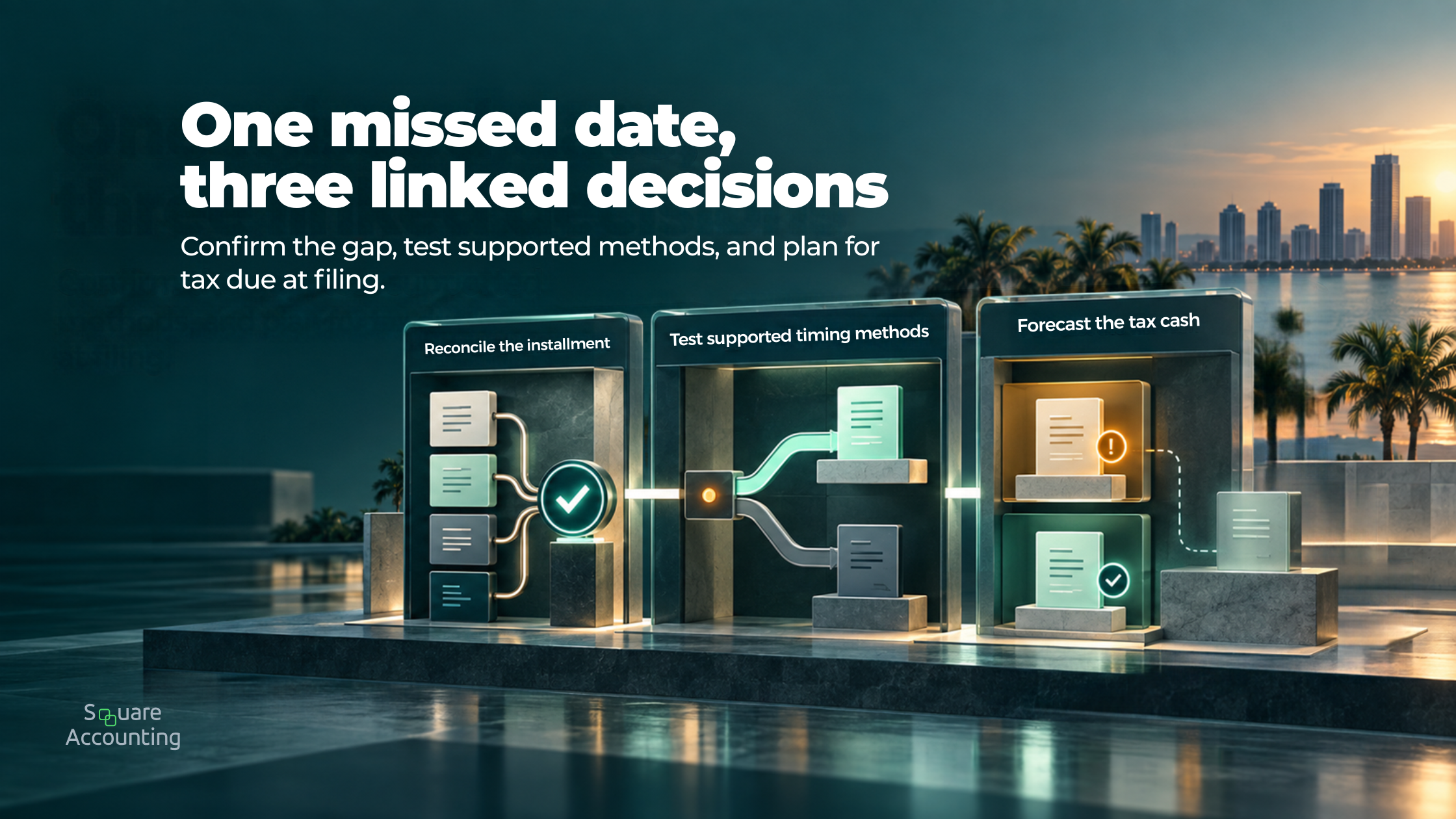
The payment record, installment calculation, and eventual tax bill answer different parts of the same planning decision.
“Satisfying the required prepayment amount does not pay the rest of a growing owner's projected liability.”
What should you do first after missing a payment?
For a calendar-year individual, the regular 2026 federal estimated-tax due dates are April 15, June 15, and September 15, 2026, and January 15, 2027. The income periods are unequal: the second ends May 31. A qualifying disaster postponement or special taxpayer rule may change a particular due date; check the applicable IRS notice before changing the schedule. The dates below follow the 2026 Form 1040-ES. As of September 26, 2026, the September date has passed and the January date is still ahead.
| Step | Question to resolve | Record or action |
|---|---|---|
| Step 1: Reconcile | Was a payment required for the missed period, and how much was short? | Gather the 2025 return, expected full-year 2026 withholding, 2026 payment dates, refundable credits, and any 2025 overpayment elected for 2026. |
| Step 2: Pay | Is a real shortfall still unpaid? | Make a supported late payment promptly, in full or in part as funds allow. Preserve its date and confirmation. |
| Step 3: Test alternatives | Do available withholding or uneven income change the period-by-period result? | Review remaining real wages or other withholding sources and, if income varied, prepare period-level figures for annualization. |
| Step 4: Forecast | What amount will remain due even if the installment target is met? | Project total 2026 tax, payments, the likely filing balance, and cash needed for that balance. |
For an individual online payment, IRS Direct Pay lists Estimated tax and Form 1040-ES. Select the correct tax year. Direct Pay does not ask you to designate a month or quarter for the estimate. Check the taxpayer identifier, save the confirmation, and confirm the payment posts to the intended year. If the full gap is unaffordable, a partial payment can reduce the amount exposed for subsequent days, while the rest remains in the calculation. Under the Form 2210 payment rules, later estimates are applied first to earlier outstanding installments; a January catch-up cannot simply be assigned to January while an earlier period remains short.
Compare dated payments and expected withholding before deciding how much, if anything, to send now.
Does missing one due date automatically create a penalty?
No. The missed voucher is a reason to calculate, not proof of a penalty. For most individuals, the 2026 Form 1040-ES generally calls for estimates when both tests are met: expected 2026 tax after withholding and refundable credits is at least $1,000, and expected withholding and refundable credits are less than the smaller of 90% of 2026 tax or 100% of 2025 tax. The prior-year return must cover a full 12 months. If 2025 adjusted gross income was more than $150,000, or $75,000 when filing separately for 2026, the prior-year percentage is generally 110%. Farming and fishing have different rules.
The annual prepayment target still has to be matched to due dates. Under the regular method, each installment generally represents one-fourth of the required annual amount, taking withholding into account. The IRS computes the addition separately for each period. A late estimate can close an earlier shortfall from its payment date forward, while the days before it was paid may remain chargeable. Even a refund on the filed return does not by itself prove that every installment was timely. This addition differs from the failure-to-pay penalty, which concerns an unpaid return balance after its payment deadline. Compare actual payments with the target before using the amount printed on a voucher prepared months earlier. Our 2026 quarterly estimated-tax guide explains the regular payment framework.
Examine whether the missed voucher reflects an actual shortfall under your individual payment record.
Which catch-up methods can change the result?
Make a late estimated payment for an actual gap
A late estimate addresses the amount still underpaid from the date it is credited; it does not become a timely installment for the missed date. Multiple missed periods require a chronological reconstruction because a subsequent payment is applied to earlier unpaid installments first. If you paid enough for a later voucher but an older period was still short, the amount available for that later installment may be smaller than you assumed. Keep the IRS confirmation and the original payment record instead of relying on annual totals alone.
Increase real federal withholding if you have income subject to it
Federal income tax withheld during the year is generally treated as paid in four equal parts on the installment due dates, unless you establish the actual withholding dates. That rule can make additional genuine 2026 withholding on remaining wages or other eligible payments more useful against an earlier shortfall than an equally sized late estimated payment. It is a timing rule, not permission to create fictitious payroll or to assume the eventual tax bill has fallen. The Form 2210 instructions explain both the equal allocation and the actual-date method; Form 1040-ES explains increasing wage withholding.
For an S corporation owner, assess available actual payroll and reasonable compensation with the payroll provider before changing withholding. A shareholder distribution does not itself become wages with income tax withheld. The IRS's S corporation compensation guidance distinguishes compensation from nonwage distributions. If there are no remaining wages or other eligible payments, this route may be unavailable.
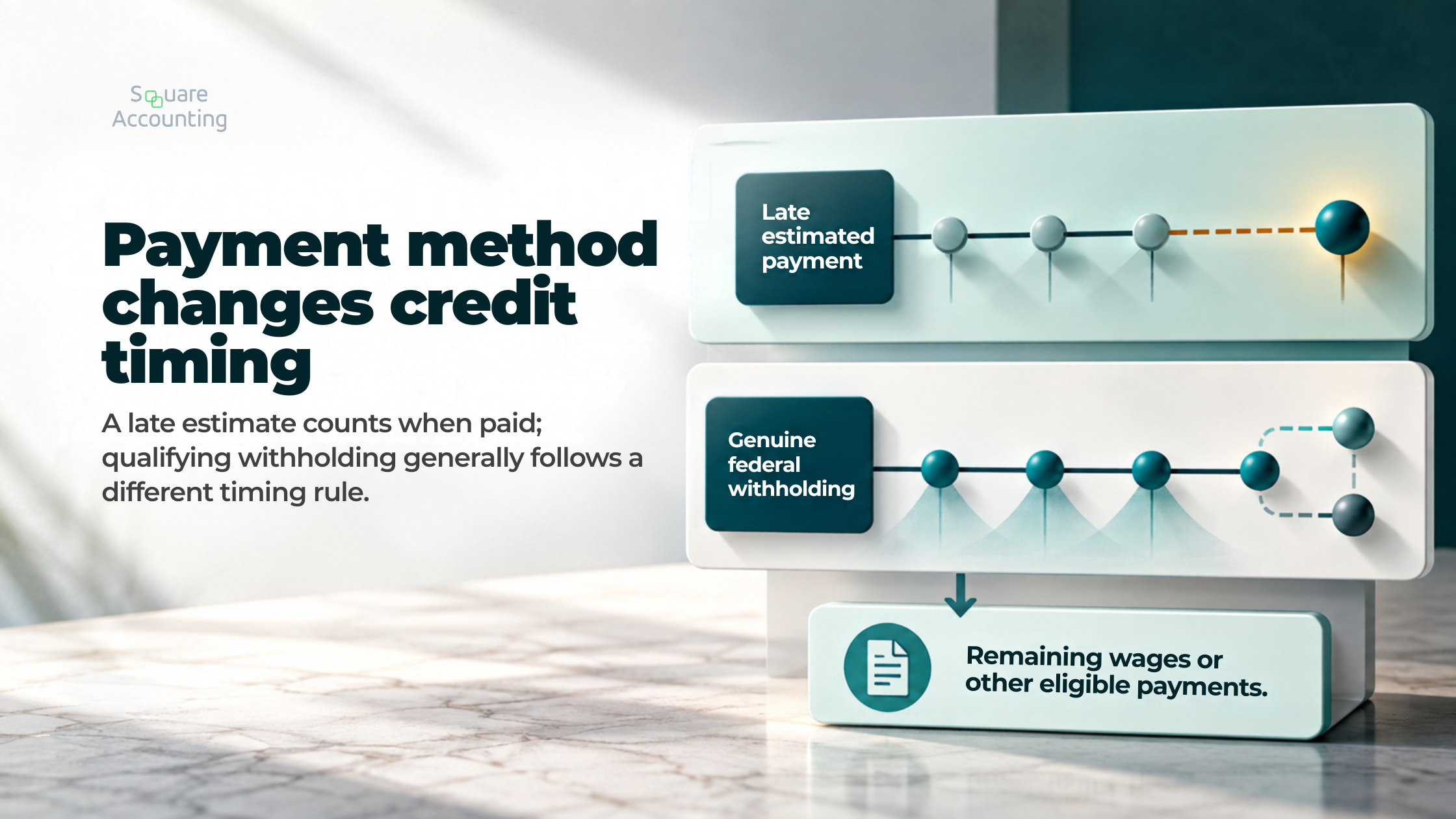
Available income subject to withholding and the applicable timing method determine whether this comparison is useful.
“A shareholder distribution does not itself become wages with income tax withheld. If there are no remaining wages or other eligible payments, this route may be unavailable.”
Annualize if income genuinely arrived unevenly
The annualized-income installment method can reduce an earlier required payment when taxable income arose later than the regular equal-installment method assumes. It is a separate computation, not a waiver for forgetting an installment on income already earned. Publication 505 (2026) provides the worksheet and requires Form 2210 with the 2026 return if this method is used.
Build cumulative figures through March 31, May 31, August 31, and December 31, reflecting income, deductions, credits, and other relevant tax items under the taxpayer's accounting method. Reconcile books with transaction dates and ask for supporting period-level information where pass-through items are material. A year-end profit-and-loss total alone does not show which installment was required earlier. Nor does the date an owner took cash settle the question: S corporation shareholders and partners can be taxed on their shares of income even without a matching distribution. Whether reliable interim information changes the installment is a calculation for the actual facts.
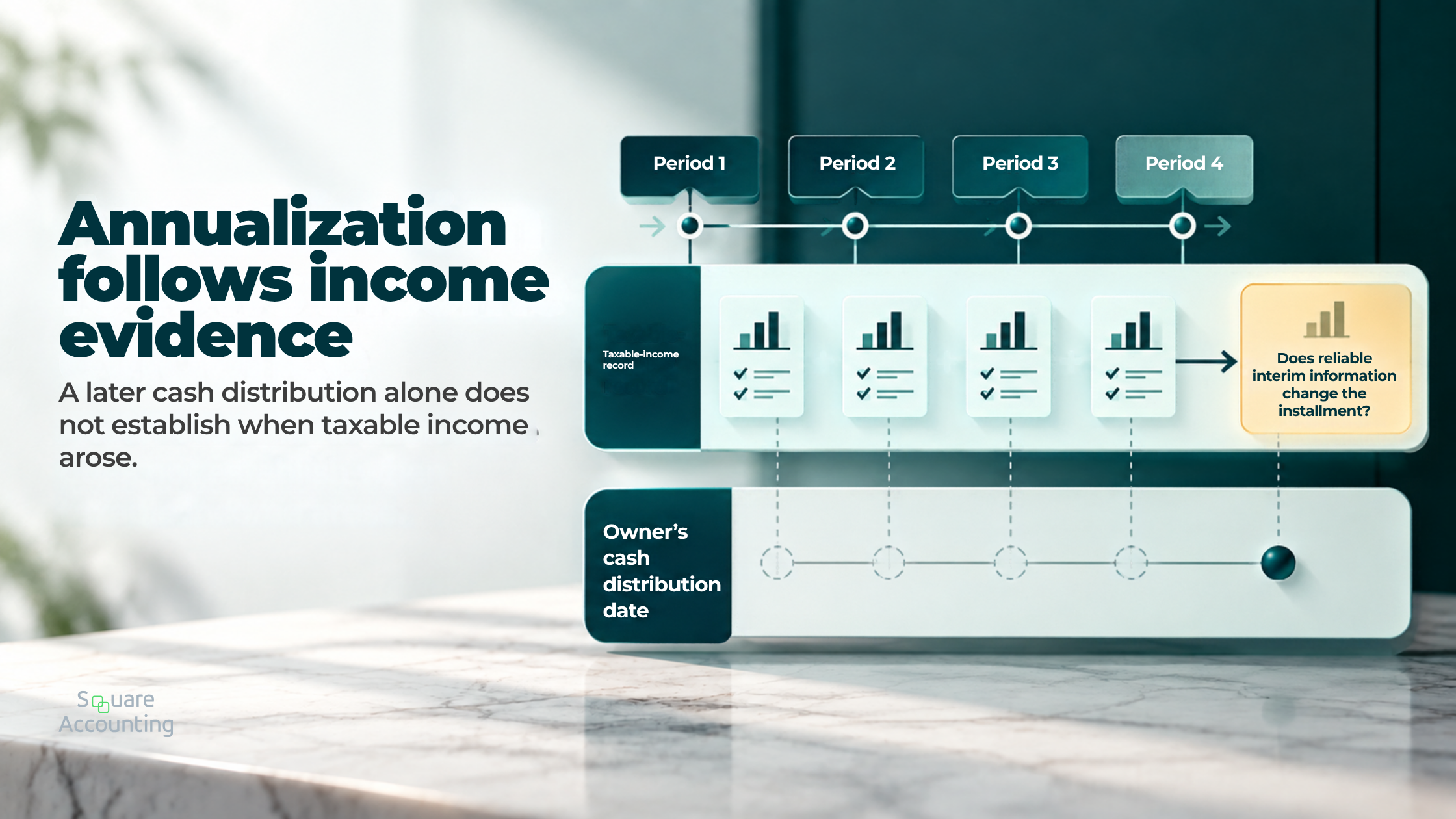
Period-level records, rather than the distribution date alone, support the annualization calculation.
“Whether reliable interim information changes the installment is a calculation for the actual facts.”
Check genuine exceptions or relief
The 2026 Form 1040-ES provides a no-prior-year-liability exception when the taxpayer had no 2025 tax liability for a full 12-month year and was a U.S. citizen or resident alien throughout 2025. For an actual underpayment, a casualty, disaster, or other unusual circumstance can support a statutory waiver when imposing the addition would be inequitable. A separate retirement-after-age-62 or disability provision requires its own conditions, including reasonable cause. A disaster-related postponement applies only when the taxpayer and payment qualify under the relevant IRS relief. See the IRS individual underpayment guidance.
Ordinary oversight and a clean prior record do not, on their own, establish an estimated-tax waiver. The IRS's First Time Abate and Automatic Exemption guidance lists failure-to-file, failure-to-pay, and failure-to-deposit penalties as eligible; it does not list the individual estimated-tax addition. Keep these penalty regimes separate when evaluating a notice.
If payment dates, pass-through income, and remaining payroll all affect the same return, request a Business Tax Planning Review to reconcile the missed period and the decisions still open before the next installment.
We can reconcile late payments, available withholding, and income timing before the next installment.
Example: a missed September installment and a larger filing-season balance
Illustrative assumptions: A calendar-year Florida S corporation owner had $60,000 of 2025 federal tax and $280,000 of 2025 adjusted gross income. Projected 2026 federal tax is $110,000. Full-year 2026 federal withholding is $18,000, treated as paid equally across four due dates. Assume no refundable credits, prior-year overpayment election, applicable special rule, or annualization adjustment. The owner paid $12,000 on April 15 and June 15, missed September 15, will pay that $12,000 on September 30, and will pay the remaining $12,000 installment on January 15, 2027.
| Calculation | Amount |
|---|---|
| 90% of projected 2026 tax | $99,000 |
| 110% of 2025 tax, given 2025 AGI above $150,000 | $66,000 |
| Smaller required annual prepayment | $66,000 |
| Less full-year withholding | ($18,000) |
| Estimates needed over four periods | $48,000, or $12,000 each under these assumptions |
For that September $12,000 gap, September 15 to September 30 is 15 days. Revenue Ruling 2026-10 sets the individual estimated-tax underpayment rate at 7% for July through September 2026. A period illustration is $12,000 × 7% × 15 ÷ 365 = $34.52, about $35. The final Form 2210 computation depends on the actual payment record and facts. Paying on September 30 limits the length of this gap; it does not make the September installment timely.
Even with all four estimates paid, the assumed withholding and estimates total $66,000 against projected tax of $110,000. That leaves a projected $44,000 filing balance if the forecast holds and no other payments are made. The $35 illustration concerns the short September interval, while the $44,000 concerns eventual tax cash. Additional legitimate withholding or a supported annualization calculation could change the first figure without changing taxable income merely because its payment timing changed.
Compare the required prepayment with projected tax still due and the cash available to fund it.
Keep the payment schedule connected to the next tax year
After addressing the missed installment, rebuild the 2026 forecast from actual business results, household wages if filing jointly, investment activity, and expected pass-through items. Track three figures separately: projected total tax, the remaining required installment amounts, and cash reserved for any filing balance. The 2026 Form 1040-ES worksheet starts with projected tax and credits; the reserve is a planning decision based on that forecast and available liquidity. When 2026 profits rise above 2025, paying enough to meet a prior-year benchmark can still leave a substantial filing balance.
Review the January 15, 2027 installment using the updated projection and actual withholding rather than repeating a stale voucher. Then use the completed 2026 result to set a 2027 forecast: a larger 2026 tax could raise the prior-year side of the next year's benchmark, subject to the rules and figures applicable to 2027. Our year-end planning checklist addresses the other decisions to coordinate before the books close.
Florida owners: identify which taxpayer missed the payment
Florida has no individual income tax, so a Florida resident's missed Form 1040-ES installment is a federal individual issue. That does not resolve an entity's separate obligations. The Florida Department of Revenue says a corporation owing more than $2,500 in annual Florida corporate income tax must make state estimates on Form F-1120ES. A federal corporation has its own corporate estimated-tax system. Identify the taxpayer and tax before applying individual safe-harbor figures to a business. If operations span other states, review those jurisdictions separately rather than treating Florida's personal-tax rule as a complete answer.
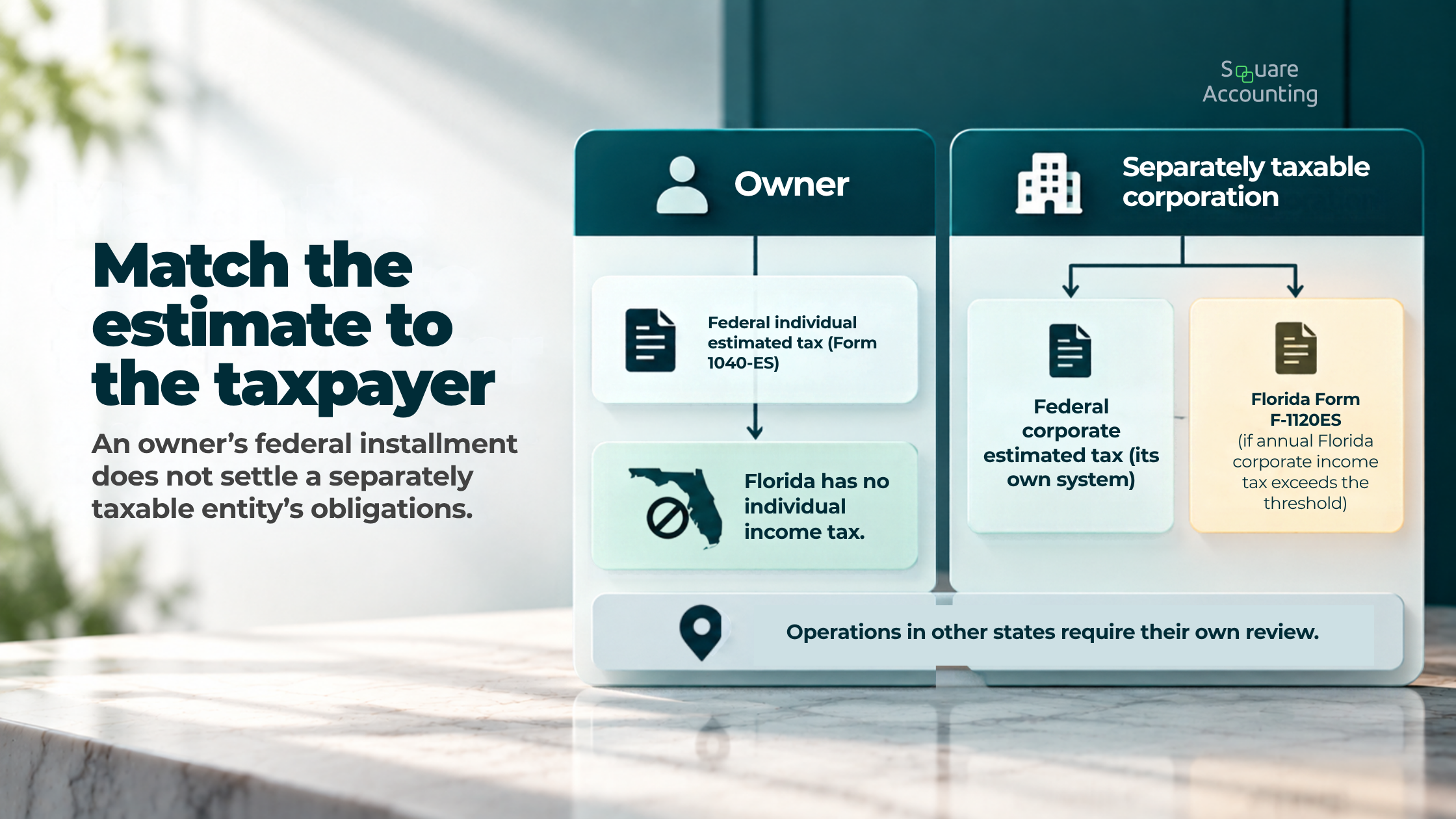
The correct taxpayer and tax must be identified before an installment rule is applied.
Turn the missed installment into a documented decision
Bring the 2025 return; dated 2026 payment confirmations and any refund-credit election; withholding to date and expected through year-end; period-level business results; material K-1 or transaction records; and an updated tax and cash forecast. This lets the team distinguish a missed obligation from an obsolete voucher, evaluate any supported Form 2210 method or waiver, and set a realistic amount for the next installment. Our tax preparation and advisory review guide shows how those records can also inform the following filing and planning cycle.
A missed estimated tax payment becomes manageable when the dates, the taxpayer, and the cash forecast agree. We can use that record in a Business Tax Planning Review to resolve the remaining 2026 installments, the filing balance, and a workable 2027 payment plan.
We can use your payment record and tax forecast to address the remaining 2026 installments and filing balance.
Payment planning questions
2026 Estimated-Tax Catch-Up FAQs
What if I elected to apply a 2025 overpayment to my 2026 estimates?
Include the elected amount in your 2026 payment record before concluding that an installment was short. Confirm the election on the 2025 return and verify the taxpayer and tax year to which the credit was applied. Then compare the complete record with expected 2026 withholding and dated estimated payments. The credit may change the size of a shortfall, so an old voucher is not enough to determine what to pay. Resolve an unclear credit record before calculating exposure for the missed period.
If I can pay only part of the missed amount, what happens to the next installment?
Paying a supported partial amount can reduce the shortfall for subsequent days, but the remainder stays in the calculation. Later estimated payments are applied first to earlier outstanding installments. Before making the next payment, reconstruct the dated payment record to see how much remains against the older period and how much of the new payment would be available for the next one. Keep a separate forecast of total 2026 tax and the filing balance; catching up on an installment does not settle that broader cash decision.
What if my S corporation payroll has ended but our joint return still includes wages?
Do not treat an S corporation distribution as wages with federal income tax withheld. Review the joint return’s expected household wages and withholding, including any eligible payments still to be made during 2026. Whether additional withholding is available or useful depends on actual remaining pay, the full withholding record, and the required installments. If no eligible payment source remains, the withholding approach may be unavailable. The payment and tax forecast still needs to be completed using the income and withholding that actually apply.
Do I still need to calculate the missed period if I pay late and increase withholding?
Yes. The two payments follow different timing rules and need to be reconciled in one period-by-period calculation. A late estimate is credited based on when it is made. Federal income tax withheld during 2026 is generally treated as paid across the four installment dates unless actual withholding dates are established. Recalculate the earlier shortfall using the dated estimates and the applicable withholding treatment. Adding the two amounts into a full-year total alone will not show whether any days of underpayment remain.
What if annual accounts show late-year profit but I lack reliable figures for earlier periods?
A full-year profit figure alone does not establish that an earlier required installment was lower. To evaluate annualization, reconstruct cumulative income, deductions, credits, and other relevant items through each payment period under the taxpayer’s accounting method. Reconcile the books with transaction dates and obtain period-level pass-through information where it matters. If those records remain incomplete, identify the uncertainty rather than assuming the profit arose late. Compare the supported period figures with the regular installment calculation before relying on annualization.
What if my S corporation had taxable income but made little cash distribution to me?
The distribution amount alone does not measure your share of taxable S corporation income or establish when that income arose. Review the expected pass-through items, available period-level records, wages, and withholding in the individual 2026 projection. Then compare the required prepayments with the projected filing balance and cash available to fund it. Limited distributions can create a cash-planning problem even when the income is included in the owner-level forecast. Keep that liquidity decision separate from whether an earlier installment was underpaid.
How is a postponed disaster deadline different from an underpayment waiver?
A qualifying postponement concerns which payment deadline applies to the taxpayer and payment; check the relevant IRS relief before changing the due date. A waiver concerns an actual underpayment caused by a casualty, disaster, or other unusual circumstance when imposing the addition would be inequitable. First establish the applicable date and payment history. If an installment was still late, evaluate the waiver’s conditions using the circumstances of that underpayment. Neither result follows merely from a missed voucher or from having business activity in Florida.
