2026 Quarterly Estimated Tax Payments for Florida Business Owners: Deadlines, Safe Harbors, and How Much to Pay
For business owners making 2026 quarterly estimated tax payments through an individual return, the regular federal due dates are April 15, June 15, and September 15, 2026, followed by January 15, 2027. In most cases, estimated tax becomes relevant when you expect to owe at least $1,000 after withholding and credits and your prepayments will fall below the applicable statutory target.
For most individuals, that target is the smaller of 90% of expected 2026 tax or 100% of 2025 tax. If 2025 adjusted gross income exceeded $150,000, or $75,000 if married filing separately for 2026, the prior-year percentage generally becomes 110%.
That is a penalty-management calculation, not necessarily a cash-flow target. A growing owner can meet the safe harbor and still face a large balance when the 2026 return is filed.
Key Takeaways
Start with two calculations: projected 2026 tax and the applicable safe-harbor amount. They answer different questions.
For higher-income taxpayers, the prior-year side of the safe-harbor comparison is generally 110% of 2025 tax, subject to special rules.
Withholding counts toward the federal prepayment requirement and can matter significantly in a late-year catch-up plan.
Uneven income may justify the annualized-income installment method rather than assuming four equal payments.
Florida does not impose personal income tax, but Florida corporate estimated tax can still apply to entities subject to the state's corporate income tax.
2026 Federal Estimated Tax Deadlines
For a calendar-year individual, the regular 2026 federal estimated-tax schedule is:
| Income period | Payment due |
|---|---|
| January 1 through March 31 | |
| April 1 through May 31 | |
| June 1 through August 31 | |
| September 1 through December 31 |
The periods are not four equal calendar quarters. In particular, the second period ends May 31.
If a due date falls on a Saturday, Sunday, or legal holiday, the IRS applies the next-business-day rule. Publication 505 also provides a January-payment exception: if you file your 2026 Form 1040 or 1040-SR by January 31, 2027 and pay the rest of the tax due, you do not need to make the January 15 estimated payment.
This article focuses on calendar-year individual business owners. Special rules can apply to farmers and fishers, fiscal-year taxpayers, nonresident taxpayers, and certain other situations.
How Much Should a Florida Business Owner Pay?
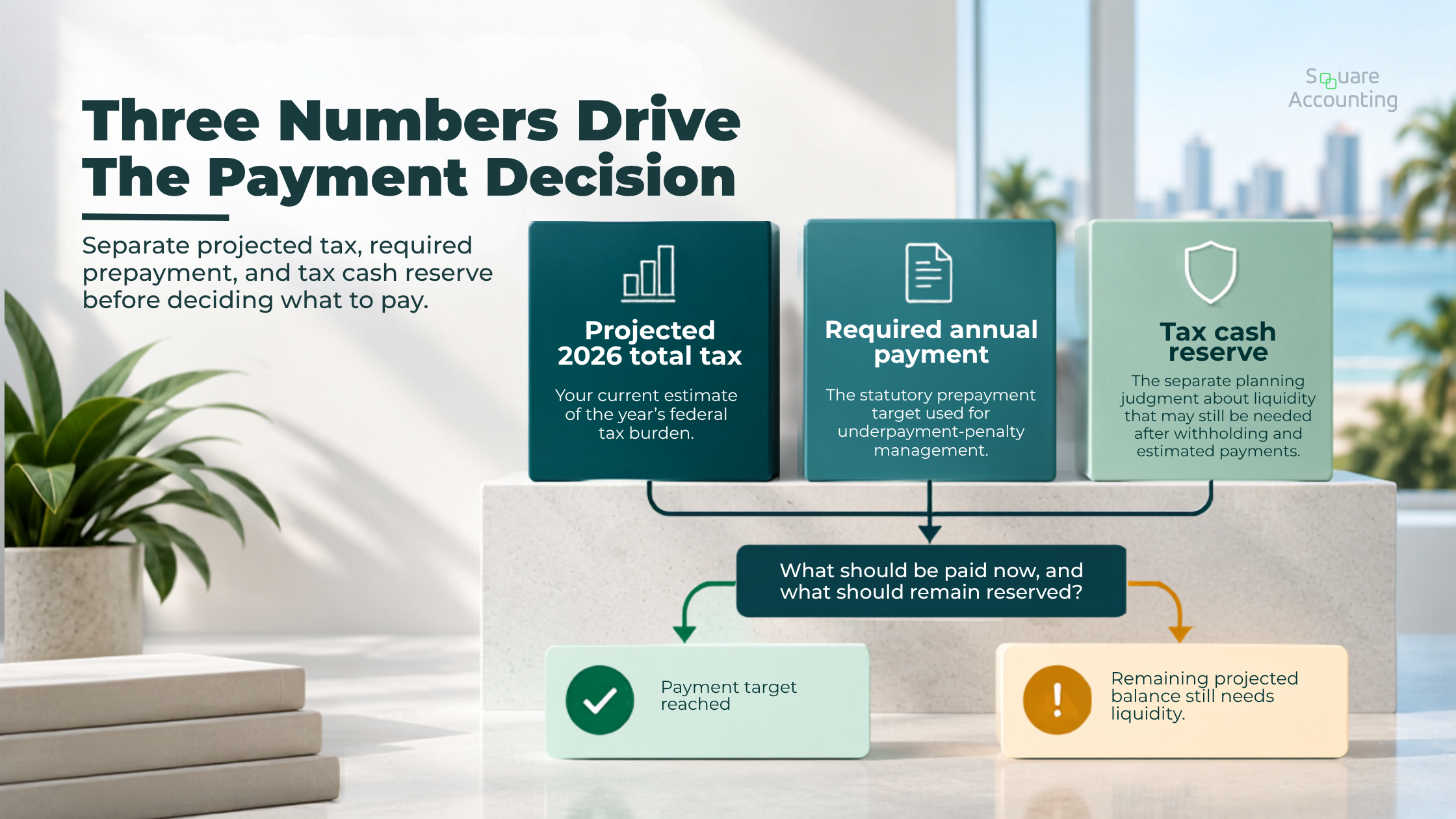
The article’s core framework separates the statutory prepayment calculation from the cash that may still be needed for the projected tax balance.
A useful planning framework separates three numbers. Only one of them is the statutory prepayment target.
| Number | What it answers |
|---|---|
| Number Projected 2026 total tax | What do we currently expect the year's federal tax liability to be? |
| Number Required annual payment | How much generally must be prepaid through withholding and timely estimated payments to manage federal underpayment-penalty exposure? |
| Number Tax cash reserve | After considering payments already made, how much liquidity should remain available for the projected balance and future installments? |
The first two come from tax law and the IRS calculation process. The third is a planning judgment based on the owner's projected liability, liquidity, forecast confidence, and business needs.
Compare the current projection, safe-harbor target, withholding, and payments already made using the facts that now define your 2026 position.
Step 1: Project the Actual 2026 Tax
Form 1040-ES starts with an annual projection. It works through expected adjusted gross income, deductions, taxable income, taxes, credits, withholding, and the required annual payment. It does not prescribe a universal percentage of business revenue.
For a service-business owner, that projection may need to combine wages, Schedule C profit, partnership or S corporation K-1 items, investment income and gains, rental activity, deductions, credits, spouse income when a joint return is being projected, and federal withholding.
The point is to project the individual return that will ultimately absorb the business income, not to estimate tax from one revenue line or bank balance.
Step 2: Calculate the Safe-Harbor Floor
For most individuals, the required annual payment is the smaller of:
90% of the tax shown on the 2026 return, or
100% of the tax shown on the 2025 return.
If 2025 AGI exceeded $150,000, or $75,000 if the 2026 filing status is married filing separately, substitute 110% for the 100% prior-year figure. The prior-year return must cover 12 months. Publication 505 also notes that the higher-income 110% rule does not apply when at least two-thirds of 2025 or 2026 gross income is from farming or fishing.
This is why simply repeating last year's vouchers can fail in either direction. The legal comparison depends on the relevant prior-year tax, current-year projection, withholding, and the taxpayer's actual facts.
Step 3: Subtract Withholding and Payments Already Made
Withholding is part of the prepayment calculation. Publication 505 subtracts expected withholding from the required annual payment to determine the estimated tax that may still need to be paid.
Payment timing also matters. A taxpayer who is recalculating in September should not divide an annual shortfall by four as though the first two installment dates had not already passed. The payment history, required installments, and any annualized-income calculation need to be reconciled before deciding what to send next.
Examine how projected 2026 tax, required prepayments, and available tax cash fit together before choosing the next payment amount.
Example: Safe Harbor Can Still Leave a Large Balance Due
Assume the following solely for illustration:
2025 tax for the safe-harbor calculation: $80,000
2025 AGI: $300,000
Projected 2026 tax: $140,000
Expected 2026 federal withholding: $20,000
The taxpayer files on a calendar year, withholding is treated ratably, and no special farming, fishing, nonresident, fiscal-year, or other special rule changes the calculation
The safe-harbor comparison is:
90% of projected 2026 tax: $126,000
110% of 2025 tax: $88,000
The smaller amount is $88,000. After $20,000 of expected withholding, approximately $68,000 remains to reach that annual prepayment target.
If that $68,000 had been paid in four equal, timely estimated installments from the beginning of the year, the installments would be approximately $17,000 each.
But projected 2026 tax is $140,000. Reaching the $88,000 prepayment target would still leave approximately $52,000 of projected tax unpaid.
That gap is the reason safe harbor and cash planning should be reviewed separately. The owner may choose to pay closer to projected liability, retain some of the cash until filing, or use another supportable payment pattern. The right choice depends on the actual projection, timing, liquidity, and tolerance for a large filing-season payment.
If your 2026 profit, K-1 income, compensation, gains, or withholding have changed materially, a Business Tax Planning Review can reconcile the safe-harbor floor with projected tax and the cash that still needs to remain available.
Clarify what to pay now, what remains projected for filing season, and how much tax cash should stay available as 2026 assumptions change.
Your Entity Type Changes Who Makes the Estimated Payment
The phrase “business estimated tax” can obscure who is actually liable for the tax.
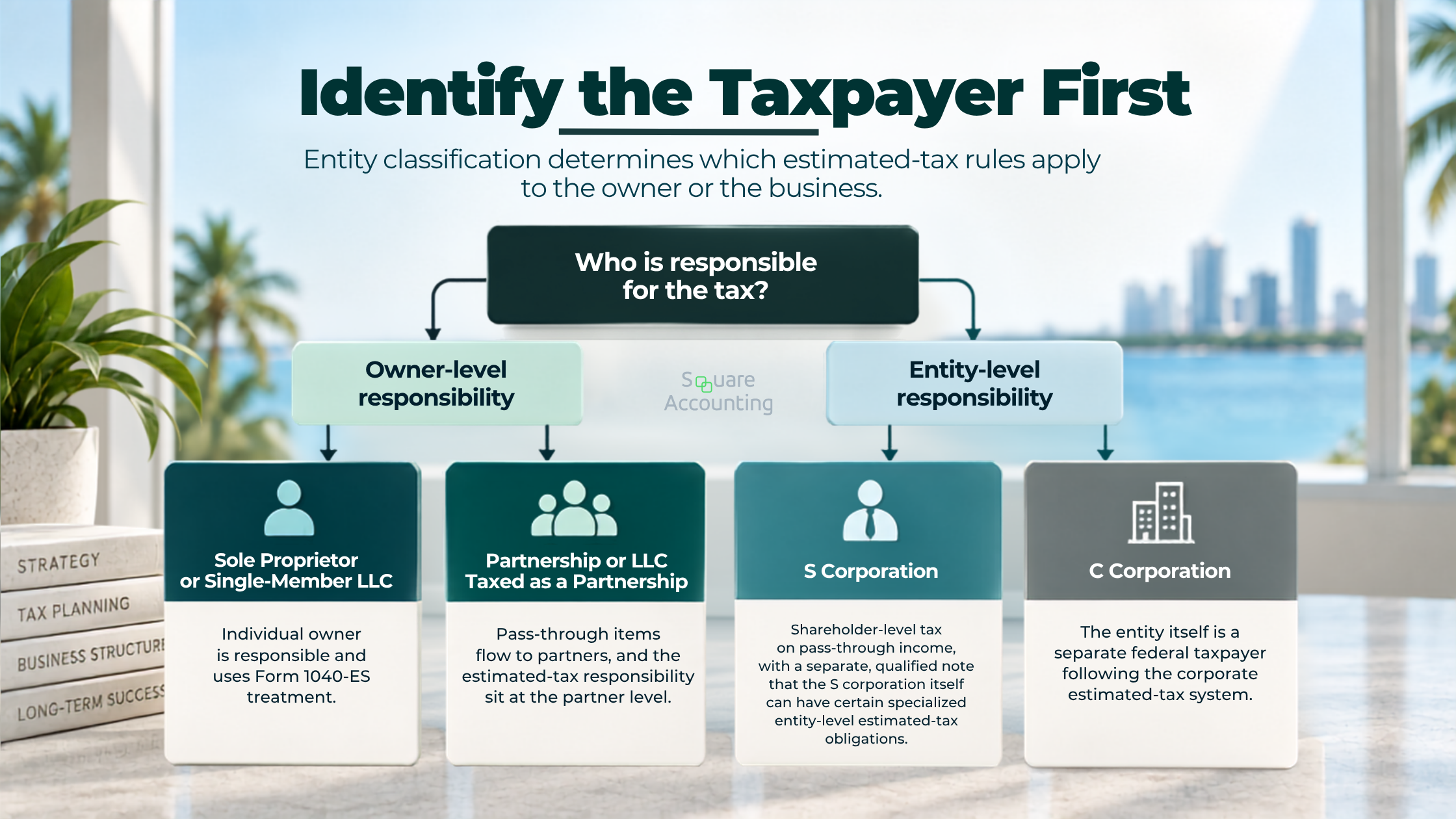
Entity classification comes before the payment calculation because different structures can place the tax obligation at different levels.
“The phrase ‘business estimated tax’ can obscure who is actually liable for the tax.”
Sole Proprietor or Single-Member LLC
A sole proprietor generally reports business activity on the owner's individual return. If the individual estimated-tax rules apply, Form 1040-ES is generally used. Estimated tax can cover federal income tax, self-employment tax, and other amounts included in the individual's tax calculation.
Partnership or LLC Taxed as a Partnership
A partnership generally files an information return rather than paying federal income tax on its pass-through profit. Partners report their shares on their own returns and are personally responsible for taxes due, including estimated tax when required.
The owner-level projection therefore needs the expected K-1 items, not just the amount of cash the partner expects to receive.
S Corporation
An S corporation shareholder may owe tax on the shareholder's share of S corporation income whether or not that income is distributed. That makes distributions an unreliable proxy for the shareholder's estimated-tax liability.
An S corporation itself can also owe estimated tax for certain specialized entity-level taxes, including built-in gains tax, excess net passive income tax, and investment credit recapture tax, when the applicable requirements are met.
C Corporation
A C corporation is a separate federal taxpayer and follows the corporate estimated-tax rules rather than the owner's Form 1040-ES safe-harbor rules. For a calendar-year corporation, the federal installment dates under section 6655 are April 15, June 15, September 15, and December 15.
Entity classification therefore needs to be settled before the payment calculation begins.
If the classification or structure itself needs review, the Florida business entity structure guide covers that decision separately.
When Equal Installments Stop Fitting the Facts
Equal installments are the default starting point under the regular method, but they are not always the right calculation when income is uneven or an owner is already behind.
Uneven Income: Test the Annualized-Income Method
Publication 505 provides an annualized estimated-tax worksheet for taxpayers who do not receive income evenly during the year. The method estimates tax at the end of each payment period using income, deductions, and other items from the beginning of the year through that period.
For a seasonal service business or a business that earns a large portion of annual profit later in the year, annualization may reduce one or more required installments compared with the regular method.
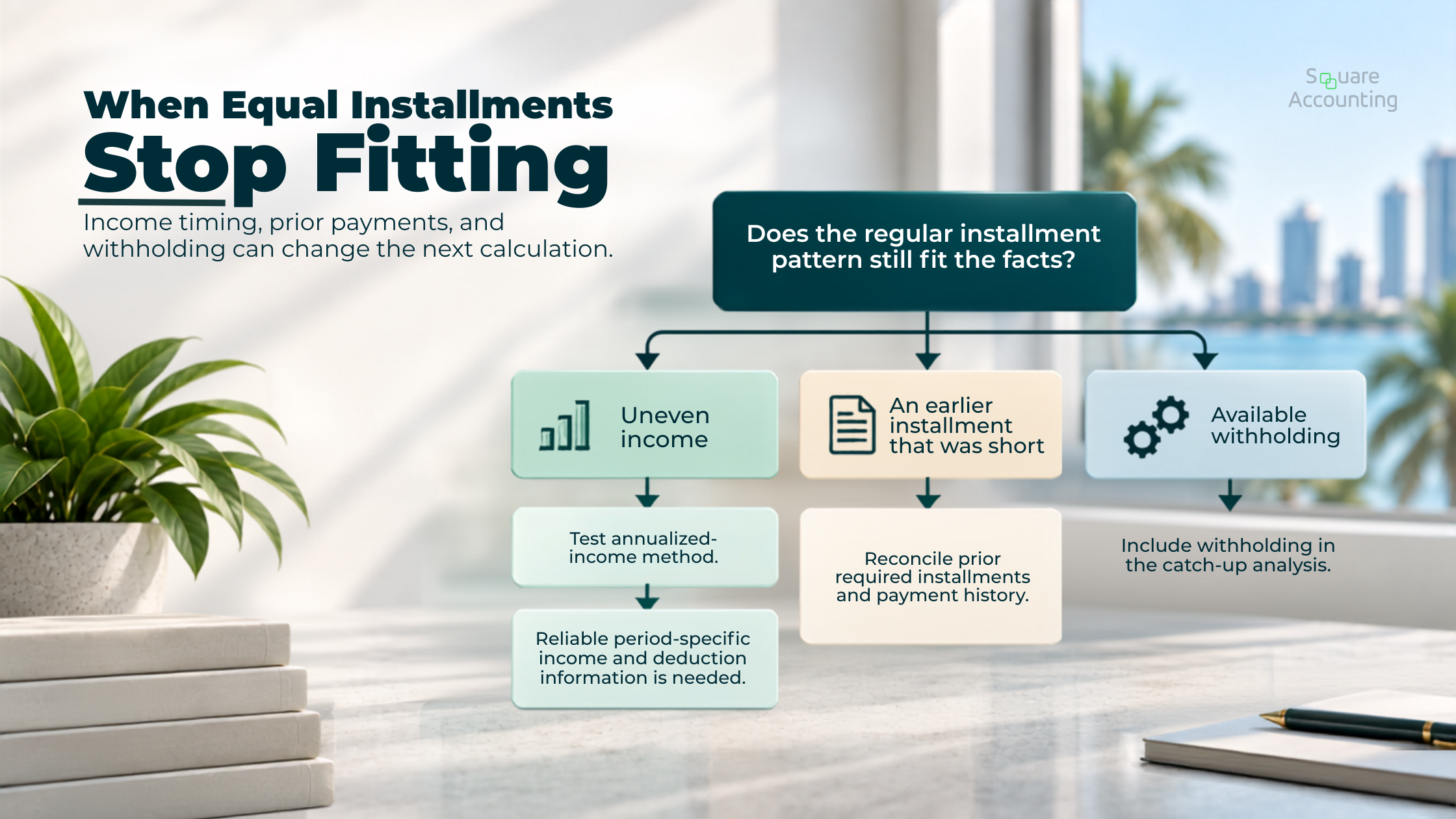
When income or payment timing changes, the next step depends on the actual pattern rather than a mechanical divide-by-four approach.
The tradeoff is documentation. The calculation needs reliable period-specific income and deduction data. A year-end profit-and-loss statement does not by itself show what had occurred by each installment period.
If an Earlier Installment Was Short
A later payment does not automatically erase an earlier underpayment. Section 6654 measures an underpayment by installment and the period during which the shortfall remains unpaid.
If the business has enough information to identify a shortfall, the next calculation should answer two questions: what amount is currently unpaid, and whether the actual income pattern supports annualization.
Withholding Can Change a Late-Year Catch-Up Calculation
Federal income tax withholding receives different timing treatment from ordinary estimated payments. Section 6654 generally treats an equal part of wage withholding as paid on each installment date unless the taxpayer establishes the actual withholding dates. Publication 505 reflects that treatment in its estimated-tax calculations.
For an owner who legitimately receives wages, increasing federal withholding on remaining wages can therefore be relevant to a late-year catch-up plan. The available wages, payroll timing, total projected tax, and amount already withheld control whether that approach is practical.
Florida Changes the State-Level Layer, Not the Federal Calculation
Florida does not impose a personal income tax, so an individual Florida resident does not have a Florida personal estimated-income-tax system comparable to federal Form 1040-ES.
That does not change the federal calculation described above.
Florida corporate income tax is different. The Florida Department of Revenue states that a corporation or other entity subject to Florida corporate income tax must make estimated payments when expected annual Florida corporate income tax liability is more than $2,500. Florida Form F-1120ES is used for the declaration and installments.
For tax years beginning on or after January 1, 2017 that end other than June 30, Florida generally schedules those corporate installments for the last day of the fifth month, sixth month, ninth month, and tax year. That schedule is separate from both the individual Form 1040-ES dates and the federal C corporation dates.
The practical point is to identify the taxpayer first. A Florida owner can have no personal Florida income-tax estimate while an entity in the same business structure has a separate Florida corporate estimated-tax obligation.
A Better Quarterly Review Process for a Growing Business
The estimated payment should be an output of the current-year tax projection, not a number that survives unchanged because it was printed on last year's vouchers.

The quarterly review cycle turns estimated tax into a forecasting process rather than a fixed set of prior-year vouchers.
Before the April Payment
Use the completed or substantially prepared prior-year return to establish the prior-year side of the safe-harbor calculation. Then build the first current-year projection using the business plan, known compensation, expected K-1 items, investment activity, and withholding.
Before the June Payment
Compare actual year-to-date performance with the opening projection. Because the second federal individual payment period ends May 31, the June 15 installment arrives earlier in the operating cycle than many owners expect.
Before the September Payment
By September, replace as many assumptions as possible with actual results. Review year-to-date profit, expected full-year profit, owner wages, K-1 expectations, major gains, deductions, withholding, payments already made, and cash reserved for tax.
For 2026, the regular third installment is due September 15.
Before the January Payment
Reconcile the substantially completed business year with the remaining owner-level tax exposure and filing-season liquidity. If the return can be filed and the remaining tax paid by January 31, 2027, Publication 505 provides the exception to the January 15 estimated payment described earlier.
This four-review rhythm turns estimated tax into a forecasting process. It also gives the owner a decision window before a payment date rather than a surprise after the return is complete.
For a broader filing-to-planning framework, the tax preparation and advisory review guide explains how estimates fit into the current-year planning cycle.
Five Failure Modes That Distort the Payment Decision
1. Treating a Revenue Percentage as the Tax Calculation
A reserve percentage can help manage cash, but it is not the federal estimated-tax calculation. Form 1040-ES is built around projected tax, credits, withholding, and the required annual payment.
2. Using Last Year's Balance Due Instead of Last Year's Tax
The prior-year safe harbor is based on the relevant tax shown on the prior-year return, subject to the statutory rules. It is not simply the check that happened to be due when that return was filed.
3. Treating S Corporation Distributions as the Tax Base
A shareholder may owe tax on S corporation income whether or not the income was distributed. Expected K-1 items and the rest of the individual return belong in the projection.
4. Assuming Safe Harbor Means the Year Is Fully Funded
Safe harbor addresses underpayment-penalty exposure. If current-year income has risen sharply, the filing-season balance can still be substantial.
5. Fixing the Annual Total but Ignoring Timing
Estimated-tax penalties are installment-based. A large later payment can reduce an outstanding shortfall without necessarily eliminating the period during which an earlier installment was underpaid.
Decision Framework: Safe Harbor, Projection, or Annualization?
The statutory calculation identifies required prepayment. The payment strategy still requires professional judgment.
Stable income: Start with the safe-harbor comparison and confirm that the projected current-year liability is not materially different.
Growing income: Calculate the safe harbor, then separately decide how much of the expected additional tax should be paid during the year versus retained as a documented cash reserve.
Falling income: Reproject the current-year tax instead of assuming the prior-year amount remains the best target.
Uneven income: Test the annualized-income method when the timing of actual income makes the regular installment method a poor fit.
Already behind: Reconcile prior installments, test annualization if supported by the income pattern, and include available withholding in the catch-up analysis.
The useful output is not simply a voucher amount. It is a payment decision that identifies the statutory target, expected filing-season balance, cash retained for that balance, and the assumptions that would trigger another recalculation.
Review whether the next payment should be guided by the regular safe-harbor calculation, an updated projection, or an annualized-income analysis.
2026 Estimated Taxes: The Bottom Line
For 2026 quarterly estimated tax payments for business owners filing individual returns, the regular federal deadlines are April 15, June 15, September 15, 2026, and January 15, 2027. Most individuals determine the annual prepayment target by comparing 90% of expected current-year tax with 100% of prior-year tax, using 110% on the prior-year side for many higher-income taxpayers.
For a growing Florida business owner, that safe-harbor calculation should be only one part of the review.
Keep three numbers visible: projected total tax, required annual prepayment, and the cash reserved for the remaining liability. Recalculate when profit, K-1 income, gains, withholding, or other material facts change.
If those numbers have separated materially, a Business Tax Planning Review can clarify what should be paid now, what remains projected for filing season, and which assumptions should be reviewed again before the next decision date.
Reconcile projected tax, required prepayments, withholding, and remaining liquidity before those numbers carry into the next filing decision.
2026 payment planning
Estimated Tax Planning FAQs
Clarify safe-harbor targets, current-year projections, payment timing, entity responsibility, and the cash reserve needed for the remaining tax position.
How can I tell whether a projected filing-season balance is a penalty
problem or a cash-reserve problem?
Compare the required annual prepayment with projected 2026 total tax and payments already expected through withholding and estimates. If the statutory prepayment target is satisfied but projected total tax is higher, the remaining amount is primarily a funding and liquidity issue rather than evidence that the safe-harbor target itself was missed. The article treats those as separate decisions. The planning question then becomes how much additional tax to pay during the year versus how much cash to retain for the projected filing-season balance.
Why can two business owners with the same prior-year tax need
different 2026 payment plans?
Prior-year tax is only one input. Two owners with the same prior-year figure can have different projected 2026 income, withholding, payments already made, income timing, and available tax cash. One may be close to the prior-year pattern while another has materially higher current-year profit or gains. Their statutory safe-harbor calculations may begin from the same prior-year amount, but their expected filing-season balances and liquidity decisions can differ substantially. That is why the article separates the safe-harbor target from the current-year projection and cash-reserve decision.
What information should trigger a new estimated-tax calculation
before the next payment?
A recalculation becomes more useful when material assumptions have changed. The final article specifically identifies changes in year-to-date profit, expected full-year profit, owner wages, K-1 expectations, significant gains, deductions, withholding, payments already made, and cash reserved for tax. The purpose is not to recalculate for every small fluctuation. It is to replace outdated assumptions when the facts that drive projected tax or the remaining payment requirement have changed enough that the prior estimate no longer describes the current year.
What records are most important if annualized income may apply?
The annualized-income method depends on knowing what income, deductions, and other relevant items had actually occurred through each payment period. That means reliable period-specific financial information matters more than a year-end total alone. A year-end profit-and-loss statement may show annual profit without showing when that profit was earned. For a business with uneven income, the practical documentation issue is whether the records can support the income and deduction amounts attributable to the relevant periods before relying on annualization instead of the regular installment method.
How should I think about withholding when correcting a late-year
estimated-tax shortfall?
Withholding and ordinary estimated payments receive different timing treatment under the rules described in the article. Federal withholding is generally treated as paid ratably across the installment dates unless actual withholding dates are established. That means available withholding can affect a late-year catch-up calculation differently from simply making another estimated payment. The practical analysis should consider the amount already withheld, remaining legitimate wages, payment history, projected total tax, and whether annualization changes the required installments. The article treats withholding as one input in the catch-up analysis, not as an automatic solution.
Why does entity classification still matter for a Florida owner who
does not owe Florida personal income tax?
Because the taxpayer responsible for the obligation can change with the entity structure. A sole proprietor, partner, or S corporation shareholder may have owner-level federal estimated-tax obligations, while a C corporation follows a separate federal corporate system. Florida also has a separate corporate estimated-tax regime for entities subject to Florida corporate income tax. The absence of Florida personal income tax therefore does not answer who must make every estimated payment. The first classification question is whether the relevant tax belongs to the individual owner or to a separate taxable entity.
What should be coordinated if I plan to rely on the January filing
exception instead of making the January estimated payment?
The final article states that the January estimated payment can be unnecessary when the 2026 return is filed by January 31, 2027 and the remaining tax is paid by that date. The practical coordination point is that the return and remaining payment must be ready together. That requires a substantially completed view of the business year, the owner's remaining tax exposure, payments already made, and available liquidity. The exception therefore changes the timing decision, but it does not remove the need to reconcile the year's actual tax position before the January filing date.