
How to Legally Reduce Capital Gains Tax Before Selling a Florida Home
For a homeowner asking how to avoid capital gains tax when selling a house in Florida, the answer starts with four steps: calculate the gain correctly, establish every supportable basis adjustment and selling expense, protect the federal Section 121 exclusion, and classify any rental or business use. If gain remains taxable, capital losses, the closing year, Net Investment Income Tax, or a properly structured installment sale may change the result.
Florida generally does not tax a natural person's capital gain, but federal tax can still be substantial. The useful planning window is usually before the contract and closing, while residence dates, records, payment terms, and sometimes the sale year remain open. Once those facts are fixed, most remaining work is reporting.
Key takeaways
Section 121 can exclude up to $250,000 of gain, or up to $500,000 on a qualifying joint return. It applies to gain, not sale price, equity, or closing cash.
Basis is a documentation question before it is a rate question. Unsupported improvements cannot safely carry the tax model.
Passing the two-out-of-five-year test does not make depreciation, nonqualified-use gain, or a separate business portion disappear.
Buying another personal residence does not create Section 1031 deferral. Only qualifying business or investment real property can enter that analysis.
Tax deferral is not automatically an economic win. Installment terms must be compared with credit, collateral, collection, liquidity, and price risk.

The planning sequence separates permanent exclusion, correct gain computation, taxable components, and recognition timing.
“Florida generally does not tax a natural person's capital gain, but federal tax can still be substantial. The useful planning window is usually before the contract and closing, while residence dates, records, payment terms, and sometimes the sale year remain open.”
The five legitimate ways to change the result
“Avoid capital gains tax” can mean several legally different outcomes. The distinction matters because each lever applies to a different layer of the sale.
| Planning lever | What it changes | Tax effect | Main constraint |
|---|---|---|---|
| Section 121 exclusion | Recognized gain | Permanent exclusion | Ownership, use, look-back, filing status, and property history |
| Adjusted basis and selling expenses | Realized gain | Correct computation | Costs must qualify and be supportable |
| Capital-loss netting | Net taxable capital gain | Offset | Investment fit, realization timing, and wash-sale rules |
| Closing-year selection | Capital-gain bands and NIIT | Rate management | Eligibility dates, market terms, other income, and carrying costs |
| Installment sale or qualifying mixed-use exchange | Recognition timing | Deferral | Transaction structure, buyer risk, liquidity, and strict eligibility |
See how a Real Estate Planning Review would organize basis, exclusion eligibility, property use, and the taxable remainder.
The order is deliberate. Compute gain first, determine how much Section 121 can exclude, identify any separately taxable components, and plan only the balance that remains.
1. Calculate the gain before estimating the tax
For a typical personal residence, the working formula is:
“Sale price minus selling expenses minus adjusted basis equals realized gain.”
The IRS uses this structure in Publication 523. A mortgage payoff reduces the cash a seller receives at closing, but it is not a separate deduction in the gain formula. Debt used to acquire the home is included in cost basis, while the later payoff does not reduce gain again. The IRS explains that mortgage proceeds used to finance the purchase are included in the home's cost in its property-basis FAQ.
Build a defensible basis file before listing
Adjusted basis may include the original cost, eligible acquisition charges, and capital improvements still reflected in the home. It must also reflect reductions such as depreciation, certain casualty-related amounts, credits, and subsidies. Seller-paid commissions, legal fees, and transfer taxes can reduce amount realized as selling expenses. The current categories and worksheets appear in Publication 523 and Publication 530.
Routine maintenance generally does not increase basis. A repair may qualify when it is part of a larger restoration or remodeling project, but its label on an invoice does not decide the result. The work performed, its relationship to the larger project, and the records matter.
A useful pre-sale file includes:
the purchase closing statement and deed;
invoices, contracts, permits, canceled checks, and card statements for improvements;
casualty, insurance, energy-credit, and subsidy records;
depreciation schedules for every rental or business-use period; and
the proposed sale contract and seller closing-cost estimate.

Basis documentation changes the gain calculation before Section 121 or sale-year rate planning begins.
“If records are incomplete, reconstruct the history from source documents before claiming an amount. Bank records, permits, contractor files, and contemporaneous photographs may help identify costs, but each amount still needs support.”
If records are incomplete, reconstruct the history from source documents before claiming an amount. Bank records, permits, contractor files, and contemporaneous photographs may help identify costs, but each amount still needs support. Publication 523 generally calls for basis records to be retained until three years after the due date of the return for the sale year, subject to longer retention when another rule requires it.
2. Protect the Section 121 exclusion before the window closes
Current 26 U.S.C. §121 generally permits an individual to exclude up to $250,000 of gain after owning and using the property as a principal residence for periods totaling at least two years during the five years ending on the sale date. The taxpayer generally cannot use the exclusion if another home sale used it during the two years ending on the current sale date.
For a married couple filing jointly, the maximum can reach $500,000 when either spouse satisfies the ownership test, both spouses independently satisfy the use test, and neither spouse is blocked by the two-year look-back. If all three joint-return conditions are not met, each spouse's separate eligibility must be analyzed. The result is not automatically zero or $500,000. IRS Topic 701 summarizes these rules.
Test each spouse against the exact sale date
Calculate ownership, residence, and look-back periods by date before accepting a closing date. The two years do not need to be continuous, and ownership and use can occur during different periods within the five-year window. Approximations such as “we moved in two summers ago” are not adequate for a material transaction.
The home must also be the taxpayer's principal residence. When an owner has multiple homes, time spent in each is the most important factor. Tax-return addresses, voter registration, licensing, banking, employment, family, and community ties can also matter under the facts-and-circumstances discussion in Publication 523.
A reduced exclusion can apply to an early sale
A seller who fails the full ownership, use, or look-back test may qualify for a reduced exclusion if the primary reason for sale is a change in place of employment, health, or an unforeseen circumstance. The statutory rule is in §121(c), and Treasury Regulation §1.121-3 provides safe harbors and a facts-and-circumstances standard.
The reduced maximum generally uses the shortest applicable qualifying period divided by two years, applied separately to each spouse when required. This is not a general hardship election. The chronology and supporting employment, medical, or event records should match the claimed reason for the sale.
Special rules may affect a surviving spouse selling within two years after death, certain divorce-related ownership and use periods, and taxpayers on qualified official extended duty. Each rule has conditions, so it should be tested against the ownership history and sale date rather than treated as an automatic extension.
Examine the ownership, residence, spouse-level, and look-back facts that must be tested against the sale date.
3. Resolve rental, vacation, and business use separately
Passing the basic two-out-of-five-year test does not guarantee that every dollar below the exclusion cap is excludable. Use history can create separate taxable components.
Depreciation after May 6, 1997 remains taxable
Section 121 does not exclude gain attributable to depreciation allowed or allowable for rental or business use after May 6, 1997. Failing to claim available depreciation does not preserve the exclusion. Publication 523 requires the basis reduction and explains the home-sale treatment.
The tax character then requires care. Depreciation-related gain on real property may be unrecaptured Section 1250 gain subject to a maximum 25% rate. Any amount treated as ordinary income under a separate recapture rule is different. The facts and property components determine which rules apply; “depreciation recapture” should not be used as a single-rate shortcut. IRS Topic 409 and the Form 4797 instructions address those character and reporting distinctions.
If a home office or rented room is within the home's living area, a separate allocation of sale price and basis is generally not required solely because of that use, but the post-May 6, 1997 depreciation remains nonexcludable. A physically separate rental or business portion, such as the other unit of a duplex or a detached business structure, can require allocation and separate reporting.
Conversion direction changes the nonqualified-use result
Certain post-2008 periods when the property was not used as a principal residence can cause a proportional part of gain to be nonqualified-use gain and therefore not excludable. A rental converted into a main home can produce taxable gain even after two years of residence.
The reverse sequence can differ. A rental period after the owner's last use as a principal residence is excluded from the statutory definition of nonqualified use, provided the seller still satisfies the two-out-of-five-year test. Depreciation allowed or allowable during that rental period remains taxable. Publication 523 illustrates both directions.
This is why “move in for two years” and “rent it before selling” are incomplete advice. The acquisition date, order of uses, total ownership period, last principal-residence date, separate-use areas, and depreciation schedule must be modeled together.
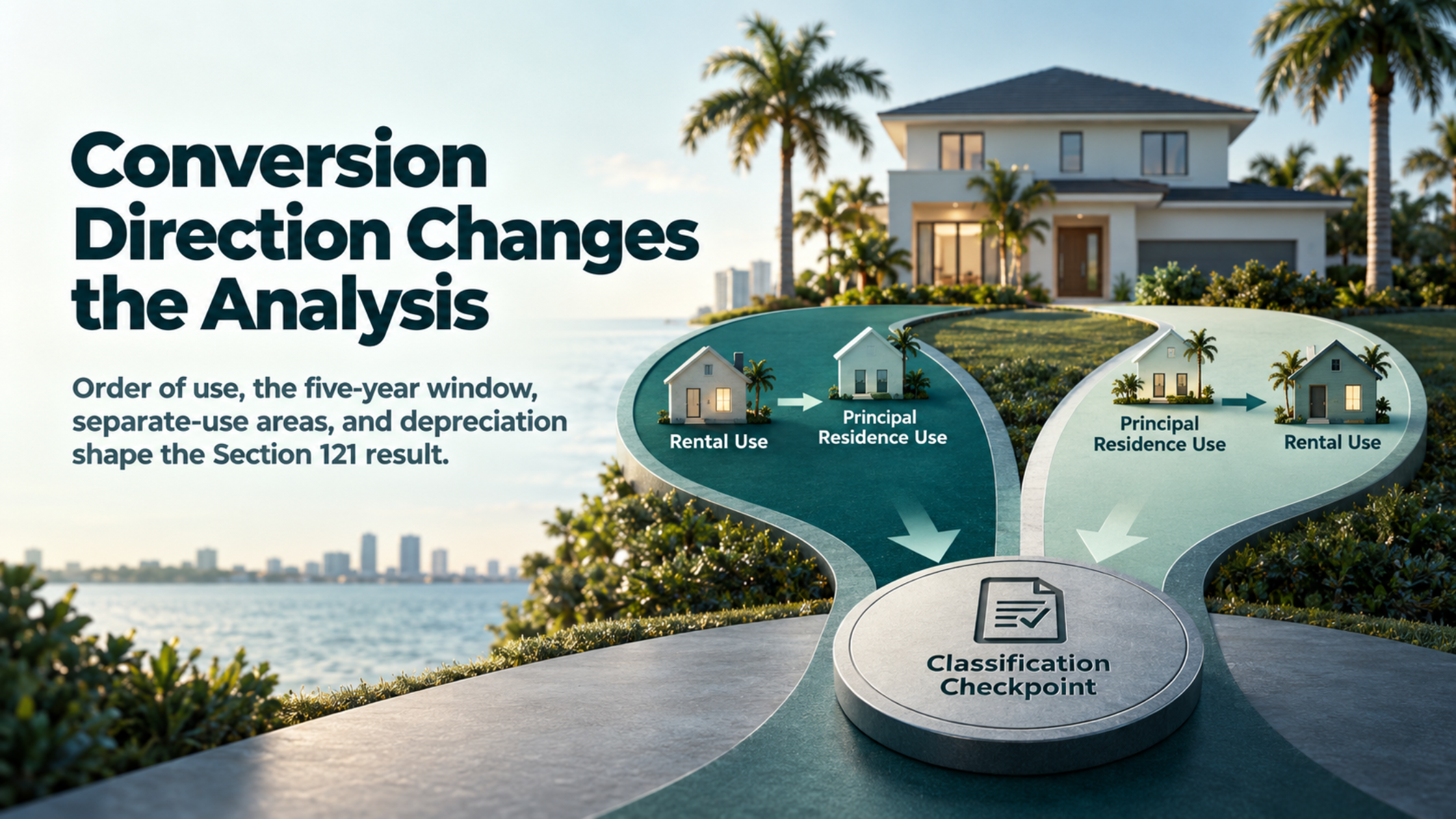
The same property can produce a different exclusion analysis when the order and location of its uses change.
“A rental period after the owner's last use as a principal residence is excluded from the statutory definition of nonqualified use, provided the seller still satisfies the two-out-of-five-year test. Depreciation allowed or allowable during that rental period remains taxable.”
A 1031 exchange is not a replacement-home rule
Buying another personal home does not defer gain on the home sold. IRS like-kind-exchange guidance limits Section 1031 to real property held for productive use in a trade or business or for investment. A property used solely as a personal residence does not qualify.
A home with genuine business or investment use may, in limited circumstances, involve both Sections 121 and 1031. Revenue Procedure 2005-14 provides ordering and basis rules when a single transaction satisfies both provisions. That is a mixed-use transaction analysis, not an automatic exchange created by purchasing another home.
4. Plan the taxable gain that remains after Section 121
Once exclusion and separately taxable components are established, the remaining gain can be placed into the sale-year income picture.
For 2026, regular net long-term capital gain generally falls into 0%, 15%, and 20% bands based on filing status and taxable income. Revenue Procedure 2025-32 establishes the thresholds. The sale does not receive one universal rate, and depreciation-related gain can use a different rate calculation. Square Accounting's 2026 Florida capital-gains guide provides the filing-status thresholds and stacking framework without duplicating that table here.
Test NIIT separately
The 3.8% Net Investment Income Tax applies to the lesser of net investment income or the excess of modified adjusted gross income over the applicable threshold. The thresholds are $200,000 for single and head-of-household filers, $250,000 for married couples filing jointly, and $125,000 for married taxpayers filing separately. Gain excluded under Section 121 is excluded from net investment income, while taxable home-sale gain may enter the calculation. The IRS NIIT guidance confirms these rules.
Moving a closing across calendar years can change the amount reaching the 20% band or NIIT when the seller's other income differs. A useful projection includes wages, business income, bonuses, retirement distributions, qualified dividends, other asset sales, deductions, and estimated-tax cash needs. Any projected tax benefit should be compared with the buyer's terms, price risk, financing, carrying costs, and insurance.
Coordinate genuine capital losses
Realized capital losses and carryovers can offset taxable capital gains under the Schedule D netting rules. IRS Topic 409 and Publication 550 explain the netting order, carryovers, and wash-sale rules.
Loss harvesting should remain consistent with the investment plan. Before acting, identify whether each gain and loss is short term or long term, confirm carryovers, and review related account activity that could trigger the wash-sale rule. A tax offset that creates unwanted market exposure or an economic loss may not improve the seller's position.
Seller financing changes timing and risk
When at least one payment is received after the tax year of sale, an eligible sale is generally reported under the installment method unless the seller elects out. Nonexcludable gain is spread through the gross-profit percentage as principal is collected, while Section 121-excluded gain is removed from gross profit. Interest is reported separately as ordinary income. Any gain treated as ordinary income under the depreciation-recapture rules is reported in the sale year rather than deferred. Publication 537 and IRS Topic 705 explain these mechanics.

An installment structure should be evaluated through both its tax-recognition pattern and its risk-adjusted cash flow.
“Interest is reported separately as ordinary income. Any gain treated as ordinary income under the depreciation-recapture rules is reported in the sale year rather than deferred.”
Installment treatment does not make the taxable gain disappear. As a planning judgment, the note should be evaluated for down payment, stated interest, collateral, senior liens, buyer credit, default remedies, collection cost, balloon terms, and seller liquidity. A contract without adequate stated interest can also create imputed-interest consequences. The relevant comparison is the risk-adjusted, after-tax cash flow of the note versus a cash offer.
A multi-year example: three facts change the taxable gain
Assume a married Florida couple sells a long-held home in 2026 with these facts:
sale price: $1,500,000;
seller-paid selling expenses: $90,000;
original cost: $600,000;
eligible acquisition costs: $10,000;
documented capital improvements still reflected in the home: $180,000; and
depreciation allowed or allowable after May 6, 1997: $30,000.
Amount realized is $1,410,000. Adjusted basis is $760,000: $600,000 plus $10,000 plus $180,000, less $30,000. Realized gain is $650,000.
| Alternate fact | Section 121 result | Taxable gain before capital-loss netting | Decision insight |
|---|---|---|---|
| Both spouses satisfy the joint-return tests | $500,000 exclusion | $150,000 | The $30,000 depreciation component remains within taxable gain and requires character analysis |
| Only one spouse is independently eligible | Assumed $250,000 exclusion | $400,000 | A later sale date could help if it allows both spouses to satisfy the use test |
| The $180,000 of improvements cannot be supported and is omitted | $500,000 exclusion | $330,000 | Basis support changes gain before any rate planning |
The example assumes no exclusion used within two years, no nonqualified-use allocation, no separate business portion, no other basis adjustment, and a long-term holding period. It shows sensitivity to facts, not a promised outcome. A delay may improve eligibility, but only an economic comparison can show whether the tax benefit outweighs market and carrying-cost risk.
Compare how basis support, spouse-level eligibility, mixed use, closing year, and liquidity affect the available sale paths.
The last practical decision point moves forward
The following timeline is a planning framework, not a statutory schedule. A contract, buyer demand, financing terms, or a factual eligibility date may move the practical deadline.
| Stage | Decisions still reasonably open | Main work product |
|---|---|---|
| Stage 12 to 24 months before sale | Residence and ownership periods, conversion plans, improvement records, and possible sale years | Eligibility calendar and preliminary gain model |
| Stage Before listing or accepting an offer | Basis reconstruction, mixed-use classification, closing-date comparison, and seller-financing terms | Alternate-facts tax and liquidity model |
| Stage Before closing | Final selling expenses, note terms, estimated-tax funding, and reporting documents | Closing and payment plan |
| Stage After closing | Required forms, available elections, and record retention | Accurate return and tax-attribute updates |
The closer the transaction gets to closing, the more the work shifts from planning to reporting. Residence dates cannot be recreated, a seller note cannot be negotiated after a cash closing, and a mixed-use exchange cannot be assembled after the transfer.
For a substantially appreciated home, incomplete basis records, mixed use, or a meaningful timing decision, a Real Estate Planning Review can compare the available sale paths before the terms become fixed. Request a Real Estate Planning Review to model eligibility, taxable gain, tax timing, and closing liquidity together.
Identify which eligibility, documentation, timing, payment, and liquidity decisions remain open before the transaction becomes fixed.
Plan the filing and tax payment before closing
Excludable gain often requires no federal reporting, but a sale generally must be reported when the seller receives Form 1099-S or has taxable gain. Topic 701 and Publication 523 explain when Form 8949 and Schedule D apply. A separate business portion can require Form 4797, an installment sale generally requires Form 6252 for the sale year and each later year a payment is received, and NIIT is calculated on Form 8960 when applicable.
A large taxable gain can also create an estimated-tax requirement or an underpayment exposure before the return due date. Topic 409 and the IRS NIIT guidance advise taxpayers to consider estimated payments. Include the projected federal payment in the closing-liquidity plan rather than treating all net proceeds as deployable capital.
Common strategies that fail or backfire
| Strategy | Why it is incomplete | Better decision question |
|---|---|---|
| Strategy Treating equity as gain | Debt changes closing cash, not the basis-and-amount-realized formula | What is realized gain after supportable basis and selling expenses? |
| Strategy Buying another personal home | Current law has no automatic personal-residence rollover, and Section 1031 does not cover solely personal use | Is any portion genuinely held for business or investment, and does it satisfy both provisions? |
| Strategy Converting the home to a rental | Depreciation, nonqualified use, and the moving five-year window can leave more gain taxable | What does the full use timeline do to exclusion and cash flow? |
| Strategy Gifting the home to family | Gift basis generally carries over for computing gain rather than resetting to fair market value | Does the transfer serve a broader estate or family objective after tax and control consequences are modeled? |
| Strategy Counting repairs as improvements | Routine maintenance does not automatically increase basis | What work was done, how was it part of a larger project, and what records support cost? |
| Strategy Waiting for return preparation | Filing applies the facts that exist; it cannot renegotiate terms or recreate residence days | Which eligibility, documentation, timing, and liquidity decisions remain open now? |
Publication 551 explains the gift-basis framework. The difference between applying completed facts and modeling a transaction before it closes is discussed further in Tax Preparation vs. Tax Advisory.
What changes because the home is in Florida?
Article VII, section 5 of the Florida Constitution limits state income taxation of natural persons. A Florida resident who owns the home individually therefore generally has no separate Florida individual income tax on the gain. The federal exclusion, capital-gain rates, NIIT, depreciation, and reporting rules still apply.
Florida documentary stamp tax and other seller-paid transfer charges also affect closing cash. When a seller pays a transfer or stamp tax, federal guidance generally treats it as a selling expense that reduces amount realized. The Florida Department of Revenue explains the state tax, while Publication 530 explains the federal treatment of seller-paid transfer taxes.
If the seller changed domicile during the year, maintained another home, or remains connected to another state, the other jurisdiction's residency and sourcing rules require separate review. Florida's rule does not control another state's claim.
Conclusion: model the home sale before the gain becomes fixed
For a homeowner deciding how to avoid capital gains tax when selling a house in Florida, the best approach is to follow the transaction in order: compute gain, support basis, verify each spouse's Section 121 eligibility, classify rental or business use, and model the taxable remainder within the sale-year income and liquidity plan.
That sequence distinguishes permanent exclusion from tax deferral and a lower reported gain from a lower tax rate. It also keeps a familiar tactic from being applied to the wrong property or too late in the transaction. The objective is a defensible after-tax sale decision that still works economically across the years that follow.
Evaluate supportable gain, available exclusion, the taxable remainder, and closing liquidity before selecting the final sale approach.
Pre-sale planning
Home Sale Tax Planning FAQs
Resolve documentation, property-use, timing, payment, and reporting questions before the transaction terms and available planning choices become fixed.
How should incomplete improvement records affect the pre-sale tax
model?
Unsupported improvement costs should not carry the base-case gain calculation. The seller can reconstruct the property history from available source documents, including closing records, bank records, permits, contractor files, and contemporaneous photographs, but each claimed amount still needs support. A useful model can compare the result using established basis with a separate scenario for unresolved items. This shows how documentation affects potential gain without treating an estimate as established fact. The reconstruction should occur before listing or accepting an offer when possible.
How do an interior home office and a separate business-use area
affect the sale differently?
A home office or rented room within the home's living area generally does not require a separate allocation of sale price and basis solely because of that use. Depreciation allowed or allowable after May 6, 1997 still remains nonexcludable. A physically separate business or rental portion, such as another duplex unit or a detached structure, can require allocation and separate reporting. The seller therefore needs to identify where the activity occurred, whether the space was part of the living area, and what depreciation was available before modeling the Section 121 exclusion.
When might changing the closing year improve the tax result?
Changing the closing year may affect how the taxable remainder fits within the seller's long-term capital-gain bands and Net Investment Income Tax calculation. The projection should consider the seller's other income, including wages, business income, bonuses, retirement distributions, qualified dividends, and other asset sales. A lower-income year may produce a different result, but that difference should be compared with the buyer's terms, market risk, financing, insurance, and carrying costs. Closing-year selection is therefore an economic decision informed by tax modeling, not an automatic tax strategy.
How should a seller compare an installment offer with a cash offer?
The comparison should extend beyond when taxable gain is recognized. An installment offer can spread eligible nonexcludable gain as principal is collected, while interest is reported separately and any ordinary depreciation-recapture income is reported in the sale year. The seller should also examine the down payment, stated interest, collateral, senior liens, buyer credit, default remedies, collection costs, balloon terms, and personal liquidity. The relevant planning comparison is the risk-adjusted, after-tax cash flow of the seller-financed note against the certainty and immediate liquidity of the cash offer.
Why can one home sale involve several federal tax calculations?
The taxable result may contain components that do not follow one universal rate calculation. Gain qualifying for Section 121 can be excluded, while the remaining regular long-term capital gain may fall into different income-based bands. Depreciation-related gain can require a separate character and rate analysis, and taxable home-sale gain may also enter the Net Investment Income Tax calculation. The correct sequence is to determine realized gain, apply the available exclusion, classify separately taxable components, and then place the remaining amounts within the seller's sale-year income picture.
Why should reporting and tax-payment needs be reviewed before closing?
A seller may need to report the transaction when Form 1099-S is issued or taxable gain remains, even when part of the gain qualifies for exclusion. Depending on the transaction, reporting can involve Form 8949, Schedule D, Form 4797 for a separate business portion, Form 6252 for an installment sale, or Form 8960 for Net Investment Income Tax. A substantial taxable gain can also create an estimated-tax requirement or underpayment exposure. Modeling these obligations before closing helps separate deployable proceeds from cash that may be needed for federal tax payments.
Is the 12-to-24-month planning window a legal tax deadline?
No. The article's 12-to-24-month period is a professional planning framework, not a statutory deadline. Its purpose is to identify when residence periods, conversion plans, basis documentation, possible sale years, and payment structures may still be evaluated. The practical deadline can arrive earlier because of a contract, buyer demand, financing terms, or a controlling eligibility date. As the transaction approaches closing, the work increasingly shifts from comparing alternatives to documenting and reporting facts that have already become fixed.
When is Florida residence insufficient to complete the state-tax analysis?
Florida residence does not necessarily resolve every state issue when the seller changed domicile during the year, maintained another home, or remains connected to another jurisdiction. Florida generally does not impose a separate individual income tax on a natural person's home-sale gain, but Florida's rule does not control another state's residency or sourcing analysis. The relevant facts include the seller's residence history and connections outside Florida. Without the other jurisdiction and its applicable facts, the article does not determine whether that state can assert a tax obligation.

Inzamam ur Rahman
Content & Marketing Strategist
Inzamam manages content and advises on marketing strategy for Square Accounting. He works with Stevan Franeta, CPA, to create clear, practical articles for business owners, high-income professionals, and real estate investors.
Reviewed for tax accuracy by Stevan Franeta, CPA
