Selling a Florida Business? Model Capital Gains Before the Deal Is Signed
Capital gains tax when selling a business in Florida depends first on what the buyer acquires and who is treated as the seller. Florida generally does not impose individual income tax on a natural person, but federal tax can divide one transaction into long-term capital gain, ordinary income, Section 1231 gain, depreciation recapture, interest, and compensation. A Florida C corporation may also face state corporate income tax.
In an asset sale, the price is allocated among separate assets. In an equity sale, the analysis begins with the owner’s stock or partnership interest, subject to important exceptions. Entity classification, tax basis, allocation, payment terms, and Net Investment Income Tax should therefore be modeled before the letter of intent or purchase agreement makes the economics difficult to change.

The sale model should trace each transaction component from the legal seller through tax recognition and eventual cash collection.
“Entity classification, tax basis, allocation, payment terms, and Net Investment Income Tax should therefore be modeled before the letter of intent or purchase agreement makes the economics difficult to change.”
Key takeaways
The headline price is not the taxable gain, and the taxable gain is not necessarily one kind of income.
“LLC sale” does not identify the federal tax result. The LLC may be disregarded, taxed as a partnership, or taxed as a corporation.
In an asset sale, purchase-price allocation can change both the seller’s tax character and the buyer’s future deductions.
Seller financing may defer eligible gain, but inventory income and depreciation recapture generally remain sale-year items.
Florida’s individual no-tax rule does not eliminate federal tax, Florida corporate tax, documentary stamp tax, sales-and-use-tax questions, or another state’s possible claim.
The strongest comparison is not price versus price. It is after-tax cash by year, adjusted for payment risk and obligations retained after closing.
How is a Florida business sale taxed?
The direct answer is that the tax follows the legal and economic components of the transaction. The IRS states that a business asset sale is usually not the sale of one asset. Each asset is classified and its gain or loss calculated separately. Corporate stock is generally analyzed as a capital asset, while a partnership-interest sale can contain an ordinary-income component for unrealized receivables and inventory. IRS Publication 544
| Transaction component | Federal starting point | Decision that must be resolved |
|---|---|---|
| Corporate stock | Usually capital gain or loss | Stock basis, holding period, special elections, and separate side agreements |
| Partnership or LLC interest taxed as a partnership | Generally capital, except Section 751 ordinary-income components | Outside basis, liabilities, unrealized receivables, inventory, and NIIT |
| Business assets | Separate treatment for each asset | Allocation, asset basis, holding period, depreciation, and Section 1231 netting |
| Seller note | Eligible gain may be recognized as principal is collected | Down payment, recapture, inventory, interest, security, and cash needed for tax |
| Employment, consulting, rent, or similar agreement | Analyzed separately from sale consideration | Economic substance, reasonable amount, service obligations, and reporting |
For individual sellers, most regular net long-term capital gain is taxed through the 0%, 15%, and 20% federal bands, depending on taxable income. IRS Topic 409 explains the general rate framework. Those rates come after the transaction has been classified and cannot determine the tax bill by themselves. Square Accounting’s separate guide to Florida capital-gains rates and pre-sale modeling addresses the bracket calculation without duplicating the business-sale analysis here.
First identify the transaction: assets or equity
Asset sale
In an asset sale, the business or its owner transfers selected operating assets and liabilities. The transferred property might include receivables, inventory, equipment, customer-based intangibles, trade names, contracts, goodwill, and real estate.
The seller calculates gain or loss asset by asset. Inventory generally produces ordinary business income. Depreciable property held for more than one year may enter the Section 1231 computation, but prior depreciation can be recaptured as ordinary income. Capital assets may produce capital gain or loss. Section 1231 gain may ultimately receive long-term capital-gain treatment after the required netting and lookback rules, while a net Section 1231 loss may be ordinary. IRS Publication 544
The buyer generally receives tax basis in the acquired assets according to the required allocation. That can create depreciation or amortization deductions after closing, subject to the rules for each asset. Those potential deductions are one reason buyers and sellers may value the same allocation differently.
Corporate stock sale
In a conventional stock sale, the shareholder sells ownership in the corporation rather than having the corporation sell its assets. The shareholder usually recognizes capital gain or loss equal to the amount realized minus adjusted stock basis. Holding period then determines whether that gain or loss is long term or short term. IRS Publication 544
The transaction can still include amounts outside the stock price. A seller note creates interest consequences. Employment, consulting, lease, licensing, and noncompete agreements require separate analysis. The agreement’s label is therefore the beginning of the review, not the conclusion.
Partnership or LLC-interest sale
An LLC is a state-law form, not one federal tax classification. Unless it elects otherwise, a domestic eligible entity with one owner is generally disregarded and one with two or more owners is generally classified as a partnership. An eligible LLC can instead elect corporate treatment. Treasury Regulation Section 301.7701-3
When a partner sells a partnership interest, Section 741 generally treats the interest as a capital asset, but Section 751 recharacterizes the portion attributable to unrealized receivables and inventory items as ordinary. For a service business, unrealized receivables can be material even when physical inventory is minimal. 26 U.S.C. Sections 741 and 751
The model should reconcile the seller’s outside basis, share of liabilities, sale consideration, and Section 751 information. Book capital is not a substitute for that work.
Entity classification determines who recognizes the sale
Two owners can accept the same economic offer and receive different after-tax results because the legal seller and federal tax classification differ.
| Seller structure | Who generally recognizes an asset sale? | Main modeling pressure |
|---|---|---|
| Disregarded single-member LLC | The owner is treated as holding and selling the assets for federal income-tax purposes | Asset basis, recapture, allocation, and owner-level income stack |
| Partnership or LLC taxed as a partnership | The partnership reports the asset-sale items, which are allocated through the partnership rules | Inside and outside basis, liabilities, allocations, and partner-specific tax |
| S corporation | The corporation reports the sale items and generally passes them through to shareholders | Asset character, shareholder basis, distributions, prior C corporation history, and state treatment |
| C corporation | The corporation recognizes asset-sale gain; distributing the after-tax proceeds can create a second shareholder-level consequence | Corporate tax, liquidation or distribution treatment, state tax, and net proceeds available to owners |
Sections 1366 and 1367 govern the pass-through of S corporation items and related shareholder-basis adjustments. Those mechanics should be modeled together rather than treating the corporate sale and shareholder distribution as unrelated events. 26 U.S.C. Sections 1366 and 1367
For a C corporation, the corporation generally recognizes gain or loss when it sells assets, and a taxable liquidation can create shareholder gain or loss when the proceeds are distributed for the stock. Publication 544 summarizes both layers and notes that specific corporate nonrecognition rules can change the result. IRS Publication 544
This entity map is why “purchase price multiplied by 20%” is not a defensible estimate for many closely held business sales.
Purchase-price allocation is part of the negotiation
For an applicable asset acquisition, the buyer and seller allocate consideration among the transferred assets under the residual method. The allocation determines the seller’s amount realized for each asset and the buyer’s basis in each acquired asset. Treasury Regulation Section 1.1060-1
The parties generally report the allocation on Form 8594. A written allocation agreement binds the parties within the regulatory standard, although the IRS can challenge the stated values. Changes to consideration after the first transaction year can also require supplemental reporting.
| Common allocation category | Seller-side issue | Buyer-side issue |
|---|---|---|
| Accounts receivable and inventory | Often ordinary-income treatment | Basis recovery follows the applicable receivable or inventory rules |
| Equipment, vehicles, and furniture | Prior depreciation can create ordinary recapture; remaining character depends on the asset and Section 1231 rules | Allocated basis may be depreciable |
| Acquired and amortized Section 197 intangibles | Prior amortization can affect character through recapture rules | Remaining basis is generally recovered under Section 197 |
| Goodwill and going-concern value | Character depends on ownership, basis, holding period, and whether it was previously acquired and amortized | Acquired goodwill is generally amortized over 15 years |
| Covenant not to compete | Must be valued and analyzed separately from goodwill and services | A qualifying acquisition-related covenant is a Section 197 intangible |
| Employment, consulting, lease, or licensing agreement | Payment may be compensation, rent, royalty, or other income rather than sale gain | Deduction or capitalization depends on the agreement and applicable rules |
Treasury’s Section 197 regulations include acquired goodwill, customer-based intangibles, and acquisition-related covenants within the intangible framework and generally provide a 15-year amortization period for amortizable Section 197 intangibles. They also distinguish a covenant from reasonable compensation for services actually rendered. Treasury Regulation Section 1.197-2
The practical point is not that one category is always favorable. It is that the allocation should be supported by the economics, valuation evidence, and transaction documents. Treating every intangible dollar as capital gain or every hard-asset dollar as ordinary income can both be wrong.

Purchase-price allocation is part of the transaction economics because each category affects the seller and buyer differently.
“The practical point is not that one category is always favorable. It is that the allocation should be supported by the economics, valuation evidence, and transaction documents.”
Basis and depreciation history must be reconstructed before rates are applied
Taxable gain is not the sale price. At a high level, the computation begins with money and the fair market value of other property received, including relevant liability relief, then accounts for selling costs and adjusted tax basis. In an asset deal, that work occurs separately for each asset.
The pre-signing file should include:
shareholder stock-basis or partnership outside-basis schedules;
the fixed-asset and tax-depreciation ledger;
Section 179 and bonus-depreciation history;
acquired-intangible and amortization schedules;
accounts-receivable and inventory detail;
prior entity elections, conversions, reorganizations, and ownership transfers;
liabilities the buyer may assume or satisfy; and
support for proposed asset values and transaction expenses.
Section 1245 recapture generally treats gain on covered depreciable personal property as ordinary income to the extent required by the recapture rules. Any remaining gain then follows the rules applicable to the property, including Section 1231 where relevant. IRS Publication 544
Accelerated depreciation may have improved operating-period cash flow. At sale, however, the lower adjusted basis and potential recapture reshape the exit. That is a timing consequence of prior deductions, not a second deduction disappearing without explanation.
Seller financing can defer eligible gain, but not every tax component
An installment sale generally occurs when at least one payment is received after the tax year of sale. Eligible gain is normally recognized as principal payments are collected unless the seller elects out. A sale of an entire business under one contract is still treated as a sale of separate assets for installment purposes. IRS Publication 537
| Component | General timing under an installment structure |
|---|---|
| Eligible installment gain | Recognized through the gross-profit percentage as principal is received |
| Inventory income | Reported in the year of sale, even if payment arrives later |
| Depreciation recapture | Reported in the year of sale, even if no installment payment is received that year |
| Loss on an asset | Generally reported in the year of sale, subject to the rules governing deductibility |
| Stated or imputed interest | Reported separately from sale gain |
| Contingent earnout | Requires the contingent-payment rules and transaction-specific modeling |
This can create a tax-to-cash mismatch. A modest down payment does not ensure a modest first-year tax bill if the allocation creates inventory income or recapture at closing.

Seller financing can change when eligible gain and cash are recognized without deferring every transaction component.
“This can create a tax-to-cash mismatch. A modest down payment does not ensure a modest first-year tax bill if the allocation creates inventory income or recapture at closing.”
Seller financing also exchanges immediate liquidity for credit risk. The model should therefore connect tax recognition to the down payment, note security, interest rate, buyer covenants, expected payment dates, estimated-tax dates, and the owner’s post-closing cash needs. Deferral is a timing benefit, not necessarily a reduction in total tax.
In Florida, a promissory note or other written obligation signed or delivered in the state may also be subject to documentary stamp tax. The Florida Department of Revenue currently states that qualifying obligations are taxed at 35 cents per $100, capped at $2,450. Florida Documentary Stamp Tax
A Business Tax Planning Review can examine the down payment, seller note, sale-year tax items, and cash available when obligations are due.
Does NIIT apply to the business-sale gain?
The 3.8% Net Investment Income Tax applies to the lesser of net investment income or modified adjusted gross income above the applicable threshold. The thresholds are $200,000 for single or head-of-household filers, $250,000 for married couples filing jointly or qualifying surviving spouses, and $125,000 for married taxpayers filing separately. IRS Topic 559
The active-business analysis is more precise than “the owner worked in the company, so NIIT does not apply.”
Gain from property held in a nonpassive trade or business may fall outside net investment income, subject to the Section 1411 rules.
Partnership interests and S corporation stock generally are not themselves treated as property held in the operating business, so sale gain generally begins inside net investment income.
If the seller materially participated in a qualifying business activity of the partnership or S corporation, the seller may need a special Form 8960 adjustment that looks through to underlying items.
Interest on a seller note remains investment income even when part of the underlying gain receives an adjustment.
The 2025 Instructions for Form 8960, the latest version reviewed as of August 26, 2026, require an adjustment calculation and a supporting statement for certain partnership-interest and S corporation-stock dispositions. They also refer taxpayers to proposed regulations for part of the computation. NIIT should therefore be modeled from the entity and underlying assets, not added or removed as a flat 3.8% assumption.
Florida removes individual income tax, not the rest of the tax map
Florida’s income-tax code is structured around the state constitutional restriction on taxing the income of natural persons. A Florida individual therefore generally has no separate Florida individual income tax on business-sale gain. Florida Statutes Chapter 220
That conclusion has boundaries:
Corporate seller: A Florida C corporation can owe Florida corporate income tax on Florida net income. The Department of Revenue lists a 5.5% rate for taxable years beginning on or after January 1, 2022. Florida Corporate Income Tax
Tangible property: An asset transaction involving equipment, vehicles, inventory, or other tangible personal property requires a Florida sales-and-use-tax review. Florida has an occasional-or-isolated-sale rule, but its conditions and exceptions must be tested against the actual assets and transaction. Florida Administrative Code Rule 12A-1.037
Seller note or Florida real property: Written obligations to pay money and documents transferring Florida real property can create documentary stamp tax. Florida Department of Revenue
Multistate facts: As a planning matter, Florida residence alone does not resolve another state’s potential sourcing or residency position. Property, payroll, customers, entity operations, owner residence history, and the asset or interest sold determine which state-specific rules must be reviewed.
The useful Florida advantage is the absence of an individual income-tax layer, not an exemption from transaction analysis.
Compare business-sale offers by tax, cash timing, and risk
Assume a Florida service-business owner receives two proposals:
| Decision factor | Offer A | Offer B |
|---|---|---|
| Structure | Asset purchase | Equity purchase |
| Stated price | Higher | Lower |
| Cash at closing | Lower | Higher |
| Allocation pressure | More value assigned to receivables and depreciated assets | Price primarily assigned to the ownership interest |
| Deferred consideration | Five-year buyer note | Short contingent earnout |
| Continued involvement | Multi-year consulting requirement | Limited transition period |
Those facts do not establish which offer is better. They establish what must be modeled.
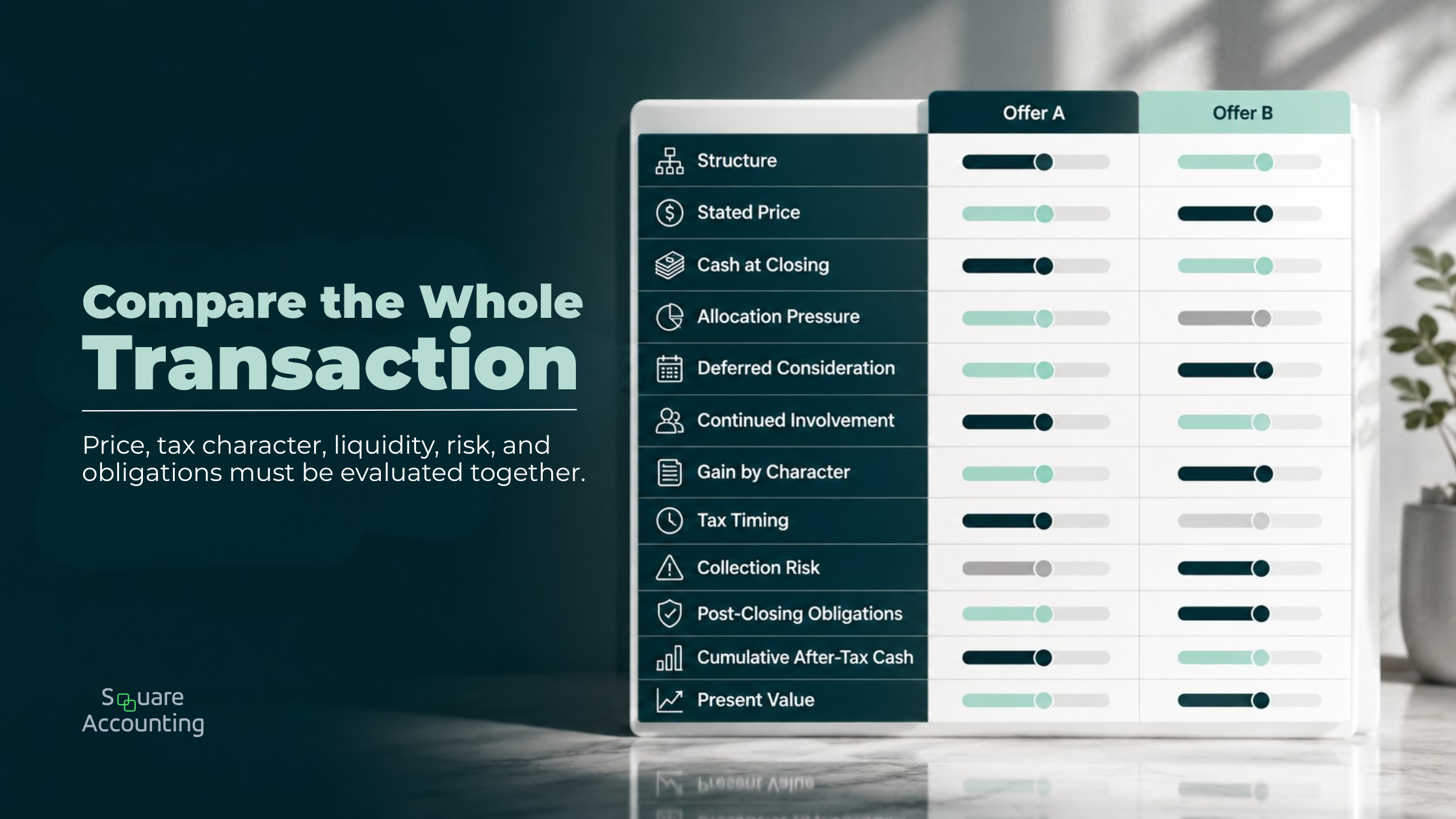
A defensible offer comparison carries each proposal through the same tax, cash-timing, and risk framework.
A defensible comparison should show, by year:
sale consideration and transaction expenses;
gain by character;
federal regular income tax and NIIT;
Florida corporate or transaction tax where applicable;
principal, interest, and compensation received;
tax due before deferred cash is collected;
probability-adjusted earnout or note collections;
post-closing service, indemnity, and restrictive-covenant obligations; and
cumulative after-tax cash and present value.
Offer A may have the larger headline price but a heavier first-year ordinary-income burden and more collection risk. Offer B may deliver more immediate liquidity but less total consideration or a different NIIT result. The answer comes from the integrated model, not the transaction label.
If you are comparing proposed terms, a Business Tax Planning Review can test the structure, allocation, payment schedule, and tax-to-cash timing before the agreement fixes them.
A Business Tax Planning Review can compare structure, allocation, payment timing, and after-tax liquidity across the terms you are considering.
The last practical decision points occur before closing
Before accepting a letter of intent
Confirm the federal tax classification, legal seller, stock or outside basis, fixed-asset history, and major ordinary-income exposures. Decide what minimum after-tax cash and closing liquidity the owner requires. If structure is economically material, the letter of intent should not leave it as an afterthought.
During purchase-agreement negotiations
Model asset and equity alternatives that the parties are actually willing and legally able to execute. Reconcile the proposed allocation with valuation support. Separate purchase price from interest, compensation, rent, licensing, and restrictive covenants. Connect the payment schedule with current-year recapture, inventory income, NIIT, estimated taxes, and reserves.
Before signing the definitive agreement
Confirm that the agreement, allocation schedule, note, closing statement, and tax model describe the same transaction. Identify who will prepare Form 8594 information, how later consideration adjustments will be handled, which liabilities transfer, and what records each party must provide after closing.
This sequence is professional planning judgment, not a statutory three-step deadline. Its value is practical: once the parties sign binding economic terms, changing structure or allocation can become expensive, contentious, or impossible.
Common modeling failures
Applying one rate to the purchase price
Purchase price is not gain, and gain character is not uniform. This shortcut ignores basis, liability relief, expenses, allocation, Section 1231 treatment, recapture, NIIT, and entity-level tax.
Treating accounting equity as tax basis
Book capital and tax basis serve different purposes. Shareholder basis, partnership outside basis, and adjusted asset basis must be supported from tax records.
Negotiating allocation after the price is fixed
Allocation changes the economics for both parties. Deferring that discussion can turn a tax issue into a late-stage price dispute.
Assuming seller financing defers the entire tax bill
Inventory income, recapture, interest, and losses do not follow the same timing as eligible installment gain.
Separating the spreadsheet from the legal documents
A favorable model is not useful if the signed agreement assigns consideration, liabilities, services, or payment rights differently.
Model capital gains tax before selling a Florida business
Capital gains tax when selling a business in Florida cannot be determined from the purchase price or residency alone. The result follows the seller’s federal classification, the assets or equity transferred, adjusted basis, purchase-price allocation, prior deductions, NIIT treatment, and the timing and reliability of payment.
The best pre-sale model answers four questions: who recognizes each item, what character it has, when the tax is due, and when the seller receives usable cash. That gives the owner and transaction attorney a common economic map while the material terms can still be negotiated.
For owners evaluating a letter of intent or proposed purchase agreement, a Business Tax Planning Review can compare the transaction’s structure, allocation, payment timing, and after-tax liquidity before those choices become difficult to change.
For owners evaluating a letter of intent or proposed agreement, we can compare the structure, allocation, payment schedule, and after-tax liquidity.
Transaction planning
Business Sale Modeling FAQs
Key questions to resolve when comparing deal structure, payment terms, supporting records, and multistate exposure before signing.
What must be clarified if a buyer proposes to “buy the LLC”?
The proposal must identify what the buyer will acquire and who will be treated as the seller. An LLC can be disregarded, taxed as a partnership, or taxed as a corporation, and the transaction might transfer assets or an ownership interest. The model should therefore confirm the federal classification, legal seller, relevant basis, liabilities, and any unrealized receivables or inventory. Until those facts are resolved, the phrase “LLC sale” does not provide enough information to determine who recognizes the transaction or how its components should be classified.
How should consulting, employment, lease, and noncompete agreements
be treated in the sale model?
These agreements should be analyzed separately from the stated purchase price. Payments may represent compensation, rent, royalties, interest, covenant value, or sale consideration, depending on the agreement and its economic substance. The model should assign each payment to the appropriate category and reflect its timing rather than treating every dollar as gain from selling the business. The purchase agreement, allocation schedule, and related agreements should also use consistent amounts and descriptions so the tax model reflects the transaction the parties actually sign.
What records are needed to compare proposed business-sale offers?
A reliable comparison requires tax records that support ownership basis, asset basis, prior deductions, liabilities, and the proposed allocation. The working file should include stock-basis or outside-basis schedules, fixed-asset and tax-depreciation records, acquired-intangible schedules, receivable and inventory details, and relevant entity elections or ownership changes. It should also identify liabilities the buyer may assume, proposed asset values, and transaction expenses. Accounting equity alone cannot replace these records because book capital, ownership basis, and adjusted asset basis serve different purposes in the sale analysis.
How can depreciation claimed in earlier years affect the choice
between offers?
Prior depreciation can change both adjusted basis and the character of gain recognized when depreciated property is sold. Accelerated deductions may have improved cash flow while the business operated, but the resulting lower basis and potential recapture can reshape the exit-year result. This becomes especially relevant when an asset offer assigns substantial value to equipment, vehicles, furniture, or previously amortized intangibles. The seller should compare that allocation with the cash available at closing because recapture may be recognized in the sale year even when part of the consideration is deferred.
What should a seller evaluate before accepting a buyer’s promissory
note?
The seller should connect the note’s payment schedule with the transaction’s tax-recognition schedule and post-closing cash needs. Eligible gain may be recognized as principal is collected, while inventory income and depreciation recapture generally remain sale-year items. Interest is analyzed separately from sale gain. The model should therefore consider the down payment, note security, interest rate, buyer covenants, expected payment dates, estimated-tax dates, and the risk that deferred amounts are not collected. A written obligation signed or delivered in Florida may also require documentary stamp tax analysis.
When should a Florida business owner review another state’s potential
tax position?
Another state’s position should be reviewed when the transaction includes material facts outside Florida. Florida residence alone does not resolve how another state may view the seller, business operations, or property being transferred. Relevant facts can include property, payroll, customers, entity operations, the owner’s residence history, and whether the transaction transfers assets or an ownership interest. This review belongs in the pre-signing model because the deal structure and legal seller may affect which state-specific questions require analysis. Florida’s individual no-tax rule does not settle those multistate issues.
How should later changes to the purchase price be coordinated?
The agreement should establish how later consideration changes will be handled and who will prepare the related allocation information. In an applicable asset acquisition, a change after the initial transaction year can require supplemental reporting. The tax model should therefore remain consistent with the purchase agreement, allocation schedule, closing statement, seller note, and any later adjustment. The parties should also identify which records each side must provide after closing. This coordination helps preserve a common description of the transaction when an earnout, adjustment, or other deferred amount changes the original consideration.