
Capital Gains Tax for Florida Residents in 2026: Rates, Brackets, and Pre-Sale Planning
Florida does not impose an individual income tax on capital gains. For a Florida resident selling in 2026, the main exposure is usually federal: regular net long-term capital gain falls into 0%, 15%, or 20% bands based on filing status and taxable income; short-term net gain is taxed at ordinary rates as high as 37%; and the 3.8% Net Investment Income Tax may also apply. A multistate or corporate fact pattern can add another layer.
The bracket table alone cannot determine the bill. A rental property, closely held business, former home, or concentrated stock position can produce several kinds of income with different rules. Before a trade, contract, or closing becomes difficult to change, establish adjusted basis, classify the gain, model the full-year income stack, test NIIT, identify asset-specific deadlines, and reserve cash for payment. Authorities and thresholds below were reviewed through August 19, 2026.

A reliable pre-sale model connects the transaction’s tax layers to its timing, documentation, and liquidity consequences.
“A 2026 sale can move through several tax layers before the final liability and available liquidity are known. The visual maps the decisions that should be coordinated before the transaction terms become difficult to change.”
Key takeaways
Florida's individual no-tax rule does not remove federal capital-gain tax, NIIT, entity-level tax, or another state's possible claim.
The 0%, 15%, and 20% long-term rates apply by layer. Ordinary taxable income generally fills the lower bands before regular long-term gain and qualified dividends.
Proceeds are not gain. Basis, selling costs, liabilities, depreciation, prior exchanges, and entity records can materially change the recognized amount and its character.
The useful planning window depends on the asset. Securities decisions may remain open until trade execution, while a Section 1031 exchange generally requires the structure and qualified intermediary to be in place before the seller receives proceeds.
A lower modeled liability is incomplete unless the seller also knows when the tax must be paid and how much sale liquidity remains available.
Florida capital gains tax in 2026: the federal bracket table
For individuals, Florida's Constitution restricts an income tax on natural persons, so Florida does not impose a separate individual capital-gains tax. The federal regular long-term capital-gain thresholds for 2026 are set by IRS Revenue Procedure 2025-32, Section 4.03
Taxable income thresholds
Capital Gain Rate Thresholds by Filing Status
The applicable capital gain rate depends on filing status and the taxpayer’s total taxable income, not solely on the amount of the gain.
| Filing status | 0% band Ends at taxable income of | 15% band Ends at taxable income of | 20% band Begins above |
|---|---|---|---|
| Single | $49,450 | $545,500 | $545,500 |
| Married filing jointly or qualifying surviving spouse | $98,900 | $613,700 | $613,700 |
| Married filing separately | $49,450 | $306,850 | $306,850 |
| Head of household | $66,200 | $579,600 | $579,600 |
These are taxable-income thresholds, not gain limits. Regular net long-term capital gain and qualified dividends occupy the remaining space in each preferential band after ordinary taxable income. Capital losses and special-rate gain categories can change the computation. IRS Topic 409 explains the general netting and maximum-rate framework.
The same $300,000 gain can produce a different federal capital-gains bill
Assume a married couple filing jointly has a $300,000 regular net long-term capital gain in 2026. The illustration excludes NIIT, special-rate gain, capital losses, deductions that change between scenarios, and other tax interactions.
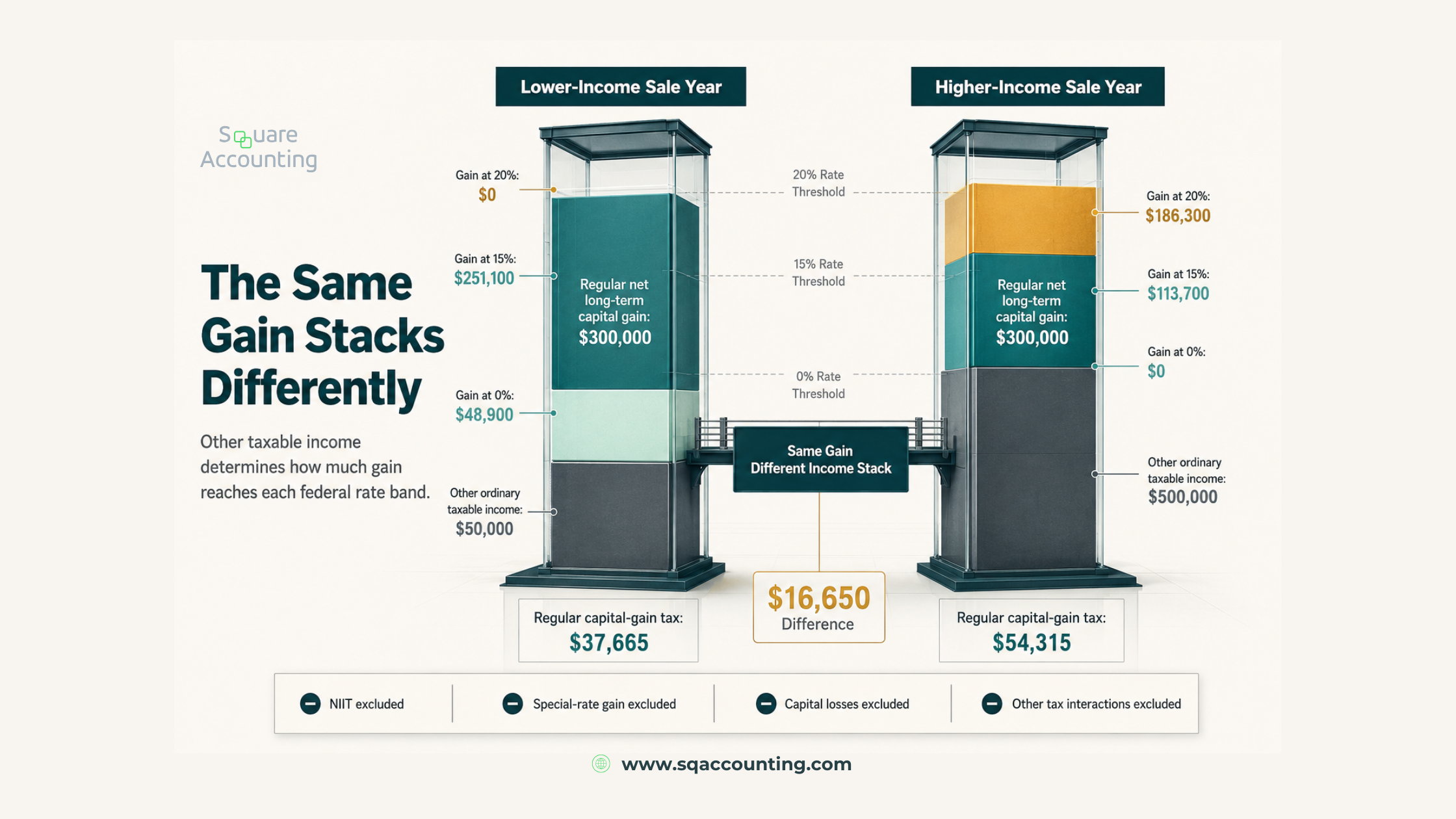
The same gain can produce a different federal result when ordinary taxable income consumes more of the preferential-rate bands.
“The gain does not enter the federal rate bands in isolation. Ordinary taxable income fills the lower layers first, changing how much of the same gain reaches the 15% and 20% bands.”
Illustrative sale-year comparison
The Same Gain Can Produce a Different Tax Result
An identical $300,000 long-term capital gain can be allocated across different rate bands depending on the other taxable income recognized during the sale year.
| Assumption | Lower-income sale year | Higher-income sale year |
|---|---|---|
| Other ordinary taxable income | $50,000 | $500,000 |
| Regular net long-term capital gain | $300,000 | $300,000 |
| Gain taxed at 0% | $48,900 | $0 |
| Gain taxed at 15% | $251,100 | $113,700 |
| Gain taxed at 20% | $0 | $186,300 |
| Federal regular capital-gain tax | $37,665 | $54,315 |
The $16,650 difference arises from income stacking, not from a change in the gain itself. That is why the sale year can matter when income, deductions, qualified dividends, or another transaction can legitimately move between years. It does not follow that delaying a sale is always better. Market risk, buyer terms, financing, and non-tax objectives still control the decision.
See how pre-sale advisory differs from return preparation when material sale decisions remain open.
Calculate basis and gain character before applying a rate
The starting calculation is:
Selling price and other consideration, including liabilities from which the seller is relieved when applicable, minus selling expenses, minus adjusted basis equals realized gain or loss.
Recognized gain can differ from realized gain when an exclusion, deferral rule, or nonrecognition provision applies. IRS Publication 551 explains basis and basis adjustments, while IRS Publication 544 addresses dispositions, amount realized, selling expenses, and business-property character.
A defensible basis file may require purchase records, capital-improvement invoices, depreciation schedules, inherited-property valuations, gift-basis records, prior exchange documents, partnership or S corporation basis schedules, and closing statements. The relevant file depends on the asset. Estimates assembled after closing can be difficult to substantiate and can conceal character issues.
The holding period is only one part of classification. Under the general federal rule, property held for more than one year is long term; property held for one year or less is short term. Different components can then follow different maximum rates or ordinary-income rules:
Capital gain character
Federal Treatment by Gain Component
A transaction may contain several gain components. Each component should be classified separately before applying a federal tax rate or evaluating the planning opportunity.
| Component | General federal treatment | Planning implication |
|---|---|---|
| Regular net long-term capital gain | 0%, 15%, or 20% bands | Model with ordinary income and qualified dividends |
| Net short-term capital gain | Ordinary income rates, up to 37% in 2026 | A holding-period date can matter, but investment risk remains |
| Collectibles gain and certain Section 1202 gain | Maximum 28% rate | Do not place it automatically in the regular 20% band |
| Unrecaptured Section 1250 gain | Maximum 25% rate | Separate depreciation-attributable real-property gain from regular long-term gain |
| Section 1245 or applicable Section 1250 recapture | Ordinary income to the extent required | A long holding period does not convert every component to preferential gain |
The word “maximum” matters. Netting, taxable income, and the interaction among rate groups determine the actual result. A single blended percentage applied to gross proceeds is not a reliable estimate.
Identify which basis, character, income-stacking, and NIIT questions may require coordinated review before the proposed sale.
When the 3.8% Net Investment Income Tax changes the result
NIIT is a separate federal calculation. It equals 3.8% of the lesser of net investment income or the excess of modified adjusted gross income over the applicable threshold. The statutory thresholds are $200,000 for single and head-of-household filers, $250,000 for married couples filing jointly and qualifying surviving spouses, and $125,000 for married individuals filing separately. The IRS NIIT guidance identifies capital gains as a common component of net investment income.
The capital-gain bands and NIIT therefore answer different questions. A taxpayer can have gain in a regular 15% capital-gain band and still owe NIIT, or reach the 20% band without every dollar of gain being subject to NIIT. Model both computations rather than adding 3.8 percentage points to the entire gain.
Entity-interest sales require particular care. Under Treasury Regulation Section 1.1411-4, gain from property outside a qualifying nonpassive trade or business generally enters net investment income. The current Form 8960 instructions generally include gain on a partnership or S corporation interest, then provide a possible adjustment procedure when the seller materially participated in the entity's trade or business. Material participation should not be treated as an automatic exemption.
What changes based on the asset being sold?
Asset type controls both the tax mechanics and the last useful planning point. The checkpoints below are professional planning guideposts, not universal statutory deadlines.
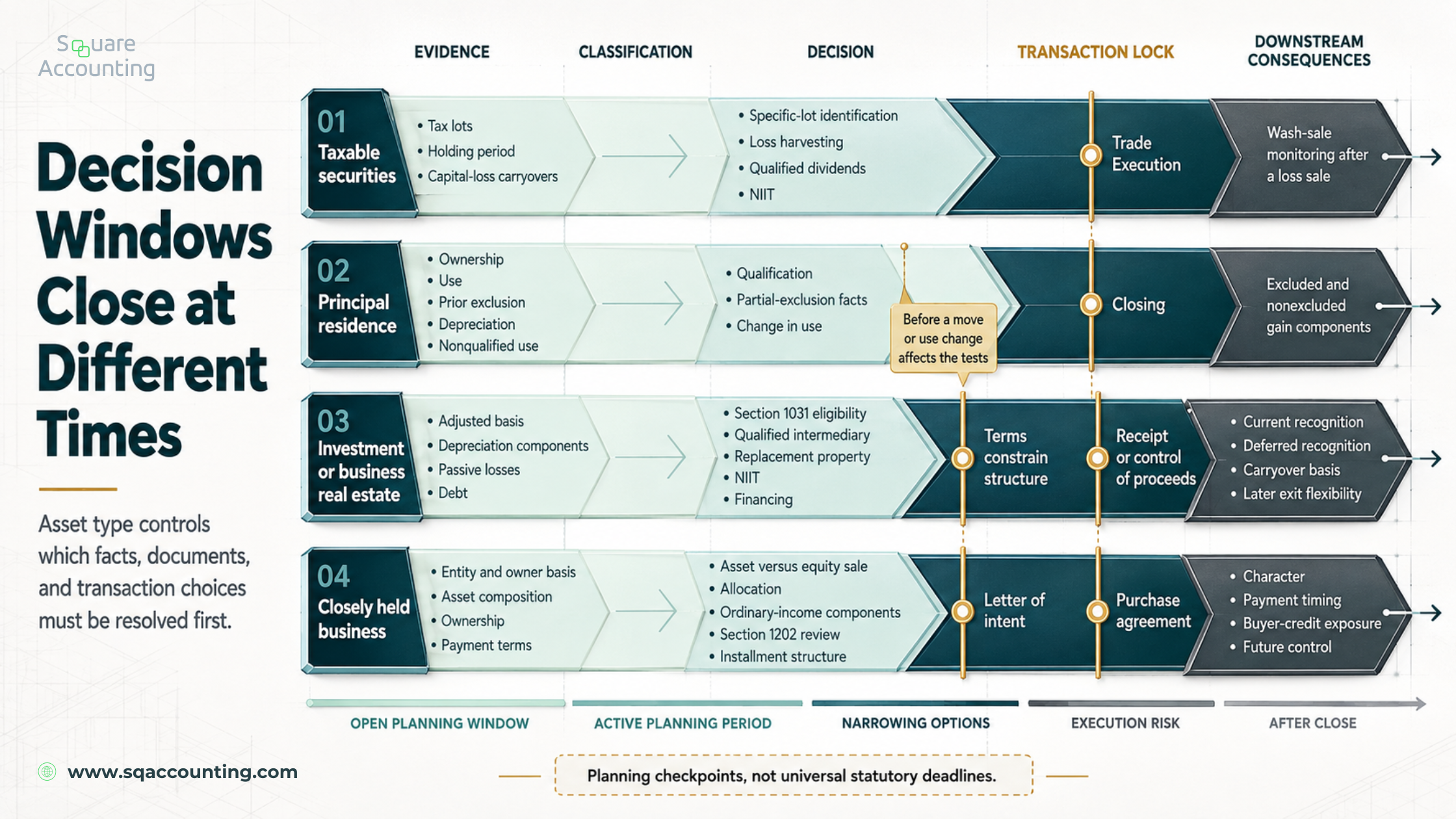
The last useful planning point depends on the asset, the transaction structure, and when control of the terms or proceeds changes.
“Asset type changes more than the applicable tax rule. It also determines which decisions remain reversible as the transaction moves toward execution, contract, or closing.”
Transaction planning windows
Planning Questions by Asset Type
Each asset creates a different set of tax questions and a different point at which planning options may begin to narrow.
| Asset | Questions to resolve | Last practical planning point |
|---|---|---|
| Taxable securities | Holding period, tax lots, capital-loss carryovers, wash sales, qualified dividends, NIIT | Before trade execution, with wash-sale monitoring extending 30 days after a loss sale |
| Principal residence | Ownership and use, prior exclusion, depreciation, nonqualified use, partial-exclusion facts | Before closing, and preferably before a change in use or move that affects the tests |
| Investment or business real estate | Adjusted basis, depreciation components, passive losses, debt, Section 1031 eligibility, NIIT | Before signing terms that constrain structure and before any receipt of exchange proceeds |
| Closely held business | Asset versus equity sale, allocation, entity and owner basis, ordinary-income components, Section 1202, payment terms | Before the letter of intent or purchase agreement fixes economics and tax-sensitive terms |
Taxable securities
Specific-lot identification can change both the amount and holding period of the shares sold. Loss harvesting can offset gains, but replacement purchases made within 30 days before or after a loss sale can trigger the wash-sale rule. IRS Publication 550 covers specific identification, capital-loss netting, carryovers, and wash sales.
Planning should also account for qualified dividends and other positions expected to be sold in the same year. Accelerating a loss solely for tax reasons can increase concentration or market risk elsewhere, so the tax result belongs inside the investment decision rather than above it.
Principal residence
Internal Revenue Code Section 121 can exclude up to $250,000 of qualifying gain, or up to $500,000 for certain married couples filing jointly. The general framework requires two years of ownership and use during the five-year period ending on the sale date, plus a lookback that generally prevents use of the exclusion more than once in two years. Joint-return qualification has additional requirements, and specified changes in employment, health, or unforeseen circumstances can support a reduced exclusion.
The exclusion is not a blanket rule for every home-related dollar. Depreciation allowed or allowable for business or rental use after May 6, 1997 generally cannot be excluded, and periods of nonqualified use can reduce the excludable amount. IRS Publication 523 provides the current eligibility tests, exceptions, worksheets, and reporting procedures.
Investment or business real estate
Real-estate gain may include regular long-term gain, ordinary-income recapture, and unrecaptured Section 1250 gain taxed at a maximum 25% rate. A property can also carry suspended passive losses. Otherwise allowable suspended losses generally are released under the passive-loss rules only when the taxpayer disposes of the entire interest in the activity in a fully taxable transaction to an unrelated person. Basis and at-risk limits can still matter. Grouping, a partial disposition, installment reporting, a gift, or a transfer at death can alter the result. See IRS Publication 925.
NIIT requires its own real-estate analysis. Real-estate-professional status under the passive-activity rules should not be treated as a blanket NIIT exclusion. Treasury Regulation Section 1.1411-4 provides a rental-real-estate safe harbor and also permits a trade-or-business conclusion outside the safe harbor when the facts support it.
A Section 1031 exchange can defer recognized gain on qualifying real property held for investment or productive use in a trade or business. It does not eliminate the gain. Property held primarily for sale does not qualify, and cash or other non-like-kind property can cause current recognition. In a deferred exchange, replacement property generally must be identified in writing within 45 days and received by the earlier of 180 days after transfer or the due date, including extensions, of the transfer-year return. A qualified intermediary is commonly used so the taxpayer does not actually or constructively receive the proceeds. The replacement property's basis generally carries the deferred gain forward. See the IRS real-estate exchange guidance, Treasury Regulation Section 1.1031(k)-1, and Form 8824 instructions.
The practical question is broader than whether an exchange is technically available. The seller must decide whether suitable replacement property, financing, diversification, basis carryover, and future exit flexibility justify the constraints. Our related guides explain depreciation-related gain, Florida landlord exit planning, and Section 1031 portfolio strategy.
Closely held business
A business sale is not automatically one capital-gain event. In an asset sale, the consideration generally must be allocated among the transferred assets, and each asset's character follows its own rules. Inventory, receivables, depreciation recapture, goodwill, and other assets may not produce the same result. In a partnership-interest sale, amounts attributable to unrealized receivables and certain inventory items can be ordinary income even though the remaining interest gain is generally capital. IRS Publication 544, IRS Publication 541, and the Form 8594 instructions address these classifications and allocations.
Equity-sale treatment depends on entity type, elections, basis, and the contract. Potential qualified-small-business-stock treatment under Section 1202 is acquisition-date-sensitive and fact-intensive, particularly after the 2025 statutory amendments. It warrants a separate eligibility review rather than a closing-week assumption.
If price is paid over time, Section 453 installment reporting may defer eligible gain as payments are received. It does not generally defer depreciation recapture, does not apply to every asset or seller, treats stated or imputed interest separately, and exposes the seller to buyer-credit and collection risk. IRS Publication 537 provides the current mechanics and exceptions.
A six-step planning sequence before a 2026 sale
The differentiated planning decision is not “Which tactic should I use?” It is “Which facts are still controllable, which rules apply to this asset, and what do I give up by changing the transaction?”
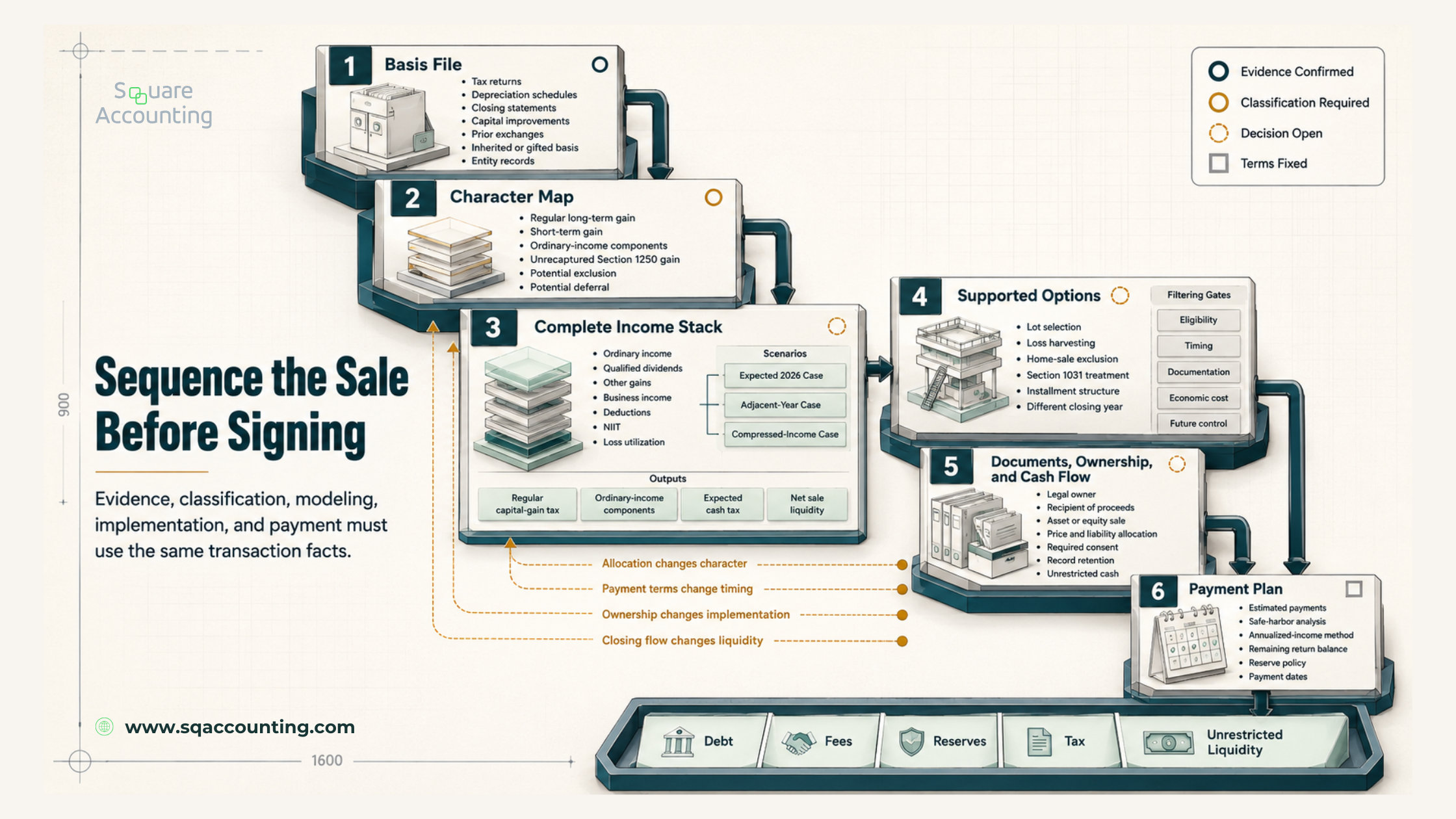
Pre-sale planning becomes more reliable when the evidence, tax model, legal terms, and payment plan describe the same transaction.
“The sequence matters because later decisions depend on the evidence and classifications established earlier. If ownership, payment terms, or transaction documents change, the character, income-stack, and liquidity models may also need to change.”
1. Build the basis file before negotiating from a tax estimate
Reconcile tax returns, depreciation schedules, closing statements, improvements, prior exchanges, inherited or gifted basis, and entity records. Flag missing support early enough to retrieve it. A large difference between economic cost and tax basis can change both the modeled liability and the negotiation strategy.
2. Create a character map
Break the projected gain into regular long-term gain, short-term gain, ordinary-income components, unrecaptured Section 1250 gain, potential exclusion, and potential deferral. Then identify the authority and facts supporting each classification. This prevents a favorable headline rate from being applied to components that do not qualify.
3. Model the complete income stack
Use at least three cases:
The expected 2026 sale and income profile.
A plausible adjacent-year case if timing is genuinely flexible.
A compressed-income case that includes other planned gains, qualified dividends, bonuses, business income, and deductions.
For each case, compute regular capital-gain tax, NIIT, ordinary-income components, loss utilization, expected cash tax, and net sale liquidity. If a strategy merely shifts tax to a later year, label it deferral rather than savings.
4. Compare only the options the asset and transaction support
The relevant set may include lot selection, loss harvesting, a qualifying home-sale exclusion, Section 1031 treatment, an installment structure, or a different closing year. Each option has its own eligibility, timing, documentation, economic cost, and effect on future control. Eliminate an option when the facts do not satisfy the rule or when its non-tax cost outweighs the modeled benefit.
5. Align tax mechanics with documents, ownership, and cash flow
Tax planning can fail when the return model assumes terms that the contract, entity documents, debt payoff, or closing flow does not deliver. Before signing, reconcile:
who owns the asset and who receives the proceeds;
whether the contract is an asset sale, equity sale, exchange, or installment obligation;
how price and liabilities are allocated;
whether lender, spouse, partner, trustee, or qualified-intermediary consent is needed;
what records must be retained; and
how much unrestricted cash remains after debt, fees, reserves, and tax.
As a planning matter, a proposed ownership change should be tested separately for income, gift, estate, governance, creditor, financing, and control effects. It should not be added solely to improve a capital-gain model. For the broader interaction, see our guide to ownership structure and succession planning.
We can examine whether the modeled tax treatment, ownership, transaction documents, and cash flow are aligned before terms are fixed.
6. Plan the payment, not just the liability
For 2026, an individual generally needs estimated payments if the expected balance due after withholding and refundable credits is at least $1,000 and those prepayments are less than the smaller of 90% of current-year tax or 100% of prior-year tax. The prior-year percentage generally becomes 110% when prior-year adjusted gross income exceeded $150,000, or $75,000 for married filing separately. Special rules apply, including for farmers and fishers. The annualized-income installment method may reduce an underpayment charge when a large gain occurs unevenly during the year. IRS Publication 505 for 2026 explains the tests and Form 2210 procedure.
Meeting a prior-year safe harbor can avoid an underpayment penalty without covering the final 2026 liability. The remaining amount can still be due with the return, so reserve policy and expected payment dates belong in the sale model.
If you are evaluating a material 2026 sale, request an Investment Tax Assessment to clarify basis, gain character, NIIT, remaining decision windows, and the cash required for tax before transaction terms become difficult to change.
We can examine basis, gain character, NIIT, remaining decision windows, and payment timing for the proposed 2026 sale.
How Florida changes the analysis
Florida's main individual-level effect is the absence of a separate state individual income tax, supported by Article VII, Section 5 of the Florida Constitution. That can make the federal model more prominent, but it does not erase federal capital-gain tax or NIIT, and it does not resolve separate entity or transaction obligations.
The individual answer should not be extended to every entity. Florida imposes a corporate income or franchise tax on corporations and entities taxed federally as corporations, subject to the state's rules and modifications. A sale inside a corporation can therefore produce a different Florida result from an individual sale. See the Florida Department of Revenue corporate-income-tax guidance.
Multistate exposure is a separate factual inquiry. As a planning caution, a Florida address should not be treated as proof that another state lacks a claim when the asset, business activity, or residency history connects to that state. Before closing, identify every jurisdiction with a plausible connection and obtain state-specific sourcing and residency analysis.
Where pre-sale planning most often fails
Capital gain planning controls
Common Planning Failure Modes
These errors often arise when a transaction is modeled too narrowly or after the relevant decision window has already begun to close.
| Failure mode | Why it matters | Corrective decision |
|---|---|---|
| Applying one rate to gross proceeds or total gain | Basis, netting, rate stacking, NIIT, and special character are lost | Build the basis and character map first |
| Treating every long-held component as regular long-term gain | Recapture, inventory, receivables, and special-rate gain can follow different rules | Classify each component under the asset-specific authority |
| Modeling the sale without the rest of the year | Qualified dividends, business income, bonuses, and other gains can consume lower bands or trigger NIIT | Run the complete income stack and alternate-year cases |
| Starting Section 1031 work after closing | Receipt or control of proceeds can defeat deferral, and statutory deadlines are short | Confirm eligibility, intermediary, and documents before proceeds are available |
| Assuming an installment note equals tax savings | Eligible gain may be deferred, while recapture and interest follow separate rules and buyer credit risk remains | Compare present value, collection risk, cash needs, and later-year rates |
| Counting on passive-loss release without testing the disposition | Partial, related-party, grouped, installment, gift, or death facts can delay or change use | Verify that the entire-interest and fully taxable unrelated-party conditions are met |
| Using a safe-harbor payment as the cash-tax estimate | Penalty protection can coexist with a substantial balance due | Separate payment timing, penalty protection, and final liability |
| Changing ownership solely for the sale | Gift, estate, governance, creditor, financing, and basis consequences can outweigh a projected rate benefit | Coordinate tax, legal, financing, and control objectives before transferring ownership |
The decision to make before you sign
For a Florida resident, the 2026 answer begins with no separate Florida individual capital-gains tax, but it ends with a transaction-specific federal model. Before committing to a sale, be able to answer five questions:
What is the supportable adjusted basis and realized gain?
Which portions are regular long-term gain, short-term gain, special-rate gain, ordinary income, excluded gain, or deferred gain?
How do taxable-income stacking and NIIT change the result under the expected and alternate-year facts?
Which elections, structures, documents, and deadlines remain open, and what economic flexibility would each option cost?
When will the tax be paid, and how much unrestricted liquidity will remain?
Those answers turn a rate lookup into a sale decision. If your current engagement is centered on return preparation, our explanation of tax preparation versus tax advisory can help identify the additional work a pre-sale analysis requires.
For a coordinated review of a material 2026 sale, request an Investment Tax Assessment. The immediate objective is to define the supportable gain, the rules that apply, the decisions that are still reversible, and the cash-flow consequence before the transaction controls the tax options.
We can help clarify the supportable gain, applicable classifications, remaining planning decisions, and expected liquidity for a material 2026 sale.
Transaction planning
Capital Gain Planning FAQs
These questions address basis, sale-year timing, deferral, passive losses, NIIT, ownership, and transaction documents before important terms become fixed.
What should be resolved if adjusted-basis records are incomplete
before a sale?
The projected gain should not be treated as reliable until the missing basis support is identified and the available records are reconciled. The relevant file depends on the asset and may include purchase and closing records, capital improvements, depreciation schedules, prior exchange documents, inherited or gifted basis information, and entity basis schedules. The decision value is in finding gaps while records can still be retrieved, not estimating them after closing. Missing support can affect both the amount of gain and whether parts of it receive different tax character.
How should a seller evaluate whether moving the sale into a
different year is worthwhile?
Compare the expected sale year with a plausible adjacent-year case using the complete income stack, not just the projected gain. The comparison should include ordinary income, qualified dividends, other gains, deductions, NIIT, ordinary-income components, loss utilization, cash tax, and net sale liquidity. A lower modeled tax for another year is only one input. Market risk, buyer terms, financing, and other non-tax objectives may make the timing change unattractive. If timing only shifts tax to a later year, the result should be described as deferral rather than savings.
Can a tax-deferral option be available but still be a poor fit for
the transaction?
Yes. Technical availability does not establish that a deferral option fits the seller’s economic objectives. A Section 1031 exchange can constrain replacement-property selection, financing, diversification, basis, and later exit flexibility. An installment structure can create buyer-credit and collection risk while treating recapture and interest separately. The comparison should therefore include documentation, control, cash needs, implementation requirements, and future options. A strategy that delays recognition but narrows the seller’s flexibility may be less suitable than a current sale with a known payment and liquidity plan.
Why must suspended passive losses and installment reporting be
reviewed together?
The sale structure can affect when otherwise allowable suspended passive losses are released. Full release under the passive-loss rules generally requires disposition of the entire interest in the activity through a fully taxable transaction to an unrelated person. Installment reporting can alter that result, as can grouping, a partial disposition, a gift, or a transfer at death. The seller should therefore avoid assuming that an installment note both defers gain and releases all suspended losses immediately. The transaction and loss-availability model need to use the same disposition facts.
Does appointing a qualified intermediary make a real estate sale
eligible for Section 1031?
No. A qualified intermediary addresses receipt and control of proceeds, but it does not establish that the relinquished and replacement properties or the seller’s use of them satisfy Section 1031. The transaction must still involve qualifying real property held for investment or productive use in a trade or business, and property held primarily for sale does not qualify. Identification, completion, documentation, boot, financing, and carryover-basis consequences also remain. Eligibility and implementation should be resolved before proceeds become available, rather than treating the intermediary as a cure for an otherwise nonqualifying transaction.
Why does material participation not settle the NIIT result by
itself?
NIIT uses a separate federal calculation and its own trade-or-business analysis. For a sale of a partnership or S corporation interest, gain generally enters net investment income, with a possible adjustment procedure when the seller materially participated. For rental real estate, real-estate-professional status is not a blanket NIIT exclusion; the applicable safe harbor and other supporting facts still matter. The seller should therefore model NIIT independently from capital-gain character and passive-activity status instead of assuming that one classification controls all three.
Should ownership be changed shortly before a sale to improve the
capital-gain result?
Not solely because one version of the capital-gain model appears more favorable. Ownership must be reconciled with who owns the asset, who receives the proceeds, the transaction documents, and the closing cash flow. A proposed change should also be tested separately for income, gift, estate, governance, creditor, financing, and control effects. The planning question is whether the ownership change supports the broader transaction and long-term objectives, not whether it improves one rate assumption while creating unmodeled consequences elsewhere.
Why can a business-sale estimate change after the purchase
agreement is drafted?
The agreement may fix whether the transaction is an asset or equity sale, how consideration and liabilities are allocated, and which parties receive the proceeds. Those terms can affect whether amounts are associated with inventory, receivables, depreciation recapture, goodwill, or other components that do not share one tax character. Entity type, basis, elections, payment terms, and potential Section 1202 treatment can also require separate review. The tax model and legal documents should therefore be reconciled before the agreement locks in economics that the original estimate did not assume.
Sources and review: Material federal and Florida claims are linked to the applicable statute, regulation, or current agency guidance in the text. Authorities were reviewed through August 19, 2026.
