
How to Know Whether a Tax Planning Relationship Is Worth It
Is tax planning worth it? A relationship is generally worth paying for when it improves material decisions while there is still time to change them—and when the expected value remains positive after advisory fees, implementation costs, future taxes, risk, and added complexity.
It may not be worth an ongoing fee when your facts are stable, consequential decisions are infrequent, or the service consists mainly of revisiting completed transactions during tax season.
That distinction matters for sophisticated taxpayers. A high tax bill, substantial net worth, or complex return may indicate that planning deserves attention, but it does not prove that a particular relationship is creating value. Many taxpayers have plenty of ideas. What they lack is a disciplined way to decide which deserve action, which should be rejected, and who owns the next step.
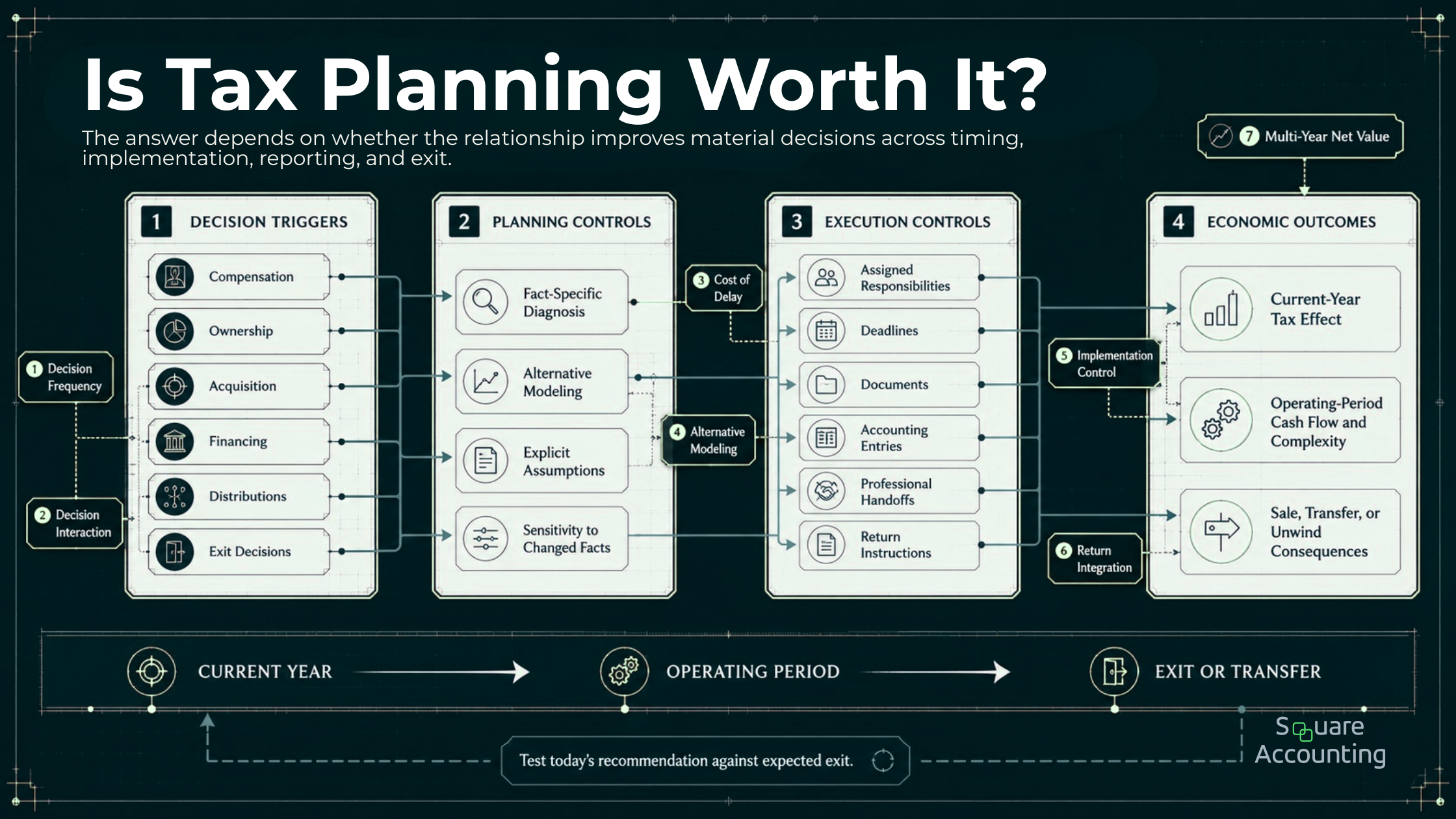
The value of a tax planning relationship is created through coordinated decisions that remain economically sound from the current year through an eventual exit or transfer.
“A tax planning relationship should be evaluated as a connected decision system. The strongest evidence of value appears when planning improves what happens before a decision, how it is implemented, where it reaches the return, and what it ultimately creates at exit.”
Key takeaways
The value of planning depends more on the decisions in front of you than on a universal income, net-worth, or tax threshold.
A projected deduction is not the same as current tax savings, and current tax savings are not necessarily the same as lifetime economic value.
A strong relationship compares alternatives, states its assumptions, assigns implementation responsibility, and connects the advice to the tax return.
Planning should be evaluated across the current year, the operating period, and an eventual sale, transfer, or unwind.
A well-supported recommendation to wait or take no action may be more valuable than implementing another structure.
Is tax planning worth it? Apply seven evidence tests
Before evaluating the advisor, ask whether your situation justifies an ongoing relationship. We look at three characteristics:
Decision frequency: How often do material compensation, ownership, acquisition, financing, distribution, or exit decisions arise?
Decision interaction: Does one choice change the result for an entity, property, owner, or another state?
Cost of delay: Would waiting make the decision more expensive, less flexible, or impossible to change?
When all three are limited, accurate preparation or a discrete project may be enough. As they increase, ongoing planning can become more useful—provided the advisor produces evidence of planning rather than a recurring idea list.
For a proposed relationship, apply the following tests to the promised scope and deliverables. For an existing relationship, apply them to what has actually happened.
Seven Tests of a Valuable Tax Advisory Relationship
A valuable planning relationship should improve decision timing, test recommendations against the taxpayer’s facts, model alternatives, control implementation, and evaluate results across multiple years.
| Test | What a Valuable Relationship Produces | Warning Sign |
|---|---|---|
| 1. Decision Timing | A forward calendar of events requiring review before action. | Planning begins after year-end or after documents are signed. |
| 2. Fact-Specific Diagnosis | Analysis of ownership, classification, income character, basis, participation, financing, state exposure, liquidity, and goals. | The recommendation could have been sent to almost any client. |
| 3. Alternative Modeling | A credible baseline, viable alternatives, explicit assumptions, and sensitivity to changed facts. | One strategy with no comparison or failure conditions. |
| 4. Net Economics | Separation of permanent savings, deferral, costs, future tax, burden, and risk. | A deduction multiplied by a tax rate is presented as the full value calculation. |
| 5. Implementation Control | Named owners, deadlines, documents, accounting entries, coordination, and return instructions. | Advice ends with a meeting or memo that no one owns. |
| 6. Multi-Year and Exit Review | Analysis of the current year, operating years, and a sale, transfer, conversion, or unwind. | The first-year result is treated as the final result. |
| 7. Accountability | Status reviews, documented decisions, monitored assumptions, and comparison of expected versus actual outcomes. | Success is described through anecdotes or theoretical savings. |
Not every year needs to produce a major tax reduction. It should produce a process that makes important decisions more informed, timely, implementable, and reviewable.
We can help you assess whether your current planning process is timely, specific, implementable, and accountable.
First define what you are actually buying
Many disappointing relationships begin with a scope mismatch. The taxpayer expects future decisions to be monitored; the professional believes the engagement covers preparation and occasional questions.
Both services can be valuable, but they are not interchangeable.
How to Measure Value Across Different Tax Engagements
Tax preparation, discrete planning projects, and ongoing advisory relationships serve different purposes. The appropriate evidence of value should match the scope and primary job of each engagement.
| Engagement | Primary Job | Appropriate Evidence of Value |
|---|---|---|
| Tax Preparation | Report completed activity accurately and satisfy filing obligations. | Correct filings, clear information requests, issue resolution, and reliable delivery. |
| Discrete Planning Project | Analyze a defined transaction, election, structure, or exposure. | A written conclusion, alternatives, assumptions, implementation steps, and consequences. |
| Ongoing Tax Planning Relationship | Monitor changing facts and coordinate a series of decisions over time. | A decision calendar, recurring projections, implementation tracking, return integration, and post-filing review. |
A preparation engagement has not failed because it excludes ongoing planning. The problem is an undefined boundary between compliance and advisory work.
Before evaluating the fee, read the engagement letter and clarify:
who is responsible for advice, review, implementation, and return preparation;
which entities, owners, transactions, and states are included;
what deliverables and meeting cadence are included;
what happens when a material decision arises between meetings;
whether return preparation is included; and
how advice will be handed to attorneys, bookkeepers, payroll providers, and other professionals.
This is consistent with Circular 230 section 10.33, which identifies clear engagement terms, relevant facts and reasonable assumptions, supported conclusions, and communication of consequences as best practices for federal tax advisors. IRS professional-responsibility guidance describes those practices as aspirational and encourages engagement agreements, regular communication, timely updates, and maintained records.
Credentials remain important, but they establish a professional baseline rather than the value of a particular relationship. Confirm that the responsible advisor has relevant experience with your mix of entities, income, real estate, transactions, and jurisdictions—and that this person will actually be involved in the work.
We can review where preparation ends, who owns implementation, and how planning should connect to your returns.
Measure net planning value, not advertised tax savings
A common way to overstate planning value is to compare a projected tax benefit only with the advisor’s fee.
A more complete framework is:
Expected net planning value = permanent tax reduction + economic value of deferral + credible costs or risks avoided + valuable options preserved − advisory fees − implementation costs − added constraints and complexity − expected future tax and exit costs
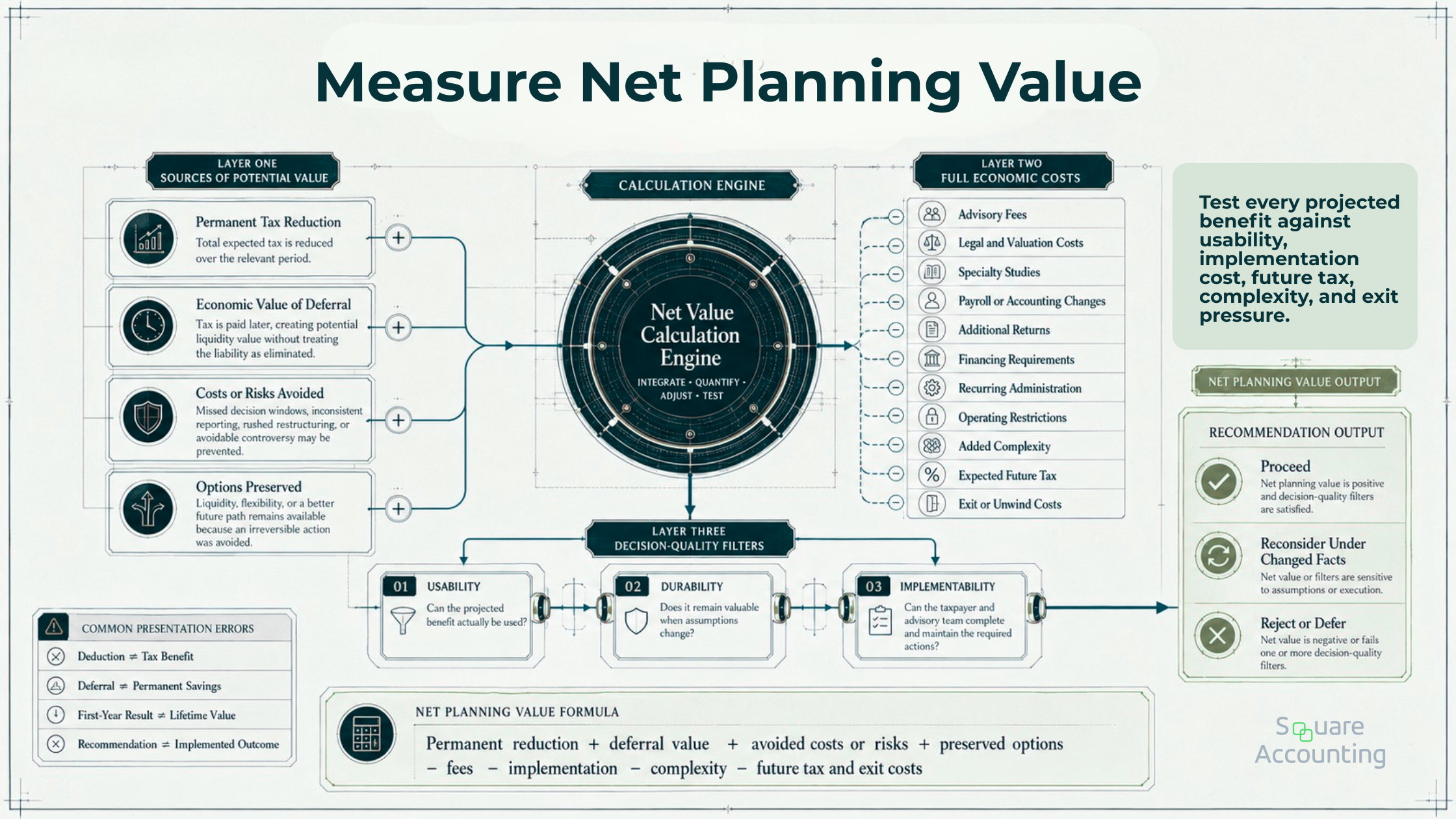
A credible value calculation distinguishes the type of benefit, counts the complete cost, and tests whether the result remains usable through exit.
“The framework is designed to prevent one attractive number from standing in for the entire decision. A strategy should remain compelling only after the benefit type, implementation burden, changed assumptions, future tax, and exit consequences have been considered together.”
Not every term can be measured precisely. The purpose is to stop one attractive number from standing in for the entire decision.
Separate four types of benefit
Permanent tax reduction changes the total tax expected over the relevant period. It is generally more valuable than shifting the same liability from one year to another.
Tax deferral can improve liquidity because tax is paid later, but the liability is not a permanent saving. Its value depends on duration, use of the retained cash, termination events, and unwind cost.
Avoided cost or reduced exposure may include preventing a missed decision window, inconsistent reporting, a rushed restructuring, or avoidable controversy. That value may not appear as a deduction.
Preserved option value keeps better paths open. Waiting for clearer facts, protecting liquidity, or avoiding an irreversible structure may be more valuable than maximizing the current-year result.
The recommendation should make clear whether it is expected to reduce tax, defer it, improve cash flow, reduce exposure, or preserve flexibility.
Count the complete cost
The advisory fee is only one cost. A recommendation may require legal documents, valuations, payroll changes, specialty studies, financing, additional returns, detailed bookkeeping, operating restrictions, or recurring administration. It may also consume liquidity or conflict with investment, control, succession, or financing objectives.
Compare the fully costed recommended path with the best realistic alternative. A weak baseline can make almost any strategy appear valuable.
Also watch for four common overstatements:
The amount of a deduction is presented as though it were the tax benefit.
The entire deferred liability is presented as though it were permanently eliminated.
A first-year benefit is projected to recur without confirming that the underlying facts will recur.
The advisor receives credit for a recommendation even though the client cannot or will not implement it.
A universal ROI multiple is usually a weak benchmark for tax planning. A relationship may be worthwhile with a modest measurable benefit if it prevents a materially worse decision. It may provide poor value despite a large first-year estimate when the benefit is unusable, fragile, expensive, or likely to create disproportionate exit pressure.
We can compare proposed business tax decisions across expected benefits, implementation costs, future taxes, and exit consequences.
Review every strategy across three time horizons
Sophisticated planning often breaks down because the analysis stops after the first favorable calculation.
Evaluate Tax Strategy Across the Full Planning Horizon
A tax recommendation should be tested across the current filing cycle, the operating period, and the eventual exit or transfer—not judged only by its first-year result.
| Horizon | What Should Be Evaluated | Questions Worth Asking |
|---|---|---|
| Current Year and Next Filing Cycle | Eligibility, timing, projected tax, required cash, elections, documentation, and immediate implementation. | Can the benefit be used now? What must happen before the decision window closes? Which assumptions drive the result? |
| Operating Period | Recurring tax effects, basis and other attributes, entity cash flows, payroll, administration, financing, and changes in income. | Does the strategy still work if income falls, ownership changes, or capital is needed elsewhere? What must be tracked each year? |
| Exit or Transfer | Sale, exchange, distribution, conversion, gift, succession, state sourcing, liquidity, and unwind costs. | What happens to basis, suspended attributes, deferred gain, depreciation, control, and after-tax proceeds? |
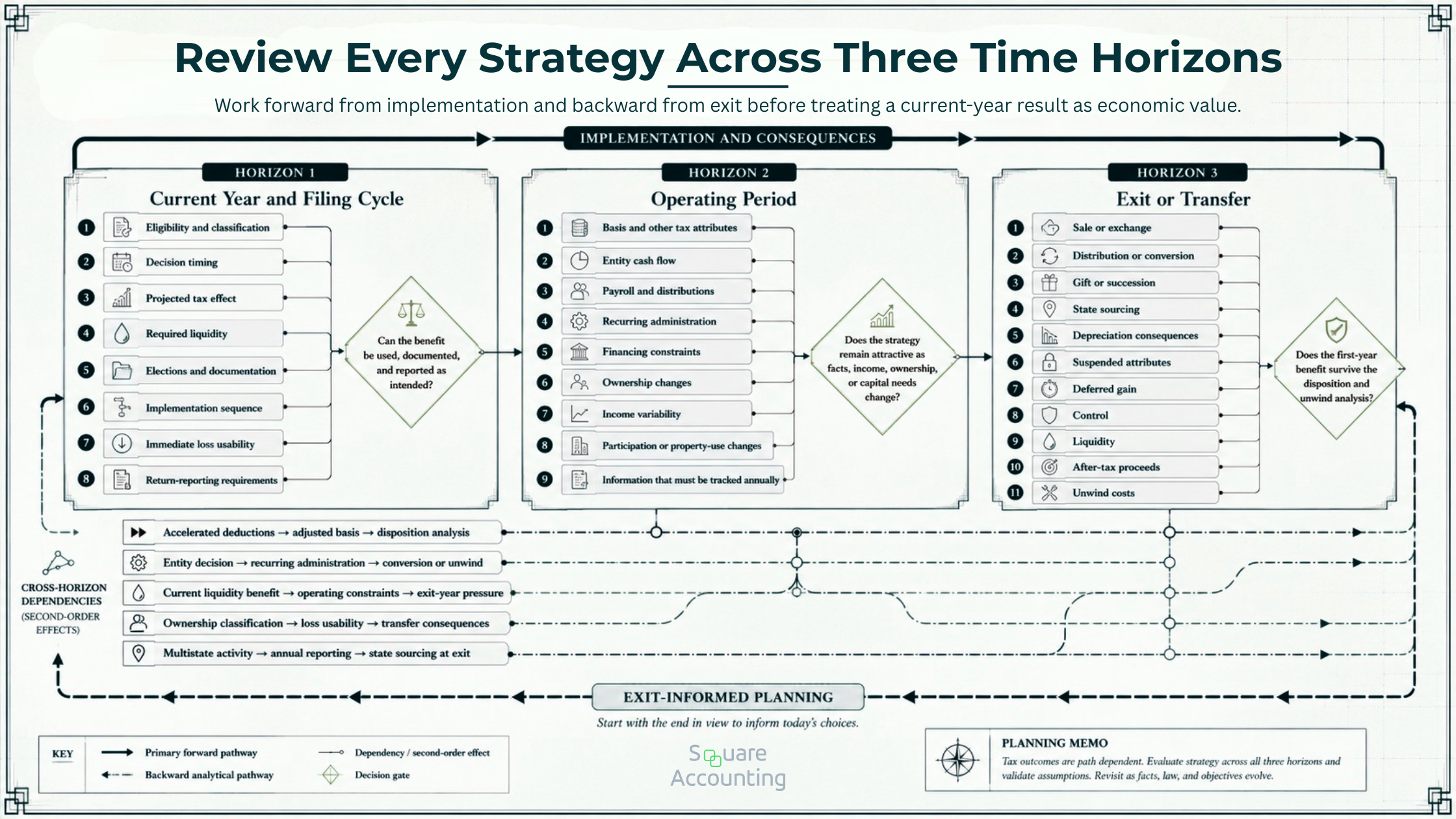
A strategy that appears favorable today should also withstand changes in income, ownership, financing, liquidity, and the eventual exit.
“The three horizons form one connected analysis rather than three separate forecasts. Decisions made in the current year can alter basis, liquidity, administration, reporting, and after-tax proceeds long after the initial benefit is recognized.”
A useful analysis works forward from today and backward from the expected exit. The first view identifies operating steps and cash consequences. The second tests whether the recommendation remains attractive when the asset, entity, or ownership position is sold, transferred, or unwound.
Sequence also matters. The advisor should identify dependencies, facts that must be established first, and actions that should wait for legal, financing, or operating constraints. A sound recommendation implemented in the wrong order may produce a different result.
The purpose is not to predict every future fact. It is to identify which facts matter, how the conclusion changes when they move, and the point at which the recommendation should be reconsidered.
The most common value leak is the advice-to-return gap
A technically sound recommendation creates limited value if it is implemented incompletely or never reaches the tax return.
We evaluate that risk through an advice-to-return chain:
The relevant facts are complete.
The activity, entity, transaction, or payment is classified appropriately.
Realistic alternatives are modeled using explicit assumptions.
The taxpayer makes an informed decision.
Legal, operational, payroll, and financial steps are completed in the required sequence.
The accounting records preserve the information needed for reporting.
The tax return reflects the intended treatment.
The filed result is reconciled to the planning estimate.
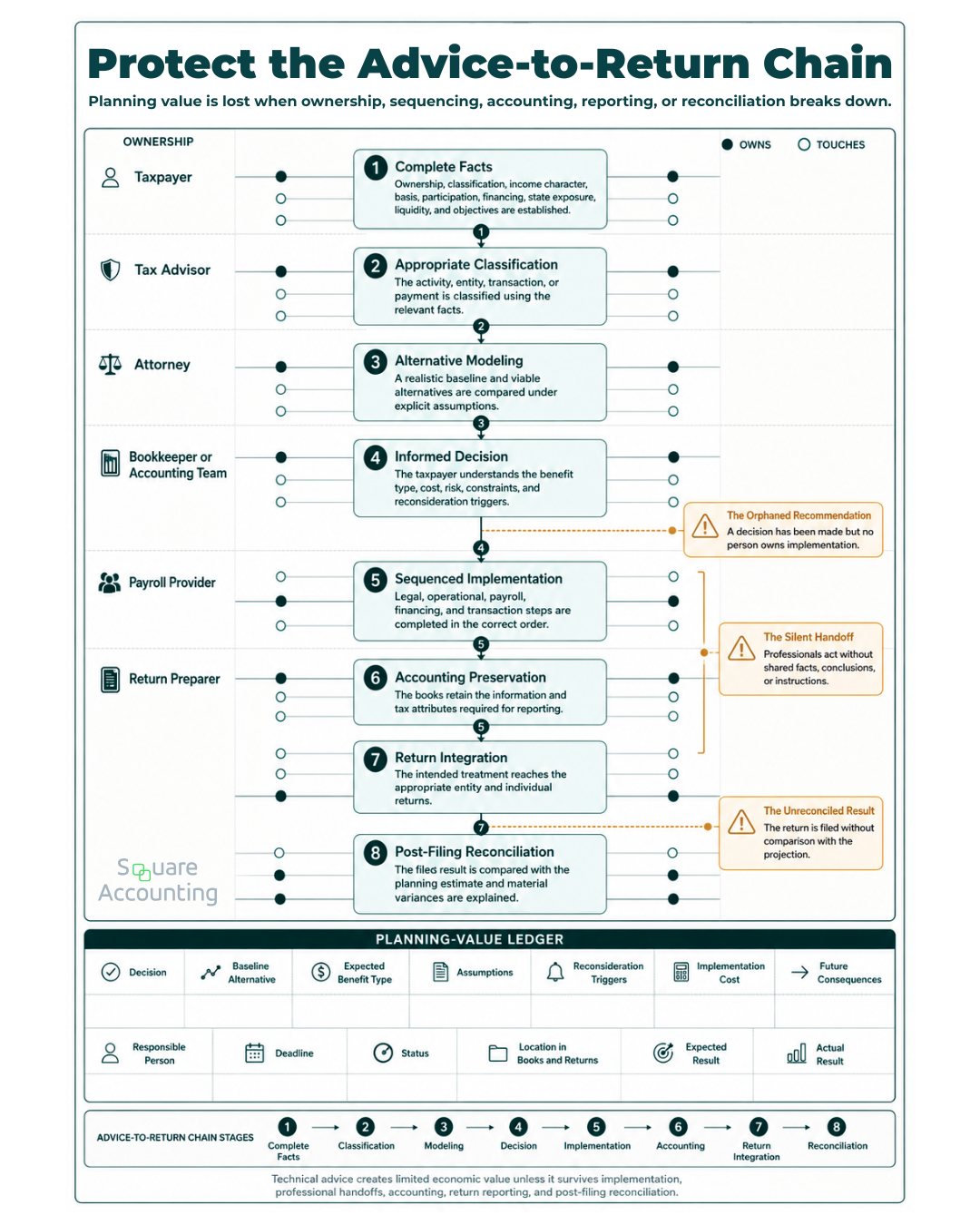
The advice-to-return chain exposes where a technically sound recommendation can lose value through incomplete execution, weak handoffs, or missing reconciliation.
“Each transition in the chain is both a handoff and a control point. Making responsibilities, assumptions, deadlines, reporting destinations, and actual results visible helps prevent theoretical planning value from disappearing during execution.”
Three failure modes deserve attention:
The orphaned recommendation: The advice is sound, but no one owns implementation.
The silent handoff: One professional acts without the facts and conclusions held by the others.
The unreconciled result: The return is filed without comparison to the projection or explanation of the variance.
This is why coordination is part of the relationship’s economic value rather than an administrative extra.
A useful control is a planning-value ledger. For each material recommendation, record:
the decision and baseline alternative;
the expected benefit type;
the assumptions and conditions that could change the conclusion;
implementation cost and future consequences;
the responsible person, deadline, and status;
where the result should appear in the books and returns; and
the actual outcome compared with the estimate.
When planning and preparation are separate, the ledger provides a written handoff. Without it, theoretical savings remain visible while incomplete actions, future costs, and abandoned recommendations disappear.
We can identify where planning may be losing value between analysis, implementation, accounting, and filing.
A real estate example: when a large first-year deduction is not enough
Consider an Orlando service-business owner who also owns a growing rental portfolio. After a property acquisition, an advisor recommends accelerated depreciation and presents a substantial first-year deduction.
The deduction may be supportable. It still does not establish whether the recommendation—or the relationship—is worth the cost.
One analysis might stop after estimating the deduction and applying an assumed tax rate. A more complete analysis would ask:
Is the resulting loss expected to be usable when generated, or could passive activity limitations defer it?
Are ownership, participation, basis, and at-risk facts consistent with the projected result?
How long is the property expected to be held?
How will accelerated depreciation affect adjusted basis and the disposition analysis?
What depreciation-recapture and asset-allocation issues could arise at exit?
What will the study, implementation, bookkeeping, and return reporting cost?
Who will maintain the component-level records needed for a later sale or exchange?
Does the recommendation remain attractive if taxable income, financing, property use, or the exit date changes?
The IRS explains in Publication 925 that passive activity losses can be disallowed in the current year and carried forward. Publication 544 addresses gain characterization and depreciation-recapture mechanics for dispositions of business property. Those interactions are why a projected deduction, current tax benefit, and lifetime economic benefit are not interchangeable.
The more complete analysis may still support accelerated depreciation. The difference is that the recommendation is built around loss usability, holding period, exit pressure, implementation, and alternative uses of cash—not the deduction alone.
It should also identify reconsideration triggers. A shorter holding period, changed use, reduced taxable income, different financing, or incomplete records may alter the economics even when the depreciation analysis remains valid.
We can examine loss usability, basis, holding period, recordkeeping, and exit pressure before an investment tax decision is implemented.
How to audit an existing tax planning relationship
If you already have a CPA or tax advisor, the first step does not have to be replacing that person. Start by making the current relationship visible.
Gather the engagement letter, recent recommendations, projections and assumptions, implementation records, filed returns, and relevant tax-attribute schedules. Then ask:
Which decisions are we monitoring before they become fixed? A useful answer identifies the transaction, decision window, responsible people, and information still needed.
What alternatives did we compare? Ask for the baseline and the strongest rejected option, not only the selected recommendation.
What part of the expected benefit is permanent, and what part is timing? The answer should separate reduction, deferral, cash flow, risk, and preserved flexibility.
What could make the recommendation wrong or no longer worthwhile? Look for explicit assumptions, sensitivity, and reconsideration triggers.
What are the operating and exit consequences? Ask about recurring administration, liquidity, basis, recapture, state exposure, control, and unwind costs where relevant.
Who owns implementation? Confirm who handles documents, payroll, accounting, elections, return reporting, and follow-up.
Where did the advice appear on the return? If it did not, determine whether that outcome was intentional, delayed, inapplicable, or missed.
How did the actual result compare with the estimate? Variances should be traceable to changed facts, assumptions, timing, or execution.
Do not judge the relationship by strategy count. Ask which decisions changed, which recommendations were rejected, which actions were completed, and what the returns reported.
The audit may support the current relationship, reveal that expectations need clarification, or show that a project scope or better coordination would fit. Generic verbal answers do not prove poor advice, but they make a complex relationship difficult to govern.
When ongoing tax planning may—or may not—be justified
Ongoing planning is more likely to be worthwhile when material decisions recur and interact. Multiple entities, variable income, significant real estate, multistate exposure, ownership changes, acquisitions, exits, and cross-advisor coordination can increase the value of continuity.
A discrete project may be more efficient when the question is narrow, facts are stable, implementation is handled internally, and continuing monitoring is unnecessary. Preparation may be sufficient when few decisions remain open.
The relationship may not justify its cost when:
another advisor or internal team already performs the same analysis and coordination;
recommendations remain generic after the advisor has the relevant facts;
advice repeatedly arrives after the decision window closes;
implementation is outside scope and no reliable handoff exists;
added structures create more cost, risk, or operational friction than plausible net value;
neither advisor nor client tracks whether recommendations were completed; or
the client is unwilling or unable to supply the information and actions the analysis requires.
Ongoing is not automatically better. The appropriate scope is often the least extensive relationship that can reliably address the decisions, dependencies, and monitoring needs.
A documented recommendation to take no action can also create value. Rejecting an attractive but unsuitable strategy may preserve liquidity, reduce risk, or avoid an expensive unwind. The relationship should be judged by decision quality rather than the number of structures implemented.
What Florida changes—and what it does not
Florida does not impose a personal income tax, according to the Florida Department of Revenue. That removes one layer from many resident projections, but it does not make planning simple.
For a Florida business owner, high-income professional, or real estate investor, the analysis may still involve:
federal income, employment, investment, estate, and transfer-tax interactions;
entity-level, transaction, property, sales, employment, or local taxes where applicable;
income, payroll, property, customers, or operations connected to other states;
residency transitions and continuing connections to a former state;
property acquisitions, short-term rentals, development, financing, and exits; and
coordination among Florida entities and owners, employees, customers, or assets located elsewhere.
When a move to Florida intersects with income, business activity, property, or continuing connections in another state, the timing and documentation should be reviewed under each relevant state’s rules.
Local access may help an Orlando or Florida-based relationship, but expertise, accountability, and coordination matter more than proximity. If an advisor is presented as a Florida CPA, the state’s Division of Certified Public Accounting recommends checking license status and disciplinary history, comparing the CPA’s experience with the services needed, confirming year-round availability, and obtaining an engagement letter identifying the work, responsible people, and cost.
Florida should change the fact pattern, not lower the standard used to evaluate the relationship.
What a strong first year should produce
You should not need several filing cycles to determine whether a planning process exists. Within the first year, you should be able to point to work products—not simply remember useful conversations.
A strong relationship should produce most of the following:
a written scope and responsibility map;
an inventory of entities, ownership, income streams, material tax attributes, jurisdictions, and open issues;
a forward calendar of decisions and deadlines;
prioritized analyses rather than an unfiltered strategy list;
written recommendations with alternatives, assumptions, costs, and future consequences;
an implementation register with owners and due dates;
a defined handoff to the accounting records and return preparer;
a post-filing comparison of expected and actual results; and
an updated multi-year plan reflecting changed facts.
If no immediate strategy is appropriate, the work should still identify why, what facts are being monitored, and which event would reopen the analysis.
The best first-year result may be cleanup, better reporting, clarified ownership, or waiting. That can still be valuable when the diagnosis is specific, the reasoning documented, and the next decisions clear.
The final test: did the relationship improve the decision?
How do you know whether a tax planning relationship is worth it? Look beyond the advisor’s strategy count, the size of a modeled deduction, or a universal return-on-fee promise.
The stronger evidence is that the relationship repeatedly improves decisions before they are fixed; separates permanent savings from deferral; accounts for implementation, future tax, risk, and complexity; coordinates advice with the books and returns; and measures what actually happened.
For sophisticated taxpayers, the best outcome is not necessarily the lowest possible tax in one year. It is a coordinated series of decisions that improves after-tax cash flow and preserves useful flexibility across multiple years without creating disproportionate exit pressure or operational risk.
If your current tax preparation is disconnected from the decisions you are making now, a Tax Prep + Advisory Review can identify whether material planning, implementation, or reporting gaps are present. The purpose is not to force a strategy. It is to determine whether the current relationship is helping you make and execute the right decisions at the right time.
We can determine whether material planning, implementation, or reporting gaps support a more coordinated relationship.
Tax Planning FAQ
Questions Sophisticated Taxpayers Ask Before Engaging an Advisor
A productive tax planning relationship should improve consequential decisions before the available options narrow.
At what level of complexity does an ongoing tax planning relationship become worthwhile?
There is no single income, net-worth, or tax-liability threshold. We would look instead at how often consequential decisions arise, how strongly those decisions interact, and what delay could cost. Multiple entities, real estate holdings, multistate exposure, ownership changes, major investments, and anticipated exits can create recurring planning value. A large tax bill alone does not establish that value. The stronger indicator is whether timely, coordinated analysis can preserve options, prevent avoidable conflicts, and improve decisions before their tax consequences become difficult or impossible to change.
How should I compare a tax planner’s fee with the value of the advice?
Compare the fee with expected net planning value—not with a headline estimate of tax savings. We would separate permanent tax reduction from deferral, avoided costs, and options preserved. Then we would subtract implementation expenses, added complexity, future tax consequences, and potential exit-year pressure. This prevents a temporary timing benefit from being presented as though it were permanent savings. The relationship becomes economically credible when the advisor can explain the assumptions, model reasonable alternatives, and show why the recommended path remains attractive after its full lifecycle costs are considered.
Can my existing CPA provide enough tax planning without a separate advisor?
Possibly, but the deciding factor is scope rather than title. We would determine whether the CPA is expected to identify decisions early, model alternatives, coordinate implementation, and reconcile the final return to the plan. A technically strong preparer may still be working under a preparation-only engagement that begins after most planning choices have been fixed. Conversely, one firm can handle both functions effectively if responsibilities and timing are explicit. The central question is whether someone owns the complete advice-to-return chain—not simply whether tax preparation and planning happen under the same name.
How often should a high-income taxpayer meet with a tax advisor?
The meeting schedule should follow the decision calendar rather than an arbitrary monthly or quarterly routine. We would identify when compensation changes, investments are acquired or sold, financing is arranged, entities are restructured, significant expenses are committed, or an exit becomes more likely. Those events may justify analysis before documents are signed. Routine check-ins add less value when no material decisions are pending. A useful relationship therefore combines scheduled reviews with clear triggers for earlier contact, ensuring the advisor becomes involved while alternatives remain available rather than after implementation has narrowed the choices.
What information should I expect to provide before receiving meaningful tax-planning advice?
Meaningful advice requires more than the current return. We would expect the analysis to consider prior filings, entity structures, ownership interests, investment and real estate activity, projected income, financing arrangements, basis-related information, participation facts, and anticipated transactions. The relevant records depend on the decision being evaluated. The objective is not document accumulation; it is establishing the facts that determine whether a strategy works, when its benefit can be used, and what happens later. Recommendations made before those facts are resolved should be treated as preliminary rather than implementation-ready.
Can tax planning still create value after year-end?
Yes, although the range of available choices may be narrower once transactions and elections have been fixed. We would use the completed year to verify reporting, identify unresolved implementation issues, reconcile prior recommendations to the return, and build the next decision calendar. This review can reveal whether an apparent strategy produced the intended result or merely shifted tax into a later period. The most important outcome may be preventing the same timing problem from recurring. Post-year-end work is most valuable when it becomes the starting point for forward planning rather than a substitute for decisions that required earlier action.
When is a one-time tax-planning project better than an ongoing relationship?
A defined project can be appropriate when the planning need centers on a specific transaction and the surrounding facts are relatively stable. We would still require clear assumptions, alternative modeling, implementation responsibilities, and an explanation of later tax consequences. Ongoing planning becomes more compelling when decisions recur, interact across entities or investments, or depend on changing operating results. The distinction is not simply project fee versus annual fee. It is whether the taxpayer needs one well-scoped decision analysis or continuing coordination across multiple decision points, reporting periods, and eventual exit scenarios.
Does living in Florida reduce the value of sophisticated tax planning?
Florida’s lack of personal state income tax can simplify one layer of the analysis, but it does not eliminate the planning relationship’s potential value. We would still evaluate federal consequences, multistate activity, entity structure, real estate ownership, property-related obligations, and the reporting effects of business or investment decisions. Florida taxpayers can also retain exposure elsewhere through operations, properties, or transactions. The practical benefit of the Florida context is sharper prioritization: planning resources should focus on the jurisdictions and decisions that materially affect the taxpayer rather than assuming Florida residency resolves the broader tax picture.
