
Florida Tax Exposure Scorecard: What Business Owners Should Review Before Filing Season
A Florida Tax Exposure Scorecard should tell a business owner three things before the return is finalized:
Where is the material exposure?
Which decisions can still be changed?
Which issues can only be reported now and redesigned for the current year?
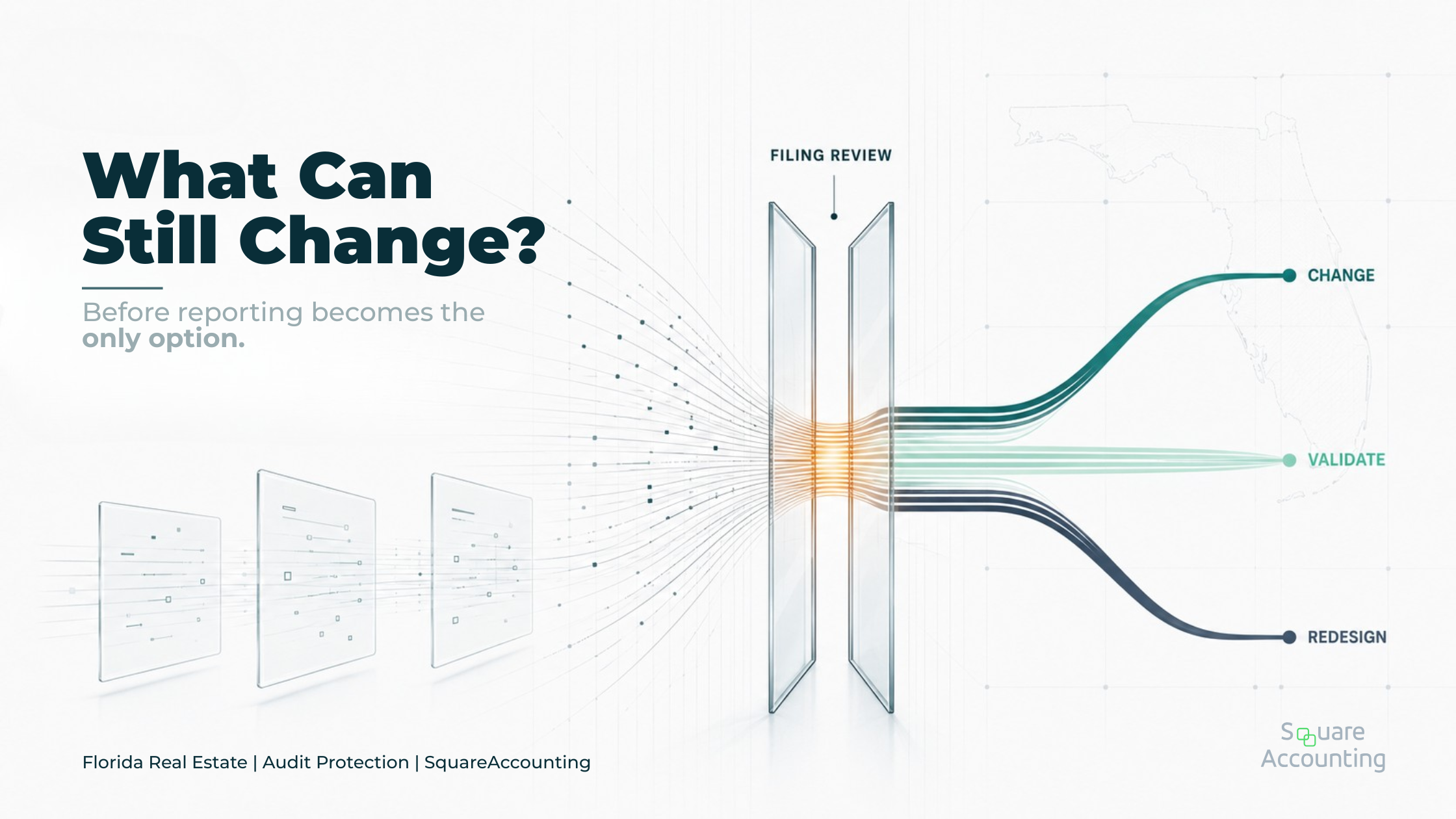
The pre-filing review separates decisions that remain controllable from issues that must be reported now and redesigned for the current year.
“A Florida Tax Exposure Scorecard should establish more than filing readiness. It should show where material exposure exists, which decisions remain controllable, and which issues must carry into the current-year plan.”
That is a different exercise from gathering tax documents. Filing readiness asks whether the return can be completed. Exposure review asks whether the entity, owner, books, supporting records, and planned transactions are telling the same story—and what happens if they are not.
For a high-income Florida business owner, the largest exposure is rarely one missing receipt. It is more likely to be static owner compensation in a growing company, an ownership change that never reached the tax records, losses that cannot be used as expected, a remote employee creating another-state obligations, or a sale being negotiated before the after-tax result has been modeled.
The scorecard below is designed to surface those issues early enough to improve the decision, not merely explain it after filing.
Key takeaways
A technically correct return can still preserve a strategically weak result.
Rank exposure by financial significance, time sensitivity, and reversibility—not by the number of open items.
Review the entity and owner together. Basis, distributions, loss limitations, estimated taxes, and transaction proceeds often meet on the owner’s return.
A tax position must survive four handoffs: decision, documentation, accounting, and return reporting.
Florida’s individual income-tax treatment does not eliminate federal, business-level, payroll, sales-tax, local, or other-state exposure.
Use the completed return as the opening model for the current year and the next major transaction—not as the end of the planning process.
We’ll help identify which filing, ownership, and planning issues warrant attention before the return is finalized.
Florida Tax Exposure Scorecard: the 10 areas to review
Assign each area a status before discussing specific strategies:
Green: The position was analyzed, implemented, documented, recorded, and connected to the owner’s return.
Yellow: The reporting may be supportable, but an assumption, reconciliation, or owner-level consequence still needs validation.
Red: A material position is missing, inconsistent, unsupported, late, or being decided for the first time during return preparation.
Then assign a priority. A red issue is not automatically more important than every yellow one. The deciding factors are the amount at risk, whether a decision window is closing, and whether the position can still be reversed.
Year-Round Tax Review Framework
A coordinated review should confirm the underlying records, identify exposure signals, and determine which decisions remain controllable before the relevant window closes.
| Review area | What should be confirmed | Exposure signal | Decision-window question |
|---|---|---|---|
| Entity and ownership | Legal ownership, tax classification, elections, economics, and cash movements agree. | Ownership changed, entities are inactive but open, or legal and tax records conflict. | Did any change require an election, consent, valuation, or filing action? |
| Income and expense integrity | Books reconcile to banks, payment platforms, payroll, debt, and supporting records. | Suspense accounts, personal charges, duplicate revenue, or unexplained balance-sheet items remain. | Can the books still preserve the intended treatment? |
| Owner compensation and benefits | Compensation, distributions, health benefits, retirement funding, and reimbursements are coordinated. | Payroll stayed static while duties, profit, or distributions changed. | Is correction available, or should the current-year system be redesigned? |
| Basis and tax attributes | Owner basis, at-risk amounts, suspended losses, credits, and carryforwards roll forward by entity and activity. | K-1 data is treated as self-contained or attributes are reconstructed only when needed. | Will an expected deduction, distribution, or sale depend on an unverified attribute? |
| Real estate and fixed assets | Ownership, placed-in-service dates, cost allocation, improvements, depreciation, and activity classification are supported. | Closing statements are missing or repairs, improvements, and participation are reconstructed after year-end. | Does the current treatment still work under the holding and exit plan? |
| Estimated tax and liquidity | Entity projections, owner income, withholding, estimates, and transaction cash needs are modeled together. | Payments repeat last year despite changing income or the business lacks tax liquidity. | Does the payment plan address both compliance and the expected cash obligation? |
| State and local exposure | Employee locations, customers, property, projects, travel, and registrations are mapped by jurisdiction. | Florida residency is assumed to eliminate other-state obligations. | Did actual operations create filing, withholding, registration, or collection duties? |
| Information reporting | Payroll, vendor data, Forms W-2 and 1099, and expense accounts reconcile. | Worker or payment classification remains unresolved. | Can mismatches be addressed before they become notices or diligence issues? |
| Transactions and exit | Purchase, sale, financing, equity, and succession decisions are modeled before documents are final. | Tax review begins after the letter of intent, closing, gift, or distribution. | Which terms and dates remain controllable? |
| Current and multi-year plan | The filed result is reconciled to the plan and the next 12–36 months are projected. | The engagement ends when the return is accepted. | What current-year decision should the completed return inform? |
The scorecard is most useful when it changes the order of work. A pending sale, unsupported ownership position, payroll inconsistency, or unreviewed state footprint may deserve attention before several lower-value bookkeeping corrections.
Our review connects the completed-year return with the decisions that remain controllable.
Score exposure by significance, timing, and reversibility
Most tax checklists count open items. Sophisticated planning ranks them.
We evaluate each issue across three dimensions:
Financial significance: Could it materially change tax, cash flow, financing, sale proceeds, or the use of a tax attribute?
Time sensitivity: Does it depend on an election, payment, payroll event, contract term, placed-in-service date, transaction sequence, or other limited window?
Reversibility: Can it be corrected through the books or return, or would correction require changing payroll, ownership, financing, legal documents, or a completed transaction?
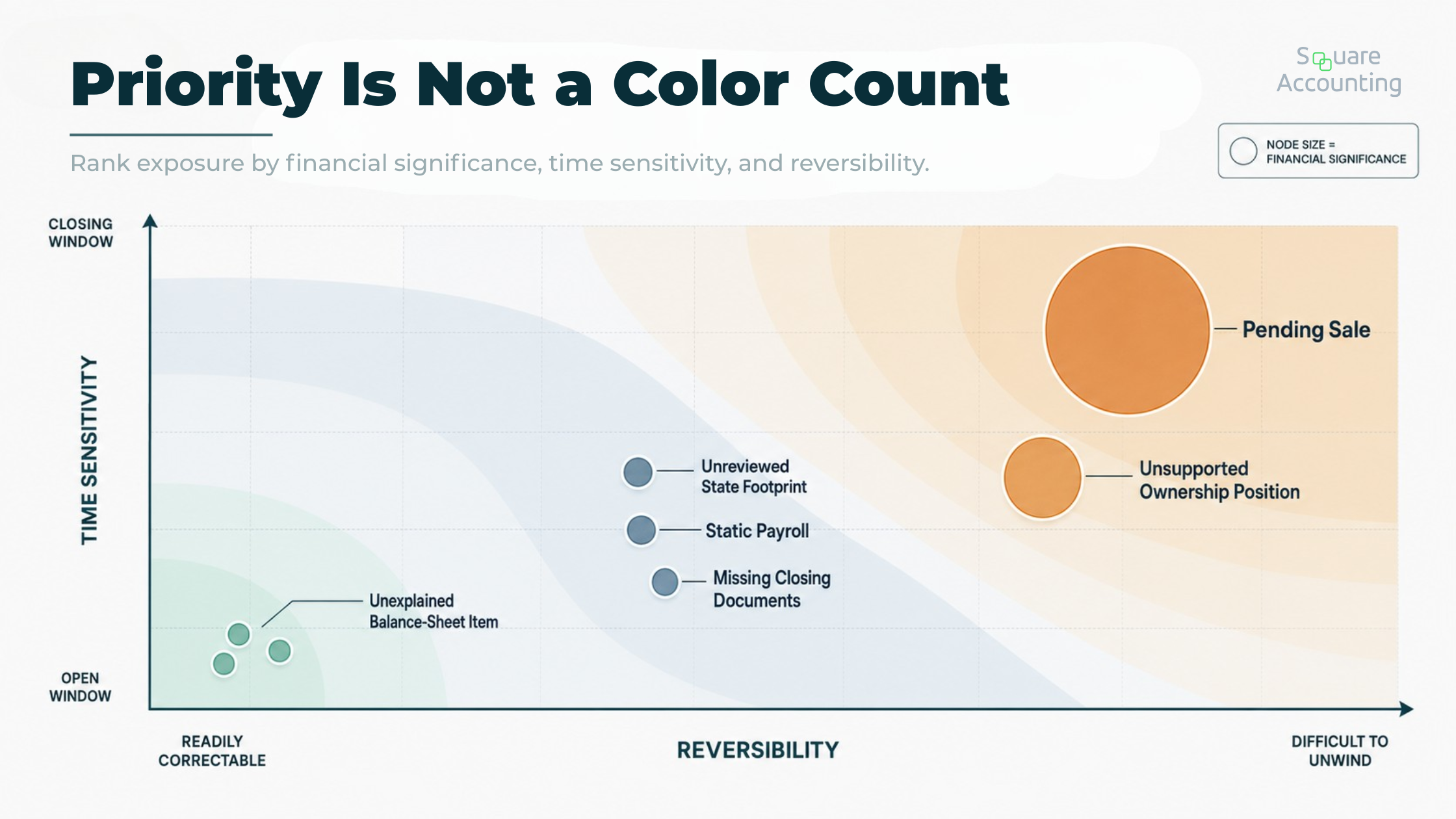
One material issue with a closing decision window can outrank several incomplete but reversible reporting items.
“The scorecard status describes the condition of an issue; it does not establish its economic priority. We still need to determine what is material, what is becoming fixed, and what can realistically be corrected.”
This creates a practical priority order:
Critical: Material and time-sensitive, or difficult to reverse.
Priority: Material but still correctable with coordinated action.
Monitor: Lower-impact support or process gaps that should be fixed without displacing a larger issue.
This is not a numeric tax-risk score. One critical item can dominate the review. Cleaning ten small accounts does not compensate for allowing a major transaction window to close without analysis.
1. Confirm that entity structure, ownership, and economics still agree
Start with a current entity map. It should show legal owners, federal tax classification, state filing status, related and disregarded entities, and where cash actually moves.
Then compare the map with reality:
Did an owner enter, leave, gift, redeem, or transfer an interest?
Do distributions and allocations follow the governing documents and economic arrangement?
Are intercompany payments recorded consistently on both sides?
Are owner advances supported as debt or equity based on their actual terms?
Does the structure still fit compensation, retirement, financing, succession, and exit objectives?
The failure mode is drift. The legal structure stays the same while the economics change around it. That drift may remain hidden until a distribution, loss, refinancing, diligence request, or sale forces everyone to reconstruct the history.
Restructuring is not automatically the answer. A new entity or election may improve one projected tax result while adding payroll, administration, financing, ownership, or exit complexity. First identify the mismatch. Then model the current structure against realistic alternatives, including the cost of unwinding either one later.
2. Test whether the books preserve the tax position
Tax planning cannot survive if the accounting system loses the facts required to report it.
Before filing, reconcile revenue to bank deposits, merchant processors, receivables, and information returns. Reconcile payroll to payroll filings. Review owner accounts, distributions, contributions, debt, reimbursements, fixed assets, and intercompany balances.
The goal is not merely a clean profit-and-loss statement. It is a balance sheet and transaction history that explain what happened, why it happened, and which entity or owner was affected.
This matters because many tax positions live outside the expense line. An owner payment may be compensation, a distribution, a reimbursement, a loan, or a capital contribution. A legal bill may relate to current operations, a capital transaction, financing, or ownership. If those distinctions disappear in the ledger, return preparation becomes reconstruction rather than reporting.
Ask a simple control question: if the person who approved the transaction left tomorrow, would the ledger and supporting file still explain the intended treatment?
3. Review owner compensation, distributions, and benefits as one system
For an owner-operated S corporation, payroll should not be reviewed separately from distributions, duties, profitability, health-insurance treatment, reimbursements, and retirement contributions.
When a shareholder-employee provides services, compensation should reflect the facts and remain supportable before non-wage payments are treated as distributions. That does not mean applying a universal salary-to-distribution ratio. The analysis may consider the owner’s duties, time, experience, revenue-producing role, staff, capital, and comparable compensation.
The second-order effects matter. Compensation can affect payroll taxes, retirement-plan contribution capacity, benefit reporting, business cash flow, and the credibility of the position during examination or transaction diligence. A salary chosen only to reduce current payroll tax may weaken the broader system.
Filing season should therefore answer two questions:
Does the completed-year compensation remain supportable under the actual facts?
What should change now so the current year does not repeat a known exposure?
If payroll, distributions, and benefits were handled inconsistently, forcing a retroactive result may create more problems than it solves. The better approach may be to report the completed year accurately and implement a documented current-year compensation process.
We can review whether ownership, compensation, distributions, benefits, and business economics remain properly coordinated.
4. Reconcile basis, loss limitations, and carryforwards before relying on them
Owners often receive K-1s from several businesses and real estate activities. A K-1 reports allocated items. It does not, by itself, establish that every loss is currently deductible, every distribution is tax-free, or every carryforward has been assigned correctly.
The review may need to coordinate:
at-risk limitations;
passive activity limitations;
suspended losses and credits;
capital-loss and other carryforwards; and
property- and state-level attributes.
Sequence matters. A loss may clear one limitation and fail another. A distribution, debt change, ownership transfer, or disposition can alter which attributes are available and when.
The failure mode is treating tax attributes as totals instead of records tied to an owner, entity, and activity. That may not become visible until a loss is claimed, cash is distributed, debt is refinanced, an interest is gifted, or the business is sold.
The controlling question is: Can every material tax attribute be traced from its originating activity through the entity return to the owner’s current and future returns?
If the answer depends on reconstructing several years of K-1s during a transaction, the exposure already exists even if the current return can still be filed.
5. Review real estate at the property and owner levels
Real estate exposure is rarely visible in one depreciation schedule. Each property should have a record of legal ownership, tax classification, adjusted basis, land allocation, improvements, depreciation, debt, participation, grouping, suspended losses, and intended holding period.
Before filing, review acquisition and refinancing files, placed-in-service support, repairs versus improvements, depreciation, personal-use and rental facts, participation records, lodging or sales-tax obligations, and expected sale, exchange, conversion, gift, or succession timing.
Current classification affects whether losses may be used, but that is only the first layer. Basis, at-risk rules, passive limitations, activity grouping, portfolio income, and owner participation can interact. A property-level deduction may not create the expected owner-level benefit in the same year.
The exit creates another layer of pressure. Depreciation can improve current cash flow while reducing adjusted basis and changing the character or timing of gain later. Installment payments may spread part of a gain while some recapture may be recognized earlier. Suspended losses may become relevant on disposition, but only if the ownership and disposition facts support the intended treatment.
This does not make current deductions undesirable. It means the analysis should show whether the benefit is a permanent reduction, a deferral, or a timing shift that creates a future cash need.
We’ll examine how basis, deductions, liquidity, and future disposition pressure interact across the investment portfolio.
6. Reforecast estimated taxes instead of repeating last year’s payments
The prior-year return is a starting point for estimated taxes, not a forecast of the current year.
For a business owner, the projection should incorporate entity profit, compensation, distributions, rental and portfolio income, capital transactions, retirement and benefit decisions, household withholding, carryforwards, and the cash needed for operations, debt, acquisitions, and taxes.
Safe-harbor planning and liability forecasting answer different questions. A payment approach may reduce underpayment-penalty exposure while still leaving a material filing-date balance. Conversely, paying every projected dollar early may protect the tax account while unnecessarily constraining business liquidity.
The scorecard should show:
the compliance payment target;
the projected total liability;
the expected payment dates;
the source of tax cash; and
the assumptions most likely to change the forecast.
That makes estimated-tax planning part of cash management rather than a quarterly repetition of last year’s vouchers.
7. Map Florida, other-state, and local exposure from actual operations
Florida generally does not impose an individual income tax on natural persons, but “Florida-based” is not a complete state-tax conclusion.
Depending on classification and activity, a Florida business may still need to evaluate corporate income tax, sales and use tax, reemployment and payroll reporting, property and transaction taxes, and local obligations.
Operations outside Florida add another layer. Employees, contractors, property, inventory, customers, temporary projects, acquisitions, or management activity may create income, franchise, gross-receipts, sales-tax, withholding, unemployment, or registration questions elsewhere.
For Orlando and other Florida service businesses, remote employees deserve particular attention. The owner may never leave Florida, while the employee’s location changes the company’s operational footprint.
The failure mode is return-based state analysis: reviewing only the states filed last year instead of mapping where the business actually operated this year. That can allow an exposure to compound across payroll, sales-tax, and income-tax systems before it appears during a notice, financing review, or sale.
Start with the facts—people, property, customers, contracts, travel, and registrations—then determine which obligations those facts may create.
8. Reconcile information reporting before mismatches become notices
Information reporting is not just a January filing task. It is a control test for how the business classifies workers, vendors, rent, legal fees, interest, and other payments throughout the year.
Confirm that:
worker classification reflects the relationship and actual services;
Forms W-2 and payroll filings reconcile to the ledger;
vendor names, classifications, and taxpayer information are complete;
reportable payments are identified by payment type and method; and
A mismatch can reveal a deeper problem: an employee recorded as a contractor, rent paid through the wrong entity, legal fees assigned to operations when they relate to an acquisition, or owner payments reported without determining their actual character.
These issues can affect more than notices. Inconsistent reporting may complicate payroll corrections, state registrations, retirement-plan administration, and transaction diligence.
9. Model major transactions before the documents determine the tax result
The most valuable finding in a filing-season review may relate to a transaction expected during the next 12 to 36 months.
Review planned sales, purchases, capital projects, owner admissions or redemptions, refinancing, distributions of appreciated property, gifts, succession steps, and changes in residency or operating footprint.
For a sale, analysis should begin before price, structure, and timing are fixed. Asset allocation, debt repayment, transaction costs, depreciation recapture, installment terms, entity-level tax, suspended losses, state sourcing, and owner liquidity may all affect the result.
The sequence matters:
Establish basis, tax attributes, ownership, and entity classification.
Model the transaction under realistic structures and closing dates.
Identify which terms affect tax character, timing, and cash.
Coordinate legal documents, accounting, and return reporting.
Reconcile the completed transaction with the model.
A projected tax bill alone is not enough. The owner needs to know when tax may be due, which attributes may offset which income, how much cash remains after debt and tax, and what changes if the transaction closes in another year.
We can evaluate structure, timing, tax attributes, and expected liquidity while important transaction terms remain open.
10. Turn the completed return into a multi-year control document
The final return should be reconciled to the planning estimate. Differences should be explained rather than carried forward as unexplained history.
Then update three horizons:
Three Planning Horizons
Effective tax planning connects the completed return with decisions that remain open today and the structural choices likely to shape future years.
| Horizon | Primary purpose | Questions to answer |
|---|---|---|
| 01 Year just closed | Accurate reporting and attribute preservation | Did the return reflect the decisions, documents, and books? What was deferred, limited, or carried forward? |
| 02 Current operating year | Implementation while decision windows remain open | What must change in payroll, estimates, benefits, accounting, ownership, or documentation now? |
| 03 Next 3–5 years | Structure, capital, exit, and succession | How would changing income, acquisitions, financing, ownership transfers, or a sale alter the plan? |
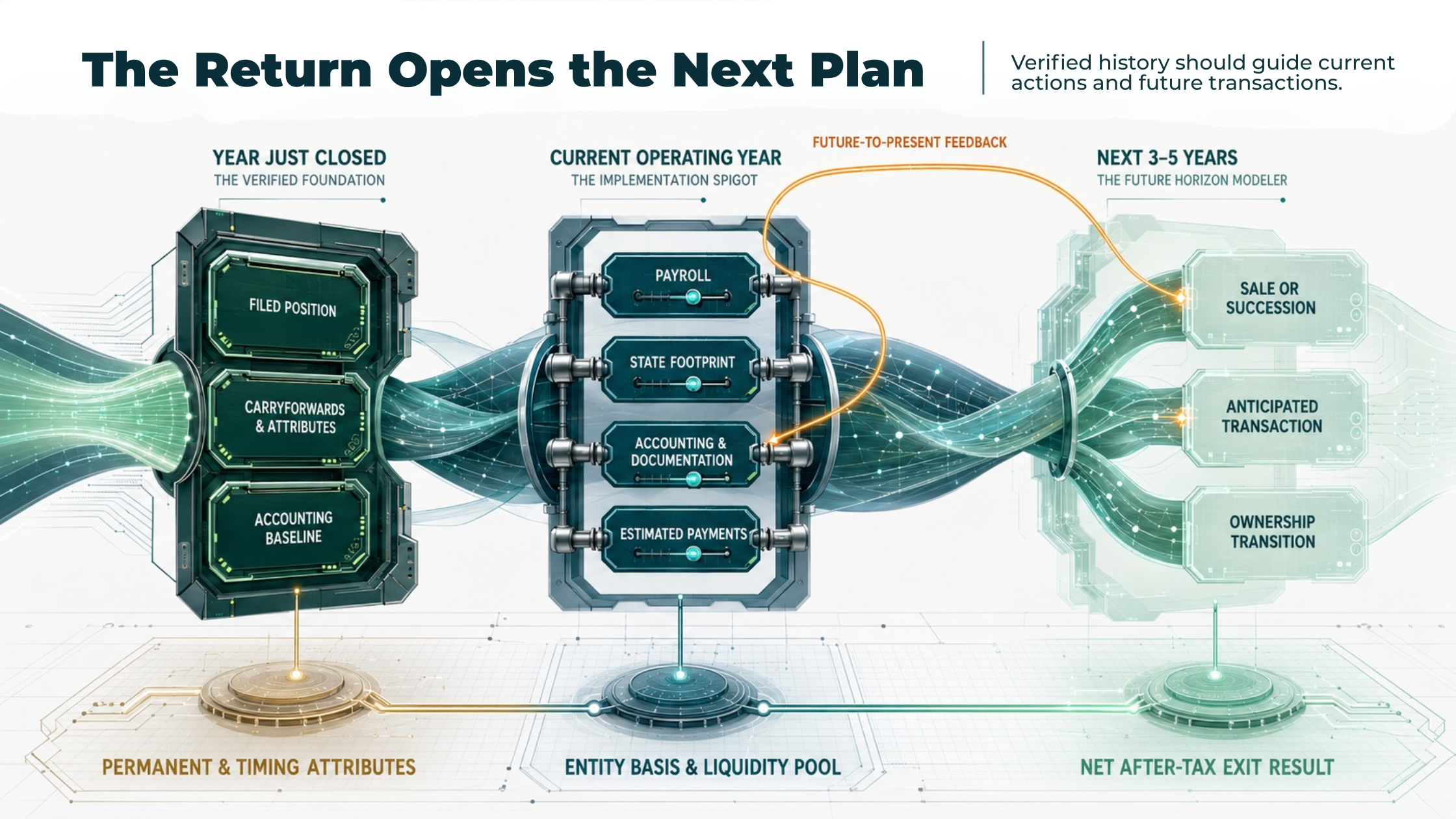
The completed return becomes a control document when it updates current-year actions and the assumptions behind future ownership, financing, and exit decisions.
“The three horizons should operate as one planning cycle rather than separate tax exercises. What was deferred, limited, or carried forward can affect current implementation, future transaction modeling, and the cash ultimately available after tax.”
This is where tax preparation connects to advisory. The return records completed activity. The advisory process uses that verified history to shape decisions that remain controllable.
For an owner who already has a CPA, this section provides a practical test of the relationship: does the completed return generate a documented current-year action list, or does the engagement pause until the next filing season?
The four-handoff test: where otherwise valid strategies fail
A technically available strategy creates limited economic value if it breaks during execution. Test every material position through four handoffs:
Decision: Were realistic alternatives modeled using complete facts?
Documentation: Were agreements, elections, invoices, logs, valuations, and approvals completed when required?
Accounting: Did the books preserve the transaction, basis, activity, and entity-level treatment?
Return reporting: Did the intended treatment reach every affected entity and owner return, with attributes preserved for later years?
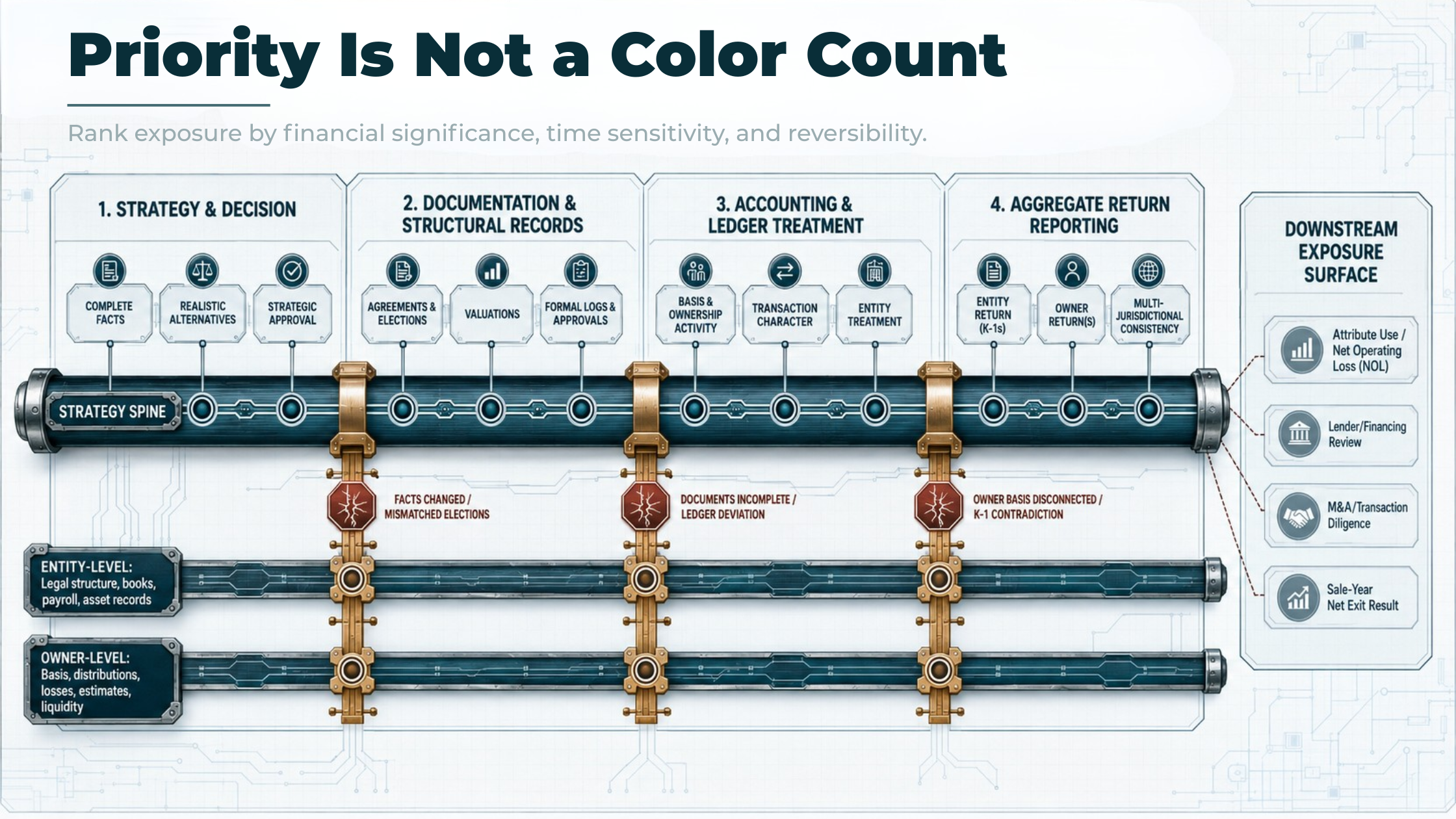
A technically available strategy creates limited value when the intended treatment breaks between the decision and the affected returns.
“The same underlying facts and intended treatment must survive every handoff. A break may remain hidden until an owner-level return, financing review, diligence request, or future transaction exposes the inconsistency.”
Consider an Orlando service-business owner with an S corporation, two rentals, and an out-of-state employee. Profit increased, shareholder payroll remained unchanged, a property improvement was recorded as repairs, and the owner expects to sell within two years.
A conventional filing checklist may focus on bank reconciliations and missing forms. The scorecard changes the order of work:
validate compensation before repeating the same payroll approach;
reconstruct property basis and classify the improvement;
evaluate the employee’s state footprint;
preserve owner and activity-level tax attributes; and
model the sale before structure and timing become fixed.
These are not independent tasks. Compensation affects retirement capacity and cash flow. Property classification affects current deductions and sale-year gain. State footprint affects compliance and transaction diligence. Weak records reduce the reliability of every projection built on them.
That is the central failure mode the four-handoff test is designed to find: good advice that never becomes an implemented, supportable, and reportable position.
What filing season can still fix—and what it usually cannot
Filing season can often improve reporting by reconciling accounts, correcting bookkeeping classifications, obtaining documents, evaluating elections or corrections that remain available, calculating attributes, and carrying unresolved planning items into the current year.
It usually cannot make a transaction occur in a prior year, recreate contemporaneous participation, change when property was placed in service, renegotiate a completed sale, or move cash and ownership retroactively as though the action happened earlier.
Some retirement-plan, accounting-method, election, and correction rules may permit action after year-end. Others depend on the plan type, taxpayer, transaction, original action, and applicable deadline. Each item should be verified under its own rules rather than treated as a universal filing-extension opportunity.
When a window has closed, the answer is not to force the desired result. Report the completed year accurately, quantify the consequence, and redesign the current-year process so the exposure does not repeat.
Common scorecard mistakes
Treating every open item as equally important
Prioritize material, time-sensitive, and hard-to-reverse exposures before lower-value cleanup. A long document request list is not the same as a risk-ranked plan.
Reviewing entities separately from their owners
Basis, distributions, loss limitations, net investment income tax, estimated payments, and transaction liquidity can converge on the owner’s return. A correct entity return does not, by itself, confirm the expected owner-level outcome.
Assuming a deduction equals permanent tax savings
A deduction may create a permanent reduction, a deferral, a basis adjustment, or a timing shift that affects future gain. Label the economic benefit accurately and show the future cash consequence.
Relying on the tax return to reconstruct operational facts
The return is the final reporting layer. It should not be the first place ownership, worker location, participation, debt terms, or transaction purpose is identified.
Treating Florida residency as a complete state-tax strategy
Florida residency can materially affect an individual’s state income-tax position. It does not resolve Florida business taxes or obligations created by operations in other jurisdictions.
Conclusion: use the Florida Tax Exposure Scorecard before filing becomes the only objective
The purpose of a Florida Tax Exposure Scorecard is not to make filing season more complicated. It is to identify which issues are material, which decision windows are closing, which attributes must be preserved, and which business decisions require coordination before the return is finalized.
For owners with multiple entities, real estate, remote employees, changing income, or a possible transaction, the review should connect four layers: the decision, its documentation, the books, and every affected return. It should then convert the result into a current-year action list and a multi-year plan.
That is also how an owner can evaluate an existing CPA relationship. The question is not only whether the returns are correct. It is whether the work identifies what should change while there is still time to change it.
Square Accounting’s Tax Prep + Advisory Review is designed to connect filing work with the decisions affecting owner compensation, tax attributes, real estate, state exposure, liquidity, and future transactions. For a lower-friction first step, complete the Square Accounting Florida Tax Exposure Scorecard and use the results to identify which items need immediate validation.
We’ll connect the filed return with a prioritized current-year action list and the decisions approaching over the next several years.
Business Tax Planning FAQ
Questions Worth Resolving Before Filing
These questions help connect the completed return with current-year decisions, unresolved exposures, and the transactions that may shape future tax and liquidity.
01
How should a business owner prioritize issues after the scorecard
identifies several exposures?
We would not prioritize issues simply by color or quantity. First identify matters that could materially affect tax, liquidity, financing, or transaction proceeds. Then determine whether the decision window is closing and how difficult the issue would be to reverse. A pending sale, unsupported ownership change, payroll inconsistency, or unresolved state footprint may deserve attention before several bookkeeping corrections. The priority order should reflect economic consequence and remaining control—not which item is easiest to clear from the request list.
02
What should a business owner ask their CPA before the return is
finalized?
We would ask which positions required judgment, which deductions or losses were limited, what tax attributes must carry forward, and whether the filed result differed from earlier projections. The discussion should also identify current-year changes involving compensation, estimated payments, documentation, ownership, or state registrations. For owners considering a sale, acquisition, refinancing, or transfer, the return should establish the baseline for that analysis. A useful filing process ends with a prioritized action list, not simply confirmation that the return was accepted.
03
How can a technically correct tax return still leave material
exposure?
A return can report the information provided correctly while the underlying decision remains poorly structured, documented, or sequenced. The intended treatment may not have reached the correct entity, the books may have lost important distinctions, or owner-level limitations may prevent the expected result. Exposure can also remain outside the return, such as an approaching transaction, unsupported intercompany balance, or operational footprint in another state. We would therefore evaluate whether the position survived the decision, documentation, accounting, and return-reporting stages—not only whether the forms were completed correctly.
04
Can a Florida business create another-state tax exposure without
the owner leaving Florida?
Yes, depending on the business’s activities. Employees, contractors, property, inventory, customers, temporary projects, acquisitions, or management activity outside Florida may create filing, registration, withholding, unemployment, sales-tax, or other state-level questions. A remote employee is a common example: the owner may remain in Florida while the employee’s location changes the company’s operational footprint. We would map where the business actually operated during the year rather than relying only on the states included in prior returns.
05
What documentation becomes important when ownership or
intercompany balances change?
We would preserve an updated entity map, governing documents, ownership records, transaction approvals, valuation support where relevant, and evidence showing when the change occurred. Intercompany payments should be recorded consistently by both entities, while owner advances should reflect their actual debt-or-equity terms. Distributions, contributions, reimbursements, and loans should remain distinguishable in the ledger. The objective is to ensure that legal documents, business economics, accounting records, and tax reporting describe the same transaction before a distribution, refinancing, diligence request, or sale forces the history to be reconstructed.
06
Why should basis and suspended losses be reviewed before a
distribution, refinancing, or sale?
Those events may change whether a deduction can be used, whether a distribution produces an unexpected consequence, or which tax attributes remain available after the transaction. A K-1 does not independently establish that every loss is deductible or every distribution produces the expected result. We would trace basis, liabilities, at-risk amounts, passive limitations, and suspended attributes to the correct owner, entity, and activity. Waiting until a transaction is underway can turn attribute verification into a time-sensitive reconstruction problem and reduce confidence in the projected after-tax proceeds.
07
When should depreciation planning be evaluated against a real
estate exit?
We would connect depreciation and exit modeling before accelerating deductions or fixing the expected holding strategy. Depreciation may improve current cash flow while reducing adjusted basis and increasing future gain pressure. An installment arrangement may spread part of the gain while some depreciation-related income may be recognized earlier. Suspended losses may also become relevant at disposition if the ownership and transaction facts support the intended treatment. The analysis should identify whether the current benefit is a permanent reduction, a deferral, or a timing shift that creates a later liquidity requirement.
08
How should estimated-tax planning change when income or transaction
timing shifts?
We would update the projection using current entity profit, compensation, distributions, investment income, rental activity, planned transactions, household withholding, carryforwards, and available tax liquidity. Prior-year payments may provide a compliance reference, but they may not reflect the current economic year. The review should separate the payment level used to manage underpayment exposure from the projected total liability and expected filing-date balance. It should also identify when payments may be required, where the cash will come from, and which assumptions could materially change the forecast.
