

Before selling, resolve three separate questions: who can sign, what basis applies, and what remains after the transaction.
Updated November 5, 2026 · Square Accounting
You can sell an inherited house in Florida once the person signing has authority to transfer it and the title requirements for closing are met. Some homes pass outside probate; others can be sold during estate administration. The sale may create federal capital gains tax, even though Florida has no individual income tax.
Before accepting an offer, answer three questions: Who can sell the home? What is its inherited tax basis? And how much will remain after selling costs, debt, and taxes?
The order matters. A quick offer doesn't resolve an ownership dispute, and a mortgage payoff doesn't tell you whether you have a taxable gain. This guide walks through the decisions that determine whether a sale works for you and the other heirs.
Selling inherited property in Florida: the five steps
- Confirm who can sign. Have a Florida title or probate attorney review the deed and inheritance documents.
- Establish the inherited basis. Document the property's value at death and any adjustments that affect the tax calculation.
- Decide whether to sell, keep, or rent. Consider the property's costs, your needs, and the other owners' plans.
- Compare offers by net proceeds. Include selling expenses, repairs, carrying costs, debt, and an estimated tax reserve.
- Close and complete the reporting. Confirm the seller's tax identification number, retain the final settlement statement, and review any estimated tax payment before distributing or spending all the proceeds.
1. Find out whether probate is required—and who can sell
Being named in a will doesn't automatically give you authority to sign a deed. Start with the recorded title and the documents governing the inheritance.

Can you sell before probate is finished?
Sometimes. A personal representative may be able to sell estate real property during administration. The will and applicable requirements determine whether court authorization is needed. The home doesn't always have to be deeded to the heirs first. Have the attorney confirm the authority before you commit to a closing date. Florida Statutes § 733.613.
Florida also allows summary administration when statutory conditions are met. Under the 2026 statute, one eligibility route is an estate subject to Florida administration, after excluding property exempt from creditor claims, of $150,000 or less; another is that the owner has been dead for more than two years. The will must not direct administration under Chapter 733. The home's market value alone doesn't establish eligibility. Florida Statutes § 735.201.
Does Florida homestead status change the process?
It can. Protected homestead has special inheritance rules, including rules affecting a surviving spouse and descendants. Ask the attorney who owns each interest and what is needed to convey it. Florida Statutes § 732.401.
Also distinguish legal homestead protections from the property-tax homestead exemption and assessment limits. Don't build your holding budget on the assumption that the deceased owner's tax bill will continue unchanged. Ask the county property appraiser to confirm the treatment of the transfer and your eligibility. Florida Department of Revenue: property-tax assessment and homestead overview.
What if the owner died without a will?
Florida's intestacy rules determine who inherits property that isn't effectively disposed of by a will, subject to other applicable rules. There is no automatic right for the relative managing the paperwork to sell. Have the attorney establish the heirs, title, and selling authority before anyone signs a contract. Florida Statutes § 732.101.
What if there are multiple heirs?
If heirs own the home together, a voluntary sale of the whole property generally needs the relevant owners to participate. An authorized estate sale is a different situation; first establish who owns the property and who controls the sale.
Agree in writing on price expectations, repairs, carrying costs, and how expenses will be settled. If one heir wants to keep the house, obtain a valuation and review a buyout before transferring money or signing a deed. A buyout can have tax consequences for the selling heirs and the buyer.
If agreement isn't possible, a Florida attorney can explain negotiated options and partition proceedings. Special procedures apply to qualifying heirs property. Florida Statutes, Chapter 64, Part II.
For related planning, see our guide to ownership structure, succession, gifting, and estate planning.
2. Calculate the tax on selling an inherited house in Florida
You generally calculate gain using the inherited basis, rather than treating the full sale price as taxable income. For an ordinary inherited home, basis generally starts with fair market value at the owner's death, subject to exceptions. IRS: inherited-property sales.
Florida has no individual income tax or inheritance tax. Its estate tax was eliminated for deaths after December 31, 2004. Federal estate-tax obligations, if any, are a separate question from the income tax on a later sale. Florida tax overview; Florida estate-tax guidance.
Establish the date-of-death value
Basis is the tax starting point used to calculate gain or loss. A date-of-death appraisal, including a retrospective appraisal when appropriate, can help support it. A property-tax assessment and a current listing estimate aren't automatically the right valuation for federal tax purposes.
The adjustment is often called a step-up in basis, but value can also step down. Certain estates elect alternate valuation, and basis-consistency rules may apply when you receive Schedule A (Form 8971).
Don't assume the entire home's basis resets if you inherited only an interest. Joint ownership requires review. Likewise, receiving property from a trust doesn't by itself establish a new basis, and a lifetime gift can carry a different basis result from an inheritance. IRS Publication 551.
Separate taxable gain from cash at closing
For a straightforward capital-asset sale:
Sale price − qualifying selling expenses − adjusted inherited basis = gain or loss.
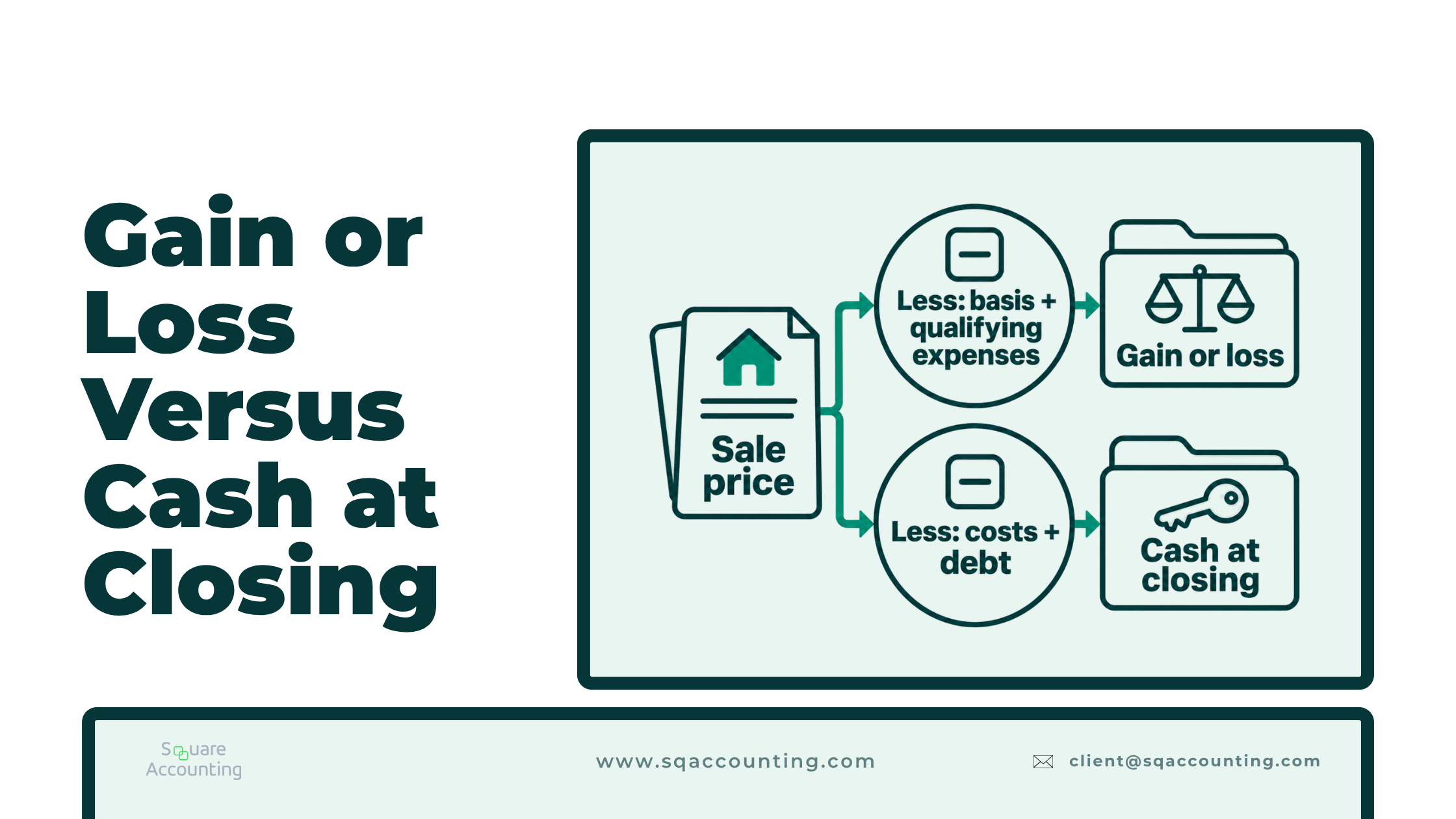
Capital improvements can increase basis. Depreciation allowed or allowable during rental use generally reduces it. Routine maintenance and every charge on a settlement statement don't automatically reduce gain. IRS Publication 551.
Consider this illustrative example, assuming no basis adjustments after inheritance:
| Item | Amount |
|---|---|
| Date-of-death value and inherited basis | $500,000 |
| Sale price | $575,000 |
| Qualifying selling expenses | $30,000 |
| Amount realized after those expenses | $545,000 |
| Federal gain before any applicable exclusion or offset | $45,000 |
| Mortgage payoff | $150,000 |
| Cash after those expenses and debt, before tax and other adjustments | $395,000 |
The mortgage payoff reduces cash, but it doesn't reduce the $45,000 gain. That's why both calculations belong in your offer review.
What capital gains rate applies?
Inherited property held as a capital asset generally receives long-term treatment even if you sell soon after inheritance. You don't ordinarily need to hold it another year for that treatment. IRS Publication 550.
For individuals, most net long-term capital gain falls under the 0%, 15%, or 20% federal rates, depending on taxable income. Rental-related gain can involve different rate rules. There is no single inherited-home tax rate. IRS Topic 409.
Higher-income sellers may also owe the 3.8% net investment income tax. It applies to the lesser of net investment income or modified adjusted gross income above the applicable threshold; it isn't automatically 3.8% of the sale price or the entire gain. IRS NIIT guidance.
Two heirs receiving equal proceeds may therefore have different tax bills. Estimate each seller's result using the closing year, other income, available losses, and ownership share.
Can you use the $250,000 or $500,000 home-sale exclusion?
Inheriting a parent's home doesn't automatically transfer the parent's exclusion to you. Generally, a seller must satisfy the ownership and principal-residence use tests for at least two years during the five years before sale, along with other requirements. Special rules can apply to surviving spouses and certain other sellers. IRS Topic 701.
Moving into the home may help you qualify later, but compare the potential benefit with the cost of keeping it. The inherited basis may already leave little gain to exclude. Rental history and depreciation can also limit what is excluded. IRS Publication 523.
Can you deduct a loss?
A personal-use loss generally isn't deductible. Investment or estate-held property may receive different treatment, depending on its use and the transaction. A sale to a related person introduces additional restrictions. Keep records showing how the home was held after death; don't assume that selling below the appraisal automatically creates a deductible loss. IRS Publication 544; IRS Publication 559.
3. Decide whether to sell, keep, or rent the home
Selling is one option. Keeping the property should also make sense after the inheritance itself is set aside.
| Option | Compare before deciding |
|---|---|
| Sell soon | Expected net proceeds, title readiness, market conditions, and the costs avoided by an earlier closing. |
| Keep it for personal use | Your actual need for the home, annual ownership costs, and any agreement needed with other heirs. |
| Rent it | Rent after vacancy, management, maintenance, insurance, property taxes, and financing; include future sale taxes. |
| Buy out other heirs | A supportable value, financing, each owner's tax result, and the buyer's resulting basis. |
If you rent after inheritance, have a tax advisor establish the rental records and depreciation schedule. Depreciation can affect basis and the character of gain when you sell. Converting a rental into a residence doesn't automatically make all later gain excludable. IRS Publication 523.
For Florida holding costs, obtain current insurance quotes and confirm occupancy requirements, HOA or condo charges, and property-tax treatment. A vacant home and an occupied home may need different insurance arrangements; ask the insurer before leaving the property empty.
4. Compare an agent listing, cash offer, and as-is sale
The best offer is the one that produces an acceptable net result on terms you can meet. Price alone won't tell you that.
Request written estimates for each credible route: listing the property, selling in its current condition, accepting a cash offer, or arranging an heir buyout. An as-is sale can still be marketed through an agent; it isn't limited to cash buyers.
Compare commissions, concessions, title and legal costs, repairs, expected time to close, financing contingencies, and carrying costs. Confirm who pays each charge. An as-is contract doesn't eliminate title requirements or every disclosure obligation; have the Florida sale professional review the terms.
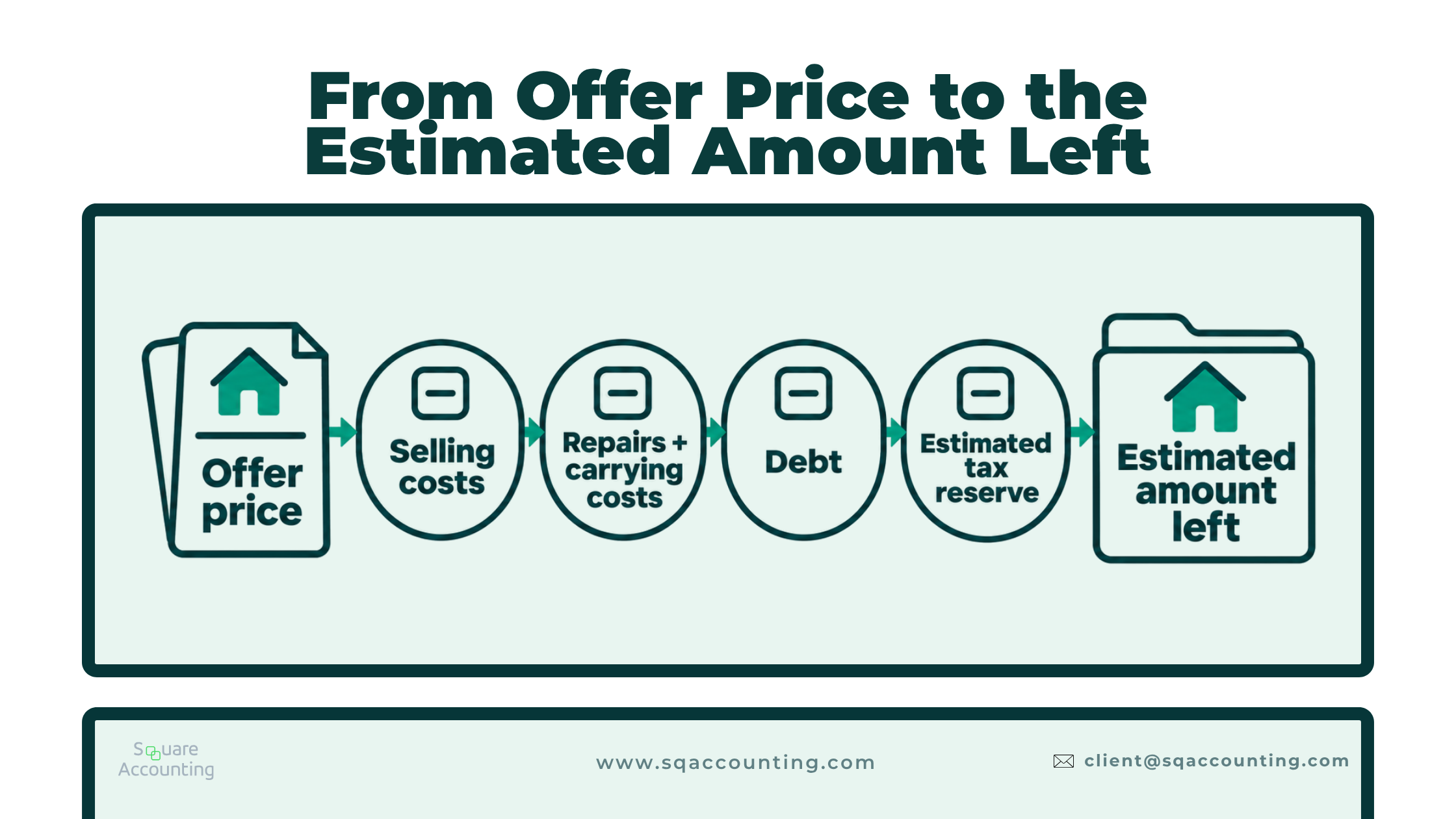
Example: does the higher offer leave you with more?
These are illustrative assumptions, not market estimates. Both alternatives use the same $500,000 inherited basis, with no improvements, depreciation, or debt. Assume the selling costs qualify to reduce the amount realized; carrying costs are shown separately for the cash comparison.
| Item | Earlier as-is closing | Later closing after preparation |
|---|---|---|
| Sale price | $530,000 | $575,000 |
| Qualifying selling costs | $10,000 | $30,000 |
| Carrying costs before closing | $2,000 | $12,000 |
| Cash before tax and debt | $518,000 | $533,000 |
| Gain before applicable exclusions or offsets | $20,000 | $45,000 |
The $45,000 difference in headline price becomes a $15,000 difference in cash before tax. The later closing also produces $25,000 more gain under these assumptions. Decide whether the remaining benefit is worth the delay, work, and risk after estimating tax.
Should you repair the inherited house before selling?
Ask for two realistic sale estimates: the home in its present condition and the home after the proposed work. Subtract the repair budget, additional carrying time, and likely selling costs from the second estimate. Keep a contingency for overruns. A higher asking price alone doesn't establish that the work will pay off, and repair spending doesn't automatically create an equivalent tax deduction.
Which Florida closing costs matter?
Florida documentary stamp tax generally applies to taxable deeds at $0.70 per $100 or portion thereof of consideration outside Miami-Dade. Miami-Dade has a different rate and a possible surtax, with an exception for a transfer of only a single-family dwelling. Ask the closing professional to calculate the amount and confirm the contract's cost allocation. Florida Department of Revenue: documentary stamp tax.
Check mortgage and lien payoffs, property-tax prorations, HOA balances, unresolved permits, and any special assessments. These affect what is available at closing, even when their tax treatment differs.
How long does selling an inherited house in Florida take?
There isn't one reliable timeline for every inherited property. Separate the work into three stages:
- Authority and title: establish who can sell and resolve probate, trust, homestead, lien, or ownership questions.
- Preparation and marketing: clear the home, evaluate repairs, set a price, and find a buyer.
- Contract to closing: satisfy contract conditions, buyer financing, title requirements, and signing arrangements.
A cash buyer may shorten the financing stage, but can't remove a missing signature or unresolved selling authority. Ask the attorney and closing professional what must happen for this property, then build the marketing schedule around that answer.
5. Confirm reporting and tax payments before distributing the proceeds
Who sells determines where the transaction is reported:
| Seller | Reporting to review |
|---|---|
| A domestic estate | Form 1041 and related schedules; treatment of capital gain and distributions requires review. |
| Heirs selling after distribution | Each heir's share, generally on Form 8949 and Schedule D when the home is a capital asset. |
| A trust | Whether the trust or another taxpayer reports under its particular tax rules. |
Confirm that the deed, settlement statement, and Form 1099-S information identify the correct seller and taxpayer identification number. Transferring cash to beneficiaries doesn't by itself establish who owes tax on the gain. IRS Publication 559.
Review the tax reserve and payment timing before spending or distributing all the cash. A taxable gain may require an estimated payment, depending on withholding, prior-year tax, and other facts. A late-year gain may warrant the annualized-income method. IRS estimated-tax guidance.
What if an heir lives outside Florida or outside the U.S.?
An out-of-state heir should check their resident-state rules. Florida's lack of individual income tax doesn't settle another state's treatment. For example, California generally taxes its residents on income regardless of source. California Franchise Tax Board.
Living outside Florida isn't the same as being a foreign seller for federal tax purposes. If a seller is a foreign person, FIRPTA withholding may apply to the amount realized even when the expected gain is small. Exceptions or a withholding certificate may change the result. Flag foreign status before closing so the advisors can address withholding, identification numbers, and filings. IRS FIRPTA guidance.
Documents to gather before you accept an offer
- Authority: deed, death certificate, will or trust, court orders, letters of administration, and required signers.
- Basis: date-of-death valuation, relevant estate-tax valuation documents, improvement receipts, and rental depreciation records.
- Costs: mortgage and lien payoffs, insurance, property-tax and HOA balances, repair estimates, and occupancy arrangements.
- Offer: price, commissions, concessions, expected closing date, contingencies, and a written net estimate.
- Reporting: seller's EIN or SSN, ownership allocations, expected Form 1099-S recipient, and estimated tax reserve.
Have the attorney resolve selling authority and title. Use the tax review to establish basis, estimate gain, and plan reporting. Bring both conclusions into the offer comparison.
Frequently Asked Questions
Can I sell an inherited house in Florida without probate?
Possibly. A trust, survivorship deed, or enhanced life estate deed may allow a transfer outside probate. The recorded deed and inheritance documents determine the route; have a Florida title or probate attorney confirm the requirements.
Can a house be sold during probate in Florida?
Yes, in appropriate circumstances. A personal representative with the necessary authority may sell during administration, subject to applicable requirements. The property doesn't always need to be distributed to heirs first.
Do all heirs have to agree to sell inherited property in Florida?
When heirs own the property together, a voluntary sale of the whole home generally requires the relevant owners' participation. An authorized estate sale is different. If co-owners disagree, discuss a buyout, negotiated sale, or partition with a Florida attorney.
Is selling an inherited house immediately tax free?
No automatic exemption applies just because you sell quickly. A sale near the date-of-death value may produce little gain, but the valuation, selling expenses, adjustments, and use of the home still matter.
Is there a deadline to sell an inherited house?
There is no single sale deadline that answers every case. Estate administration, a court order, loan terms, insurance, or agreements among owners may affect timing. Ask the attorney and lender which deadlines apply. For an inherited capital asset, long-term treatment generally doesn't require waiting a year.
Do I have to wait a year to get long-term capital gains treatment?
Generally no, if the inherited property is a capital asset. Inherited capital assets generally receive long-term treatment regardless of how long you held them.
Can I sell an inherited house as is?
You may be able to sell in its present condition through a listing or a direct buyer. Compare net proceeds and contract terms. An as-is sale doesn't eliminate selling-authority, title, or applicable disclosure requirements.
Does paying off the mortgage reduce capital gains tax?
The payoff generally reduces cash received, rather than the gain. Gain is based on the amount realized and adjusted basis. Keep the mortgage payoff separate from qualifying selling expenses in your calculation.
Do I avoid tax if I use the proceeds to buy another home?
Buying another personal home doesn't itself eliminate the gain. A home-sale exclusion requires its own qualifications. A Section 1031 exchange has separate business-or-investment requirements and isn't a general replacement-home exemption. IRS Publication 544.
Get a tax estimate before the sale becomes final
Before selling an inherited house in Florida, know who can sign, which basis is supported, and what the offer leaves after costs and taxes.
Square Accounting can review the inherited basis, ownership and reporting path, proposed closing figures, and federal tax impact. If you're comparing a sale with rental use or an heir buyout, we can help evaluate the tax differences before you choose.
Bring the deed, valuation, probate or trust documents, rental records, and closing estimate. Your Florida attorney should handle title and probate questions.

Inzamam ur Rahman
Content & Marketing Strategist
Inzamam manages content and advises on marketing strategy for Square Accounting. He works with Stevan Franeta, CPA, to create clear, practical articles for business owners, high-income professionals, and real estate investors.
Reviewed for tax accuracy by Stevan Franeta, CPA
