
Using Commercial Real Estate to Smooth Income and Depreciation Across Multiple Years
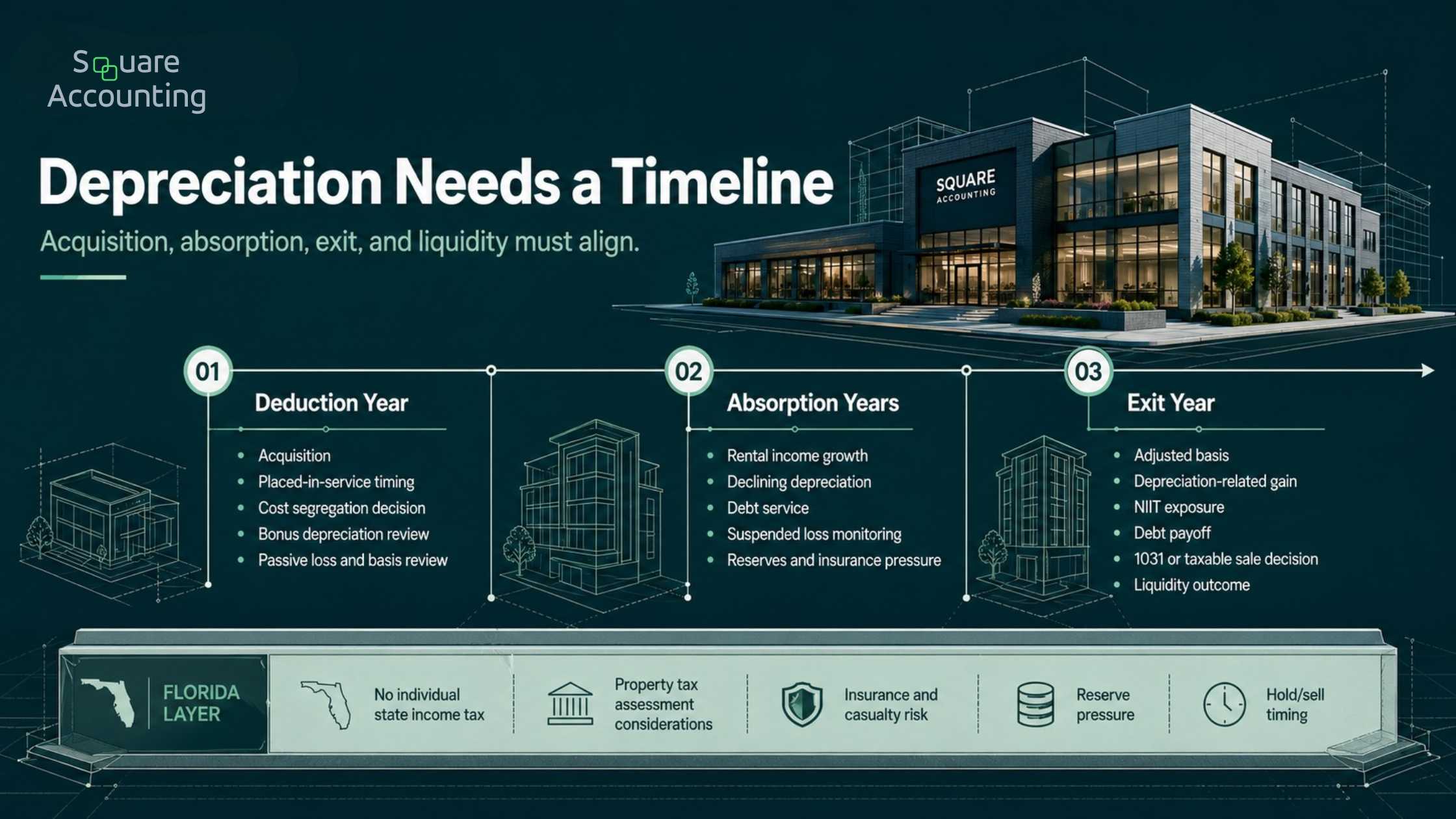
Commercial real estate becomes a stronger planning asset when depreciation, income, cash flow, Florida property economics, and exit exposure are modeled across the full holding period.
Commercial real estate can smooth taxable income across multiple years, but only when the property is planned as part of a broader income, depreciation, liquidity, and exit strategy.
The immediate answer is this: commercial real estate helps smooth income when depreciation deductions are timed to years when they can actually be used, and when the later consequences of those deductions are modeled before the property is acquired, improved, refinanced, sold, exchanged, or transferred.
That is the planning issue beneath the search query. A commercial property is not just an asset that produces rent and depreciation. It is a timing instrument. It can shift taxable income between years, create suspended losses, reduce basis, affect NIIT exposure, and change the tax cost of an exit.
For high-income Florida taxpayers, the planning usually comes down to three linked periods:
| Planning Period | What Should Be Decided | What Can Go Wrong |
|---|---|---|
| Acquisition Year | How much depreciation should be accelerated, and can the taxpayer actually use it? | The deduction is maximized but trapped by passive loss, basis, or at-risk limits. |
| Holding Years | How will rent growth, declining depreciation, debt service, reserves, and other income sources interact? | The property looks tax-efficient early, then taxable income rises as depreciation falls. |
| Exit Year | How will gain, depreciation-related exposure, NIIT, liquidity, and replacement property timing stack together? | The deduction strategy creates pressure in the year of sale, exchange, or restructuring. |
This is why using commercial real estate to smooth income and depreciation across multiple years should not begin with the question, “How large can the first-year deduction be?”
It should begin with a better question:
Which years need relief, which years can absorb income, and what will the exit look like after depreciation has done its job?
Current federal rules make the sequencing especially important. IRS guidance provides that certain qualified property acquired and placed in service after January 19, 2025 may qualify for a 100% special depreciation allowance, while qualified property generally includes certain tangible MACRS property with a recovery period of 20 years or less. Buildings themselves follow different recovery periods: residential rental property is generally recovered over 27.5 years and nonresidential real property over 39 years under MACRS.
That gap between the building and its shorter-lived components is where much of the tax planning lives. It is also where a shallow strategy can create problems later.
Introduction: Why Commercial Real Estate Works Best as a Multi-Year Planning Asset
Many high-income taxpayers first encounter commercial real estate tax planning through cost segregation, bonus depreciation, or a year-end acquisition. Those tools can be valuable. They can also create a false sense of strategy when they are used without a multi-year model.
A commercial property can produce several tax outcomes at the same time:
Rental income or operating business income
Straight-line depreciation
Accelerated depreciation from properly classified shorter-lived components
Passive or nonpassive losses
Interest expense considerations
Suspended losses
Gain on sale
Depreciation-related gain
Unrecaptured Section 1250 gain
Potential NIIT exposure
Entity-level allocation and basis consequences
The planning value is not created by any one item. It is created by the coordination between them.
For Florida investors, this coordination is often more important because Florida does not impose an individual income tax. That does not make taxes simple. It usually shifts more of the meaningful planning to the federal level, including depreciation, passive activity treatment, NIIT, capital gain timing, estate planning, charitable strategy, installment sale planning, and exit sequencing.
Florida real estate concentration adds another layer. A high-net-worth taxpayer may own an operating business, a professional practice, a medical office building, warehouse space, short-term rentals, triple-net properties, multifamily units, and family-owned entities. These assets may all create different income patterns, depreciation schedules, debt maturities, and exit windows.
That is where smoothing matters.
The goal is not to make every year look identical. The goal is to avoid unnecessary spikes, cliffs, and mismatches between taxable income, actual cash flow, liquidity, and future gain recognition.
Key Takeaways
Commercial real estate can smooth income only when depreciation is matched to usable income. A deduction that is suspended may still have value, but it is not the same as a current-year tax reduction.
The strongest depreciation strategy is rarely “take the most possible now.” The right answer depends on passive activity treatment, future income, entity structure, basis, debt, holding period, and exit timing.
Cost segregation is a sequencing tool, not a stand-alone strategy. It should be judged by full-cycle tax efficiency, not just the size of the first-year deduction.
Exit-year planning belongs at acquisition. Depreciation reduces basis and can increase future gain, including unrecaptured Section 1250 gain and possible NIIT exposure.
Florida property economics can change the federal tax decision. No individual income tax increases the importance of federal planning, while insurance, reserves, casualty exposure, and property tax reassessment risk can change hold/sell timing.
A multi-year plan should preserve optionality. Entity structure, ownership percentages, debt terms, elections, and documentation can either keep future choices open or narrow them when flexibility matters most.
See how NIIT, depreciation recapture, passive loss rules, and entity structure connect across a real estate portfolio.
How Commercial Real Estate Smooths Income Across Multiple Years
Commercial real estate smooths income through timing. It does not make taxable income disappear. It changes when income and deductions appear, which income buckets they affect, and how future gain is created.
The smoothing effect usually comes from four levers.
| Lever | How It Smooths Income | Planning Question |
|---|---|---|
| Straight-Line Depreciation | Creates predictable deductions over the building’s recovery period. | Is stable annual shelter more valuable than acceleration? |
| Accelerated Depreciation | Pulls deductions into earlier years for qualifying shorter-lived property. | Can the taxpayer use the deductions in the intended year? |
| Portfolio Sequencing | Staggers acquisitions, improvements, refinancings, and exits. | Are deductions and gains clustered or deliberately spaced? |
| Exit Timing | Coordinates sale, exchange, installment reporting, or transfer with other income. | Will the exit land in a tax-heavy year or a planned absorption year? |
This matters most when the taxpayer has predictable income pressure. Examples include:
A business owner expecting several high-profit years before a sale
A physician, attorney, executive, or founder with consistently high W-2, K-1, or equity income
A real estate investor whose early depreciation-heavy properties are becoming taxable
A Florida investor with several properties likely to sell or refinance in the same cycle
A family office coordinating income, estate, liquidity, charitable giving, and real estate exposure
The mistake is treating depreciation as the strategy. Depreciation is a timing mechanism. It can be extremely valuable, but its value depends on what it offsets, when it offsets it, and what it creates later.
A commercial property with weak fundamentals, fragile cash flow, excessive leverage, or a forced exit is not a good tax strategy just because it produces deductions. Tax planning should improve a sound investment. It should not be used to rationalize a property that does not work economically.
A better smoothing analysis asks:
Which income years are likely to be unusually high?
Which deductions can be used currently rather than suspended?
Which properties are moving from depreciation-heavy years into taxable income years?
Which planned exits may stack into the same year?
Which elections or structures preserve flexibility if income changes?
Which Florida property costs could shorten the intended holding period?
Those questions move the discussion from deduction hunting to income design.
We can help identify where your acquisitions, deductions, holding period, and exit windows may be misaligned.
The Core Framework: Deduction Year, Absorption Years, Exit Year
A stronger way to evaluate commercial real estate tax planning is to divide the property into three linked phases: the Deduction Year, the Absorption Years, and the Exit Year.
The point is not to predict every outcome perfectly. It is to avoid making a first-year decision that quietly limits later choices.
1. The Deduction Year
The Deduction Year is the year the property is acquired, improved, placed in service, or studied for cost segregation. This is where most tax conversations start, and where many plans become too narrow.
The visible question is usually, “How much depreciation can we create?”
The more useful question is, “How much depreciation should we create in this year, given how it will be used and what it will do to the exit?”
Commercial real estate often includes components that may be depreciated faster than the building itself, such as certain land improvements, fixtures, equipment, or qualified improvement property when properly classified. If eligible, some shorter-lived property may qualify for bonus depreciation. That can be powerful in a high-income year.
But a deduction has to pass through several planning gates before it produces the intended result:

Accelerated depreciation is most useful when the deduction can be used in the intended year and still supports the later exit strategy.
Asset classification: What is building, land, land improvement, equipment, or qualified improvement property?
Placed-in-service timing: Is the property or improvement actually ready and available for its intended use?
Loss allowance: Is the loss limited by passive activity, basis, at-risk, or other rules?
Income match: Is the deduction offsetting the income the taxpayer actually wants to reduce?
Marginal-rate value: Is the deduction being used in a high-value year or pushed into a lower-value year?
Exit impact: How will accelerated depreciation affect basis, gain, and recapture-related exposure later?
This is where a high-income taxpayer with a strong projection can still get surprised. The tax model may show a large depreciation number, but the return may show suspended losses. That is not necessarily a failed outcome, but it is a different outcome. Suspended losses may have value against future passive income or upon a taxable disposition. They should be planned, not discovered.
In some cases, the best move is to accelerate depreciation aggressively. In other cases, it may be better to elect out of bonus depreciation for certain property classes where the law allows, preserve deductions for future years, stagger improvements, or coordinate the acquisition with a known income event.
The Deduction Year should not be optimized in isolation. It should be designed with the next two phases already in view.
2. The Absorption Years
The Absorption Years are the years after acquisition when the first-year deduction fades and the property begins to reveal its long-term tax profile.
This is where many plans lose discipline. The cost segregation study has been completed. The return has been filed. The investor assumes the property is now “tax-efficient.”
But the tax profile is changing.
Rental income may rise as leases reset. Depreciation may decline after accelerated deductions. Interest expense may change because of refinancing, amortization, or rate resets. Repairs, tenant improvements, reserves, insurance, and capital expenditures may alter cash flow. Other income sources may increase or decrease.
During the Absorption Years, the investor should monitor:
Whether rental income is increasing faster than remaining depreciation
Whether suspended losses are being used or accumulating
Whether passive income exists elsewhere in the portfolio
Whether another acquisition or improvement project should be sequenced into a high-income year
Whether debt service is consuming cash that the tax model assumed would be available
Whether reserves are realistic given insurance, repairs, and tenant rollover
Whether the taxpayer’s business income, compensation, or liquidity events have changed
Whether entity structure still supports the intended allocation and exit path
The smoothing value often comes from portfolio-level timing. One property may be moving out of its high-depreciation years while another is being acquired or improved. A taxpayer may choose to complete improvements in a year when business income is unusually high. A sale may be delayed or accelerated to avoid stacking gain with another liquidity event.
This is where planning becomes active. The property is no longer just being depreciated. It is being managed against a changing income pattern.
3. The Exit Year
The Exit Year is where weak depreciation planning becomes visible.
A sale, exchange, installment sale, ownership transfer, or restructuring can create several layers of tax and liquidity pressure at once. These may include appreciation gain, gain attributable to prior depreciation, unrecaptured Section 1250 gain, Section 1245 recapture on certain reclassified property, NIIT, debt payoff, partner distributions, and replacement property demands.
The IRS describes unrecaptured Section 1250 gain as the portion of long-term capital gain from Section 1250 real property attributable to depreciation, and the portion of gain from selling Section 1250 real property is taxed at a maximum 25% rate.
NIIT also needs to be modeled for high-income taxpayers. The NIIT is 3.8% on the lesser of net investment income or the amount by which modified adjusted gross income exceeds the statutory threshold. The IRS lists the thresholds as $250,000 for married filing jointly or qualifying surviving spouse, $125,000 for married filing separately, and $200,000 for single or head of household filers. Net investment income generally includes items such as capital gains and rental income.
The Exit Year is not just a capital gain calculation. It is a stack.
| Exit-Year Layer | Why It Matters |
|---|---|
| Adjusted Basis | Prior depreciation reduces basis and can increase recognized gain. |
| Depreciation-Related Gain | The earlier deduction may reappear in a different form at exit. |
| NIIT | A sale may push investment income and MAGI into a higher exposure year. |
| Debt Payoff | Taxable gain and available cash do not always move together. |
| Suspended Losses | Some losses may be released in a taxable disposition, but timing and ownership details matter. |
| Replacement Property | A 1031 exchange may defer gain, but it requires suitable property, timing, financing, and owner alignment. |
| Other Income Events | A business sale, bonus, Roth conversion, trust distribution, or portfolio rebalancing may land in the same year. |
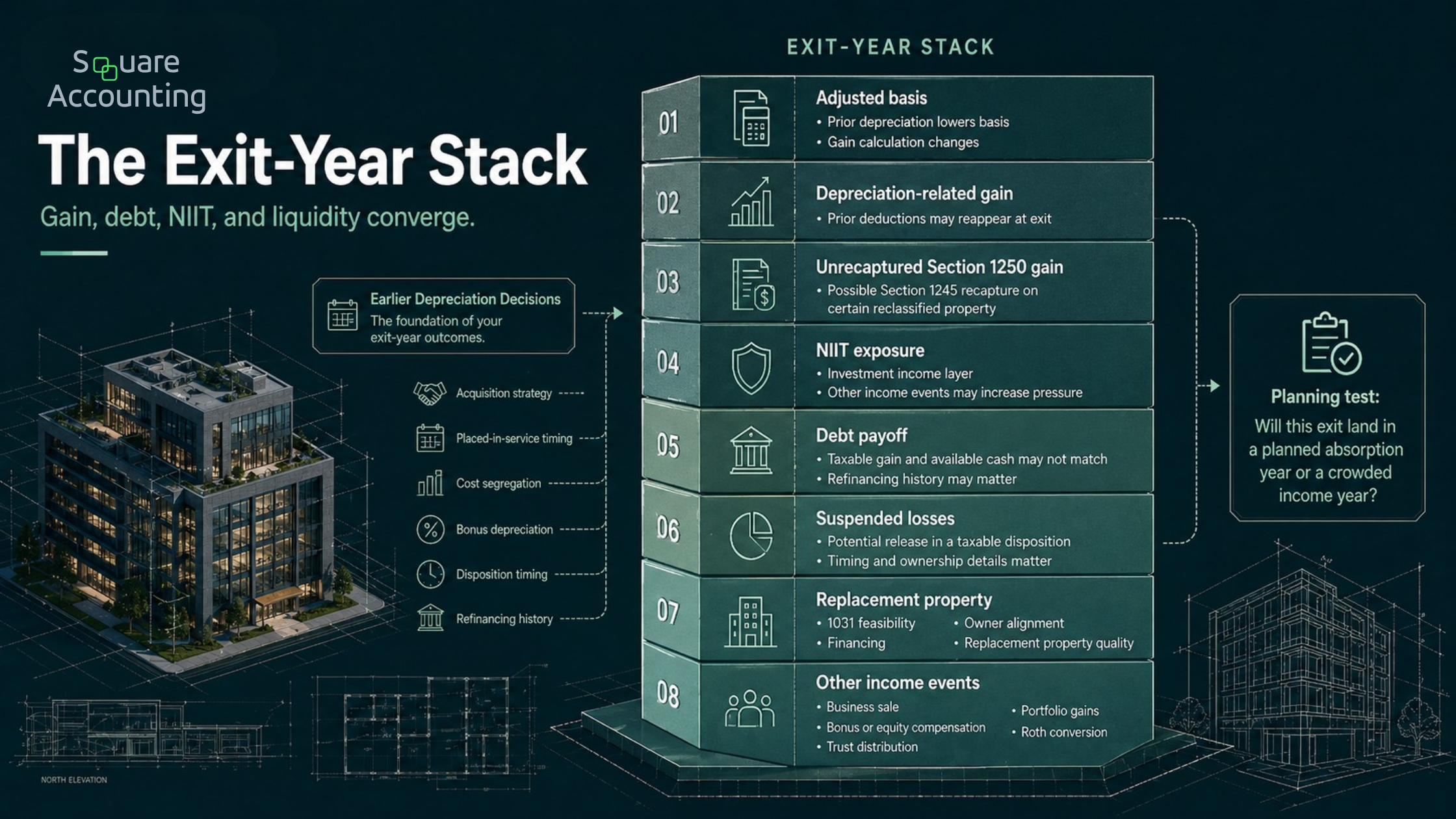
The exit year should be modeled as a stack of tax and liquidity effects, not just a capital gain calculation.
The right exit question is not only, “Can we defer gain?”
It is, “What happens if this exit lands in the same year as everything else?”
For a high-income taxpayer, a poorly timed exit can erase much of the perceived benefit of earlier deductions. The taxpayer may have lowered taxable income in Years 1 and 2, only to concentrate gain, NIIT exposure, and liquidity pressure in Year 5.
That does not mean accelerated depreciation was wrong. It means the exit should have been modeled before the acceleration decision was made.
Use our multi-year real estate tax planning framework to evaluate whether depreciation, income, and exit timing are working together.
Cost Segregation: Useful, but Often Over-Simplified
Cost segregation can be an important part of commercial real estate tax planning. It identifies components of a property that may be depreciated over shorter lives than the building itself. In the right situation, it can accelerate deductions and improve after-tax cash flow.
But cost segregation is not automatically a better strategy. It is a sharper tool, which means the planning margin matters more.
It is most useful when:
The taxpayer can use the deductions currently or has a clear plan for suspended losses
The property has meaningful shorter-life components
The taxpayer has income in the year the deductions are most valuable
The expected holding period supports the cost, complexity, and exit consequences
The investor’s entity structure supports the intended allocation of income, loss, and debt
The exit model accounts for depreciation-related gain and possible recapture dynamics
It may be less useful, poorly timed, or incomplete when:
The investor is passive and cannot absorb the losses currently
The property may be sold in a short time frame
The taxpayer already has large suspended losses without a clear use case
The deduction falls into a lower-income or lower-rate year
The property has fragile cash flow or heavy reserve needs
The study creates administrative complexity without improving the full-cycle result
The ownership group has different income needs, bases, or exit intentions
Cost segregation should not be judged only by first-year tax reduction. The better metric is full-cycle efficiency:
Did the acceleration move deductions into the right years, preserve flexibility, support cash flow, and avoid creating a worse exit-year stack?
A cost segregation study may still be worthwhile when losses are suspended, but the planning rationale changes. The value may come from future passive income shelter, release of losses on disposition, or coordination with other portfolio activity. That should be documented as part of the plan.
The most important point is simple: accelerated depreciation is accelerated timing. It is not extra depreciation.
The “Works Early, Breaks Later” Pattern
One of the most common failure modes in deduction-heavy real estate planning is the works early, breaks later pattern.
It often looks like this:
Year 1: The taxpayer acquires a commercial property and accelerates depreciation. The projected deduction looks strong.
Year 2: The property stabilizes. Taxable income is low, but cash flow is tighter than expected because of insurance, repairs, tenant improvements, tenant rollover, or debt service.
Year 3: Depreciation drops. Rental income rises. The taxpayer has fewer deductions and more taxable income from the same property.
Year 4 or 5: The taxpayer sells, refinances, gifts interests, restructures ownership, or considers a 1031 exchange. Prior depreciation has reduced basis. Gain recognition, unrecaptured Section 1250 gain, possible Section 1245 recapture, and NIIT now matter more than expected.
The plan did not fail because depreciation was wrong. It failed because depreciation was treated as the plan.
This pattern is especially common when the first-year projection is prepared without a property lifecycle model. A tax estimate may show a large deduction, but it may not show:
When depreciation falls off
Whether losses are usable or suspended
How the deduction affects basis
Whether refinancing proceeds will be available without a tax event
Whether the owners will agree on a sale or exchange later
Whether the replacement property market will support a 1031 strategy
Whether Florida insurance, reserves, or casualty exposure will shorten the intended holding period
The correction is not to avoid accelerated depreciation. The correction is to test it.
Before choosing the depreciation approach, model the property through likely exit windows. A three-year, five-year, and ten-year scenario can reveal very different answers. Sometimes the largest first-year deduction is still the best answer. Sometimes a more measured approach produces better lifetime tax efficiency.
Tax efficiency is not measured by the biggest deduction in the first year. It is measured by the best after-tax result across the ownership period, including the year the property leaves the plan.
Let’s evaluate whether your commercial real estate strategy is improving your multi-year after-tax position or simply shifting pressure forward.
Active, Passive, and Mixed Investors: The Classification Problem
Sophisticated taxpayers often underestimate how much classification controls the result.
A business owner may assume that being active in business makes them active in real estate. A real estate investor may assume that owning multiple properties creates enough involvement. A high-income professional may assume that a large investment produces usable losses.
Those assumptions can be costly.
The main planning issue is whether the real estate loss can offset the income the taxpayer wants to offset. If the activity is passive, losses may be limited unless the taxpayer has passive income or another rule allows current use. If the taxpayer qualifies as a real estate professional and materially participates in the relevant activities, the analysis may change. Short-term rentals require their own review because the classification may differ from traditional long-term rentals depending on average stay, services, participation, and reporting facts.
A useful way to think about this is the loss-absorption map.
| Taxpayer Profile | Planning Pressure |
|---|---|
| High W-2 Professional With Passive Rentals | Large depreciation may be suspended unless passive income or another planning path exists. |
| Business Owner With Operating Income and Rental Property | The real estate activity must be analyzed separately from the operating business. |
| Real Estate Professional Candidate | Documentation, material participation, grouping, and spouse activity may determine loss usability. |
| Short-Term Rental Operator | Classification may help or hurt depending on services, average stay, participation, and self-employment tax exposure. |
| Passive Investor in Partnerships | K-1 losses may be limited by passive rules, basis, at-risk rules, and entity-level choices. |
| Mixed Florida Portfolio Owner | Multiple activities may create offset opportunities, but only if grouped, documented, and modeled correctly. |
The planning cannot stop at the property level. It has to connect the taxpayer, the activity, the entity, the income bucket, and the intended offset.
This is where many fragmented advisory teams miss value. The attorney sees the entity. The lender sees the debt. The CPA sees the return. The investment advisor sees liquidity. The property manager sees operations. But no one may be modeling how the losses, income, basis, and exit year interact across the taxpayer’s full picture.
That is also why an article about depreciation is not enough for a high-income reader. The deduction is only useful if the taxpayer’s classification lets it reach the intended income.
Entity Structure Can Preserve or Limit Flexibility
Entity structure should not be designed only for liability protection, lender preference, or administrative simplicity. It also affects tax flexibility.
For commercial real estate, structure can influence:
Allocation of income, loss, and cash distributions
Outside basis and debt basis
Ability to use losses
At-risk exposure
Transferability of ownership interests
Estate planning and gifting options
1031 exchange execution
Partnership tax complexity
State filing exposure for non-Florida properties
Financing and refinancing options
Buy-sell terms and exit alternatives
A structure that works at acquisition may not work well at exit.
For example, a multi-member partnership may provide allocation flexibility and shared ownership, but it can complicate a sale if partners have different tax bases, suspended losses, liquidity needs, or reinvestment goals. One owner may want a 1031 exchange while another wants cash. One family branch may want to hold for estate planning while another wants to sell. The tax plan becomes an ownership governance issue.
A disregarded entity may be simpler, but it may not support the same capital-raising, estate planning, or family ownership objectives. A corporate structure may create serious complications for appreciated real estate if used without careful planning.
Entity structure also matters when commercial real estate is connected to an operating business. A taxpayer who owns a building and leases it to their own company may face different classification and planning issues than a taxpayer who owns a passive rental property. The rental arrangement, entity ownership, lease terms, and exit strategy should be reviewed together.
The right structure is not the one that produces the cleanest opening documents. It is the one that supports the intended holding period, income allocation, debt strategy, estate plan, asset protection goals, and exit path.
The test is practical: Will this structure still work when one owner wants liquidity, one wants deferral, and the tax profile of the property has changed?
Florida-Specific Planning Considerations
Florida’s tax environment changes the planning emphasis. It does not remove the need for planning.
Because Florida does not impose an individual income tax, high-income Florida taxpayers often focus heavily on federal outcomes. That is logical. But it can also create a blind spot: federal tax efficiency does not automatically mean the property-level economics are durable.
Several Florida-specific issues deserve attention.
Federal Planning Carries More Weight
For a Florida resident, the largest income tax planning opportunities often sit at the federal level. Depreciation, passive activity treatment, NIIT, gain recognition, installment sale treatment, charitable planning, estate planning, and timing of business income may matter more than they would in a state where the taxpayer is also modeling a large state income tax.
That makes multi-year federal modeling more important, not less.
A Florida taxpayer may not have state personal income tax, but they may still face substantial federal tax from ordinary income, long-term capital gain, depreciation-related gain, NIIT, and trust or estate structures. The absence of a state income tax can make federal timing decisions more visible because there is less state-level noise in the model.
The practical point is that Florida residency should not make the planning narrower. It should make federal sequencing more precise.
Real Estate Concentration Can Magnify Exit-Year Risk
Many Florida high-net-worth taxpayers have substantial real estate exposure. That may include a primary residence, second home, short-term rental, land, commercial buildings, operating business real estate, and partnership interests.
Concentration can magnify exit-year risk. If several properties have been depreciated aggressively and are likely to be sold near the same time, the taxpayer may face clustered gains. That cluster may coincide with a business sale, retirement, relocation, estate planning transfer, portfolio rebalancing, trust distribution, or liquidity need.
A concentrated portfolio can also create false comfort. The taxpayer may feel diversified because the properties are in different LLCs or different markets. From a tax-timing perspective, the portfolio may still be concentrated if several properties have similar depreciation curves, debt maturities, insurance pressure, or exit windows.
Smoothing requires sequencing exits before they become urgent.
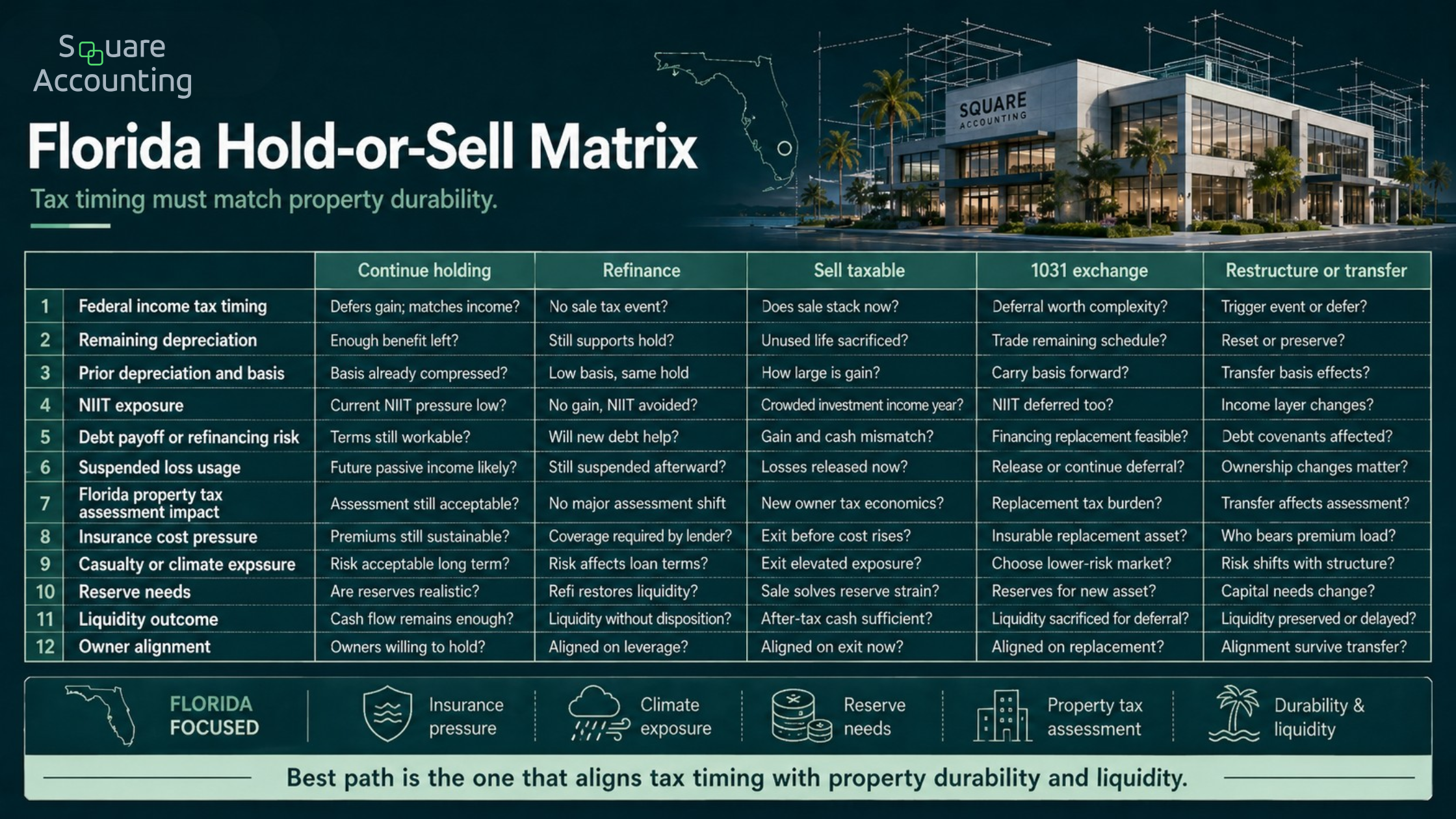
For Florida investors, federal tax efficiency should be tested against property-level durability, insurance pressure, reserves, and liquidity.
Homestead and Non-Homestead Property Tax Rules Affect Hold/Sell Thinking
Florida property tax rules can influence real estate decisions even when they do not directly change federal income tax.
Florida’s Department of Revenue states that if a homestead property’s just value increases, assessed value for the next year generally cannot increase by more than 3% of the prior year’s assessed value or the CPI change, whichever is lower. For non-homestead property, the Department states that assessed value increases are limited to 10% each year.
This matters because a federal tax plan may recommend holding, improving, transferring, or selling a property. The Florida property tax consequences may alter the economics of that decision.
For example, a transfer that looks efficient for income tax or estate planning purposes may have reassessment implications. A sale that looks attractive from a federal capital gain perspective may lead to replacement property with a different property tax profile. Improvements that support higher rent may also affect assessed value, insurance, and reserves.
The planning point is not that property tax should control the income tax strategy. It is that property tax should be part of the hold/sell model.
Insurance, Casualty, Reserves, and Climate Risk Affect Timing
Florida investors also need to treat insurance and reserve planning as tax-adjacent issues. Rising carrying costs, wind coverage, flood exposure, casualty risk, tenant improvements, and capital reserve needs can change the intended holding period.
A property may be tax-efficient but capital-inefficient. If insurance, repairs, or reserves consume cash flow, the taxpayer may be forced into a sale in a poor tax year. Alternatively, a taxpayer may defer an exit for tax reasons while property-level risk is increasing.
The better approach is to model tax and liquidity together. That means asking:
How much after-tax cash flow remains after realistic reserves?
Could insurance changes force a refinancing, capital call, or sale?
Would casualty exposure make a longer hold less attractive?
Is the property still worth holding after accelerated depreciation has declined?
Does the tax plan depend on a holding period the property may not support?
Would a sale create enough after-tax liquidity after debt payoff, gain, NIIT, and replacement needs?
For Florida real estate, tax planning should not be isolated from risk planning. The most elegant depreciation strategy can break if the property cannot support the holding period assumed in the model.
Common Misuse and Oversights Sophisticated Taxpayers Still Make
Even experienced investors make mistakes when commercial real estate tax planning is treated as a deduction exercise rather than a multi-year strategy.
Mistake 1: Treating Depreciation as a Permanent Savings Strategy
Depreciation is valuable, but it usually changes timing. It reduces taxable income during the holding period and reduces basis for a future sale. That can be a good trade when deductions offset higher-tax income, when gain is deferred or recognized in a better year, or when the after-tax cash flow is reinvested productively.
But depreciation is not free.
The planning question is whether the timing shift improves the taxpayer’s full-cycle outcome. A deduction taken in a high-income year may be highly valuable. A deduction that creates low-rate shelter or suspended losses with no plan may be less valuable than it looks.
The right analysis compares years, not just deductions.
Mistake 2: Accelerating Deductions Without Confirming Loss Usage
A large depreciation deduction may look compelling in a projection. But if passive activity rules prevent current use, the result may be suspended losses rather than immediate tax reduction.
Suspended losses can still be valuable. They may offset future passive income or be released in a taxable disposition if the rules are satisfied. But that is not the same as using the deduction against current business, professional, or investment income.
This mistake is common because the projection often shows the deduction before it shows the limitation stack. A better model asks, in order:
Does the taxpayer have basis?
Is the taxpayer at risk?
Is the activity passive or nonpassive?
Is there passive income available?
Are excess business loss or other limitations relevant?
If the loss is suspended, when and how is it expected to be used?
The answer may still support acceleration. But the plan should say why.
Mistake 3: Ignoring NIIT Until the Sale Year
NIIT is often missed because it is not part of the headline capital gain rate. For high-income taxpayers, rental income and capital gains may fall within net investment income depending on the facts. The 3.8% tax can become material in an exit year, especially when the sale coincides with other income.
NIIT should be modeled before the exit year, not after the purchase agreement is signed.
The most important NIIT question is not whether the taxpayer is generally high income. Many readers of this article already are. The more useful question is whether the real estate exit will stack on top of another income event.
Examples include:
Sale of an operating business
Large bonus or equity compensation year
Roth conversion
Trust distribution
Portfolio rebalancing
Sale of another property
Deferred compensation payout
Installment sale income from a prior transaction
A real estate exit that looks reasonable on its own may become inefficient when layered into a larger income year.
Mistake 4: Assuming a 1031 Exchange Solves Everything
A like-kind exchange can be a valuable deferral tool, but it is not a substitute for planning. It requires replacement property, timing discipline, lender coordination, liquidity, ownership alignment, and a willingness to remain invested in real estate.
A forced exchange into a mediocre property can preserve tax deferral while weakening the investment portfolio. That is not a successful outcome.
A 1031 plan can also become complicated when owners have different goals. One partner may want cash. Another may want deferral. A family entity may have estate planning goals. A lender may limit replacement options. A Florida investor may want to reduce property-level risk but still preserve deferral.
The better question is not simply, “Can we exchange?”
It is, “Should we remain in real estate, what type of property fits the next stage, and how much flexibility do we need if the replacement market does not cooperate?”
Mistake 5: Separating the Real Estate Plan From the Business Income Plan
Many high-income taxpayers buy commercial real estate while also operating a business or professional practice. That creates opportunity, but only if the two plans are coordinated.
A business may have a high-income year, a reinvestment year, a pending sale, a change in owner compensation, new debt, or a large capital expenditure. Commercial real estate depreciation should be timed around that income pattern where possible.
The same deduction can be more valuable in one year than another.
For example, a taxpayer expecting a business sale may want to preserve certain deductions or plan a real estate acquisition before the liquidity event. Another taxpayer may want to avoid creating a large suspended loss in a year when future passive income is uncertain. A third may need to revisit ownership structure because the real estate is tied to the operating company’s location, lease, or succession plan.
Real estate tax planning and business tax planning should not run on separate calendars.
Mistake 6: Letting the Entity Structure Become a Trap
Ownership structures often persist long after they stop serving the plan. A structure created for one property may later hold several properties. A partnership designed for friends may become a family office vehicle. A disregarded entity may become too simple for the estate plan. A lending structure may limit transfer options.
Entity structure should be reviewed before a sale, refinance, gift, ownership change, or 1031 exchange. Waiting until the transaction is already in motion can narrow the choices.
The warning sign is when the property has a strong tax opportunity, but the structure cannot execute it cleanly.
Examples include:
Owners with different bases and different exit goals
Partnership agreements that do not address tax distributions adequately
Debt allocations that affect loss usage differently among owners
Ownership interests that are difficult to gift or recapitalize
A planned exchange that does not align with how the property is owned
Family members entering ownership without clarity on liquidity and control
A structure is not successful because it was simple at formation. It is successful if it still works when the tax plan changes.
A Practical Multi-Year Planning Sequence
A strong commercial real estate tax plan should usually move in this order.
Year 0: Pre-Acquisition Modeling
Before closing, model the property under several scenarios:
Standard depreciation only
Cost segregation with accelerated depreciation
Bonus depreciation where available
Conservative cash flow and reserve assumptions
Passive loss limitations
Basis and at-risk limitations
Potential refinancing
Sale in year 3, year 5, and year 10
1031 exchange possibility
Installment sale possibility
Estate or family transfer goals
Florida property tax, insurance, and reserve assumptions where relevant
This is also the time to review entity structure, lender requirements, ownership percentages, operating agreements, related-party leases, and whether the property will be used in connection with an operating business.
The pre-acquisition model should answer one practical question: What does this property need to do for the taxpayer’s multi-year tax position, and what assumptions would cause that plan to fail?
Year 1: Acquisition and Depreciation Decisions
After closing, confirm the placed-in-service date, asset classification, land allocation, improvement history, and whether a cost segregation study is appropriate. Decide whether to claim or elect out of certain accelerated depreciation where the law allows.
The objective is not simply to create the largest deduction. It is to create the best deduction pattern.
Year 1 should also include a loss-usage review. If the model assumes the deduction will offset current income, confirm that the taxpayer’s classification, basis, at-risk position, and passive income profile support that result.
If the deduction will be suspended, document the reason it still makes sense.
Years 2 and 3: Absorption and Adjustment
Compare the original model to actual results.
Did income rise faster than expected? Did repairs, tenant improvements, or insurance reduce cash flow? Are losses being used or suspended? Has the taxpayer’s other income changed? Did debt terms change? Is another property entering or leaving the portfolio?
This is where a second acquisition, improvement project, refinancing, grouping review, or exit plan may become relevant.
Years 2 and 3 are often the best time to correct the plan because the property is seasoned enough to produce real data, but not so close to sale that options are limited.
Years 4 and Beyond: Exit Readiness
Before the property is marketed, model the sale.
Estimate gain categories, depreciation-related exposure, NIIT, debt payoff, suspended losses, partner-level consequences, liquidity, and reinvestment options. Compare a taxable sale, 1031 exchange, installment sale, partial sale, refinance, family transfer, or continued hold where appropriate.
The exit decision should not be based only on market price. It should include after-tax proceeds, replacement opportunities, reserve needs, owner alignment, and the taxpayer’s broader income year.
This is also where Florida-specific realities should be revisited. If insurance, casualty exposure, property tax economics, or reserve needs have changed, the tax plan may need to change with them.
When Commercial Real Estate Is the Wrong Smoothing Tool
Commercial real estate is not always the right answer.
It may be a poor fit when:
The taxpayer needs liquidity in the near term
The investment depends on unrealistic appreciation assumptions
Losses are likely to be suspended with no clear future use
The taxpayer is buying primarily for tax deductions
The property has weak fundamentals
Debt terms create refinance risk
Insurance or reserves make the holding period fragile
The investor does not want operational complexity
The ownership group has conflicting goals
The exit strategy depends on finding a perfect replacement property
The tax benefit is small relative to the risk, cost, and complexity
A tax-efficient bad investment is still a bad investment.
The better standard is this: the property should make sense before tax, and tax planning should improve the timing, flexibility, and after-tax result. If the property only works because of an aggressive deduction assumption, the plan is fragile.
For high-income taxpayers, the danger is not usually lack of opportunity. It is overcommitting to an asset that solves one tax year while creating a longer-term liquidity or exit problem.
What Commercial Real Estate Investors Get Wrong About Depreciation and Tax Planning
Depreciation is one of the most powerful tools in commercial real estate — and one of the most misunderstood. A large deduction on paper does not guarantee a current-year benefit. Whether those losses can offset W-2 or business income depends on passive activity rules, material participation, ownership structure, basis, and at-risk limits. The first question is never how much you can depreciate. It is whether those losses can reach the income you actually want to offset.
Cost segregation and bonus depreciation follow the same logic. Cost segregation is most valuable when you can use the deductions in the near term, plan to hold the property, and have an exit strategy that accounts for future gain. The building structure itself is generally not the primary target — the opportunity lies in shorter-lived components identified through proper classification. And once bonus depreciation is claimed, the decision is irrevocable. Section 179 offers more flexibility for the portion of your strategy where optionality matters.
The permanent 100% bonus depreciation rate under the One Big Beautiful Bill Act removes the deadline pressure that defined planning under the TCJA phase-down. Timing is now driven by your income curve and economics — not the tax calendar.
On the income tax side, Real Estate Professional Status does not eliminate the 3.8% Net Investment Income Tax. REPS reclassifies rental losses as non-passive, but net rental income and capital gains can still be subject to NIIT above the applicable MAGI threshold. What reduces NIIT exposure is reducing net investment income — and a well-timed cost segregation study can accomplish that even without professional status. The more common breakdown happens at exit, when a real estate sale stacks with a business sale, bonus, Roth conversion, or other gain in the same year. That is when marginal rates and NIIT collide, and when the absence of advance planning is most costly.
Two other points worth holding: depreciation recapture only applies where a gain exists — a sale below adjusted basis produces a capital loss, not recapture income. And for investors who hold property until death, the stepped-up basis permanently eliminates accumulated recapture, making front-loaded depreciation strategies asymmetrically favorable with no downstream cost.
Tax efficiency on paper must still reflect economic reality. In Florida, where state income tax is not a variable, planning attention shifts almost entirely to federal exposure — but property-level costs, insurance, reassessment risk, and liquidity requirements remain material. A position that is structurally sound from a tax perspective still has to hold up under the actual economics of ownership.
Conclusion: The Goal Is Not More Depreciation. It Is Better Sequencing.
Using commercial real estate to smooth income and depreciation across multiple years requires more than a cost segregation study, a year-end purchase, or a large first-year deduction.
It requires sequencing.
The strongest plans connect acquisition timing, depreciation choices, passive activity treatment, entity structure, cash flow, reserves, federal tax exposure, Florida property economics, and exit strategy.
For high-income Florida taxpayers, this coordination can be especially valuable. With no individual state income tax, federal planning often carries the heaviest weight. But Florida real estate also brings practical realities that can change the timing decision: property tax caps and resets, insurance pressure, casualty exposure, reserve needs, liquidity demands, and concentrated real estate exposure.
Commercial real estate can smooth taxable income. It does so best when the plan is built before the deduction, monitored during the holding period, and tested against the exit year.
The right question is not, “How much can we deduct?”
It is, “How do we use this property to improve the taxpayer’s multi-year after-tax position while preserving flexibility?”
That is where the planning becomes strategic.
We can review your Florida real estate holdings, depreciation posture, and exit assumptions as part of a coordinated multi-year tax strategy.
Commercial Real Estate Tax Planning FAQs
Key planning questions for high-income investors evaluating depreciation, loss usability, entity structure, and exit-year exposure.
How should a high-income investor decide whether to accelerate or preserve depreciation?
We would start by matching the deduction to the years where it has the most practical value. Accelerating depreciation may help when the taxpayer has income that can absorb the loss and a holding period that supports the strategy. Preserving deductions may be more useful when future income is expected to rise, losses may be suspended, or an exit is likely sooner than expected. The right answer is not based on the largest first-year deduction. It depends on income timing, loss limitations, basis, debt, ownership structure, and the likely exit window.
What should be modeled before buying commercial real estate for tax planning?
Before acquisition, we would model more than rent, debt service, and depreciation. The planning should test standard depreciation, accelerated depreciation, conservative reserve assumptions, passive loss limitations, basis and at-risk limits, refinancing scenarios, and multiple exit windows. For Florida investors, the model should also include property tax, insurance, casualty exposure, and liquidity assumptions where relevant. The goal is to understand what the property needs to accomplish in the taxpayer’s broader multi-year tax picture and which assumptions could cause the strategy to break.
How can commercial real estate create tax problems in a later year?
Commercial real estate can create later pressure when early depreciation reduces taxable income but also reduces basis. As the property stabilizes, rental income may rise while depreciation declines. If the property is later sold, exchanged, restructured, or transferred, prior depreciation may affect gain exposure, liquidity, and NIIT planning. The issue is not that depreciation is bad. The issue is that a deduction-heavy strategy can shift pressure into a year when the taxpayer also has a business sale, bonus, trust distribution, portfolio gain, or other income event.
Why does loss absorption matter more than the size of the deduction?
A large depreciation deduction is only useful in the way the rules allow it to be used. If passive activity, basis, at-risk, or other limitations prevent current use, the deduction may become a suspended loss rather than a current offset. Suspended losses can still be valuable, but they serve a different purpose. We would want to know whether the taxpayer has passive income, whether activity classification is supportable, and when the loss is expected to become useful. Without that analysis, the deduction number can overstate the actual planning benefit.
How should commercial real estate planning change before a sale or exchange?
Before a sale or exchange, we would shift from deduction planning to exit stack planning. That means reviewing adjusted basis, prior depreciation, suspended losses, debt payoff, owner-level consequences, NIIT exposure, liquidity needs, and replacement property options. A 1031 exchange may help defer gain, but it does not solve every planning issue. The better question is whether the taxpayer wants to remain in real estate, whether replacement options fit the portfolio, and whether the exit year overlaps with other major income events.
What makes Florida commercial real estate planning different for HNW taxpayers?
Florida’s lack of individual income tax often makes federal planning the primary income tax focus, but it does not make the analysis simpler. Florida investors still need to coordinate depreciation, passive activity treatment, gain timing, NIIT, entity structure, and exit planning. Property-level economics can also change the decision. Insurance costs, casualty exposure, reserves, property tax assessment issues, and liquidity needs may affect whether a tax-efficient holding period is realistic. For Florida HNW taxpayers, the strongest plan connects federal tax strategy with property durability.
How do entity and ownership choices affect multi-year depreciation planning?
Entity and ownership choices can determine whether income, losses, debt, basis, distributions, and exit options work as intended. A structure that is simple at acquisition may become restrictive when owners have different tax bases, liquidity needs, or reinvestment goals. This matters for partnerships, family entities, related-party leases, and commercial real estate tied to an operating business. We would review whether the structure can support the intended depreciation strategy, future transfers, possible refinancing, 1031 planning, and an eventual sale without forcing avoidable tax or governance conflicts.
When does commercial real estate stop being a good income-smoothing tool?
Commercial real estate becomes a weak smoothing tool when the tax benefit depends on assumptions the property cannot support. Warning signs include fragile cash flow, near-term liquidity needs, suspended losses with no clear use, unrealistic appreciation expectations, refinance risk, heavy insurance or reserve pressure, and owners with conflicting exit goals. The property should make sense before tax. Tax planning can improve timing and after-tax outcomes, but it should not be the reason to buy or hold an asset that creates long-term liquidity or exit risk.
