
Common Entity Structuring Mistakes That Undermine Otherwise Sound Tax Plans

Entity structure should be evaluated as a multi-year system, not a one-time formation decision.
Common entity structuring mistakes usually do not look like mistakes when the entity is formed.
The LLC is created. The S corporation election is filed. The property closes. The operating agreement is signed. The books begin cleanly enough.
The problem often appears later, when the structure has to do more than exist. It has to support loss use, basis, financing, payroll treatment, ownership changes, estate planning, and an eventual sale or transfer.
The central planning issue is this: a tax plan can be technically sound and still underperform if the entity structure blocks the timing, character, or flexibility the plan depends on.
The core issue: the wrong entity can block the right tax strategy
The most common entity structuring mistakes are not limited to choosing the “wrong” entity. They usually involve choosing an entity before the tax lifecycle is understood.
For high-income owners and real estate investors, the entity should be tested against six questions early:
| Planning Question | Why It Matters |
|---|---|
| What type of income will the entity produce? | Ordinary income, rental income, capital gain, portfolio income, and service income are not planned the same way. |
| Who needs to use the deductions? | Losses may be limited by basis, at-risk rules, or passive activity treatment. |
| How will debt be allocated? | Financing can affect basis, cash distributions, refinancing options, and loss capacity. |
| Will the asset appreciate? | Appreciation raises exit, recapture, estate, and transfer issues. |
| Will ownership change? | New partners, trusts, family members, or investors can change both tax and governance outcomes. |
| What is the likely exit? | Sale, exchange, refinance, gift, succession, and liquidation can require different structures. |
The structure is doing its job only if it supports those answers over time.
A common mistake is treating entity choice as a menu: LLC, S corporation, partnership, corporation, trust. A better approach is to treat entity choice as a control system. The structure should control how income flows, how losses are used, how debt is supported, how owners enter or exit, and how the tax plan behaves when the asset is sold.
That is where many generic entity-selection discussions fall short. They explain the containers, but they do not stress-test the plan.
The quick diagnostic
A structure deserves review when any of the following are true:
The entity was formed before the tax strategy was designed.
The entity holds appreciating real estate but was chosen for payroll tax reasons.
A high-income owner expects current deductions, but passive activity treatment has not been modeled.
Multiple assets with different risk, financing, or exit timelines are held together.
Depreciation was accelerated without reviewing basis, recapture, NIIT, and liquidity.
A spouse, trust, family member, or outside investor was added without revisiting ownership economics.
The expected exit has changed.
These are not merely compliance issues. They are planning issues.
The IRS recognizes that an LLC may be treated differently for federal tax purposes depending on ownership and elections, including as a disregarded entity, partnership, or corporation. A domestic LLC with at least two members is generally classified as a partnership unless it elects corporate treatment. That classification decision affects much more than the tax form filed. It can change loss use, compensation planning, debt basis, distributions, ownership transfers, and exit mechanics.
We can help identify where your entity structure may create friction around basis, passive losses, ownership changes, or future exits.
Why this matters more for high-income Florida taxpayers
Florida’s lack of individual income tax is an advantage, but it does not make entity structure less important. It often makes federal planning more visible.
For a high-income Florida taxpayer, the biggest income tax questions are usually federal: ordinary income timing, passive loss usability, depreciation, capital gain, NIIT, estate planning, and exit-year gain recognition. Florida does not impose an individual income tax, which means there may be less state income tax friction on Florida-source individual income, but federal tax classification still carries the weight.
That matters because many Florida taxpayers hold concentrated real estate, short-term rentals, closely held operating businesses, professional practices, and investment entities across family members or trusts. The structure that works for one property or business line may not work once the portfolio grows, debt changes, or the exit plan becomes more serious.
Florida also adds planning realities that are not purely income-tax driven:
Homestead and non-homestead property tax economics can affect hold, sell, rent, or convert decisions.
Insurance costs and casualty exposure can change liquidity needs and holding periods.
Short-term rental activity can create classification questions that should be addressed before deductions are claimed.
Real estate concentration can magnify depreciation, recapture, basis, and exit-year consequences.
Florida’s Save Our Homes assessment limitation generally caps annual assessment increases on qualifying homestead property after the first year at the lesser of 3% or the CPI change. That is a property-tax planning factor, not an entity-selection shortcut, but it can affect whether a residence, rental conversion, transfer, or sale fits the broader plan.
Key takeaways
Entity structure should be designed around the full tax lifecycle: formation, operations, financing, deductions, ownership changes, and exit.
Many structures work in Year 1 and become restrictive later, especially when appreciation, debt, or new owners enter the picture.
Real estate investors should be cautious about using S corporations for appreciating property without a specific exit analysis.
Passive activity classification, basis, and debt allocation often determine whether deductions are usable or merely deferred.
NIIT, depreciation recapture, and unrecaptured Section 1250 gain should be modeled before a large real estate exit, not after a letter of intent is signed.
Florida’s no-income-tax environment increases the importance of federal coordination rather than eliminating complexity.
A good structure preserves options. A weak structure forces tax decisions when liquidity, market timing, or family objectives have already changed.
Mistake 1: Treating entity formation as the tax plan
A formation document is not a tax plan.
Many taxpayers start with the entity because it feels concrete. They ask whether they need an LLC, an S corporation, a partnership, or a holding company. Those are valid questions, but they are rarely the first questions.
The better starting point is:
What tax result does this structure need to preserve over the next several years?
For example, a stabilized rental property, an active development project, a professional services firm, and a short-term rental with meaningful owner involvement each create different planning needs. A property expected to be sold in three years should not automatically be structured the same way as a property intended for family ownership over decades.
Entity formation should be matched to:
income character
expected losses
financing and refinancing plans
ownership changes
liability separation
payroll and compensation planning
estate and succession goals
state and local tax exposure
exit strategy
The failure mode is simple. The taxpayer forms a valid entity, but not one that supports the strategy.
For a sophisticated taxpayer, the entity should be formed only after the planning assumptions are visible. If the assumptions are not yet clear, the structure should be flexible enough to change without creating unnecessary tax cost.
Mistake 2: Assuming “LLC” answers the tax question
An LLC is a legal form. It is not a single federal tax answer.
This is one of the most common entity structuring mistakes because the word “LLC” is often used as if it settles both liability planning and tax planning. It does not.
A single-member LLC may be disregarded for federal income tax purposes. A multi-member LLC may be treated as a partnership. An LLC may elect corporate taxation. In some cases, an eligible LLC may elect S corporation treatment.
Those classifications can produce very different outcomes.
For real estate, partnership taxation may support flexibility around allocations, partner-level basis, debt sharing, contributions, distributions, and certain ownership changes. For an operating business, S corporation taxation may reduce self-employment tax exposure in some cases, but it brings reasonable compensation requirements and ownership limitations.
For a high-income taxpayer, the question is not simply:
Should this be an LLC?
The better question is:
What federal tax classification should this legal entity have, and how does that classification interact with the owner’s income, losses, debt, family ownership, and exit plan?
This distinction becomes more important as the taxpayer adds properties, investors, trusts, management companies, or operating businesses. A simple LLC structure may still be legally valid, but the tax classification may no longer match the facts.
Mistake 3: Using an S corporation where partnership flexibility is needed
S corporations can be valuable for certain operating businesses. They can also be a poor fit for appreciating real estate.
The issue is not that S corporations are inherently wrong. The issue is that they are often selected for one perceived benefit without enough attention to asset type, appreciation, distributions, basis, debt, ownership changes, and exit planning.
For an active business with meaningful owner services, an S corporation may be appropriate. But the plan has to include reasonable compensation. The IRS states that S corporations must pay reasonable compensation to shareholder-employees for services before making non-wage distributions.
That means an S corporation strategy should not be reduced to “take a low salary and the rest as distributions.” A reasonable compensation position should be supportable based on the owner’s role, market compensation, business economics, and documentation.
For real estate, the concern is different.
Appreciating property often requires structural flexibility. Owners may want to refinance, admit partners, allocate economics in different ways, distribute property, exchange assets, transfer interests to trusts, or separate assets before a sale. Partnership-taxed structures are often better suited to those dynamics.
An S corporation can make some of those moves more rigid. The problem may not show up when the property is acquired. It may show up when the property has appreciated, the owner wants to restructure, and the tax cost of moving the asset is no longer minor.
The mistake is not choosing an S corporation. The mistake is choosing it for an early benefit while ignoring what the entity may need to do later.
Mistake 4: Separating legal planning from tax planning
Entity structure is often handled in fragments.
A lawyer forms entities for liability protection. A CPA files returns based on the structure already created. A lender requires a borrower entity. A financial advisor models liquidity. An estate attorney transfers interests. Each advisor may be doing competent work within a narrow scope.
The problem is that entity-structure mistakes often arise between the scopes.
Examples include:
The legal structure separates liability, but the tax structure traps losses.
The operating agreement allows special economics, but the tax allocations do not support them.
A lender-required transfer changes ownership or basis consequences.
A trust receives an interest without reviewing income, NIIT, or future gain.
An S corporation election is made before reasonable compensation and exit issues are modeled.
A holding company simplifies the chart but complicates financing, sale negotiations, or asset-level reporting.
Sophisticated taxpayers rarely suffer from having no advisors. They more often suffer from having uncoordinated advice.
The structure should be reviewed as a system before major acquisitions, elections, refinances, gifts, ownership changes, and exits. That review should include tax, legal, financing, insurance, and estate planning implications.
A structure is not integrated just because every document exists. It is integrated when the documents, tax classification, books, cash movement, and long-term plan all point in the same direction.
Mistake 5: Ignoring passive activity classification
Passive activity classification is where many otherwise strong real estate tax plans lose their current-year value.
A taxpayer may buy real estate, complete a cost segregation study, claim depreciation deductions, and expect those deductions to offset high W-2 or business income. But rental activity is often treated as passive unless an exception or specific set of facts changes the result. The tax result depends on participation, grouping, activity classification, basis, at-risk exposure, and the taxpayer’s broader income profile.
This matters because a deduction is not the same as a currently usable deduction.
A loss may be real and properly reported, yet suspended. That may still have value, but it changes the economics of the strategy. The taxpayer who expected current cash-tax relief may instead be building deferred tax attributes that become useful only against passive income or upon a qualifying disposition.
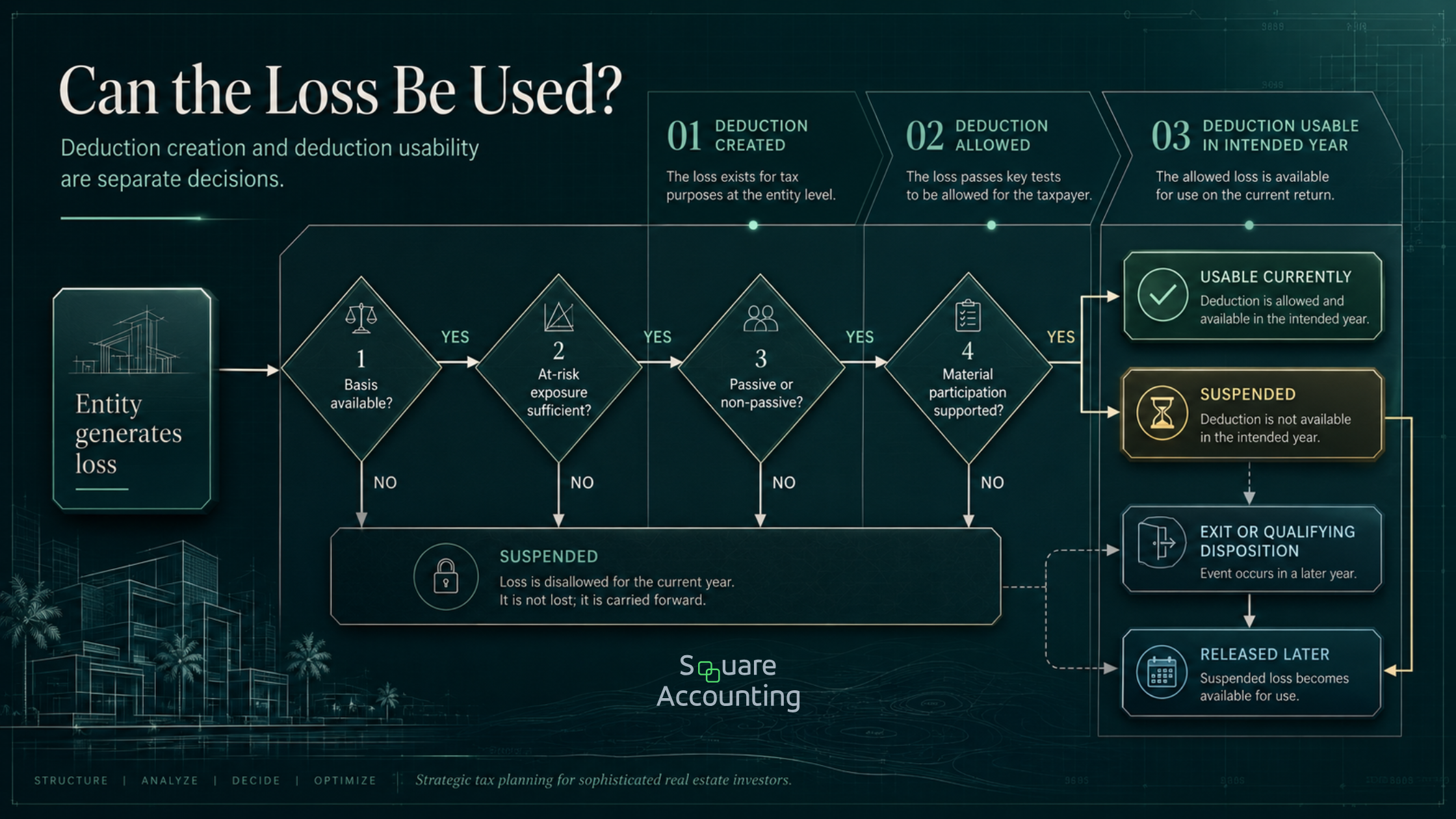
The value of a deduction depends on who can use it, against what income, and in which year.
For high-income taxpayers, loss planning should not stop at whether the entity produces a deduction. The more important question is whether the structure allows that deduction to create tax value in the intended year.
For high-income taxpayers, the planning question is not simply:
Can the entity generate losses?
The better question is:
Who can use those losses, against what type of income, and in which year?
Short-term rentals deserve special attention. IRS passive activity guidance provides that an activity is not treated as a rental activity for this purpose if the average period of customer use is seven days or less, although that does not by itself make losses automatically usable against all income. Material participation, services provided, grouping, and self-employment tax exposure may still need review.
This is where entity structure, operations, and documentation intersect. The entity should match the actual activity. The owner’s participation should match the claimed tax treatment. The books should distinguish rental income, services, reimbursements, management fees, and owner payments.
When those items are not aligned, the strategy can look strong in planning but weak in examination or exit.
Mistake 6: Creating deductions without modeling the exit year
Many tax plans are built around the deduction year. Better plans model the exit year before claiming the deduction.
This is especially important for real estate investors using cost segregation, accelerated depreciation, or other deduction-heavy planning. Those tools can be valuable, but they affect basis, future gain, liquidity, and the character of income on sale.
For depreciated real estate, part of the gain may be treated as unrecaptured Section 1250 gain. IRS guidance states that the portion of any unrecaptured Section 1250 gain from selling Section 1250 real property is taxed at a maximum 25% rate.
High-income taxpayers also need to model NIIT. IRS guidance states that the 3.8% net investment income tax applies to certain individuals, estates, and trusts that have net investment income above applicable threshold amounts. The IRS lists statutory individual threshold amounts of $250,000 for married filing jointly, $125,000 for married filing separately, $200,000 for single or head of household, and $250,000 for a qualifying widow or widower with a child.
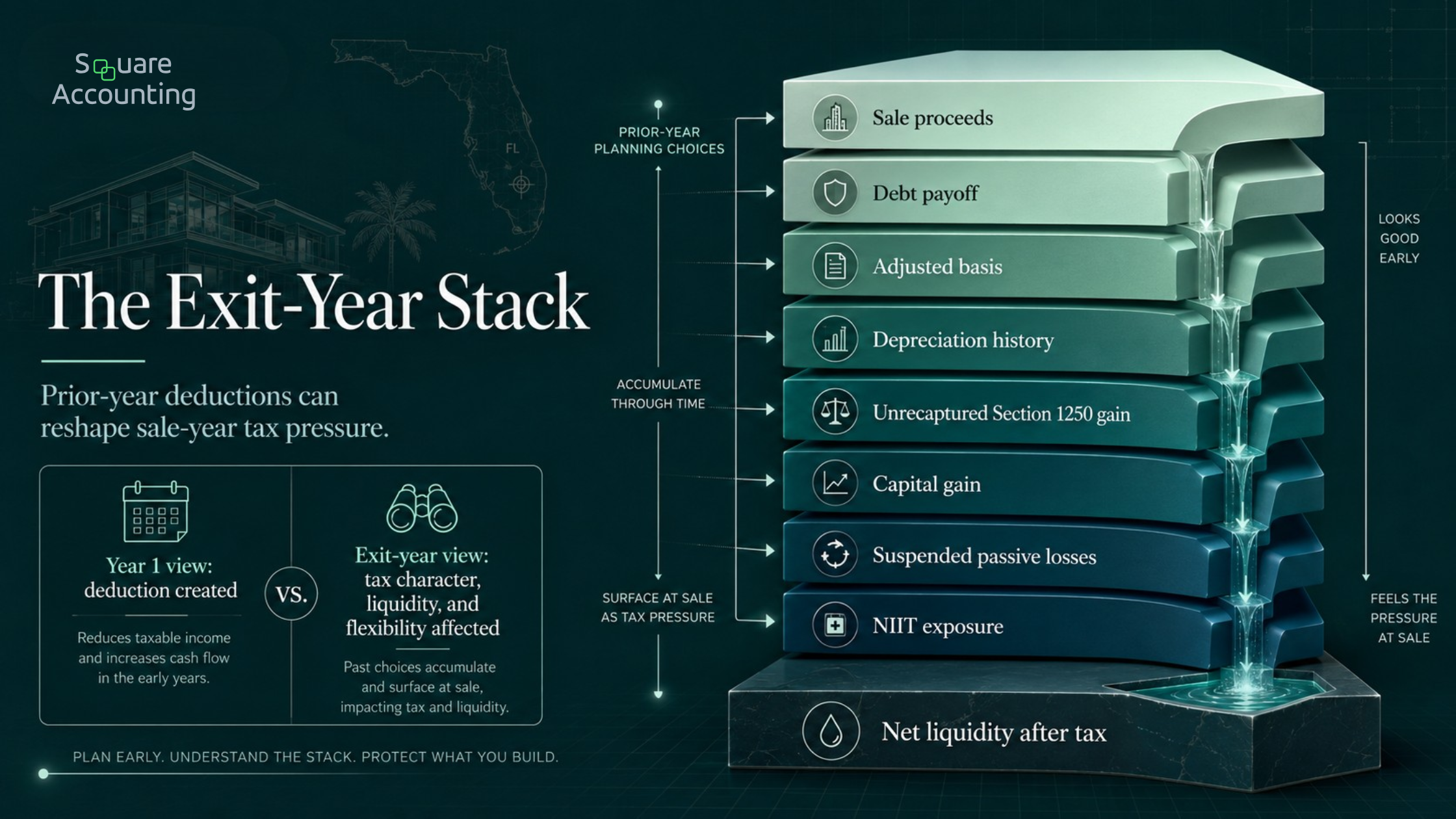
Exit-year modeling helps reveal whether early deductions improved long-term efficiency or shifted tax pressure forward.
The sale year often concentrates issues that were created over several prior years. A useful model should show not only gain, but the layers that determine cash tax and liquidity after closing.
In a real estate exit, the tax stack may include:
regular long-term capital gain
unrecaptured Section 1250 gain
gain tied to depreciation and basis reduction
suspended passive loss release or limitation
NIIT
state income tax outside Florida, if property or owners are outside Florida
debt payoff and liquidity demands
replacement property or reinvestment timing
trust, estate, or family ownership issues
This is the “works early, breaks later” pattern.
A strategy may create useful losses in Years 1 and 2. But if the property is sold in Year 5, the prior depreciation, debt history, suspended losses, ownership structure, and NIIT exposure all meet in one year.
The question is not merely:
Can we create the deduction?
The better question is:
What will this deduction do to basis, gain character, NIIT exposure, liquidity, and exit flexibility?
Continue with deeper planning topics such as NIIT, depreciation recapture, passive loss rules, and real estate exit timing.
A more useful framework: formation year, operating years, exit year
Entity structure should be stress-tested across three time periods.
This is the framework we find most useful because it exposes problems that a one-year projection misses. A formation-year choice may look efficient, an operating-year result may look acceptable, and the exit-year outcome may still be poor.
Formation year
In the formation year, the key decisions are classification, ownership, capitalization, operating agreement design, asset separation, and election timing.
Questions to ask:
Should the entity be disregarded, partnership-taxed, S corporation-taxed, or C corporation-taxed?
Are we holding appreciating real estate, operating income, intellectual property, investment assets, or mixed activities?
Will owners contribute cash, property, guarantees, or services?
How will debt be allocated?
Are spouses, trusts, children, or outside partners involved?
Do we need different entities for property ownership, management, and operations?
What would make this structure difficult to unwind later?
The unwind question is important. Many structures can be created easily but changed only at a tax cost.
Operating years
In the operating years, the structure must support reporting, deductions, cash distributions, payroll, loss use, financing, and documentation.
Questions to ask:
Are losses usable, suspended, or limited by basis or at-risk rules?
Is debt being tracked correctly for tax purposes?
Are distributions tax-efficient and properly documented?
Are shareholder-employees receiving reasonable compensation where required?
Are intercompany payments supportable?
Are management fees, leases, reimbursements, and owner payments documented?
Do grouping and participation positions still match the facts?
Has the business or portfolio outgrown the original structure?
A structure should be maintained, not merely formed.
Exit year
In the exit year, structure becomes most visible.
Questions to ask:
Will the transaction be an asset sale, interest sale, exchange, installment sale, gift, or liquidation?
What gain character will be created?
How much depreciation has been claimed?
Will suspended losses be released, and to whom?
Will NIIT apply?
Do different owners have different basis, liquidity needs, or tax profiles?
Does a trust or family structure change the timing or burden of tax?
Can the taxpayer exchange, refinance, hold, sell, gift, or restructure without triggering an avoidable result?
Does the current structure limit buyer or lender options?
The exit year is where earlier shortcuts become visible.
Use our entity-structure review lens to see whether your current structure still matches your income, debt, ownership, and exit assumptions.
Mistake 7: Combining assets that should be separated
High-income taxpayers often prefer simplicity. One entity, one bank account, one set of books, one tax return.
That simplicity may become expensive.
Combining unrelated assets in one entity can create problems around liability, financing, sale negotiations, partner disputes, insurance, and tax planning. A rental property, short-term rental, operating business, investment account, and management company may all need different treatment.
For example, placing multiple Florida rental properties in one LLC may reduce administrative work, but it can make it harder to sell one property cleanly, admit a partner into one asset, isolate casualty risk, refinance one property, or track suspended losses by activity.
The answer is not always “more entities.” Too many entities can create unnecessary cost, weak bookkeeping, compliance failures, and confusion.
The better answer is intentional separation.
Assets may deserve separate treatment when they have different:
liability profiles
financing arrangements
ownership groups
exit timelines
tax characteristics
operating risks
insurance concerns
succession goals
A good structure should reduce future friction. It should not create a complex chart that no one maintains.
Mistake 8: Letting payroll tax planning drive the entire structure
S corporation planning is often oversimplified as a payroll tax strategy.
For some business owners, S corporation taxation may be appropriate. But it should not be selected without reviewing profit level, owner involvement, reasonable compensation, retirement plan design, qualified business income planning, fringe benefits, state issues, and future sale goals.
The reasonable compensation requirement is not a footnote. It is central to the structure.
A structure that depends on an aggressive salary assumption is not a durable tax plan. It is a risk position.
For Florida professional service firms, medical practices, consulting firms, agencies, and closely held operating companies, the analysis should include:
market compensation for the owner’s role
business profitability after wages
whether income is tied mainly to owner labor or enterprise value
payroll tax savings compared with compliance cost
retirement plan contribution goals
health insurance treatment
future sale structure
whether a future buyer would prefer assets or equity
The goal is not to minimize wages. The goal is to create a defensible structure that supports the owner’s broader tax plan.
This is also where operating businesses and real estate portfolios should be separated conceptually. The structure that works for an active management company may not be the structure that should hold appreciating property.
Mistake 9: Failing to coordinate entity structure with estate planning
Entity structure and estate planning often intersect, especially for Florida families with real estate, closely held businesses, or multi-generational wealth.
A structure that works for annual income tax reporting may not work for estate planning. Conversely, a structure that works for gifting may create income tax complications if basis, debt, control, NIIT, or future sale plans are ignored.
Common issues include:
gifting minority interests without modeling future income allocations
transferring interests to trusts without reviewing NIIT exposure
failing to document capital accounts and basis
moving real estate into entities without considering lender or property tax consequences
giving family members ownership without clear governance rights
creating structures that are difficult to unwind before sale
separating control from economics without clear operating agreement language
Trusts can be powerful, but they add another layer of tax analysis. NIIT can apply to certain estates and trusts as well as individuals when the statutory conditions are met.
A family structure should answer both questions:
Who should own or control the asset for estate and governance purposes?
Who should recognize the income, deductions, and gain for tax purposes?
Those are related questions, but they are not the same question.
For high-net-worth families, the wrong answer may not create an immediate problem. It may surface when a property is sold, a parent dies, a child wants liquidity, a trust distributes income, or a buyer asks for a cleaner transaction path.
Mistake 10: Ignoring basis until losses or distributions are blocked
Basis is not just a return-preparation number. It is a planning constraint.
Basis can determine whether losses are deductible, whether distributions are taxable, how debt affects the owner, and what happens when an interest is sold or transferred. In real estate structures, basis can move materially as debt is incurred or repaid, depreciation is claimed, capital is contributed, distributions are made, and ownership shifts.
The practical risk is that owners often pay attention to basis only after the problem appears:
A loss is limited.
A distribution is unexpectedly taxable.
A refinance changes the economics.
A partner exits.
A sale produces more gain than expected.
Suspended losses do not land where the taxpayer expected.
For multi-owner deals, basis planning should be part of the operating agreement and annual tax review. Waiting until a large loss, refinance, or sale occurs is too late.
Basis should be reviewed before:
large depreciation deductions
cash-out refinances
partner admissions or redemptions
property distributions
trust transfers
ownership gifts
sale negotiations
A taxpayer can have strong cash flow and still lack the tax basis needed to use losses or receive distributions without tax cost. That is why basis belongs in the planning conversation, not only in the return workpapers.
Common misuses and oversights sophisticated taxpayers still make
Sophisticated taxpayers rarely make simple mistakes. They make mistakes that are reasonable in isolation but weak as part of a broader plan.
They optimize one tax year instead of the ownership lifecycle
A structure that reduces tax this year may increase tax later, reduce exit options, or complicate succession. Multi-year modeling should compare the deduction year, normal operating years, refinance scenarios, and exit year.
They overuse S corporations
S corporations may be useful for operating businesses, but they are not universal. They can be especially problematic where appreciating real estate, debt allocation, property distributions, or ownership flexibility are central to the plan.
They confuse legal liability protection with tax efficiency
An LLC may provide legal separation, but that does not mean the desired federal tax result follows. Legal form and tax classification must be reviewed separately.
They chase depreciation without reviewing passive loss limits
Cost segregation and accelerated depreciation can be valuable, but only if the losses are usable in the intended timeframe or intentionally deferred as part of a broader plan.
They use holding companies without defining the purpose
A holding company can simplify governance or ownership. It can also add complexity, obscure asset-level economics, complicate financing, or create unnecessary intercompany transactions.
They ignore the buyer’s perspective
A future buyer may prefer assets, equity, clean books, separate entities, assignable contracts, or a structure that supports financing. Entity planning should consider how a buyer, lender, or successor will view the structure.
They fail to update the structure after facts change
A structure created for one property may not fit a portfolio. A structure created before marriage, children, trusts, new partners, out-of-state investments, or a larger operating business may need redesign.
The pattern is consistent. The entity was not necessarily wrong when created. It simply stopped matching the facts.
Florida-specific planning considerations
The earlier Florida context explains why federal coordination matters. The planning question here is where Florida-specific economics can actually change the structure, timing, or exit decision.
Florida taxpayers should not assume that no state individual income tax makes entity structure secondary.
For many high-income Florida residents, federal tax planning becomes the main income tax planning environment. That makes classification, passive activity treatment, depreciation, basis, NIIT, and exit modeling especially important.
Florida-specific planning should focus on the issues that actually change decisions.
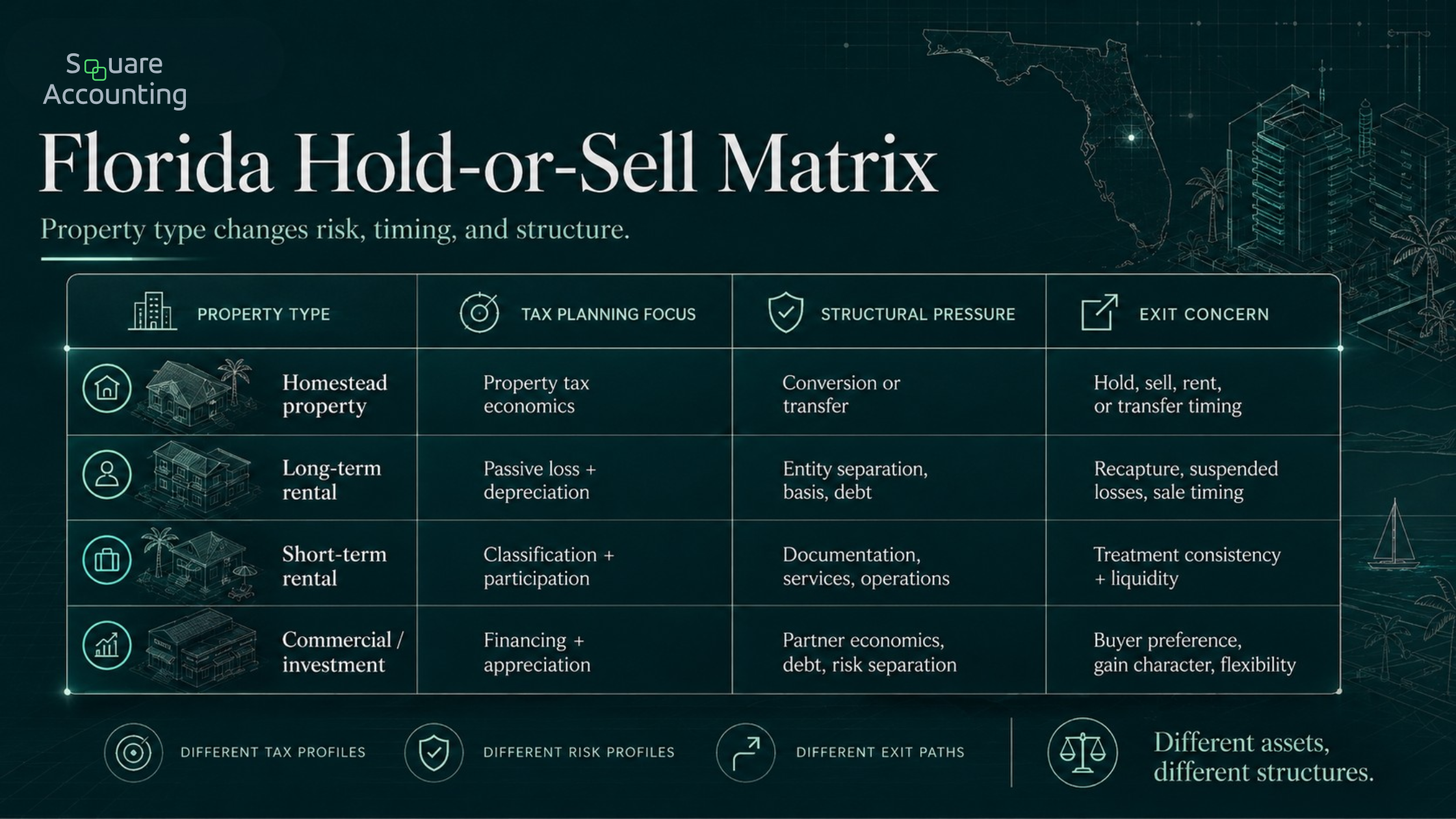
Florida planning should connect federal tax structure with property-level risk, insurance realities, and hold-or-sell timing.
Florida-specific planning is most useful when it changes the decision, not when it adds local color. The structure should reflect the property’s use, risk profile, financing needs, and realistic exit path.
Homestead versus investment property economics
A primary residence may have homestead protections and assessment limitations that differ from non-homestead property. Moving, converting, renting, transferring, or selling property can change the economics. These property-tax considerations do not replace federal income tax planning, but they can influence hold/sell timing and liquidity.
Real estate concentration
Florida investors often hold multiple rental, commercial, vacation, or short-term rental properties. Entity structure should account for property-level risk, insurance markets, debt, investor participation, and exit timing.
When multiple properties are held together, one property’s financing, casualty issue, partner dispute, or buyer demand can affect the rest of the portfolio. That may be acceptable in some cases, but it should be intentional.
Insurance and casualty reserves
Higher insurance costs, deductibles, and casualty exposure can affect whether a structure remains durable. A plan that assumes a long hold should be tested against reserve needs, repairs, liquidity events, and the possibility of selling earlier than expected.
This is not only a risk-management issue. It can become a tax timing issue if a taxpayer needs to sell, refinance, contribute capital, or restructure ownership sooner than planned.
Short-term rental classification
Florida short-term rentals can create attractive planning possibilities, but the facts matter. Average stay, owner participation, services provided, management arrangements, and documentation may all affect the tax result.
The entity should support the operating reality. A short-term rental treated like a passive investment in the documents and books may not support a more active tax position without careful review.
Exit timing
A Florida real estate sale may be driven by market pricing, insurance costs, financing, family needs, or risk concentration rather than tax timing. The entity structure should preserve enough flexibility to respond without forcing a poor tax result.
That means the exit should be discussed before the exit is imminent.
We’ll review your entity structure in the context of your Florida residency, real estate holdings, income profile, and multi-year tax plan.
The best entity structure is the one that preserves future choices
Strong entity planning does not begin with “LLC or S corporation?”
It begins with a better set of questions:
What are we trying to protect?
What income character are we creating?
Who needs to use the deductions?
What happens if the asset is refinanced?
What happens if one owner wants out?
What happens if the property is sold earlier than expected?
What happens if the taxpayer dies while still holding the asset?
What happens if tax law changes?
What happens if the plan works and the asset appreciates substantially?
That last question is often overlooked.
Many structures are built to solve today’s tax problem. Better structures are built to handle success.
A real estate investment that appreciates, a business that scales, or a family portfolio that becomes more complex will expose weaknesses in the original structure. The structure should be flexible enough to handle growth without forcing unnecessary tax costs.
This is why entity structure should be revisited at predictable decision points:
before a major acquisition
before making an S corporation election
before a cost segregation study or large depreciation strategy
before admitting a partner or family member
before refinancing
before transferring interests to a trust
before a sale process begins
after the business or portfolio materially changes
The best structure is not always the most elaborate. It is the one that keeps the taxpayer from being boxed into a tax result that could have been avoided with earlier coordination.
Entity Structure Is a Tax Decision, Not Just a Legal One
An LLC provides legal structure — but the federal tax result depends entirely on how it is classified. A single-member LLC, a partnership-taxed LLC, and an LLC electing corporate treatment can produce materially different outcomes on depreciation, distributions, exit planning, and basis. The entity form is the starting point, not the answer.
S corporations deserve particular caution in real estate. They may serve a purpose in certain operating businesses, but appreciating real estate requires flexibility around debt allocation, distributions, ownership changes, and exits that partnership-taxed structures typically handle better. An S corporation election made without a full exit analysis can create problems that are difficult and costly to unwind.
For Florida investors, the absence of state income tax does not reduce the importance of entity planning — it increases the stakes on the federal side. The relevant variables are federal income tax, NIIT, depreciation, passive activity limits, basis, and exit exposure. Removing the state layer does not simplify those questions; it makes each federal decision carry more weight.
Consolidating all real estate into a single holding company is sometimes appropriate, but should never be automatic. Separate properties may require separate entities because of liability exposure, lender requirements, investor participation, insurance considerations, or mismatched exit timelines. Simplicity in ownership structure is a reasonable goal — but not at the cost of flexibility or protection.
Entity structure should be reviewed before any major decision: acquiring a significant asset, making an S corporation election, admitting a new partner, refinancing, claiming large depreciation deductions, transferring interests to trusts or family members, or preparing for a sale. By the time a transaction is closing, the review is usually too late to matter.
Conclusion: entity structure is not separate from tax strategy
Common entity structuring mistakes undermine otherwise sound tax plans because they disconnect the legal container from the tax lifecycle.
For high-income Florida taxpayers, the entity should not be chosen only for simplicity, liability protection, or one year of tax savings. It should be coordinated with income character, passive activity rules, basis, debt, depreciation, payroll, NIIT, property tax economics, estate planning, and exit strategy.
The best structure is rarely the most complicated one. It is the one that supports the plan across multiple years.
That requires sequencing. It requires integration. It requires reviewing the structure before the tax result is already locked in.
A well-designed entity structure does not guarantee a tax outcome. It gives the plan room to work.
Bring us in before the structure is locked, the deduction is claimed, or the exit is already underway.
Entity Structure and Exit Planning FAQs
Key questions for high-income taxpayers evaluating real estate exits, suspended losses, short-term rentals, trusts, S corporations, ownership transfers, and NIIT planning.
When should an entity structure be reviewed before a real estate exit?
The review should happen before the sale process is already underway. Once a letter of intent, buyer preference, lender requirement, or family liquidity need is driving the timeline, the structure may have fewer clean options. We would look at whether the transaction is likely to be an asset sale, interest sale, exchange, installment sale, gift, or liquidation, and how that path interacts with depreciation, basis, suspended losses, NIIT exposure, debt payoff, and ownership differences. The goal is not to force one exit method. It is to avoid discovering structural friction after the economic deal is already set.
How can entity structure affect suspended passive losses?
Entity structure can affect how losses are tracked, who owns the activity, how debt and basis are allocated, and whether losses become usable in the intended year. A taxpayer may have properly reported losses that still do not offset high ordinary income because passive activity rules, basis limitations, or at-risk rules restrict current use. The planning issue is not whether the entity can produce deductions. It is whether the right taxpayer can use those deductions against the right income at the right time. That should be reviewed before cost segregation, refinancing, ownership changes, or a sale.
Why can a structure that worked in Year 1 create problems later?
Many structures are designed around the first tax benefit they produce. That can work early, then become restrictive when the facts change. A structure may support clean formation and current deductions but create pressure later around refinancing, admitting a partner, transferring interests to a trust, separating assets, or selling appreciated property. The issue is usually not that the original structure was invalid. It is that the structure was never stress-tested against appreciation, basis reduction, debt changes, ownership changes, or exit-year gain. We prefer to test the structure before those pressure points arrive.
How should Florida real estate investors think about holding multiple properties in one entity?
Holding multiple properties in one entity may reduce administrative work, but it can also combine risks and limit flexibility. Different properties may have different financing, insurance exposure, partners, operating risks, depreciation profiles, and exit timelines. One property’s casualty issue, refinance need, buyer demand, or partner dispute can affect the entire entity. That does not mean every property automatically needs its own entity. The better question is whether each asset has a distinct risk profile, tax profile, or exit path that deserves separate treatment. Entity simplicity should not come at the expense of future options.
What makes short-term rental entity planning different from traditional rental property planning?
Short-term rentals may raise classification questions that do not apply in the same way to traditional long-term rental real estate. Average stay, owner participation, services provided, management arrangements, documentation, and how income and expenses are reported can all affect the tax analysis. The entity should match the actual operating model. If the property is being positioned as more active, the books, agreements, participation records, and payment flows should support that position. The mistake is treating short-term rental structure as a standard rental template while expecting a different tax result.
How do trusts or family transfers change entity structure planning?
Trusts and family transfers add a second layer of planning because ownership, control, income recognition, deductions, gain, and liquidity may no longer sit with the same person. A transfer that makes sense for estate or governance purposes can still create income tax friction if basis, debt, NIIT exposure, suspended losses, or future sale plans are not reviewed. We would look at who controls the asset, who receives income, who bears tax, and what happens if the property is sold or refinanced later. Family ownership should clarify the plan, not make future decisions harder.
What should a business owner evaluate before choosing S corporation treatment?
S corporation treatment should be evaluated in the context of the owner’s role, business profit, compensation, retirement planning, fringe benefits, future sale goals, and whether the income is driven by owner labor or enterprise value. Payroll tax planning alone is too narrow. The structure also needs supportable reasonable compensation, clean books, defensible distributions, and a plan for what happens if the company grows or is sold. For owners who also hold real estate, the operating business structure should usually be analyzed separately from the structure used to hold appreciating property.
How does entity structure affect NIIT planning for high-income taxpayers?
Entity structure can influence how income, gain, and losses are reported, who recognizes them, and whether planning options remain available before a major transaction. NIIT planning is not isolated from the rest of the structure. It interacts with passive activity classification, trust ownership, real estate exits, suspended losses, depreciation history, and the timing of income recognition. The important point is not simply whether NIIT may apply. It is whether the structure gives the taxpayer enough flexibility to coordinate income, deductions, ownership, and exit timing before the tax year is effectively locked.

Inzamam ur Rahman
Content & Marketing Strategist
Inzamam manages content and advises on marketing strategy for Square Accounting. He works with Stevan Franeta, CPA, to create clear, practical articles for business owners, high-income professionals, and real estate investors.
Reviewed for tax accuracy by Stevan Franeta, CPA
