
Stress-Testing Tax Strategies Against Market Downturns and Income Declines
A tax strategy should not only reduce tax when income is high, asset values are rising, and liquidity is comfortable.
It should also be tested against the years when those assumptions weaken.
That is the purpose of stress-testing tax strategies against market downturns and income declines. The goal is not to predict the next recession, rate cycle, insurance spike, business slowdown, or real estate reset. The goal is to understand whether the plan still works when the facts become less favorable.
For high-income Florida taxpayers, business owners, and real estate investors, this is where tax planning often becomes more important. A strategy that looks efficient in a peak income year may create pressure when cash flow declines, passive losses are limited, refinancing becomes harder, or an asset must be sold earlier than expected.
The immediate question is not, “How much tax can we reduce this year?”
The better question is:
“If income drops, liquidity tightens, and an exit happens sooner than expected, does this tax strategy still improve the after-tax result?”
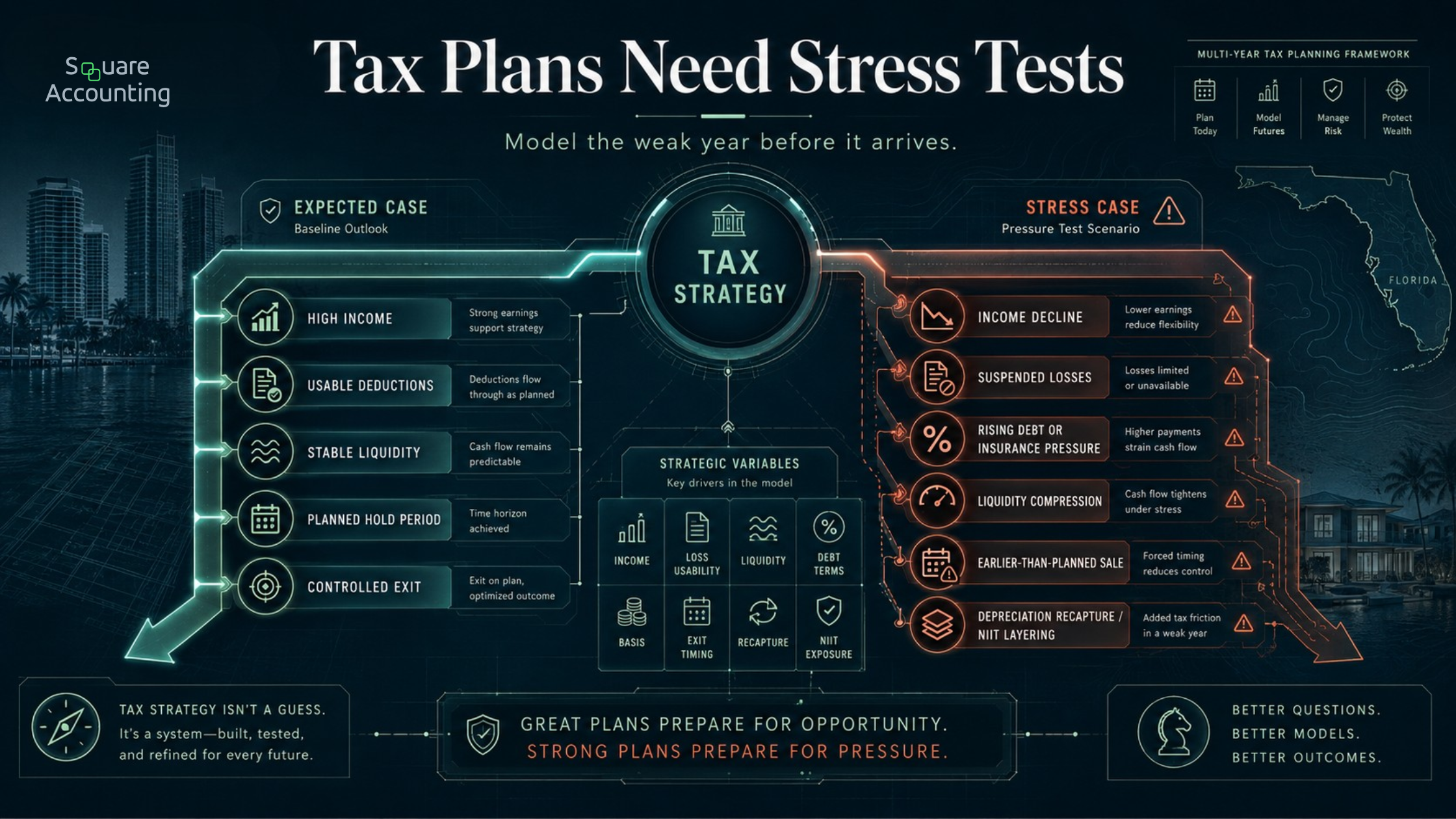
A durable tax strategy should be tested across both favorable and weaker future scenarios before the taxpayer relies on projected savings.
“Before a strategy is judged by projected savings, it should be tested against the conditions most likely to disrupt the plan. The strongest planning conversations compare the expected case against a weaker but realistic downside case.”
Stress-Testing Tax Strategies Against Market Downturns and Income Declines: The Immediate Framework
A useful tax strategy stress test should start with five pressure points.
Tax Strategies Should Be Tested Against Pressure Points
A strategy that works in a strong year should also be tested against cash flow, character, classification, control, and exit pressure before market conditions change.
| Pressure Point | Core Question | What Can Break in a Downturn |
|---|---|---|
| Cash Flow | Does the strategy preserve liquidity after the tax benefit? | A tax-motivated move may consume cash that is needed for debt service, reserves, payroll, insurance, repairs, or capital calls. |
| Character | What type of income, gain, or loss will appear later? | Ordinary income, capital gain, depreciation-related gain, passive income, and investment income may not offset each other cleanly. |
| Classification | Will the tax result land in the right bucket? | Losses may be passive, limited by at-risk rules, separated by entity, or unusable against the income the taxpayer expected to offset. |
| Control | Can the taxpayer still change timing if conditions worsen? | Entity agreements, lender restrictions, partner conflicts, trust terms, or transaction deadlines may reduce flexibility. |
| Exit | What happens if the asset or business must be sold earlier than planned? | Deferred tax, depreciation recapture exposure, suspended losses, debt payoff, NIIT exposure, and liquidity needs may converge in one year. |
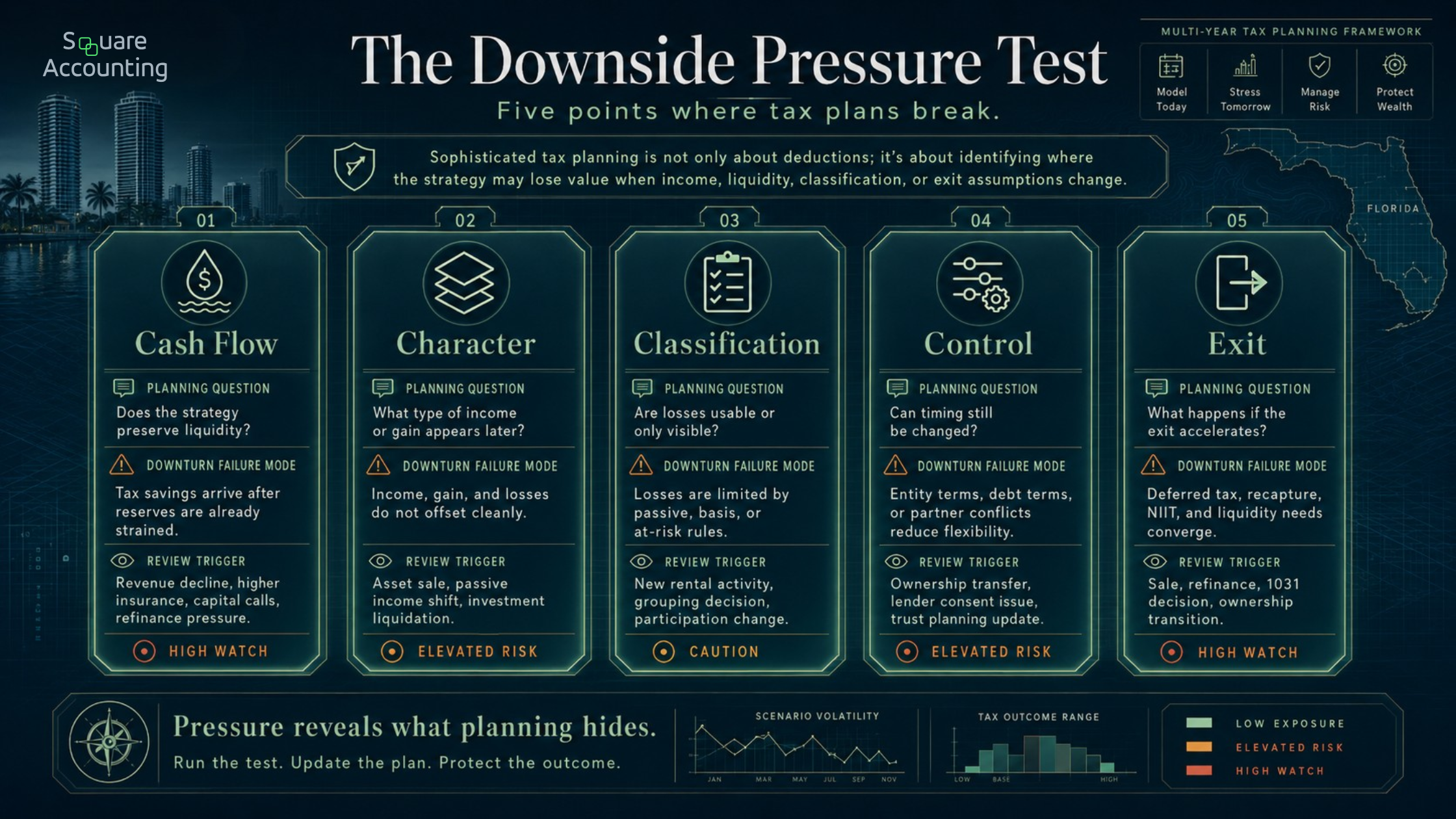
A tax strategy becomes more useful when each pressure point is reviewed before income, liquidity, or exit assumptions change.
“The framework is useful because it separates tax savings from tax resilience. A plan may reduce tax in the current year while still creating pressure in one of these five areas.”
This is the first screenful answer: a tax strategy is not fully planned until it has been tested for cash flow, character, classification, control, and exit.
Most weak plans fail because they were evaluated only under the favorable case.
A stronger plan asks how the strategy performs under a weaker but plausible case.
Use the downside tax pressure test to evaluate whether your current plan depends on income, liquidity, or exit assumptions that may change.
Why Downturns Expose Weak Tax Planning
Downturns rarely create tax problems by themselves. They expose assumptions that were already inside the plan.
A business owner may have lower revenue but fixed payroll, debt, and estimated tax pressure. A real estate investor may have tax losses but no immediate ability to use them. A high-income professional may experience one liquidity event followed by several lower-income years. A family office may hold appreciated assets but need cash when market values are down.
The tax rules may not have changed. The taxpayer’s facts changed.
That distinction matters because many strategies depend on assumptions that are easy to miss:
income will remain high enough to absorb deductions
cash flow will remain strong enough to support tax-motivated investment
refinancing will be available when needed
passive losses will be usable
the taxpayer will hold the asset long enough for the plan to mature
the preferred exit will remain available
entity structure will not limit cash movement or decision-making
advisors will coordinate across tax, legal, lending, investment, and estate planning
When those assumptions weaken, the tax strategy may still be technically valid but strategically fragile.
For Florida taxpayers, the federal tax layer often carries the greatest income tax weight because Florida does not impose an individual income tax. That makes federal timing, character, classification, depreciation, passive loss usage, NIIT exposure, and exit-year modeling especially important.
Florida also creates practical planning pressure for real estate investors. Insurance volatility, property tax changes, local rental rules, casualty exposure, reserve needs, and financing terms can affect whether a federal tax strategy is still sensible. Those are not always income tax rules, but they can determine whether the taxpayer has the liquidity and control to use the strategy well.
The Most Common Mistake: Optimizing for the Best Year
Many tax strategies are designed during a strong year.
That is natural. High income creates urgency. The taxpayer wants to reduce current tax, accelerate deductions, defer income, fund retirement plans, buy assets, restructure ownership, or harvest losses.
Those strategies may be appropriate.
The mistake is treating the strong year as the base case.
A strategy that looks attractive in a peak year may create friction if:
the deduction is generated after income declines
a loss is suspended instead of currently usable
the strategy requires cash that should have remained in reserves
debt service increases faster than income
an asset must be sold before the expected hold period
prior depreciation creates exit-year pressure
a 1031 exchange is assumed but replacement property is unattractive
an entity structure traps cash, losses, or decision rights
a trust, partnership, or S corporation creates timing limits that were not modeled
The planning issue is not whether the strategy is allowed.
The issue is whether the strategy is durable.
A tax plan should be measured across more than one year and more than one economic outcome. That is especially true for taxpayers with uneven income, leveraged real estate, closely held businesses, concentrated positions, or multi-entity structures.
The Downside Tax Pressure Test
Before implementing a major tax strategy, build a downside case.
The downside case does not need to be extreme. It should be realistic enough to expose weak assumptions.
For a business owner, that may mean revenue drops, margins compress, receivables slow, owner compensation changes, or a key customer is lost.
For a real estate investor, it may mean vacancy rises, insurance increases, repairs accelerate, refinancing proceeds are lower than expected, or a property must be sold sooner than planned.
For a high-income professional, it may mean bonus income declines, equity compensation is worth less, investment losses increase, or a liquidity event does not repeat.
The test should ask five questions.
Does the strategy still work if income declines?
Are losses usable, or only visible on paper?
Does the plan preserve liquidity and control?
What happens to basis, debt, and at-risk capacity?
What happens if the exit occurs in the wrong year?
The value of the stress test is not the spreadsheet. It is the conversation it forces before the taxpayer is under pressure.
1. Will the Strategy Still Work if Income Declines?
A deduction is most valuable when it offsets income that can actually absorb it.
This is where many strategies are oversold internally, even when no one intends to overstate the benefit. The projection shows a large deduction. The tax return may eventually show a large loss. But the real question is whether the deduction is usable in the right year against the right income.
This matters for:
cost segregation studies
accelerated depreciation planning
equipment purchases
retirement plan contributions
repair versus capitalization decisions
business expansion costs
loss-generating partnerships
real estate acquisitions
short-term rental planning
charitable contribution timing
deferred compensation decisions
The stress test should ask:
What income is this strategy expected to offset?
Is that income ordinary, capital, passive, portfolio, or investment income?
Is the income recurring or unusual?
What happens if next year’s income is materially lower?
Could a loss be limited by basis, at-risk rules, passive activity rules, or excess business loss rules?
Does the taxpayer need the tax benefit now, or can they absorb a delayed benefit?
This is the difference between creating deductions and creating usable tax value.
A $300,000 deduction that offsets high-tax income in the intended year is different from a $300,000 loss that becomes suspended, limited, or pushed into years when the taxpayer has less income.
2. Will Passive Losses Be Usable When the Market Turns?
Real estate investors often focus on generating losses.
The more important question is whether those losses can be used.
Passive activity rules, at-risk limits, material participation, real estate professional status, short-term rental classification, grouping decisions, and ownership structure can all affect whether a loss produces a current tax benefit.
The order also matters. In many real estate and closely held business situations, a loss may first need to clear basis and at-risk limitations before passive activity rules determine whether it is currently deductible.
That sequence is a common blind spot.
A taxpayer may have an economic loss, a tax loss, and still no current deduction against the income they expected to offset.
In a strong market, suspended losses may feel manageable. The asset is appreciating, cash flow is positive, and the investor expects the tax benefit to matter later.
In a weaker market, suspended losses can become more painful. The taxpayer may need liquidity, but the tax loss may not reduce current tax. The plan created a tax asset, not immediate relief.
A real estate tax strategy should therefore be tested for both tax loss creation and tax loss usability.
That means reviewing:
whether the activity is passive or nonpassive
whether material participation can be supported with records
whether a real estate professional position is realistic based on facts
whether short-term rental activity is classified and documented correctly
whether grouping elections support the broader plan
whether basis and at-risk limits may suspend losses
whether passive income exists to absorb passive losses
whether suspended losses may be released on a fully taxable disposition
whether spouse participation changes the participation analysis
whether ownership through partnerships, S corporations, trusts, or holding entities affects the result
For a reader who already has a CPA, this is often the question to ask directly:
“Are we projecting losses, or are we projecting losses we can actually use?”
Those are not the same plan.
3. Does the Strategy Preserve Liquidity?
Tax planning should improve the after-tax result. It should not quietly weaken the taxpayer’s ability to stay in control.
Some strategies create tax benefits by requiring cash outlay.
Examples include:
buying equipment before year-end
funding retirement plans
acquiring rental property
completing renovations
accelerating deductible expenses
contributing capital to an entity
paying down debt for structural reasons
entering a transaction before financing terms are clear
These moves may be appropriate. But they should be tested against liquidity needs.
A high-income taxpayer may have the income to justify a strategy but not the liquidity profile to absorb a weaker year. A real estate investor may have depreciation deductions but still need cash for insurance, assessments, repairs, tenant turnover, debt service, and reserves. A business owner may reduce taxable income but leave too little cash to handle payroll or a revenue decline.
The stress test should ask:
How much cash does this strategy require before tax savings are realized?
What reserves remain after implementation?
What happens if revenue drops or expenses rise?
Does the strategy depend on refinancing, distributions, or future capital contributions?
Would the taxpayer still make this decision without the tax benefit?
Is the tax benefit immediate, delayed, limited, or uncertain?
Could preserving cash produce a better risk-adjusted outcome?
Tax savings are only part of the planning equation.
Liquidity is often what allows the taxpayer to keep the tax plan intact.
4. What Happens to Basis, Debt, and At-Risk Amounts?
Basis and at-risk limits often become visible only when the taxpayer needs the deduction.
That is too late.
A strategy that relies on losses should be reviewed for whether the taxpayer has enough tax basis and at-risk amount to use those losses. This is especially important in partnerships, S corporations, leveraged real estate, and multi-entity structures.
The taxpayer may feel economically exposed to the activity. The tax rules may not treat the full exposure as available for deduction.
Debt allocation, guarantees, capital accounts, distributions, refinancing, partner loans, shareholder loans, and ownership changes can all affect the result.
Stress-testing should include a downside review of:
beginning and projected tax basis
capital contributions and distributions
shareholder or partner loans
debt allocations
guarantees and recourse exposure
refinancing assumptions
at-risk capacity
suspended losses
entity-level agreements
partner or shareholder changes
whether cash can be moved without creating tax or legal friction
This is also where advisor coordination matters.
The lender may want one structure. The attorney may prefer another. The tax advisor may need basis or at-risk support. The estate plan may move ownership into a trust. Each decision may be reasonable in isolation. Under stress, the combined structure may either preserve flexibility or reduce it.
The key question is not only whether a loss exists.
The question is whether the taxpayer has enough tax capacity and structural flexibility to use it.
5. Will Depreciation Create Exit-Year Pressure?
Depreciation can be a valuable planning tool.
But depreciation is not free. It reduces basis and changes the future gain profile.
This is where shallow real estate planning often breaks down. The plan celebrates the deduction year but does not model the exit year.
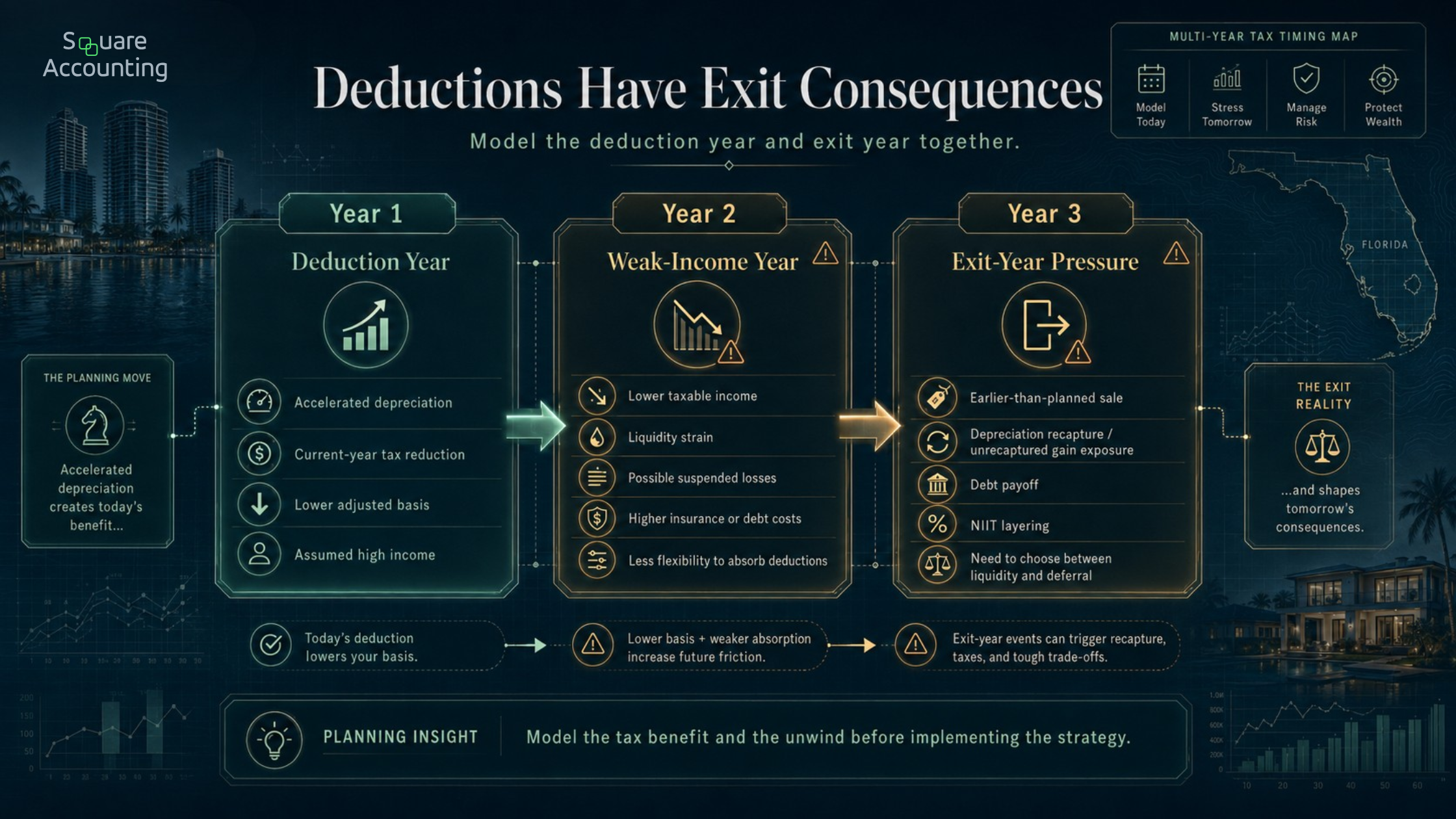
The tax value of a deduction depends on when it is used, whether it is limited, and how it affects the future exit.
“Accelerated deductions should not be reviewed in isolation. The more useful analysis connects the deduction year, the years of ownership, and the year the taxpayer may need to sell, exchange, refinance, or transfer the asset.”
That may be acceptable if the investor has a long hold period, sufficient liquidity, and a realistic plan for disposition. It may be risky if the investor is likely to sell, refinance, restructure, consolidate the portfolio, or transfer ownership during a weaker market.
A downturn can accelerate exit pressure.
If the taxpayer sells earlier than planned, prior depreciation may show up as:
lower adjusted basis
larger taxable gain
depreciation recapture or unrecaptured Section 1250 gain exposure
Section 1245 recapture on certain components
suspended passive loss release considerations
debt payoff pressure
limited reinvestment flexibility
possible NIIT exposure
a need to choose between tax deferral and liquidity
The issue is not whether depreciation is good or bad.
The issue is whether the depreciation strategy fits the expected hold period, cash flow profile, exit options, and income pattern.
A strong plan models the deduction year and the exit year together.
6. Could NIIT Exposure Increase in the Wrong Year?
Net investment income tax planning is often treated as a separate calculation.
It should be integrated into the stress test.
For high-income taxpayers, rental income, passive business income, portfolio income, capital gains, and certain trust income may interact with NIIT exposure. The issue becomes more important when a downturn causes the taxpayer to sell assets, rebalance investments, liquidate holdings, or recognize gains in a compressed year.
This can happen when a taxpayer sells an appreciated property to raise liquidity, exits a passive investment, sells marketable securities, restructures ownership, or completes a business transaction with investment income components.
The problem is not only the gain.
The problem is the stacking.
A taxpayer may have ordinary income, capital gain, depreciation-related gain, suspended losses, state-level issues outside Florida, estimated tax pressure, and NIIT exposure landing in the same year.
A proper stress test should ask:
What income is included in net investment income?
Is the taxpayer already near or above the applicable NIIT threshold?
Could a forced or accelerated sale create threshold exposure?
Are passive losses available to offset passive income?
Does material participation affect the classification?
Does the ownership structure affect the result?
Would sequencing asset sales reduce compression?
Could charitable planning, installment reporting, or entity restructuring change the timing or character?
NIIT planning is not just a year-end calculation. For wealthy taxpayers, it is often an exit-year planning issue.
7. Does the Entity Structure Help or Trap the Plan?
Entity structure is often created for legal, financing, operational, estate, or investor reasons.
Tax consequences follow.
In a downturn, structure can either preserve flexibility or reduce it.
For example:
an S corporation may create payroll and reasonable compensation issues when income declines
a partnership may create basis, debt allocation, distribution, and capital account complexity
a holding company may simplify ownership but complicate financing or transfers
a trust may support estate planning but change control, reporting, tax rates, or lender analysis
a multi-entity real estate structure may protect assets but make loss usage and cash movement more complex

Entity structure should be reviewed not only for protection or tax efficiency, but also for flexibility when conditions weaken.
“A structure that looks efficient during growth may become restrictive when cash needs to move, debt must be refinanced, or ownership needs to change. This is where coordinated planning can matter more than any single tax tactic.”
The question is not whether the structure is good in theory.
The question is whether it still supports the strategy under stress.
A structure that works during growth may become restrictive when:
cash must be moved between entities
one property needs support from another
a partner wants liquidity
debt must be refinanced
losses are trapped in the wrong entity
a property needs to be sold
ownership needs to be transferred
Sophisticated taxpayers often have multiple advisors involved. That can be valuable. It can also create fragmentation.
The tax plan should be coordinated with the legal structure, debt structure, estate plan, investment plan, insurance plan, and liquidity plan.
Review whether your entity, debt, ownership, and tax planning structure still supports flexibility under weaker conditions.
8. Does the Strategy Depend on a Perfect Exit?
A tax strategy is fragile if it only works under one exit scenario.
Real estate investors see this often.
A 1031 exchange may be attractive if the investor wants to continue holding real estate, can identify suitable replacement property, and does not need liquidity from the sale. But if values decline, lending tightens, replacement options are weak, or the investor needs cash, the exchange may not solve the larger planning problem.
The same issue can appear with installment sales, opportunity zone investments, private funds, carried interests, deferred compensation, concentrated stock positions, and closely held business exits.
The stress test should ask:
What if the taxpayer cannot execute the preferred exit?
What if the buyer changes terms?
What if financing falls through?
What if replacement property increases concentration risk?
What if liquidity is more important than deferral?
What if a partner or family member wants out?
What if the taxpayer needs to sell in a year when other income is already high?
What if tax deferral creates a worse balance sheet?
Tax deferral is valuable only if the taxpayer wants the future that comes with the deferral.
If the strategy creates concentration, illiquidity, or forced reinvestment risk, it should be evaluated as a trade-off, not an automatic win.
Model how an earlier sale, refinance, exchange, or ownership transfer may affect depreciation, liquidity, and tax timing.
9. Does the Plan Handle a High-Income Year Followed by a Low-Income Year?
Many high-income taxpayers do not have smooth income.
This is common for:
business owners
real estate developers
executives with bonuses or equity compensation
investors with liquidity events
professionals with variable compensation
fund investors
taxpayers selling appreciated assets
owners preparing for a business transition
The tax planning challenge is not only the high-income year. It is the sequence.
A taxpayer may have a large income year, implement deductions or deferrals, then experience a lower-income year when those tools are less valuable. Or the taxpayer may defer income from a peak year into a year that becomes unexpectedly complicated because of asset sales, debt restructuring, or reduced deductions.
That sequence can create problems.
For example:
deductions may be accelerated into the wrong year
income may be deferred into a year with less offsetting capacity
NOLs may not offset income as expected
estimated tax payments may be misaligned
charitable planning may be mistimed
capital losses may not match capital gains
business losses may be limited
retirement contributions may not fit cash flow needs
QBI planning may change when income, wages, or business profit changes
A multi-year tax plan should model income across years, not just within the current filing year.
The planning question is:
“Which year is the right year for this tax event?”
That question is often more valuable than asking whether the deduction is technically available.
10. Florida-Specific Considerations in a Downturn
Florida’s lack of individual income tax can be an advantage for high-income residents.
But Florida planning is not tax-free planning.
For real estate investors and business owners, Florida-specific issues can influence whether a federal tax strategy is practical:
documentary stamp tax on certain deeds, notes, mortgages, and other taxable documents
property tax reassessment concerns
homestead rules for personal residences
insurance volatility
casualty and storm reserve needs
lender requirements on transfers or refinancing
title, deed, and entity-ownership issues
multistate payroll, sales tax, or nexus exposure when operations cross state lines
These items do not replace federal tax planning. They shape the conditions around it.
For example, transferring Florida real estate may be attractive for estate, liability, or ownership reasons. But the transfer may also raise documentary stamp tax, lender consent, title, property tax, and legal questions. A homestead property may require a different analysis than a non-homestead rental property. A short-term rental may require different classification and operational review than a long-term rental.
For Florida business owners, the absence of state individual income tax does not eliminate payroll tax, entity tax, sales tax, apportionment, or multistate employment issues.
The point is not to force Florida into every tax decision.
The point is to integrate Florida property, legal, lending, and operational realities into the federal tax strategy.
A Practical Tax Strategy Stress-Test Checklist
Before implementing a major tax strategy, ask these questions.
Income and timing
What income does the strategy assume?
Is that income recurring, volatile, or one-time?
What happens if income declines next year?
Are deductions being accelerated into the right year?
Are we deferring income into a better year or simply delaying the issue?
Is the strategy built around taxable income, cash flow, or both?
Loss usability
Are losses active, passive, portfolio, or investment-related?
Are basis and at-risk limits sufficient?
Is material participation properly documented?
Are grouping decisions aligned with the plan?
Could losses be suspended when cash flow is tight?
Would a disposition release suspended losses, and at what tax cost?
Liquidity
How much cash does the strategy require?
What reserves remain afterward?
Does the strategy depend on refinancing or future capital?
What happens if insurance, interest, payroll, or repair costs rise?
Would this move still make sense without the tax benefit?
Does the tax benefit arrive soon enough to matter?
Exit risk
What happens if the taxpayer sells earlier than planned?
How much depreciation-related gain could appear?
Are suspended losses available on disposition?
Is a 1031 exchange realistic or only assumed?
Would the exit create NIIT exposure?
Does the plan create concentration or reinvestment risk?
Is liquidity more valuable than deferral in the downside case?
Structure and control
Does the entity structure support the strategy?
Are debt agreements, operating agreements, and tax goals aligned?
Can cash move where needed?
Are ownership transfers likely?
Could estate planning documents limit tax flexibility?
Are advisors coordinating, or is each advisor solving only one piece?
Who has authority to make decisions if the plan needs to change?
When a Popular Tax Strategy Can Backfire
A strategy can be technically valid and still poorly timed.
That is the blind spot.
Cost segregation may accelerate deductions, but the taxpayer still needs to model passive loss limits, basis, at-risk exposure, hold period, cash flow, and exit-year depreciation exposure.
A 1031 exchange may defer gain, but it may also force reinvestment into an unattractive market, increase leverage, or concentrate the portfolio.
An S corporation may reduce certain employment tax exposure in the right fact pattern, but it also requires payroll compliance, reasonable compensation analysis, basis tracking, and planning for lower-income years.
A retirement plan may reduce taxable income, but it may not be the best move if liquidity is more valuable in a volatile business cycle.
A trust or holding company may support asset protection or estate planning, but it may also affect control, financing, reporting, tax rates, and transaction flexibility.
A private investment may defer or recharacterize income, but it may create capital call obligations, valuation issues, K-1 delays, UBTI concerns for retirement accounts, or limited exit options.
The issue is not whether these strategies are useful.
Many are.
The issue is whether they have been tested against the taxpayer’s actual downside risks.
Review related planning considerations around depreciation, passive losses, entity structure, NIIT, and exit-year tax pressure.
The Strategic Value of Planning Before the Downturn
The best time to stress-test tax strategies is before the downturn.
Once income has dropped, liquidity is tight, debt terms are unfavorable, or a sale is forced, many options narrow.
Before stress appears, taxpayers often have more flexibility to:
adjust entity structure
improve participation documentation
revisit grouping decisions
review debt and basis
build liquidity reserves
plan charitable giving
sequence income and deductions
model exit alternatives
evaluate 1031 exchange options before a sale is forced
prepare for estimated tax changes
coordinate estate and income tax planning
renegotiate operating agreements or debt terms
identify which assets should not be sold in the same year
Good planning does not remove market risk.
It helps the taxpayer avoid adding tax friction to market risk.
That difference matters.
A downturn is difficult enough without discovering that the tax strategy depends on income, liquidity, or exit assumptions that no longer exist.
What Sophisticated Taxpayers Should Expect From Their Advisory Process
A sophisticated tax planning process should not only collect last year’s documents.
It should pressure-test the next several years.
That means asking questions such as:
What income changes are likely over the next 12 to 36 months?
Which assets may be sold, refinanced, exchanged, contributed, or transferred?
Which deductions are being accelerated, and why?
Which losses are usable, limited, or suspended?
How does the current structure affect future flexibility?
What happens if cash flow is weaker than expected?
What happens if the taxpayer exits earlier than expected?
Are legal, lending, estate, insurance, investment, and tax decisions coordinated?
What assumptions would cause this plan to fail?
Which tax benefits are immediate, and which are only deferred?
This is especially important for taxpayers who already have advisors.
The issue is often not lack of advice. It is lack of integration.
The attorney may design the structure. The CPA may prepare the return. The investment advisor may manage liquidity. The lender may influence debt terms. The insurance advisor may respond to rising premiums. The trustee may focus on estate objectives.
Each advisor may be doing their job.
But if no one is modeling how the pieces interact under a weaker scenario, the taxpayer may still be exposed.
A useful tax advisor should be able to explain not only the strategy, but also the failure mode.
We can review whether your current tax plan is coordinated across income, entities, liquidity, and exit assumptions.
Conclusion: A Tax Plan Should Survive More Than One Version of the Future
Stress-testing tax strategies against market downturns and income declines is not about pessimism.
It is about discipline.
For high-income Florida taxpayers, business owners, and real estate investors, the strongest tax plans are built around flexibility, timing, classification, liquidity, and exit awareness.
A plan that only works in a strong year may not be a strategy. It may be a favorable assumption.
Before implementing a major tax move, the better question is:
“What happens if income, valuation, financing, liquidity, or exit assumptions change?”
That question often reveals the real planning issue.
And it is usually where the most valuable tax strategy begins.
Bring the key facts behind your income, real estate, entities, liquidity, and exit plans into one coordinated discussion.
Tax Strategy Stress Test FAQs
Key questions for high-income taxpayers, business owners, and real estate investors evaluating whether a tax strategy can survive weaker income, liquidity pressure, classification limits, and earlier-than-planned exits.
What should be included in a tax strategy stress test?
A useful tax strategy stress test should include more than projected tax savings. We would want to see the expected tax result under a normal case, a weaker income case, and an earlier-than-planned exit case. The review should cover usable deductions, passive loss limitations, basis, at-risk exposure, liquidity, debt terms, depreciation recapture exposure, NIIT layering, and entity-level restrictions. For sophisticated taxpayers, the most important output is not just the projected tax reduction. It is identifying which assumptions must remain true for the strategy to work.
How often should high-income taxpayers review their tax strategy?
A high-income taxpayer should review the strategy whenever the underlying facts change materially. That may include a business slowdown, major acquisition, sale, refinance, liquidity event, ownership change, compensation shift, real estate transfer, estate planning update, or expected income decline. A yearly review may be enough for stable facts, but sophisticated taxpayers often need planning checkpoints before major transactions. The better timing is before the tax year closes and before the transaction becomes hard to unwind. Waiting until return preparation usually limits the available planning moves.
What makes a tax strategy too fragile?
A tax strategy is fragile when it depends on one favorable outcome. Examples include assuming income stays high, losses remain usable, refinancing is available, a 1031 exchange can be completed, partners stay aligned, or an asset can be held long enough to avoid an unfavorable exit. Fragility often appears when the strategy reduces tax in one year but limits flexibility in later years. We look for dependency points: income level, cash reserves, classification, entity structure, documentation, debt terms, and exit timing. The more assumptions required, the more the strategy should be stress-tested.
How can a business owner plan for taxes when income is unpredictable?
For unpredictable income, the focus should shift from one-year tax reduction to sequencing. We would look at which income is recurring, which is one-time, which deductions are flexible, and which planning moves require cash. Estimated payments, retirement plan funding, owner compensation, entity distributions, capital purchases, and charitable planning may all need to be coordinated across multiple years. The goal is to avoid accelerating deductions into a year where they produce limited value or deferring income into a year that becomes more tax-compressed than expected.
Why can tax deferral become a problem in a downturn?
Tax deferral can be valuable, but it usually moves the tax issue into the future rather than eliminating it. In a downturn, the future year may arrive with weaker liquidity, lower asset values, tighter credit, or an earlier-than-planned sale. That can make deferred gain, depreciation recapture, or NIIT exposure more difficult to manage. The question is not simply whether deferral is available. The better question is whether the taxpayer wants the future fact pattern that the deferral creates, including reinvestment requirements, concentration risk, and reduced exit flexibility.
What should real estate investors review before relying on tax losses?
Real estate investors should review whether the losses are usable, not just whether they are generated. That requires looking at the activity classification, material participation, basis, at-risk amount, grouping decisions, debt allocations, and passive income availability. A loss that appears on a projection may not offset the income the investor expects. This is especially important when cash flow is tight because the taxpayer may feel the economic loss but receive no current tax relief. The review should also consider whether suspended losses may be released only through a later disposition.
How should a Florida real estate investor think about tax planning during weaker markets?
A Florida real estate investor should connect federal tax planning with Florida property realities. The federal issues may include depreciation, passive losses, basis, recapture, NIIT, and exit timing. The Florida-side pressure often comes from insurance costs, property taxes, reserves, local rental rules, lender requirements, and transaction structure. A strategy that looks strong federally may still strain liquidity if operating costs rise or refinancing options narrow. The better approach is to model the tax strategy alongside the property’s cash flow, debt terms, reserve needs, and realistic exit options.
What should you ask your CPA before implementing an advanced tax strategy?
Ask which assumptions must hold for the strategy to work. Specifically, ask whether the projected deductions are usable, whether losses could be suspended, whether basis or at-risk rules limit the benefit, whether cash reserves remain sufficient, and what happens if the asset or business is sold earlier than expected. Also ask how the strategy interacts with legal structure, debt agreements, estate planning, and liquidity needs. A strong answer should explain both the intended benefit and the failure mode. That is usually where the real planning value appears.
