
Tax Update May 2026: Planning Moves for Florida High-Income Taxpayers
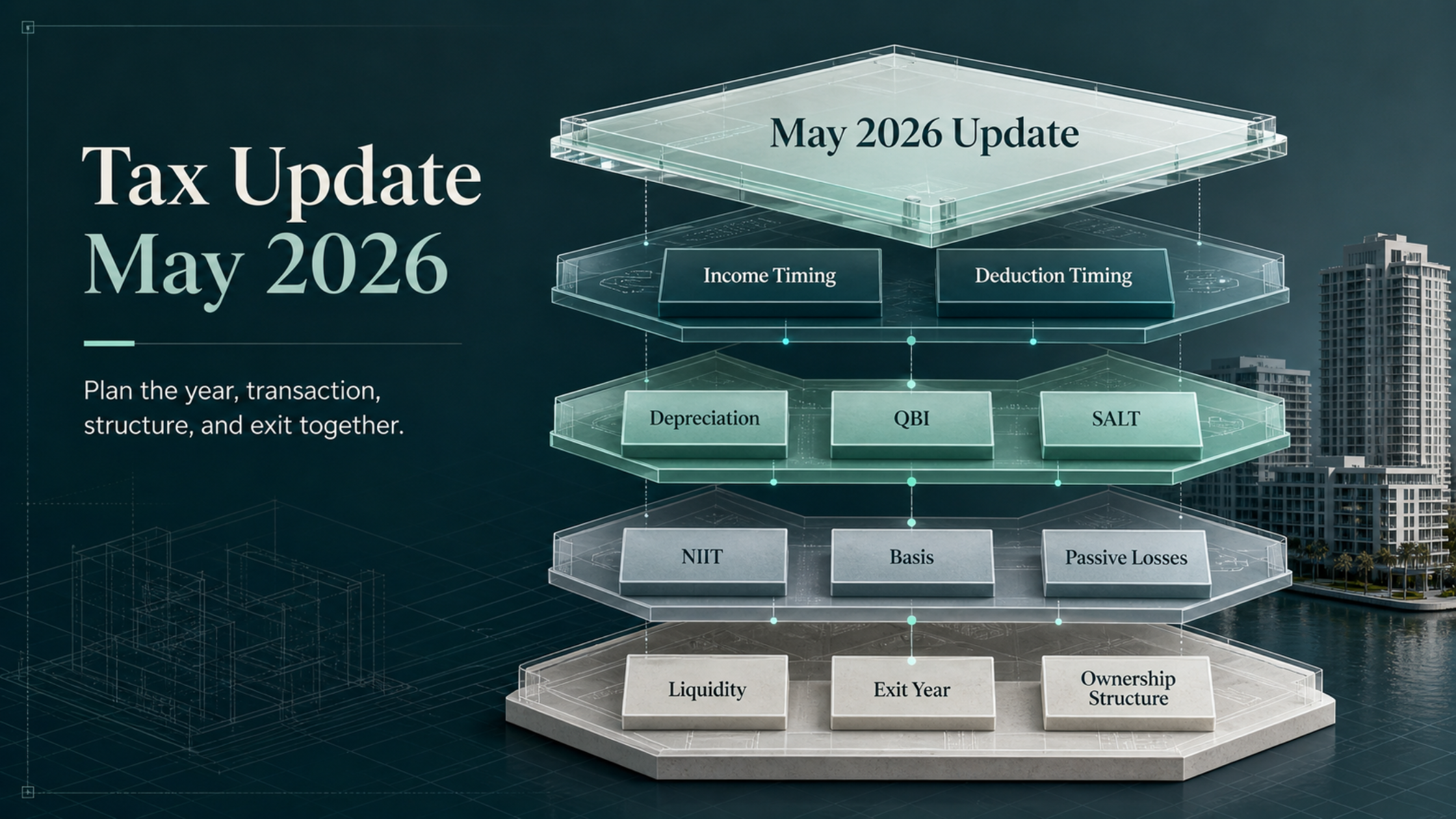
The May 2026 update matters most when each rule is tested against the taxpayer’s broader multi-year plan.
May 2026 Tax Update: What Changed and What Matters Now
The May 2026 tax update is not just a list of new numbers. For high-income Florida taxpayers, the more important question is how the updated rules affect planning order.
Some provisions affect 2025 returns filed in 2026. Others affect 2026 planning for returns filed in 2027. Several provisions create attractive current-year deductions but may also change basis, taxable income, NIIT exposure, passive loss outcomes, and exit-year tax pressure.
The first planning move is to separate what changed from what should change in the taxpayer’s actual plan.
| Planning Area | May 2026 Update | Strategic Planning Issue |
|---|---|---|
| 2026 Standard Deduction | $32,200 for married filing jointly; $16,100 for single and married filing separately; $24,150 for head of household. | Mostly a baseline figure for high-income taxpayers, but it affects whether itemizing, charitable timing, mortgage interest, and SALT planning create incremental value. |
| 2026 Top Ordinary Bracket | 37% begins above $640,600 for single filers and $768,700 for married filing jointly. | High-income taxpayers should model marginal-rate years before accelerating income, exercising equity compensation, triggering gains, or shifting business income. |
| 2026 Long-Term Capital Gain Thresholds | 20% capital gain rate begins above $545,500 for single filers and $613,700 for married filing jointly. | Exit timing matters. A sale year can combine capital gain, depreciation recapture concepts, unrecaptured Section 1250 gain, NIIT, and suspended loss release. |
| NIIT | 3.8% applies to certain net investment income when MAGI exceeds $200,000 for single/head of household or $250,000 for married filing jointly. | The NIIT threshold is often crossed long before the top capital gain bracket. For high-income real estate investors, this can be the overlooked federal layer. |
| SALT Deduction | Individual SALT deductions are capped at $40,000, or $20,000 for married filing separately, subject to MAGI limits and not reduced below $10,000. | Florida residents may still have property taxes, sales taxes, and out-of-state taxes, but the value can be limited for very high-income taxpayers. |
| Bonus Depreciation | For most qualifying business property bought and placed in service after Jan. 19, 2025, businesses can generally deduct 100% of the cost in the first year. | This can improve current-year deductions, but it can also reduce basis and increase future gain pressure. |
| Section 179 | 2026 maximum expense deduction increases to $2.56 million, with phaseout beginning at $4.09 million of qualifying property placed in service. | Strong business-owner tool, but not every asset or taxpayer benefits equally. Eligibility rules, income limits, SUV limits, and carryforward treatment still matter. |
| QBI Deduction | Section 199A QBI deduction becomes permanent beginning in 2026, with modified phase-in limits and a new minimum deduction for certain active businesses. | Permanence improves long-range planning, but SSTB restrictions, wage/property limits, taxable income limits, and business grouping still matter. |
| Retirement Limits | 2026 401(k)/403(b)/457 elective deferral limit increases to $24,500; IRA limit increases to $7,500. | Higher contribution limits create planning room, but contribution type, Roth exposure, cash flow, and business retirement plan design matter more than the limit alone. |
| Estate Planning | 2026 basic exclusion amount is $15 million. | The exemption level creates more planning flexibility, but basis, asset location, liquidity, and family governance still drive the long-term result. |
The IRS released 2026 standard deduction amounts, ordinary-rate thresholds, AMT figures, and estate/gift inflation adjustments, and the 2026 items generally apply to returns filed in 2027. The IRS also lists the 2026 standard deduction, marginal rate thresholds, AMT amounts, and estate exclusion in its OBBB individual provisions guidance.
The planning issue is not whether these numbers are useful. They are. The issue is whether they are used as isolated facts or integrated into a multi-year projection.
For a Florida high-income taxpayer, the same update can produce different decisions depending on whether 2026 is a normal income year, a liquidity event year, a real estate exit year, a business investment year, or a transition year before retirement.
The Larger Planning Issue Behind the May 2026 Tax Update
The One Big Beautiful Bill Act significantly affected federal taxes, credits, and deductions and was signed into law on July 4, 2025, as Public Law 119-21. For high-income taxpayers, the practical question is not simply, “What changed?”
The better question is:
Which provisions are stable enough to build into long-term planning, which are temporary or income-sensitive, and which may create future tax pressure if used aggressively today?
That distinction matters for Florida taxpayers because Florida does not impose a personal income tax. Federal planning often carries more weight in the overall tax result. For Florida real estate investors, the federal consequences of depreciation, gain character, NIIT, passive loss treatment, QBI, entity structure, and exit timing often drive more value than state-level income tax planning.
A basic tax update identifies new rules.
A strategic tax update helps decide what to do first, what to delay, what to model, and what not to overuse.
Key Takeaways
The tax update May 2026 should be treated as a planning reset, not a deduction checklist.
High-income taxpayers should separate permanent rules from temporary and income-sensitive benefits.
Bonus depreciation and Section 179 can be powerful, but accelerated deductions must be tested against loss usability, basis, liquidity, and exit-year consequences.
QBI permanence improves long-term planning for business owners, but SSTB restrictions and taxable income limitations still require careful modeling.
NIIT remains one of the most important hidden layers for Florida investors with capital gains, rental income, dividends, or portfolio income.
Florida’s lack of state income tax does not make planning simpler; it shifts more attention to federal timing, property economics, liquidity, and exit flexibility.
A technically valid strategy can still be weak if it improves the current year while reducing flexibility in a future sale, refinance, retirement, or ownership transition.
Use our May 2026 planning framework to compare income timing, deductions, NIIT exposure, depreciation, liquidity, and exit-year pressure.
The Strategic Framework: Permanent, Temporary, and Exit-Triggered Rules
A standard tax update lists provisions. A better planning process sorts them by how they affect decisions.
For high-income taxpayers, we would organize the May 2026 tax update into three categories:
Permanent or long-range rules
Temporary and income-sensitive rules
Exit-triggered rules
That ordering matters. Permanent provisions can support longer planning horizons. Temporary provisions need timing discipline. Exit-triggered rules need stress testing before deductions are accelerated.
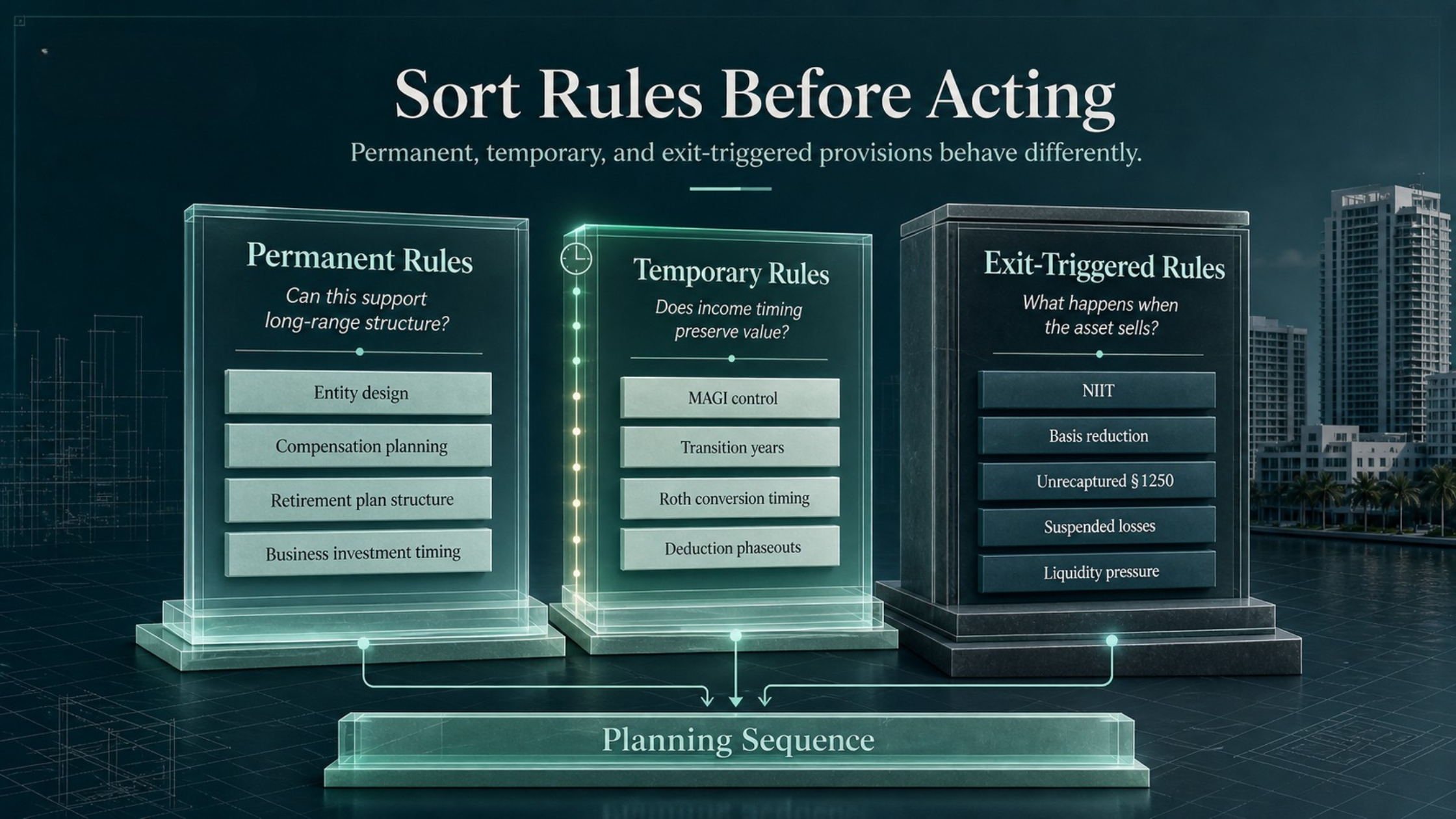
A useful tax update does more than list provisions; it classifies which rules support long-term structure, timing decisions, or exit modeling.
1. Permanent or long-range rules
These are rules that can support multi-year structure decisions.
Examples include QBI permanence, higher Section 179 limits, and the return of 100% bonus depreciation for many qualifying business assets. IRS business guidance states that OBBB makes the qualified business income deduction permanent, modifies phase-in limits, and adds an inflation-adjusted minimum deduction beginning in 2026. IRS guidance also states that for most qualifying business property bought and placed in use after Jan. 19, 2025, businesses can deduct 100% of the cost in the first year.
These rules matter for:
Entity design
Compensation planning
Retirement plan structure
Equipment and improvement timing
Real estate depreciation strategy
Business acquisition modeling
Ownership transition planning
Cash flow allocation between tax reduction and reserves
The planning mistake is treating permanent provisions as if they must be used immediately. A permanent rule gives more room to sequence, not less.
A high-income taxpayer may be better served by delaying a deduction into a higher-income year, preserving basis for a planned sale, or using retirement plan design before depreciation if the retirement contribution produces a cleaner result.
2. Temporary and income-sensitive rules
Some provisions are available only for limited years or lose value as income rises.
The additional senior deduction applies from 2025 through 2028 and phases out above $75,000 of MAGI for single filers and $150,000 for joint filers. The tip, overtime, and passenger vehicle loan interest deductions are also structured with defined effective periods, annual limits, and MAGI phaseouts.
For sophisticated taxpayers, some of these provisions may be less valuable directly because income levels often exceed phaseout ranges. But they still matter in family-level planning, retirement transition years, part-year business sale years, Roth conversion years, and years involving large capital gains.
The planning question is not simply whether a deduction exists.
It is whether the taxpayer can control MAGI enough to preserve the deduction without disrupting better long-term moves.
For example, a retiree with significant portfolio income may not care about a temporary deduction in a normal year but may care in a year where a Roth conversion, rental sale, or large capital gain pushes MAGI into a phaseout range. Likewise, a business owner may be able to time income, retirement contributions, charitable giving, or capital gains to reduce the erosion of a temporary benefit.
3. Exit-triggered rules
Some rules are not “new” in the same way, but they become more important when other provisions encourage deductions, asset purchases, and gain realization.
For real estate investors, the exit stack may include:
Long-term capital gain
Unrecaptured Section 1250 gain
Depreciation recapture concepts
NIIT
Suspended passive loss release
Installment sale treatment
Debt replacement and liquidity constraints
State tax exposure for non-Florida properties
Ownership continuity issues for partnerships, disregarded entities, trusts, or S corporations
This is where many high-income taxpayers lose part of the benefit of a good early-year deduction.
The strategy works in Year 1, but creates pressure in the exit year.
The original deduction may have been technically correct. The problem is that the deduction was not modeled against the next transaction.
That is the difference between tax compliance and tax strategy.
2026 Rates and Thresholds: What High-Income Taxpayers Should Actually Use Them For
The 2026 standard deduction and bracket updates are important, but high-income taxpayers should not stop at the table.
The real use is scenario modeling.
A taxpayer earning $250,000, $750,000, or $2 million does not need the bracket table merely to know the marginal rate. They need it to answer questions like:
Should income be accelerated into 2026 or deferred?
Should a Roth conversion occur before or after a liquidity event?
Should capital gains be harvested in a lower-income year?
Should charitable giving be bunched into a sale year?
Should a real estate exit be timed before or after depreciation-heavy improvements?
Should a business owner adjust salary, distributions, guaranteed payments, or retirement plan contributions?
Should a sale be structured as a direct taxable sale, installment sale, 1031 exchange, or partial exit?
Should family gifting or estate planning be completed before additional appreciation occurs?
The top ordinary rate remains 37% for taxable income above $640,600 for single taxpayers and $768,700 for married couples filing jointly in 2026. Long-term capital gains are still not taxed in isolation. For 2026, the 20% long-term capital gain rate begins above $545,500 for single filers and $613,700 for joint filers.
But the capital gain bracket is only one layer.
For high-income taxpayers, a sale year can combine:
Ordinary income
Short-term capital gain
Long-term capital gain
Qualified dividends
Rental income
K-1 income
Depreciation-related gain character
NIIT
Charitable deductions
Suspended passive losses
Estimated tax payment requirements
For Florida investors, this means the sale year needs its own projection. A year with rental income, K-1 income, depreciation adjustments, portfolio income, and a property sale can produce a very different result than a normal operating year.
The planning point is simple:
Use the 2026 brackets to identify the year where the next decision has the highest marginal impact.
That may not be the current year.
We can help review whether 2026 is a normal income year, transition year, sale year, or liquidity event year for planning purposes.
Bonus Depreciation and Section 179: More Useful, But More Dangerous When Isolated
The renewed strength of depreciation planning is one of the most important business and real estate updates for 2026.
The IRS states that for most qualifying business property bought and put into use after Jan. 19, 2025, businesses can deduct 100% of the cost in the first year, rather than spreading the deduction over several years. Section 179 also remains a significant planning tool, with 2026 indexed limits reflected in current tax guidance.
That creates opportunity. It also creates a common failure mode.
A business owner or real estate investor sees a large deduction and assumes it should be used immediately. But accelerated depreciation is not automatically strategic. It is strategic only if it matches the taxpayer’s income, loss limitation profile, financing position, and exit plan.
For real estate investors, this is especially important because a depreciation decision can affect more than one tax year.
It can affect:
Current taxable income
Passive loss carryforwards
Basis
Debt-financed distributions
Refinance flexibility
1031 exchange planning
Sale-year gain character
Unrecaptured Section 1250 gain
NIIT exposure
Estate and succession planning
A deduction can be allowed and still be poorly timed.
The “works early, breaks later” depreciation pattern
A depreciation-heavy strategy may look excellent in the acquisition or improvement year. It can reduce current taxable income, improve after-tax cash flow, and create room for reinvestment.
But the same strategy can weaken later flexibility if it is not modeled correctly.

Accelerated depreciation should be evaluated by usable benefit, liquidity impact, and future exit pressure, not just the size of the current-year deduction.
“The issue is not whether accelerated depreciation is available. The issue is whether the deduction fits the taxpayer’s income capacity, passive activity position, basis, debt, and expected exit path.”
| Planning Year | What Looks Attractive | What Must Be Tested |
|---|---|---|
| Year 1 | Accelerated depreciation reduces taxable income. | Can the taxpayer actually use the deduction, or will losses be suspended? |
| Hold Years | Lower tax liability improves cash flow. | Is basis being reduced faster than the investor’s exit plan can absorb? |
| Refinance Year | Cash-out proceeds may feel tax-efficient. | Does added leverage reduce flexibility for a 1031 exchange, sale, or reserve strategy? |
| Exit Year | Sale produces liquidity. | How much gain is ordinary, capital, unrecaptured Section 1250, or exposed to NIIT? |
This is especially relevant for Florida real estate investors using cost segregation, bonus depreciation, and short-term rental strategies.
The issue is not whether accelerated depreciation is allowed.
The issue is whether the deduction fits the taxpayer’s income capacity, passive activity position, basis, debt, and intended exit path.
A high-income taxpayer with active business income may be able to use accelerated deductions efficiently. A taxpayer with passive rentals and limited passive income may simply create suspended losses. A taxpayer expecting a near-term sale may be trading current-year savings for exit-year pressure.
The better question is not:
“Can we depreciate this faster?”
The better question is:
“Which year should absorb the depreciation, and what future transaction does it affect?”
We can review whether accelerated deductions fit your income capacity, passive loss position, basis, liquidity, and expected exit path.
QBI Becomes More Stable, But Not Automatically Simpler
The QBI deduction becoming permanent is valuable because it lets business owners plan around Section 199A with more confidence.
IRS guidance states that OBBB makes the qualified business income deduction permanent, modifies phase-in limits, and adds a new inflation-adjusted minimum deduction beginning in 2026. The same guidance also notes that the deduction structure under Section 199A remains in place, including wage and qualified property limitations, aggregation rules, and the overall taxable income limitation.
That is the key point for sophisticated taxpayers.
Permanence improves planning stability. It does not eliminate complexity.
Business owners still need to consider:
Whether the business is a specified service trade or business
Whether taxable income limits reduce the deduction
Whether W-2 wages and qualified property support the deduction
Whether income should be paid as wages, distributions, guaranteed payments, or retained earnings
Whether multiple businesses should be aggregated or analyzed separately
Whether retirement plan contributions reduce taxable income in a helpful or harmful way for QBI
Whether depreciation reduces QBI in a way that offsets part of the intended benefit
Whether a business sale, restructuring, or ownership change alters future QBI eligibility
For professional service businesses, including consulting, law, accounting, financial services, health care, and similar fields, the SSTB rules remain important. IRS guidance states that OBBB did not eliminate the specified service trade or business restrictions.
For high-income owners, QBI planning should be coordinated with compensation, retirement plan design, entity structure, and projected taxable income.
A QBI projection that does not include wages, qualified property, retirement contributions, depreciation, capital gains, and owner compensation is incomplete.
This matters because high-income taxpayers often evaluate one lever at a time.
They ask whether to increase retirement contributions.
They ask whether to buy equipment.
They ask whether to change salary.
They ask whether to restructure an entity.
But QBI often sits at the intersection of all four.
A better process is to model the owner’s full taxable income architecture before changing any one lever.
Retirement and HSA Planning: Higher Limits Are Only the Starting Point
The 2026 retirement contribution limit for employees participating in 401(k), 403(b), governmental 457 plans, and the federal Thrift Savings Plan increases to $24,500. The IRA contribution limit increases to $7,500. The general catch-up limit for many 50-and-over workplace plan participants increases to $8,000, while a higher catch-up limit remains available for ages 60 through 63.
For high-income taxpayers, the planning value is not simply contributing the maximum.
The more important questions are:
Should contributions be pre-tax, Roth, or mixed?
Should a business adopt a cash balance plan?
Should retirement contributions be coordinated with QBI limits?
Should Roth conversions be timed before a business sale or real estate exit?
Should charitable giving offset a conversion or gain year?
Should retirement plan design be used to smooth uneven income across multiple years?
Should catch-up contributions be reviewed for Roth requirements if wages exceed the applicable threshold?
Should the owner’s retirement plan be designed around spouse payroll, controlled-group issues, or multiple entities?
For a business owner, retirement planning is not just savings planning. It can be tax-bracket planning, QBI planning, payroll planning, succession planning, and cash-flow planning at the same time.
For a Florida taxpayer, retirement contributions may also carry more federal weight because there is no Florida personal income tax layer. The benefit is not diluted or amplified by Florida income tax planning. The decision is primarily federal, cash-flow, and long-term distribution planning.
HSA planning should also be reviewed, but eligibility must be verified. OBBB expanded HSA-related rules in certain areas, including telehealth and eligibility for certain bronze and catastrophic plans. For high-income taxpayers with eligible coverage, HSAs can still combine a current deduction with long-term tax-free medical expense reimbursement.
But the HSA decision should not be isolated from the larger plan.
It should be coordinated with:
Employer benefits
Self-employed health insurance
Medicare timing
Family coverage
Cash reserves
Retirement account sequencing
Long-term medical expense planning
For HNW taxpayers, contribution limits matter. But the sequencing of taxable, tax-deferred, tax-free, and basis-step-up assets matters more.
SALT Deduction: More Room, But Not a Florida Windfall
The increased SALT cap may be meaningful for some taxpayers, but Florida residents should analyze it carefully.
Florida does not have a personal state income tax, so the SALT conversation often centers on real property taxes, sales tax, and taxes paid to other states. The IRS states that an individual’s deduction for state and local taxes is limited to a combined total deduction of $40,000, or $20,000 for married filing separately, subject to MAGI limitations and not reduced below $10,000.
For high-income Florida taxpayers, the planning issue is often not whether the SALT cap increased.
It is whether itemizing actually produces incremental value after accounting for:
The larger standard deduction
Mortgage interest
Charitable contributions
Real estate taxes
Sales tax
Out-of-state source income
MAGI-based limitations
Entity-level state tax planning for non-Florida operations
The timing of property tax payments
The interaction between personal and business-level deductions
A Florida taxpayer with large non-homestead property taxes may still benefit from itemizing. But a very high-income taxpayer may see the benefit reduced by the MAGI limitation. The increased cap should be modeled, not assumed.
This is also where Florida planning can become counterintuitive.
A taxpayer may not pay Florida income tax, but they may still own high-value Florida property, operate in other states, receive K-1 income from multi-state businesses, or hold investment real estate outside Florida. The SALT result can depend on the mix of property taxes, sales taxes, and non-Florida income taxes.
The right question is not:
“Did SALT improve?”
The better question is:
“Does the taxpayer’s actual deduction profile produce a meaningful incremental benefit after income limits and itemized deduction math?”
Florida-Specific Planning: No State Income Tax Does Not Mean Low-Complexity Planning
Florida’s lack of personal income tax is a planning advantage, but it also changes where the pressure shows up.
Without a state income tax layer, federal choices often dominate the total result.
For Florida real estate investors, the biggest planning pressure usually comes from four areas.
1. Real estate concentration
A Florida portfolio may hold appreciated property, short-term rentals, commercial assets, or mixed-use properties.
When multiple assets are concentrated in one market, a change in liquidity needs, reserve requirements, financing terms, or insurance costs can force a sale earlier than expected.
That matters because depreciation strategy, debt structure, and passive loss planning may have been built around a longer hold period.
A cost segregation study may be efficient under a 10-year hold assumption. It may look different if insurance, debt service, repairs, casualty exposure, or market conditions push the investor into a sale in Year 3.
The tax plan should include both the intended hold period and the forced-sale scenario.
2. Homestead vs non-homestead economics
Florida homestead and non-homestead properties are not identical planning assets.
The tax article should not turn into a property tax manual, but the planning distinction matters. Homestead protection, assessment limitations, non-homestead property tax exposure, and residence conversion decisions can influence whether a property is better held, converted, rented, sold, or transferred.
For planning purposes, that distinction can affect:
Hold/sell decisions
Residence conversion decisions
Rental conversion strategy
Cash-flow modeling
Estate and family transfer planning
Liquidity reserves
The timing of improvements
The economics of replacing one property with another
A property that looks efficient federally may still become less attractive if property tax, insurance, reserves, or casualty risk changes the economics of holding it.
3. Insurance, casualty, and reserve pressure
Tax planning should not assume the property can be held indefinitely.
In Florida markets, higher insurance costs, repair reserves, storm exposure, and financing pressure can shorten the realistic hold period.
That changes the depreciation decision.
If a taxpayer accelerates deductions assuming a 10-year hold but sells in Year 3, the exit-year tax result may look very different. The planning should test the expected hold period and the forced-sale scenario.
This does not mean depreciation should be avoided.
It means depreciation should be modeled with liquidity.
A property owner may need to decide whether the tax benefit should be reinvested, reserved, used to pay down debt, or held for future tax exposure. That decision is not usually visible on a tax return. It has to be made in the plan.
4. Federal exit stack
A Florida real estate exit may still involve federal capital gain, unrecaptured Section 1250 gain, depreciation recapture concepts, NIIT, suspended losses, and 1031 exchange timing.

For Florida real estate investors, the sale year should be designed before the transaction occurs.
A Florida sale can look simple because there is no personal state income tax layer. The real planning work is often federal: gain character, NIIT, suspended losses, exchange timing, debt replacement, and available liquidity.
The absence of Florida personal income tax does not remove those federal layers.
It simply makes them more central.
The exit stack is where fragmented advice becomes expensive. The investment advisor may see the liquidity event. The tax preparer may see the return. The attorney may see the entity or trust. The lender may see debt replacement. But the taxpayer needs one coordinated view of the transaction.
For a high-income Florida taxpayer, the question is not only whether a sale is taxable.
It is whether the sale year has been designed.
See how federal tax timing, real estate concentration, reserves, and exit flexibility can interact for Florida high-income taxpayers.
Common Misuses and Oversights Sophisticated Taxpayers Still Make
Mistake 1: Treating the May 2026 tax update as a deduction list
A deduction list is not a strategy.
High-income taxpayers should first identify the year they are planning for:
A normal income year
A transition year
A sale year
A retirement year
A business investment year
A real estate acquisition year
A liquidity event year
A family transfer year
The same deduction can have different value in each year.
A deduction that is useful in a high-income year may be less useful in a lower-income year. A deduction that helps a business owner today may reduce QBI, alter basis, or increase future gain pressure. A deduction that appears valuable on the return may have limited practical benefit if the loss is suspended.
The update should trigger a projection, not a reaction.
Mistake 2: Accelerating depreciation without testing loss usability
A cost segregation study or bonus depreciation claim may create a strong deduction on paper.
But if the taxpayer cannot use the loss because of passive activity rules, basis limits, at-risk constraints, or the excess business loss limitation, the current-year benefit may be limited. IRS business guidance notes that taxpayers must apply passive activity loss rules before applying the excess business loss limitation.
That does not mean the strategy is wrong.
It means timing and classification matter.
For real estate investors, the critical questions include:
Is the activity passive or nonpassive?
Does the taxpayer materially participate?
Is real estate professional status relevant?
Are losses usable against the taxpayer’s income?
Is there sufficient basis and at-risk amount?
Will the deduction reduce QBI or interact with another limitation?
Is the taxpayer planning to sell, refinance, exchange, or hold?
A depreciation study should not be evaluated only by the size of the deduction. It should be evaluated by the usable deduction, the timing of use, and the future tax cost.
Mistake 3: Ignoring NIIT until the return is prepared
NIIT is often discovered too late.
Because it applies to certain investment income above fixed MAGI thresholds, it can affect taxpayers who do not think of themselves as being in the “top” capital gain bracket.
For high-income Florida taxpayers, NIIT can matter in years with:
Capital gains
Rental income
Interest
Dividends
Passive K-1 income
Installment sale income
Portfolio rebalancing
Real estate dispositions
Business sale proceeds
Trust or estate income
The IRS states that NIIT applies at 3.8% to certain net investment income of individuals, estates, and trusts with income above statutory threshold amounts. It applies to the lesser of net investment income or the amount by which MAGI exceeds the applicable threshold.
For real estate investors, this means rental income, capital gains, dividends, and portfolio income should be modeled before year-end.
The important planning question is whether income classification, timing, grouping, material participation, installment reporting, or charitable strategy can improve the total federal result.
Mistake 4: Assuming QBI permanence removes planning friction
QBI becoming permanent is helpful, but it does not eliminate SSTB limits, wage/property tests, taxable income limitations, or the need to coordinate owner compensation with entity structure.
For high-income service business owners, QBI still requires planning.
A taxpayer may need to model:
S corporation salary
Partnership guaranteed payments
Entity aggregation
Qualified property
Retirement plan contributions
Capital expenditures
Depreciation deductions
Taxable income after capital gains
Business sale timing
Owner spouse compensation
Multiple business lines
The QBI deduction is not simply a pass-through owner benefit. It is a calculation that can change when the taxpayer changes compensation, entity structure, retirement contributions, or capital spending.
Mistake 5: Overvaluing SALT changes in Florida
The increased SALT cap can help some taxpayers, especially those with meaningful property taxes or out-of-state tax exposure.
But Florida residents should not assume the change produces a major benefit. The larger standard deduction, MAGI limitations, and the absence of Florida personal income tax all affect the calculation.
A Florida taxpayer may still have SALT exposure through:
Florida real property taxes
Sales tax
Non-Florida rental properties
Non-Florida business income
K-1 state allocations
Part-year residency issues
Trust or entity-level tax considerations
The SALT update should be reviewed, but it should not dominate the strategy unless the taxpayer’s facts support it.
Mistake 6: Separating tax planning from liquidity planning
A tax-efficient strategy can still fail if it creates liquidity pressure.
Examples include:
Accelerating depreciation without reserving for exit-year tax
Entering a 1031 exchange without replacement-property flexibility
Using leverage that complicates future refinancing or sale
Creating suspended losses that do not align with cash needs
Selling appreciated property without modeling NIIT and recapture
Funding retirement plans without preserving business liquidity
Making large charitable gifts without matching them to income years
Holding property for tax deferral while insurance and reserve pressure reduce economic durability
Tax planning should improve decision quality, not just reduce the current-year number.
Mistake 7: Assuming the advisor team is automatically coordinated
Sophisticated taxpayers often have multiple advisors.
That does not mean the planning is integrated.
A CPA may focus on the return. An investment advisor may focus on portfolio gain. An attorney may focus on entities or estate documents. A lender may focus on leverage. A property manager may focus on operations. Each view may be correct but incomplete.
The May 2026 tax update creates a useful opportunity to align the advisory team around one projection.
That projection should show:
Current-year income
Next-year income
Expected capital gains
Real estate exits
Passive loss position
Basis and debt
QBI exposure
NIIT exposure
Retirement plan strategy
Charitable strategy
Estate and ownership transition goals
A taxpayer who already has a CPA may still benefit from asking whether the plan is coordinated across these layers.
A Practical May 2026 Planning Sequence
For high-income Florida taxpayers, the best next step is not to chase every new rule.
It is to update the planning model in the right order.
Step 1: Update the 2025 and 2026 income forecast
Separate recurring income from unusual income.
Recurring income may include wages, business profits, K-1 income, rental income, dividends, and interest.
Unusual income may include:
Property sales
Business sale proceeds
Equity compensation
Roth conversions
Large bonuses
Litigation proceeds
One-time distributions
Debt cancellation
Installment sale income
Large charitable contributions
Trust or estate distributions
This matters because a deduction is only as useful as the year in which it lands.
Step 2: Identify the marginal year
A high-income taxpayer may have one year that carries most of the planning opportunity.
That could be:
A lower-income year before retirement
A high-income year before a business sale
A real estate exit year
A year with large capital expenditures
A year with unusually high charitable intent
A year before a major liquidity event
A year after a business downturn
A year with suspended losses becoming usable
The marginal year drives whether income should be accelerated, deferred, offset, converted, or harvested.
This is where the May 2026 tax update becomes useful. The updated thresholds and deduction rules help identify which year should carry which transaction.
Step 3: Test deduction usability
Before claiming or accelerating deductions, test whether they can be used.
This includes:
Passive loss limits
Basis
At-risk rules
Excess business loss rules
QBI interaction
AMT exposure
Charitable AGI limits
Business interest limits
State-level effects for non-Florida operations
Entity-level allocation issues
Trust and ownership restrictions
The key is to distinguish three different outcomes:
A deduction that reduces current tax
A deduction that is allowed but deferred
A deduction that creates future tax pressure without enough current benefit
Those are not the same result.
Step 4: Model the exit year before accelerating deductions
This is especially important for real estate.
Before using bonus depreciation or a cost segregation strategy, model what happens if the property is sold under multiple scenarios:
Intended hold period
Early sale
1031 exchange
Refinance and hold
Partial disposition or major improvement
Installment sale
Estate transfer or family transition
For Florida real estate investors, the early-sale scenario deserves special attention. Insurance costs, casualty risk, reserve demands, tenant quality, financing terms, and local market conditions can all affect hold-period durability.
A depreciation plan that does not include an exit model is incomplete.
Step 5: Coordinate tax strategy with liquidity
A strategy that lowers taxes today but leaves the taxpayer under-reserved for insurance, repairs, debt service, estimated tax payments, or exit-year tax is not complete.
For Florida investors, liquidity planning is part of tax planning.
A practical review should ask:
What cash is being preserved by the strategy?
Where will that cash be held or reinvested?
Will reserves be adequate if insurance or repairs increase?
Will debt service remain durable if rental income changes?
Will the taxpayer have liquidity for estimated taxes?
Will a 1031 exchange require additional cash or debt replacement?
Will a future sale create a tax bill that has not been reserved for?
The strongest tax plans do not only reduce tax. They preserve optionality.
We can review your May 2026 planning position across income timing, NIIT, entity structure, depreciation, liquidity, and exit-year exposure.
What High-Income Taxpayers Need to Know About the May 2026 Tax Landscape
The most significant tax development of May 2026 is not any single provision — it is the interaction between them. The One Big Beautiful Bill Act changes, inflation-adjusted brackets, renewed 100% bonus depreciation, higher Section 179 limits, permanent QBI treatment, and temporary income-sensitive deductions all exist simultaneously. The value is in coordinating them around one taxpayer's income profile and multi-year outlook, not reviewing each rule in isolation.
The 2026 brackets matter not because the numbers are surprising, but because they inform sequencing — whether income should be accelerated or deferred, whether a Roth conversion makes sense this year, whether depreciation should be front-loaded or held. For Florida-based investors, the absence of state income tax does not reduce the planning burden. It shifts the emphasis toward federal timing, transaction design, and liquidity, where decisions carry more weight and mistakes are harder to recover.
Bonus depreciation and NIIT follow the same logic: availability is not the same as benefit. Bonus depreciation works when the deduction can be absorbed and the exit plan accounts for future gain. NIIT should be modeled before a sale year, not identified after the return is filed. The increased SALT deduction deserves the same scrutiny — for many high-income Florida taxpayers, the benefit depends on facts that need to be modeled, not assumed.
The practical response is a projection update. Revisit 2025 and 2026 income estimates, identify which year carries the greater planning opportunity, test whether anticipated deductions are actually usable, and model any exits before they occur. The goal is not to capture every available provision — it is to use the right ones in the right year without trading near-term savings for long-term flexibility.
Conclusion: The May 2026 Tax Update Is a Planning Reset
The tax update May 2026 is useful only if it leads to better decisions.
The rules now create more room for planning in several areas: bonus depreciation, Section 179, QBI, retirement contributions, estate planning, SALT, and certain temporary deductions.
But more room does not automatically mean a better result.
For high-income Florida taxpayers, the strongest planning comes from sequencing. The goal is to coordinate deductions, income timing, entity structure, depreciation, investment exits, NIIT exposure, and liquidity before the tax year is already over.
A good tax plan should answer more than:
“What can we deduct?”
It should answer:
What year should carry the deduction?
What income will absorb it?
What future tax pressure does it create?
What happens if the asset is sold earlier than expected?
What happens if liquidity becomes more important than tax deferral?
What structure gives us flexibility three, five, and ten years from now?
What advisor needs to be involved before the transaction occurs?
What assumption would cause the strategy to break?
That is the difference between a tax update and a tax strategy.
For Florida business owners, real estate investors, and high-income professionals, the May 2026 update should be used as a coordination point. Not every new provision will matter. Not every deduction should be accelerated. Not every favorable rule improves the long-term result.
The better outcome comes from connecting the rules to the taxpayer’s actual income pattern, asset base, ownership structure, liquidity needs, and exit path.
We can help review the year, transaction, structure, and liquidity assumptions that shape your multi-year tax position.
May 2026 Tax Planning FAQs
Key questions for high-income Florida taxpayers reviewing 2026 tax updates, depreciation planning, NIIT exposure, QBI, liquidity, and multi-year strategy.
How should a high-income Florida taxpayer prioritize the May 2026 tax changes?
Start with the planning year, not the provision. We would first separate normal recurring income from unusual events such as a property sale, business sale, Roth conversion, large capital expenditure, or ownership transition. Then we would identify which year carries the highest marginal planning impact. Some updates may matter only as baseline figures, while others affect depreciation, QBI, NIIT, liquidity, or estate planning. The priority is not to use every available rule. The priority is to match the right rule to the right year without weakening future flexibility.
What makes a tax update different from a tax strategy?
A tax update tells the taxpayer what changed. A tax strategy decides what should change in response. For sophisticated taxpayers, the gap is usually sequencing. A new deduction, threshold, or limit may be useful, but only after reviewing income timing, entity structure, passive loss position, basis, liquidity, and exit-year consequences. We would treat the May 2026 update as a coordination point, not a reaction trigger. The strongest value comes from turning new rules into better decisions across several years, not simply lowering the current-year tax number.
When can accelerated depreciation create a future planning problem?
Accelerated depreciation can create a future problem when the current-year deduction is modeled without the exit year. It may reduce taxable income today, but it can also reduce basis, affect gain character, create suspended losses, or increase pressure when a property is sold earlier than expected. This is especially important for Florida investors facing insurance, reserve, financing, or casualty pressures that may shorten the intended hold period. The issue is not whether the deduction is allowed. The issue is whether the deduction fits the taxpayer’s income capacity, loss limitations, liquidity, and exit path.
Why should NIIT be modeled before a liquidity event?
NIIT can change the economics of a sale or investment year because it sits on top of other federal tax layers. A taxpayer may focus on capital gain rates, depreciation recapture concepts, or QBI and still miss how investment income, rental income, dividends, passive K-1 income, or installment sale income affects the total result. We would model NIIT before a liquidity event because the planning options are usually stronger before the transaction occurs. Timing, classification, charitable planning, installment reporting, and activity grouping may all matter more before the return is prepared.
How should Florida investors think about no state income tax in planning?
Florida’s lack of personal income tax is an advantage, but it does not make planning simple. It often shifts more weight to federal decisions: depreciation, NIIT, gain character, QBI, passive losses, estate planning, and exit timing. For real estate investors, Florida-specific economics also matter. Insurance costs, reserves, casualty exposure, homestead versus non-homestead treatment, financing, and hold-period durability can affect whether a tax-efficient plan remains economically sound. We would not treat no state income tax as the end of the analysis. It is the starting point for deeper federal and liquidity planning.
What should be reviewed before relying on the QBI deduction?
QBI should be reviewed in context with the owner’s full taxable income architecture. That includes compensation, entity structure, retirement contributions, depreciation, wages, qualified property, SSTB status, capital gains, and business grouping. Permanence improves the ability to plan around QBI, but it does not remove the technical limits. A high-income owner may change salary, make capital expenditures, adopt a retirement plan, or restructure operations without realizing those decisions can affect QBI. We would review QBI alongside the owner’s broader income plan rather than treating it as a stand-alone pass-through deduction.
How do liquidity and reserves affect tax planning for Florida real estate?
Liquidity and reserves can determine whether a tax strategy is durable. A real estate plan may reduce current tax but still create pressure if insurance, repairs, debt service, estimated taxes, or exit-year costs are underfunded. In Florida markets, a property owner may need to decide whether tax savings should be reinvested, reserved, used to reduce debt, or preserved for future tax exposure. We would connect depreciation, financing, 1031 exchange flexibility, and reserve planning before assuming a strategy improves the total outcome. Tax efficiency should support optionality, not reduce it.
What should a taxpayer ask their advisor team after reviewing the May 2026 update?
A sophisticated taxpayer should ask whether the plan is coordinated across income, investments, entities, real estate, liquidity, and estate objectives. The key question is not whether each advisor is correct in isolation. It is whether the combined plan shows the current year, next year, expected transactions, passive loss position, basis, debt, NIIT exposure, QBI exposure, retirement strategy, charitable planning, and exit assumptions in one view. We would use the May 2026 update as a reason to align the advisory team around a shared projection before major transactions occur.
