
The best tax strategies for high income earners start with a projection. The 2025 tax law (Public Law 119-21, often called the One Big Beautiful Bill Act) kept the 37% top rate and added limits that switch on at specific income levels. That makes the order of moves matter more than any single move.
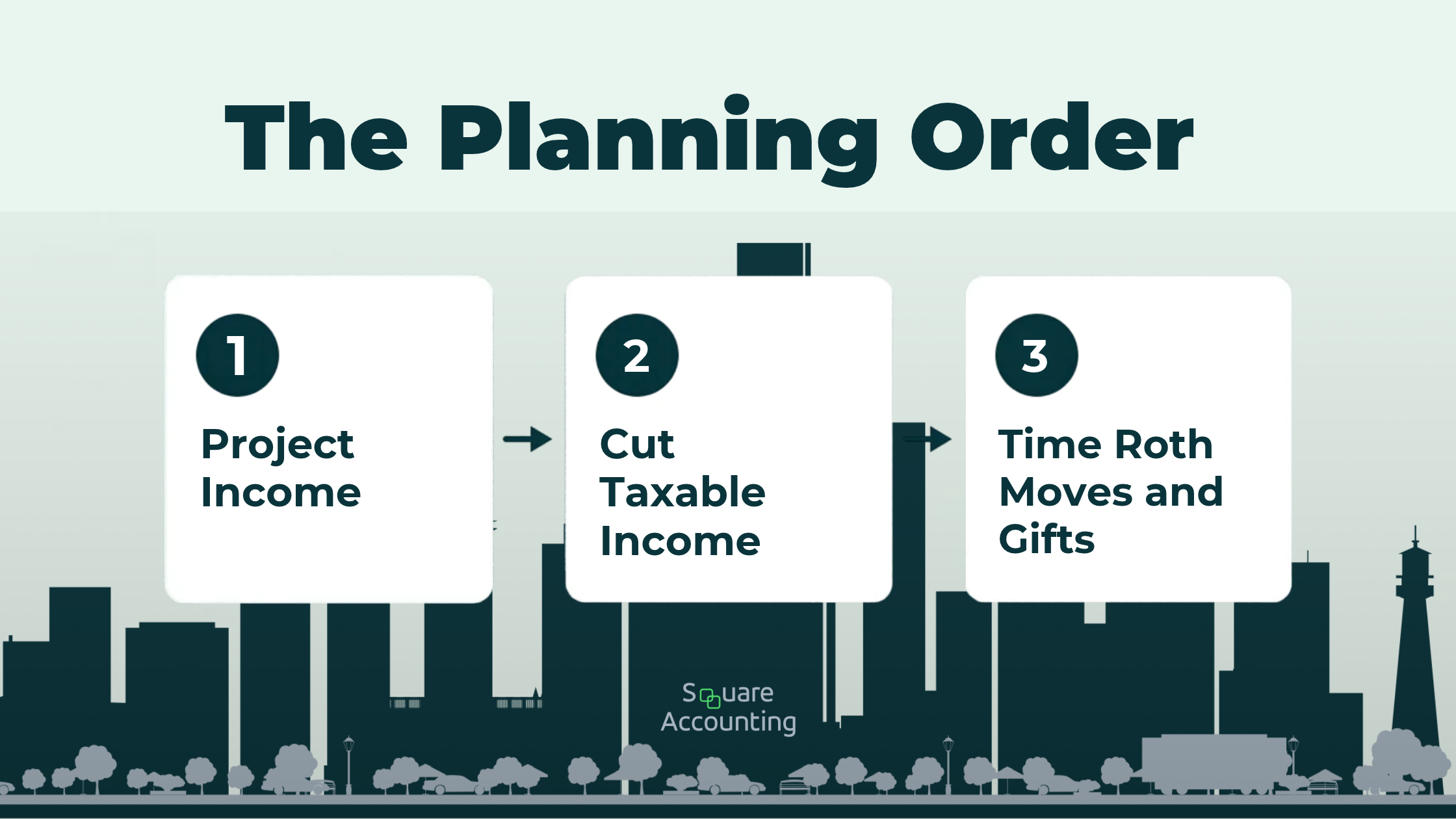
First, project where your income lands against those levels this year and over the next few years. Then cut taxable income with retirement and HSA contributions. Only after that, decide on Roth moves and charitable timing, because each one changes the math on the others.
In reviews, the mistake we see most often is the one Stevan Franeta, CPA, describes plainly: chasing a deduction before checking what income it can actually offset.
Written by Inzamam ur Rahman · Reviewed by Stevan Franeta, CPA · Reviewed November 24, 2026
Key takeaways
If your 2026 modified adjusted gross income (MAGI) is near $505,000 and you itemize, a Roth conversion or a large bonus can shrink your SALT deduction. Check the projection first.
At $1 million of income, the first $5,000 of your charitable gifts no longer reduces tax each year. Bunching two years of gifts into one can recover part of that.
Employees whose 2025 wages from the employer topped $150,000 must make 2026 catch-up contributions as Roth, or not at all if the plan has no Roth option.
A cash balance plan is a pension with yearly funding requirements. Don't start one on the strength of a single record year.
Florida has no personal income tax, so much of the national SALT advice doesn't apply to you. Federal tax, the 3.8% net investment income tax and property tax still do.
What changed for high earners in 2026 and 2027
The 2025 law made the current brackets permanent, raised the SALT deduction cap with a phase-down above $505,000 of income, and added two new limits on itemized deductions starting in 2026. The IRS has also published the 2027 inflation adjustments, so you can plan both years now.
Scroll sideways to see the full table.
| Item | 2026 | 2027 |
|---|---|---|
| 37% bracket starts (taxable income) | $768,700 / $640,600 | $793,650 / $661,375 |
| 35% bracket starts (taxable income) | $512,450 / $256,225 | $529,100 / $264,550 |
| Standard deduction | $32,200 / $16,100 | $33,200 / $16,600 |
| SALT deduction cap | $40,400, reduced by 30% of MAGI over $505,000, not below $10,000 | Rises 1% a year through 2029; $10,000 from 2030 |
| 401(k), 403(b), 457 deferral | $24,500 | $25,500 |
| Catch-up, age 50+ / ages 60 to 63 | $8,000 / $11,250 | $8,500 / $11,750 |
| Roth catch-up wage test (prior-year wages) | Over $150,000 | Over $155,000 |
| Total defined contribution limit | $72,000 | $75,000 |
| IRA contribution (catch-up 50+) | $7,500 ($1,100) | $7,500 ($1,100) |
| HSA, self-only / family | $4,400 / $8,750 | $4,500 / $9,000 |
| Top of 0% / 15% capital gains rate (joint) | $98,900 / $613,700 | $102,100 / $633,600 |
| QBI threshold (taxable income) | $403,500 / $201,750 | $416,600 / $208,300 |
| Excess business loss limit | $512,000 / $256,000 | $528,000 / $264,000 |
Sources: IRS IR-2025-103, IR-2025-111, IR-2026-133, IR-2026-136, Notice 2026-66, Rev. Proc. 2025-19, 2025-32, 2026-24, 2026-35; 26 USC 164(b)(7).
Three changes matter most at this income level.
The SALT cap rose, with a phase-down. For 2026, the deduction for state and local taxes is capped at $40,400. The cap falls by 30% of MAGI above $505,000, but never below $10,000, under 26 USC 164(b)(7). The cap rises 1% a year through 2029 and returns to $10,000 in 2030.
Itemized deductions are worth less in the 37% bracket. Starting in 2026, 26 USC 68 trims itemized deductions by 2/37 of the smaller of two amounts: total itemized deductions, or the amount by which taxable income plus those deductions exceeds the start of the 37% bracket. In practice, a deduction that would have saved 37 cents per dollar saves about 35 cents.
Charitable gifts now have a floor. Itemizers can deduct charitable gifts only to the extent they exceed 0.5% of their contribution base, which for most people is AGI (IRS Publication 505). Non-itemizers get a new deduction of up to $1,000, or $2,000 on a joint return, for cash gifts (IR-2026-135).
Start with the income lines
Most tax strategies for high earners work by moving income above or below a specific line. Once you know which lines you're near, the right strategies usually become obvious.
In reviews, we put this year and the next few years side by side, especially when a big bonus, a business sale or a retirement date is coming. We do that because a deduction is worth the most in the year it offsets income taxed at the highest rate. The same deduction in the wrong year can be worth much less, or get stuck as a carryforward.
Fill in the last column of the map with your own projected 2026 numbers. Recent pay stubs and brokerage statements are close enough for a first pass.
Scroll sideways to see the full table.
| Line | 2026 amount | What crossing it costs | Moves that pull income back below it | Your 2026 projection |
|---|---|---|---|---|
| Roth IRA phase-out (MAGI) | $242,000 to $252,000 / $153,000 to $168,000 | No direct Roth IRA contributions above the range | Pre-tax 401(k) and HSA contributions | |
| Net investment income tax (MAGI) | $250,000 / $200,000, not indexed | 3.8% on the smaller of investment income or MAGI above the line | Pre-tax contributions, timing of gains, loss harvesting | |
| QBI threshold (taxable income) | $403,500 / $201,750 | Limits on the QBI deduction begin to phase in | Pre-tax contributions, timing of income | |
| SALT phase-down (MAGI) | $505,000 | Cap falls by $3,000 for every $10,000 above, to a $10,000 floor | Deferring a bonus, skipping a conversion that year | |
| Excess business loss limit | $512,000 / $256,000 of net business loss | The excess becomes a carryforward instead of offsetting other income | Timing of business deductions | |
| 37% bracket (taxable income) | $768,700 / $640,600 | Itemized deductions save about 35 cents per dollar, not 37 | Pre-tax contributions, bunching gifts |
Sources: IRS IR-2025-103, IR-2025-111, Rev. Proc. 2025-32; 26 USC 68, 164(b)(7), 1411. MAGI definitions differ slightly by rule.
Two lines catch people most often. The 3.8% net investment income tax applies to the smaller of investment income or MAGI above $250,000 on a joint return ($200,000 single). Those amounts are fixed in section 1411 of the Code and don't rise with inflation, so more households cross them each year. The SALT phase-down is the other: every $10,000 of MAGI above $505,000 cuts the cap by $3,000.
See where your 2026 income lands
In a personal tax planning review, we project your 2026 and 2027 income against these lines and set the order of your next moves.
Plan my next movesWe respond within 24 to 48 hours.
Cut the income that's taxed this year
Pre-tax retirement and HSA contributions are the most direct way to move income below a line, because they reduce AGI, MAGI and taxable income at once. The limits for 2026 and 2027 are in Table 1.
Workplace plans. The 2026 deferral limit for a 401(k), 403(b) or governmental 457 plan is $24,500. If you're 50 or older you can add $8,000, or $11,250 if you're 60 to 63 (IR-2025-111). Employee and employer contributions to one person's defined contribution account can reach $72,000 in total for 2026, a limit that matters most for owners who make both (IRS COLA table).
Cash balance plans. For owners with steady profits, a cash balance plan can allow much larger deductible contributions, within the defined benefit limit of $290,000 of annual benefit for 2026. It's a pension, though, with funding requirements every year.
Stevan's test: if the business needs another record year to afford the plan, hold off. Before we recommend one, we ask the actuary what funding could look like in a slow year, including the cost of covering eligible employees. We also weigh administration costs and how soon the owner might sell or wind down. The first-year deduction is only one part of that decision. More on cash balance plans as long-term deferral.
HSAs. With a high-deductible health plan, you can contribute up to $4,400 for self-only coverage or $8,750 for family coverage in 2026, plus $1,000 at age 55 or older (Rev. Proc. 2025-19).
Deferred compensation. A nonqualified deferred compensation plan, where an employer offers one, can move part of a bonus into a later year when the rate may be lower. We check the election deadline and the payout schedule before recommending a deferral. The election generally has to be made before the year you earn the pay. A lump sum can land in another high-tax year, and with an unfunded plan, you're relying on your employer to be able to pay you later.
Choose pre-tax or Roth on purpose
Pre-tax saves tax now at your current rate. Roth saves tax later. At the top brackets, base the choice on the rate you expect in each future year.
Roth catch-ups are now required for many high earners. When last year's FICA wages from an employer were over $150,000, 2026 catch-up contributions to that employer's plan must be Roth (IRS catch-up rules). If the plan has no Roth option, no catch-ups are allowed there at all. For 2027 the test uses 2026 wages over $155,000 (Notice 2026-66).
Roth IRAs have income limits. Direct Roth IRA contributions phase out between $242,000 and $252,000 of MAGI on a joint return in 2026, and between $153,000 and $168,000 for single filers. Above that, any workaround should be modeled with your CPA before you start.
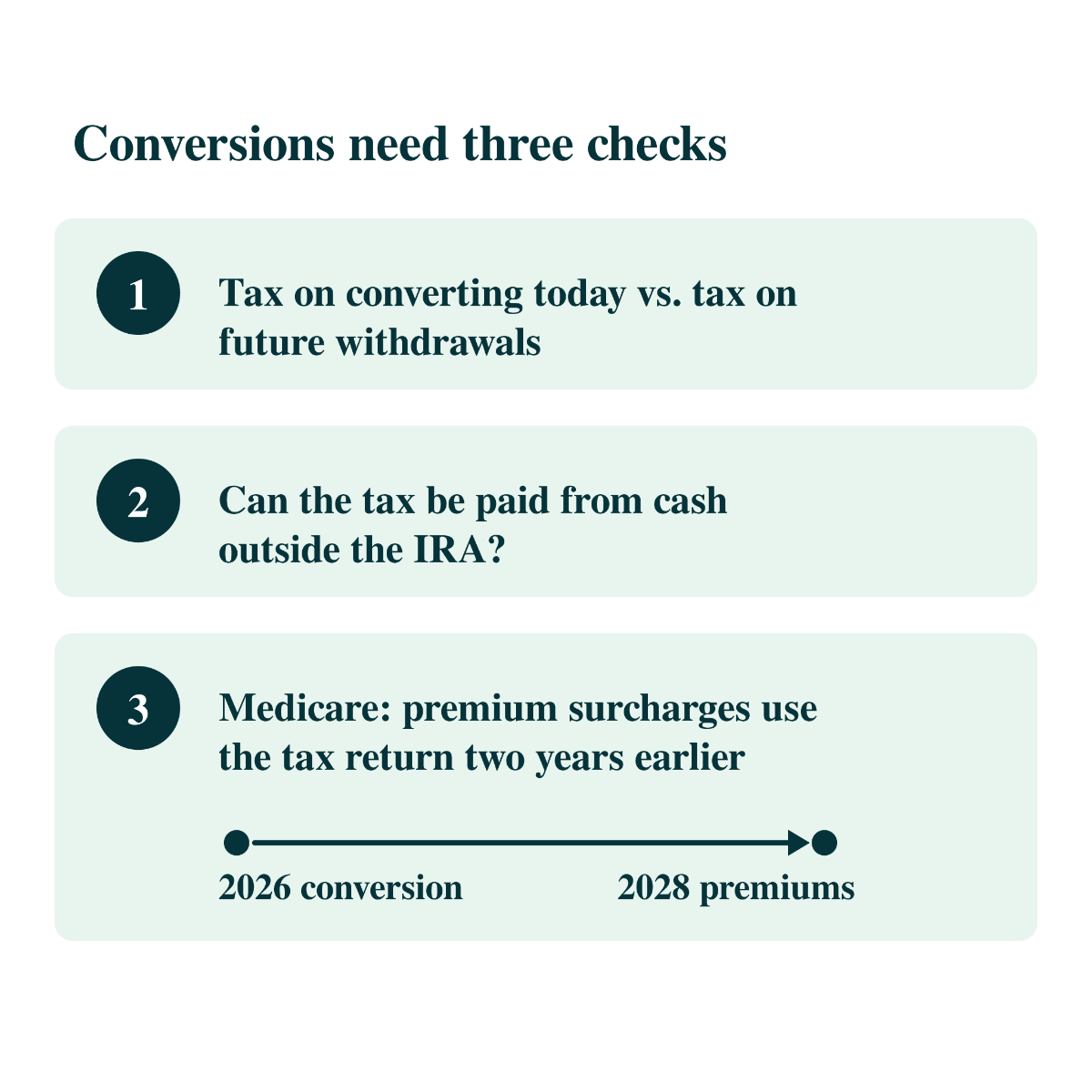
Conversions need three checks. We usually wait on a conversion in a peak earnings year if there should be room in a lower bracket after retirement, before required distributions start. That's age 73 if you were born from 1951 through 1959, and 75 if you were born in 1960 or later (final IRS regulations, T.D. 10001).
First, we compare the tax on converting today with the tax on future withdrawals. Second, we check whether the tax can be paid from cash outside the IRA. Third, we check Medicare: Social Security generally sets premium surcharges from the tax return two years earlier, so a 2026 conversion can raise your 2028 premiums.
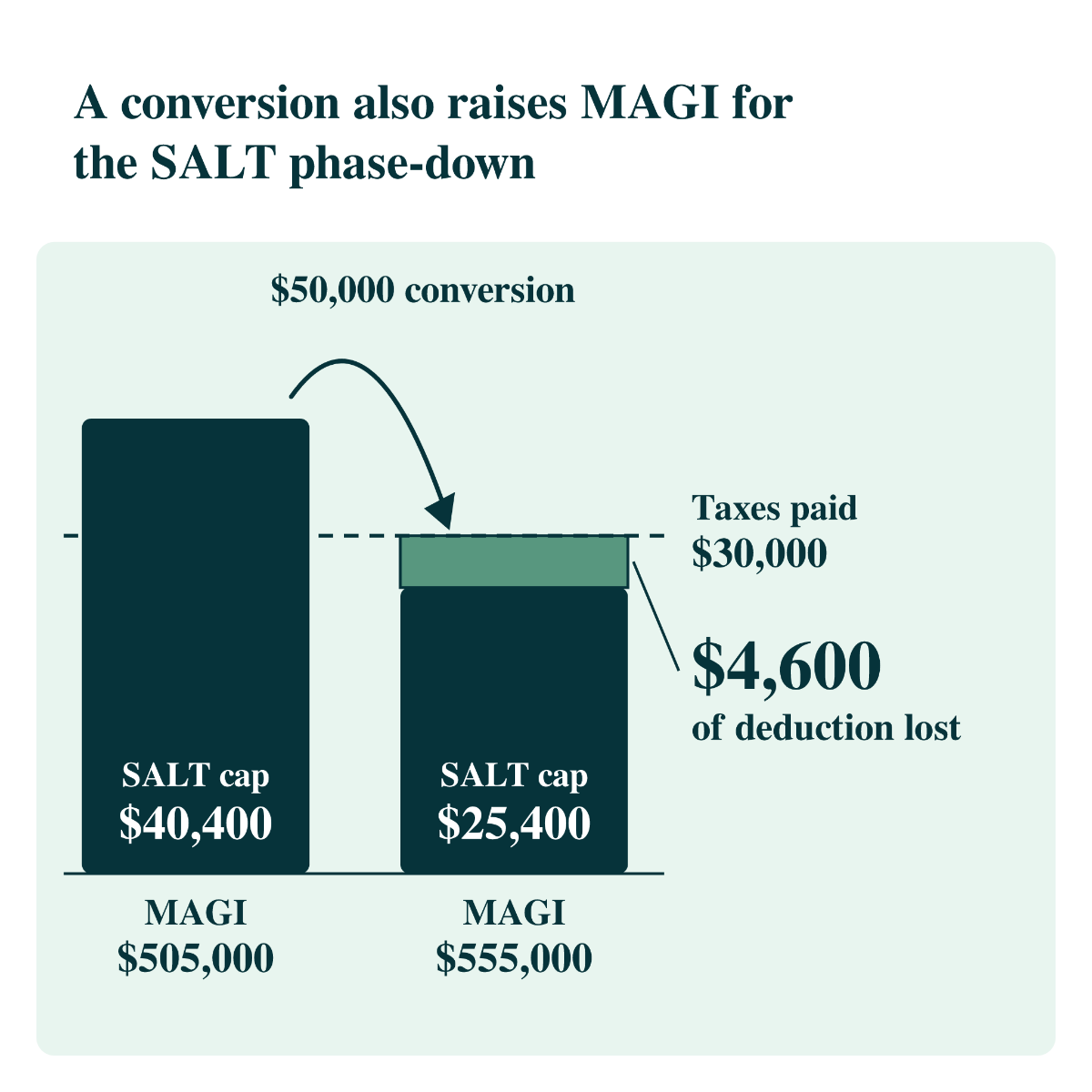
A conversion also raises MAGI for the SALT phase-down. Example (assumptions labeled): a Florida couple already itemizes, has $30,000 of property and sales taxes, and expects $505,000 of MAGI before a conversion. A $50,000 conversion lifts MAGI to $555,000. Their SALT cap drops from $40,400 to $25,400 (30% of $50,000 is $15,000), so they lose $4,600 of deduction on top of the tax on the conversion itself.
Give to charity under the new floor and cap
For itemizers in the top bracket, the 0.5% floor and the 35-cent limit make the timing of gifts matter more than it used to. Giving the same amount every year can cost more than giving it in fewer, larger years.
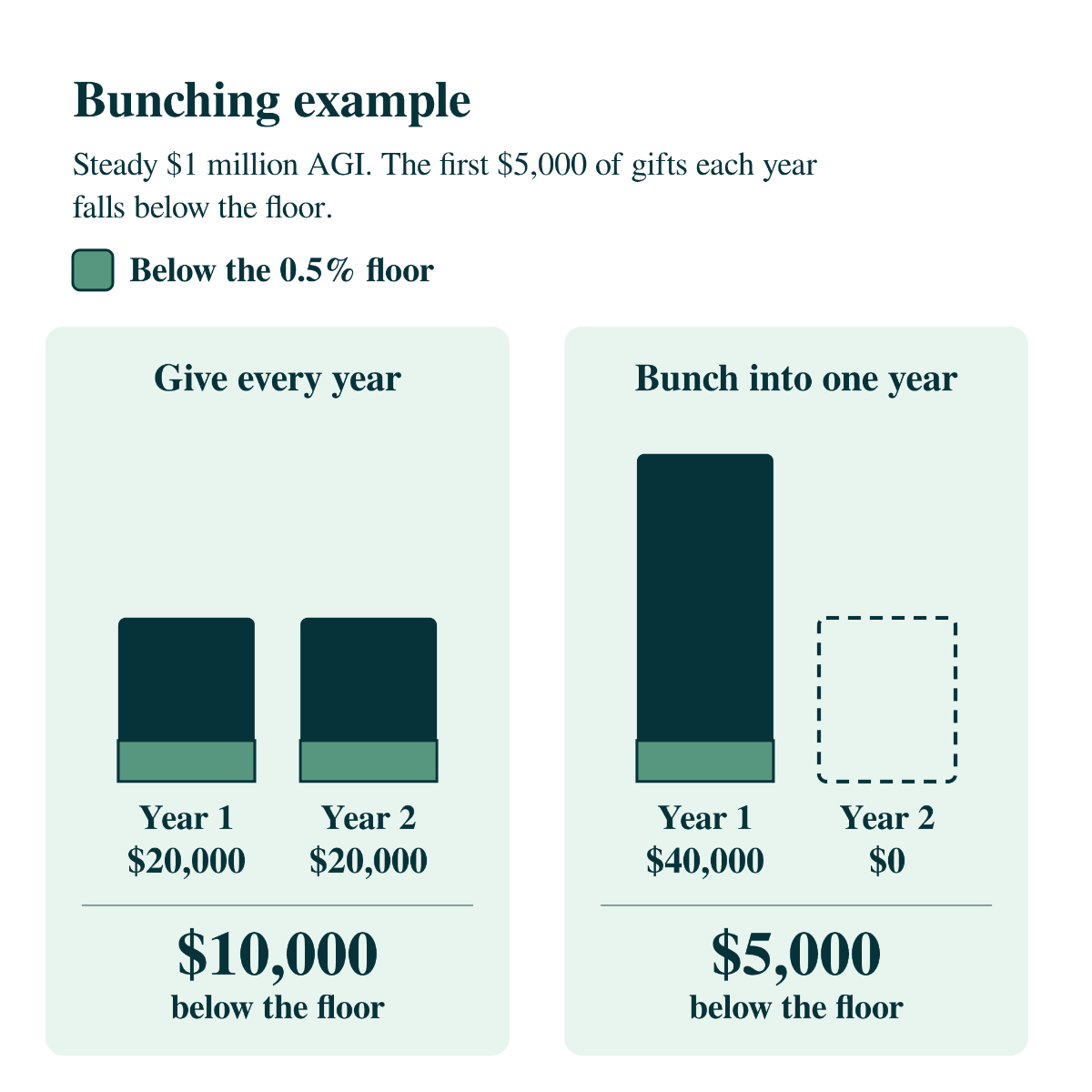
Stevan's numbers: at $1 million of adjusted gross income, the first $5,000 of otherwise eligible gifts falls below the floor each year. Bunching example (assumptions labeled): a couple with steady $1 million AGI gives $20,000 a year. Over two years, $10,000 of gifts fall below the floor. If they give $40,000 in one year and nothing the next, only $5,000 does.
What happens to the amount below the floor matters. Starting in 2026, the part of an itemizer's gifts disallowed by the 0.5% floor generally produces no deduction. It can be carried forward only if that year's gifts already create a carryforward under one of the charitable percentage limits (26 USC 170).
A few related rules matter for your timing:
Gifts to a donor-advised fund generally don't count toward the new non-itemizer deduction (IRS Publication 6196), so a bunching year only helps if you itemize that year.
From age 70½, a qualified charitable distribution sends money directly from an IRA to a charity. It's excluded from income rather than deducted, and it can count toward the required distribution (IRS Publication 526). The annual limit is adjusted for inflation each year; it was $108,000 for 2025.
Stock held more than a year counts as capital gain property for charitable purposes, with its own deduction limits (IRS Publication 526). Ask your CPA before giving shares instead of cash.
Manage tax on investment income
Investment income at this level can carry up to three layers: the capital gains rate, the 3.8% net investment income tax, and Medicare premium surcharges for those 65 and older. Much of the planning is about when gains land.
Long-term rates apply to assets held more than one year (IRS Topic 409). For 2026, the 15% rate runs up to $613,700 of taxable income on a joint return ($545,500 single), and gains above that are taxed at 20% (Rev. Proc. 2025-32). The 3.8% tax is added once MAGI passes $250,000 on a joint return.
If your losses exceed your gains, you can deduct up to $3,000 of the excess against other income and carry the rest forward (IRS Topic 409). Harvesting losses in a year with large gains usually does more than harvesting them in a quiet year. Tax-exempt interest still counts in the income Medicare uses to set premium surcharges (20 CFR 418.1135). If a sale is coming, read capital gains planning before a Florida sale.
If you own a business or rentals
Business and rental income bring their own lines, and the deductions they create only help if they can offset real income. Stevan's example: before you close on a Florida rental, he wants to know whether accelerated depreciation would lower this year's tax or leave a passive loss to carry forward. That answer can change what a buyer should be willing to spend on the deal.
Bonus depreciation. Qualified property acquired after January 19, 2025 can now be written off 100% in the first year, permanently (IR-2026-06).
Passive losses. Rental activities are generally passive, and passive losses above passive income are disallowed for the year and carried forward (IRS Topic 425). Qualifying as a real estate professional is the main exception, and it rests on records. A habit we recommend: set repeating calendar entries for each qualifying task, weekly, monthly or yearly, and add notes to each one about what you did.
Excess business losses. Net business losses above $512,000 on a joint return ($256,000 single) can't offset other income in 2026, and the excess carries forward as a net operating loss (Rev. Proc. 2025-32). The 2027 limits are $528,000 and $264,000. Congress made the excess business loss limitation permanent for noncorporate taxpayers (Public Law 119-21, section 70601).
QBI deduction. Above $403,500 of taxable income on a joint return ($201,750 single), limits on the qualified business income deduction begin to phase in for 2026. Entity choice affects how much of the deduction you keep.
Florida: what no state income tax changes
Florida does not impose a personal income tax, so most national advice about deducting state income tax doesn't apply to a Florida-only household. Federal income tax, the net investment income tax, payroll tax and property tax all still apply.
For a Florida-only client, we look at eligible property taxes on the home and qualifying sales taxes. Then we check whether itemizing beats the 2026 standard deduction of $32,200 for a joint return. You can elect to deduct general sales taxes instead of income taxes, within the same SALT cap (IRS Topic 503). If you also pay income tax to another state, we compare that amount with the sales tax deduction, because only one can be claimed.
The larger cap can help a Florida homeowner who itemizes and has enough eligible taxes. Above $505,000 of MAGI, the phase-down takes that back. Pass-through entity tax elections are a multistate planning issue. For a Florida resident with a Florida-only business and no income tax exposure in another state, there is no Florida election to make. If the business or an owner owes income tax to another state, we check whether the entity can elect there and run the numbers on the federal deduction, the state tax and any credits the owners can actually use. Florida's 5.5% corporate income tax applies to entities taxed as corporations.
Mistakes that backfire
Converting to Roth in the wrong year. A conversion that pushes MAGI over the SALT phase-down, or adds to income Medicare will use two years later, can cost more than it saves.
Giving small amounts every year. Each year's first slice falls below the 0.5% floor. Bunching keeps more of it deductible.
Buying depreciation you can't use. A 100% first-year deduction on a rental helps only if the loss isn't stuck as a passive carryforward.
Copying high-tax-state advice. SALT workarounds built for New York or California readers often do nothing for a Florida-only household.
Deferring pay without checking the plan. With an unfunded plan, a deferred balance depends on the employer being able to pay it later, and a lump-sum payout can land in another high-tax year.
When this gets complicated
You'll get the most from a CPA review when one of these applies:
A bonus, a sale or a swing in business profit could move your projected income by about $50,000, or by less if you're close to a phase-out or a Medicare premium threshold.
A big bonus, a business or property sale, or a retirement date falls within the next three years.
Business losses run above the excess business loss limit, or rental losses are stuck as carryforwards.
You're weighing a cash balance plan, a Roth conversion or real estate professional status.
You earn income taxed by another state as well as Florida.
Bring last year's return and a current-year income estimate. The checklist of what to bring to a tax strategy review covers the rest.
The planning order
For tax strategies for high income earners, the order decides the result. Project 2026 and 2027 income against the lines, cut taxable income where the rate is highest, and then time Roth moves and gifts around those lines. Do that before December 31, and most of the year's decisions are already made. For how this year's law changes fit together, see our May 2026 tax update.
Frequently asked questions
Does the 35-cent limit matter if my income is below the 37% bracket?
No. The limit only trims itemized deductions against taxable income above the start of the 37% bracket, which in 2026 is $768,700 on a joint return and $640,600 for single filers. Below that line, an itemized deduction saves tax at your own bracket rate. The 0.5% charitable floor works differently: it applies to every itemizer, whatever the bracket. So a household in the 35% bracket still loses the first slice of its gifts each year, but not the extra trim.
Should I wait for the 2027 numbers before acting this year?
No. The IRS has already published the 2027 figures, so you can plan both years together now. That matters most when income is moving because of a bonus, a sale or a retirement date. Projecting 2027 shows whether a deduction is worth more this year or next, and whether deferring income into 2027 lands it below a line or just moves the problem a year. Most of the decisions in this guide are best settled before December 31.
What changes once I'm 65 or older?
Medicare premiums become another income line to watch. Social Security generally sets premium surcharges from your tax return two years earlier, so a large Roth conversion can raise premiums two years later, and tax-exempt interest counts in that income too. From age 70½, a qualified charitable distribution lets you give from an IRA with the gift excluded from income, and it can count toward your required distribution. Required distributions start at 73 for people born from 1951 through 1959, and at 75 for those born in 1960 or later.
Does 100% bonus depreciation help if I'm not a real estate professional?
Often not right away. Rental activities are generally passive, and passive losses above your passive income are disallowed for the year and carried forward. Without real estate professional status, a large first-year deduction on a rental may only offset other passive income, with the rest waiting for later years. That's why Stevan wants to know, before you close, whether accelerated depreciation would lower this year's tax or leave a passive loss to carry forward. Qualifying as a real estate professional rests on records, so keep the hours log from the start.
Do these rules change if I also earn income in another state?
Some do. Most national SALT advice doesn't apply to Florida-only income because Florida has no personal income tax. Once you pay income tax to another state, compare that amount with the sales tax deduction, because only one can be claimed, and both sit under the same SALT cap. With income taxed in another state, we also check whether the business can make a pass-through entity tax election there, and whether the owners can actually use the credits.
Set your planning order with a CPA
In a 30-minute assessment, we look at your projected income, the lines you're near and which of these moves fit your year.
Request an assessmentCPA-led firm in Orlando since 2020. We respond within 24 to 48 hours.
Not ready to talk yet? Read how to know whether a tax planning relationship is worth it.

Inzamam ur Rahman
Content & Marketing Strategist
Inzamam manages content and advises on marketing strategy for Square Accounting. He works with Stevan Franeta, CPA, to create clear, practical articles for business owners, high-income professionals, and real estate investors.
Reviewed for tax accuracy by Stevan Franeta, CPA
