
What Should Be Reviewed Before Filing Season?
Before filing season, taxpayers should review more than forms, receipts, and prior-year tax documents. A serious pre-filing review should examine income patterns, entity structure, owner compensation, real estate activity, depreciation, passive losses, capital gains, estimated tax payments, documentation, basis, retirement planning, charitable planning, state exposure, and upcoming transactions.
For high-income taxpayers, the more important question is not simply, “Do we have everything needed to file?”
The better question is:
What decisions are already fixed, what can still be clarified or adjusted, and what needs to be planned before the next tax year becomes another reporting exercise?
That distinction is where filing season becomes useful. Many taxpayers first discover planning gaps when the return is already being prepared. Payroll has closed. A property was purchased without modeling depreciation. A gain was realized before charitable planning was coordinated. A business distribution strategy was never matched against reasonable compensation. A rental loss was created, but the taxpayer did not meet the classification, basis, participation, or documentation requirements needed to use it.
Key takeaway: A pre-filing review should not only organize the prior year. It should show where tax control was lost, where tax pressure is building, and what needs to be sequenced before the next business decision, real estate transaction, liquidity event, or year-end deadline.
A strong review does not try to turn tax preparation into tax planning after the fact. It identifies what happened, confirms how it should be reported, and creates a planning agenda while the next decision window is still open.
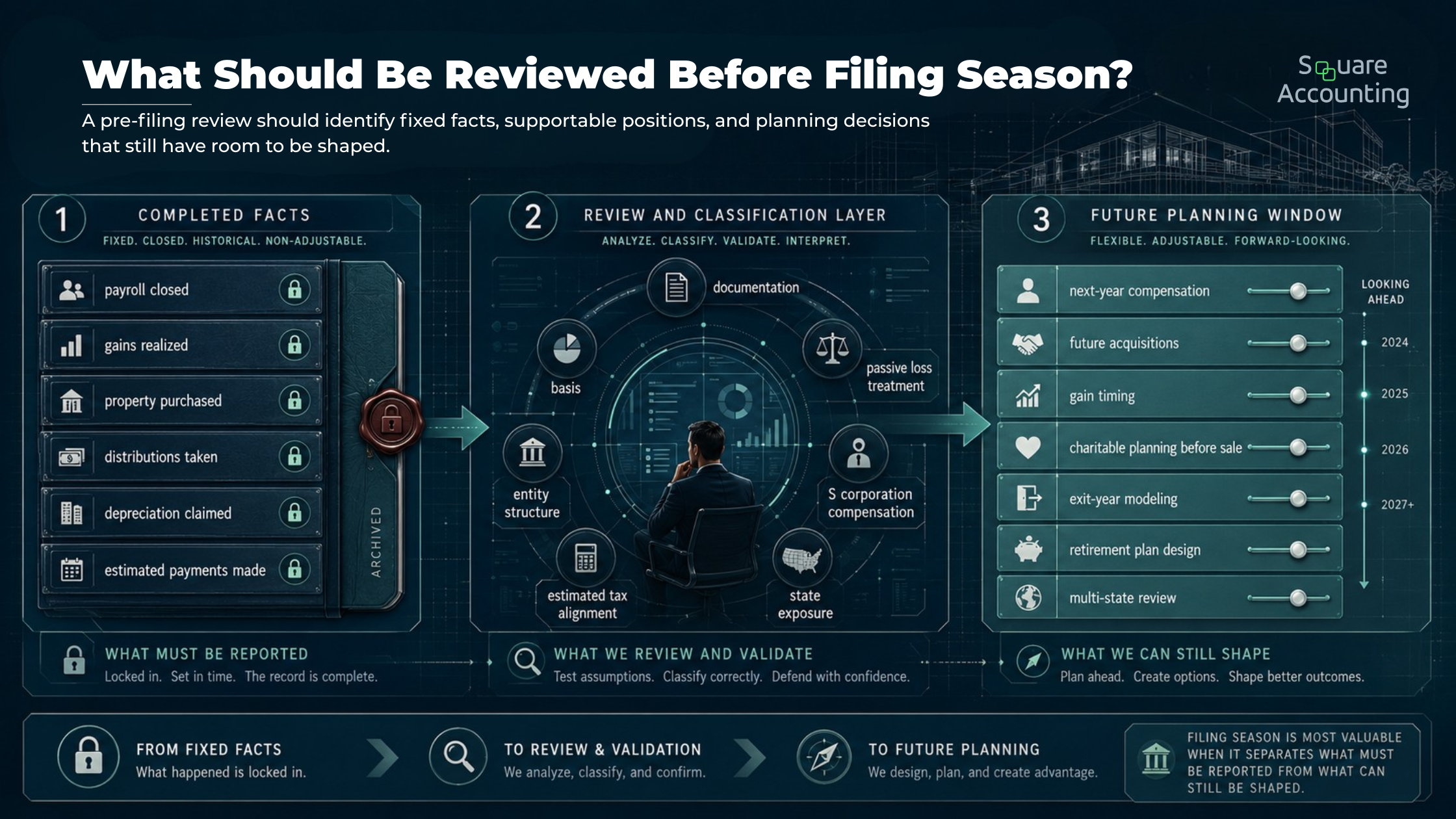
A strong pre-filing review shows where tax control was lost, where documentation is needed, and where the next planning window is still open.
“Filing season should not treat every tax issue as equal. Some facts are already fixed, some positions still require judgment or documentation, and some future decisions still have meaningful planning leverage.”
We can review whether your filing season process is only reporting completed facts or also identifying the next planning window.
What Should Be Reviewed Before Filing Season?
Before filing season begins, the review should cover these areas:
Key Areas a Tax Review Should Examine
A useful review looks beyond whether the return is complete. It connects income, entities, compensation, real estate, investments, basis, documentation, and upcoming decisions into a clearer planning picture.
| Review Area | Why It Matters |
|---|---|
| Income and Cash Flow | Shows whether income was normal, concentrated, unusual, or likely to repeat. |
| Entity Structure | Confirms whether the current structure still fits income, ownership, liability, and growth plans. |
| Owner Compensation | Especially important for S corporation owners and service-based businesses. |
| Real Estate Activity | Affects depreciation, passive loss treatment, grouping, basis, and future gain. |
| Investment Gains and Losses | Helps evaluate capital gain timing, loss harvesting, NIIT exposure, and liquidity planning. |
| Depreciation and Fixed Assets | Determines whether deductions align with basis, holding period, and exit strategy. |
| Passive Losses and Basis | Controls whether losses are usable, suspended, limited, or carried forward. |
| Estimated Tax Payments and Withholding | Reduces surprise balances, penalties, and cash-flow strain. |
| Documentation | Supports deductions, basis, participation, charitable gifts, business expenses, and real estate positions. |
| Upcoming Transactions | Converts filing-season findings into next-year planning before decisions become fixed. |
For a sophisticated taxpayer, this review should not be treated as an administrative checklist. It should function as a diagnostic process.
The goal is to understand where the tax result came from, whether that result was intentional, and what needs to be coordinated before the next income event, real estate acquisition, business expansion, property sale, compensation change, or liquidity transaction.
A useful pre-filing review should answer three questions quickly:
What must be reported based on completed facts?
What still needs judgment, documentation, or classification before filing?
What should be planned now so the next return is not reactive?
That is the difference between collecting tax documents and managing a tax strategy.
We review income, entities, real estate activity, estimates, and documentation before the return becomes a narrow reporting exercise.
Filing Season Is Usually Too Late for Strategy, But Not Too Late for Diagnosis
By the time filing season begins, many tax decisions have already been made.
That does not make the review unimportant. It means the purpose of the review changes.
During the year, tax advisory can still shape decisions. During filing season, the return generally reports the facts as they occurred. But a well-run filing-season review can still uncover:
missed coordination between business income and personal tax planning
weak documentation for real estate or business deductions
suspended losses that were not incorporated into future planning
entity structures that no longer fit the taxpayer’s income level
cash-flow problems caused by underpaid estimates
depreciation decisions that may create future recapture pressure
capital gains that were realized without sequencing
upcoming transactions that need planning before they close
This is where many high-income taxpayers lose tax control. They treat filing season as the beginning of the tax conversation when, strategically, it should be the review point for a planning process that began earlier.
The practical value of filing season is diagnosis. It should show which issues are final, which positions need support, and which planning problems should not be allowed to repeat.
Review Total Income Before Looking at Deductions
The first major review area is total income.
Not just taxable income on the return. The broader review should look at how income was produced, where it was concentrated, and whether the same pattern is likely to repeat.
For Florida business owners and investors, this often includes:
W-2 income
S corporation wages and distributions
partnership or LLC income
rental income
short-term rental income
capital gains
interest and dividends
retirement distributions
consulting or professional income
deferred compensation
installment sale income
trust or estate income
income sourced to other states
The planning issue is not simply whether the income was reported correctly. The issue is whether income is being compressed into high-tax years without a strategy.
A taxpayer earning $250,000, $500,000, or $1 million annually may not benefit from the same deduction timing strategy every year. In some years, accelerating deductions may help. In other years, preserving basis, managing gain timing, coordinating charitable planning, or avoiding a future recapture problem may matter more.
The pre-filing review should ask:
Was this a normal income year, a peak income year, a transition year, or a setup year for a larger future event?
That answer affects the entire planning conversation. It determines whether the next step should be cleanup, documentation, estimated payment adjustment, entity review, or multi-year modeling.
Review Whether the Entity Structure Still Fits
Entity structure should not be reviewed only when a business is formed or a property is purchased.
For a Florida service-based business owner, the structure that worked at an early profit level may not be the right structure after income, payroll, employees, partners, or liability exposure changes. The same is true when a real estate investor moves from one rental property to multiple entities, joint ventures, short-term rentals, development activity, or out-of-state holdings.
Before filing season, the review should consider:
whether the current entity structure still fits the income level
whether ownership percentages are correct
whether the business has outgrown Schedule C reporting
whether an S corporation election remains appropriate
whether payroll and distributions were handled consistently
whether multiple entities are coordinated or fragmented
whether real estate entities are separated for liability but still reviewed together for tax planning
whether intercompany transactions were documented
whether state filing obligations exist outside Florida
whether the structure still supports future sale, succession, or gifting plans
The mistake is assuming entity structure is only a legal or filing decision.
It is also a tax sequencing decision. Structure affects compensation, self-employment tax, basis, loss limitations, retirement plan design, exit planning, and how easily future ownership transfers can be handled.
A pre-filing review should not automatically recommend restructuring. It should identify whether the current structure is still serving the taxpayer’s tax, legal, cash-flow, and long-term planning goals.
For readers who already have an attorney or CPA, this is often where fragmented advice shows up. The entity may be valid legally, but still weak operationally or tax-wise because payroll, basis, distributions, books, and exit planning were never reviewed together.
Review S Corporation Compensation Before It Becomes a Pattern
For S corporation owners, compensation should be reviewed before filing season because it affects more than payroll compliance.
It influences:
payroll tax exposure
retirement plan contributions
qualified business income planning
cash flow
shareholder distributions
audit risk
future loan or mortgage qualification
A common failure mode is treating salary as a number chosen near year-end instead of part of a coordinated owner-income strategy.
For a service-based Florida business owner, this can become especially important because the owner’s labor, reputation, client relationships, and technical skill may drive much of the company’s profit. If the owner takes very low wages and large distributions, the tax savings may look attractive in isolation but create risk when viewed in context.
The pre-filing review should ask:
Was compensation reasonable for the role performed?
Were distributions supported by basis and cash flow?
Did payroll close before compensation was reviewed?
Did compensation support retirement plan goals?
Was the owner’s total household income considered?
Is the same compensation approach appropriate next year?
A good review does not treat S corporation planning as a one-line payroll adjustment. It connects compensation, distributions, retirement contributions, business profit, personal cash flow, and long-term planning.
The issue is not only whether last year’s number can be defended. The issue is whether the same pattern should continue.
We help business owners connect compensation, distributions, entity structure, estimates, and next-year planning before patterns repeat.
Review Real Estate Activity Before Losses Are Assumed to Be Usable
Real estate tax planning is one of the areas where sophisticated taxpayers can still make basic timing and classification mistakes.
Before filing season, real estate investors should review:
rental classification
passive versus nonpassive treatment
material participation
real estate professional status considerations
short-term rental activity
grouping elections
basis and at-risk limits
suspended passive losses
depreciation schedules
cost segregation studies
capital improvements versus repairs
refinancing activity
property sales or exchanges
state activity outside Florida
The critical point is this:
A real estate loss is not automatically useful just because it appears on a profit and loss statement.
The ability to use that loss depends on basis, at-risk rules, passive activity rules, participation, income level, and the type of rental activity involved. Passive activity rules can limit current use of losses and may require losses to be carried forward until there is passive income or another triggering event.
This is where filing-season disappointment often occurs. A taxpayer buys a rental property, completes improvements, accelerates depreciation, and expects the loss to offset high W-2 or business income. Then the return review reveals that the loss is suspended, limited, or not supported by the required participation facts.
That does not necessarily mean the planning failed. But it may mean the planning was incomplete.
The pre-filing review should connect the real estate result to the taxpayer’s broader income picture. For high-income Florida taxpayers, the review should also consider whether the real estate strategy is designed for current deductions, long-term cash flow, appreciation, estate planning, or eventual exit.
Those are not the same objective.
A property acquired for long-term appreciation may not need the same tax posture as a property acquired for current-year loss utilization. A short-term rental strategy may require different documentation and operating discipline than a traditional long-term rental. A multi-property portfolio may require a different planning process than a single property held for cash flow.
Review Depreciation With the Exit in Mind
Depreciation should not be reviewed only as a current-year deduction.
For real estate investors and business owners, depreciation affects current taxable income, future gain, recapture exposure, basis, and after-tax return on sale.
A large deduction may be valuable in a high-income year. But depreciation planning becomes weaker when it ignores:
how long the asset will be held
whether the property may be sold soon
whether the owner expects higher income in future years
whether passive limitations prevent current use of the deduction
whether the deduction creates suspended losses
whether recapture may compress tax into an exit year
whether the deduction aligns with cash flow and financing
The planning question is not, “Can we depreciate this faster?”
The better question is:
Does accelerating depreciation improve the taxpayer’s lifetime after-tax result, or does it merely move taxable income into a future year with less flexibility?
This is especially important for real estate investors who may buy, refinance, cost segregate, and sell within a relatively short window. A deduction strategy that looks strong in year one can create a weaker exit if it was never modeled as part of the full investment cycle.
The pre-filing review should therefore look at both sides of the transaction: the deduction year and the unwind year.
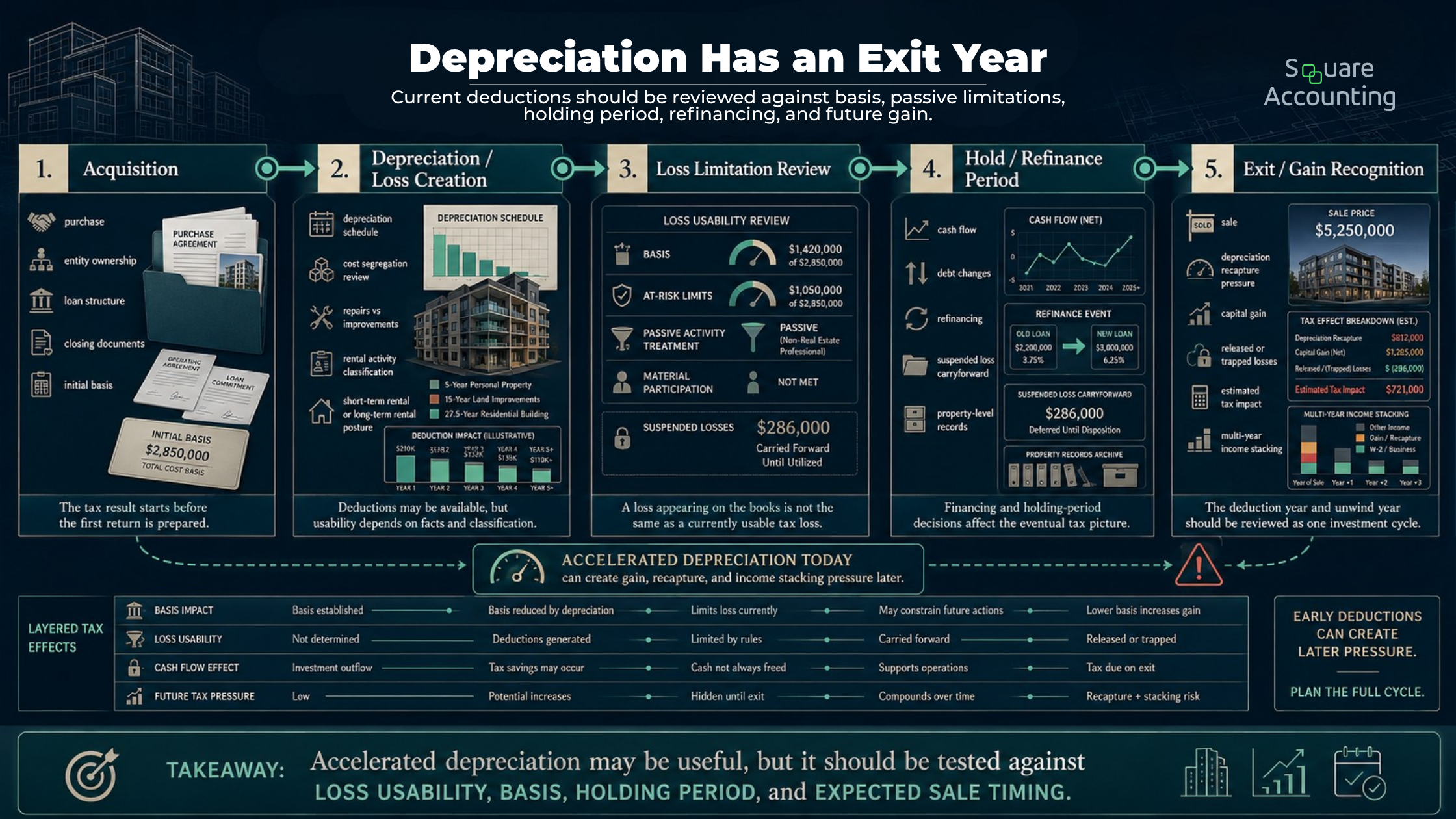
Depreciation planning is strongest when the deduction year and unwind year are reviewed as one investment cycle.
“A depreciation strategy can look strong in the acquisition year but create pressure in the exit year if it is not modeled across the full investment cycle. The review should test whether the deduction improves lifetime after-tax results, not just the current return.”
If a taxpayer accelerates depreciation while losses are suspended, the immediate benefit may be limited. If the property is later sold, the tax cost may appear in a year when the taxpayer also has gain, business income, or another liquidity event. That stacking effect can turn a technically valid deduction strategy into a less efficient multi-year outcome.
We review whether real estate losses, depreciation, basis, and exit timing are aligned with the investment plan.
Review Capital Gains Before They Stack Into One Year
Capital gains should be reviewed before filing season even if the transaction already occurred.
The review should identify whether gains were isolated, recurring, or part of a broader liquidity pattern.
This matters for:
sale of appreciated investments
sale of business interests
real estate dispositions
installment sales
taxable brokerage activity
concentrated stock positions
digital asset transactions
sale of inherited or gifted assets
partnership redemptions
private equity or business exit proceeds
For high-income taxpayers, capital gains can create a layering effect. The gain itself may receive a different tax treatment than ordinary income, but the total income picture can affect other tax items, phaseouts, net investment income tax exposure, estimated payments, charitable deduction planning, and cash-flow needs.
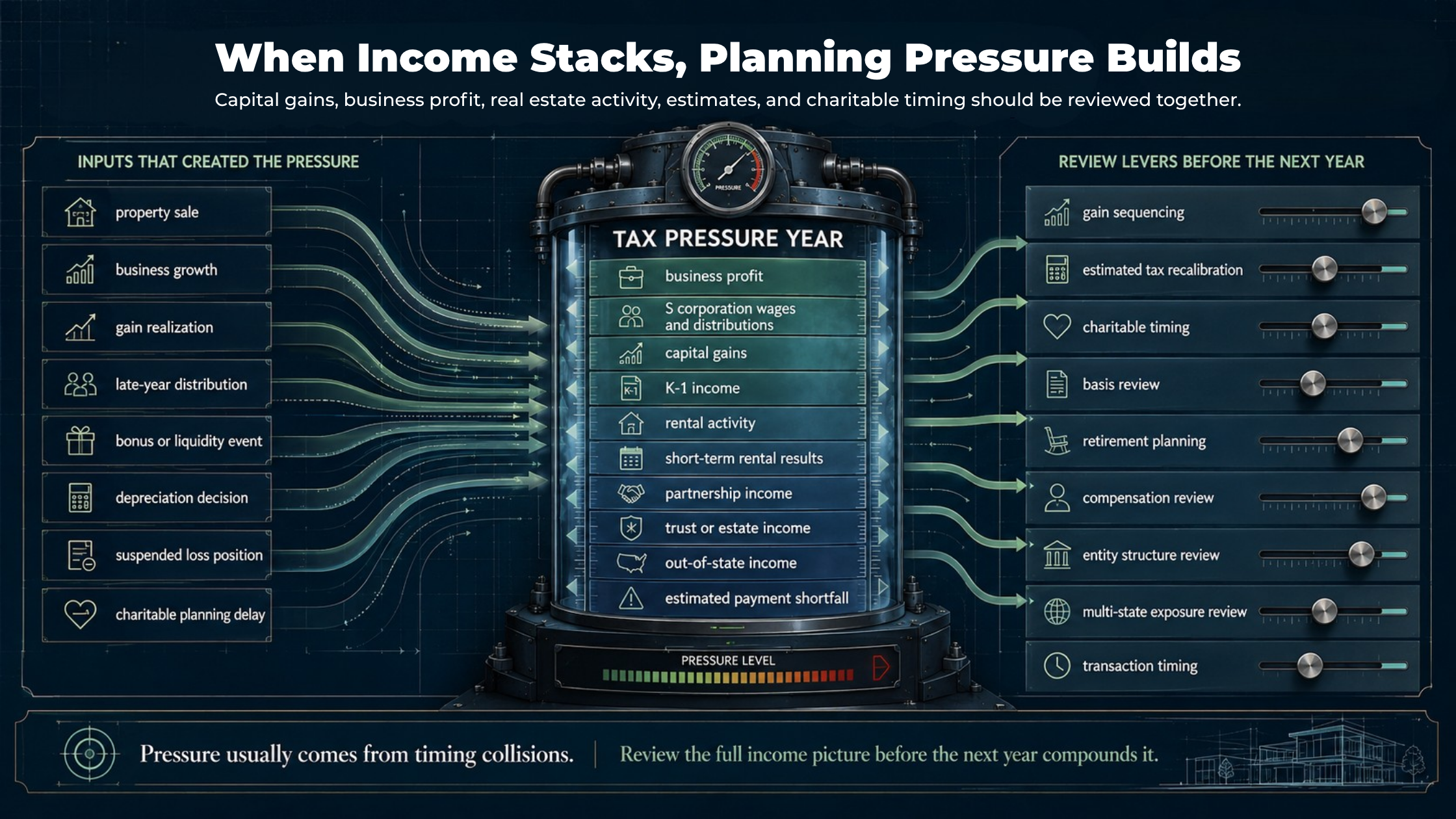
A pre-filing review should identify whether income was concentrated by design, by timing, or by missed coordination.
“The issue is not only whether each income item is reported correctly. The planning question is whether gains, business profit, passive losses, estimates, charitable timing, and future transactions were coordinated before they compressed into the same tax year.”
The filing-season review should ask:
Was the gain expected?
Was the sale date planned or reactive?
Were losses harvested before year-end?
Was charitable planning considered before the sale?
Was basis documentation complete?
Were suspended losses released or still trapped?
Will another gain occur next year?
Should future sales be sequenced differently?
The mistake is reviewing a gain only after the closing statement arrives.
By then, the transaction may be reportable, but much of the planning leverage may already be gone.
A stronger process reviews potential gains before sale terms are final. That allows the taxpayer to evaluate installment treatment, charitable timing, entity consequences, state exposure, estimated payments, and whether other deductions or losses should be coordinated in the same year or intentionally separated.
Review Estimated Tax Payments and Withholding as a Cash-Flow System
Estimated tax payments are often treated as a compliance issue. For high-income taxpayers, they are also a cash-flow planning system.
Before filing season, the review should compare:
prior-year tax
current-year income
withholding
estimated tax payments
business distributions
partnership income
capital gains
rental activity
state taxes outside Florida
household liquidity
The goal is not simply to avoid penalties. The goal is to prevent tax payments from becoming disconnected from how income is actually earned.
This matters when income is uneven. Many business owners and investors do not earn income in smooth monthly amounts. They may have a large fourth-quarter profit, a property sale, a bonus, a partnership distribution, or a gain event that changes the tax picture late in the year.
The pre-filing review should identify whether the payment strategy matched the actual year and whether next year’s estimates need to be adjusted before the same issue repeats.
For Florida taxpayers, this is especially important because the absence of a Florida individual income tax can make federal payment planning feel simpler than it actually is. The federal liability may still be substantial, and out-of-state rental or business activity can add state-level payment obligations.
Review Documentation Before the Return Is Prepared
Documentation is not just about audit defense. It also determines whether the advisor can confidently claim the intended tax treatment.
Before filing season, documentation should be reviewed for:
business expenses
meals and travel
accountable plan reimbursements
home office support
vehicle use
charitable contributions
real estate improvements
repairs versus capitalized costs
closing statements
loan documents
refinancing records
partnership basis
material participation logs
short-term rental activity
digital asset transactions
estimated tax payment confirmations
The key issue is whether the documentation supports the story the return is telling.
For example, a real estate investor may have a strong tax position based on participation. But if time records are incomplete, the position becomes harder to support. A business owner may have valid expenses, but if personal and business accounts are mixed, the filing process becomes slower and less reliable.
Sophisticated taxpayers often do not lose tax efficiency because they lack ideas. They lose it because the execution trail is weak.
A pre-filing review should identify documentation gaps before the return is finalized, not after a notice arrives.
Review Basis Before Losses, Distributions, or Sales Are Finalized
Basis is one of the most important areas to review before filing season.
It affects whether losses can be deducted, whether distributions are taxable, and how gain is calculated on sale.
The review should consider:
S corporation shareholder basis
partnership outside basis
debt allocations
capital contributions
distributions
suspended losses
prior-year carryovers
real estate improvements
depreciation adjustments
gifted or inherited property basis
installment sale basis
refinancing and debt changes
Basis problems often remain hidden until something happens: a loss is claimed, a distribution is taken, a partner exits, a property is sold, or the IRS questions the return.
By then, reconstructing basis can be time-consuming and uncertain.
A pre-filing review should not wait until a sale year to confirm basis. It should maintain basis as an ongoing planning record, especially for taxpayers with multiple entities or real estate holdings.
For a high-income taxpayer with several K-1s, rental properties, and ownership interests, basis is not a footnote. It is the bridge between annual tax reporting and future transaction planning.
Review Retirement Plan Strategy Before the Year Is Already Closed
Retirement planning should be reviewed before filing season because some opportunities depend on timing, plan design, compensation, and business cash flow.
For business owners, the review should connect:
entity type
owner compensation
employee census
profitability
cash flow
contribution goals
plan deadlines
household income
long-term wealth strategy
A retirement plan should not be evaluated only by the size of the deduction. The better analysis considers whether the contribution fits the owner’s liquidity needs, employee obligations, future income expectations, and estate planning goals.
For some high-income business owners, retirement contributions are part of a broader tax-efficiency strategy. For others, aggressive contributions may create cash-flow pressure or conflict with business reinvestment.
The pre-filing review should clarify whether retirement planning was intentional or simply addressed after profits were already known.
It should also identify what needs to be reviewed earlier next year. If plan design, payroll, and cash flow are not coordinated before deadlines, filing season may reveal the issue but not fully fix it.
Review Charitable Planning Before Gains Are Realized
Charitable planning often becomes less effective when it begins after a liquidity event.
Before filing season, taxpayers should review:
cash gifts
appreciated securities
charitable trusts
bunching strategy
timing relative to business or real estate sales
documentation requirements
whether charitable intent aligns with tax timing
The key planning issue is timing.
If a taxpayer sells appreciated assets first and considers charitable planning afterward, some options may be less efficient than if planning had occurred before the sale. This does not mean charitable planning should be driven only by tax savings. It means the tax structure should support the taxpayer’s charitable intent instead of limiting it.
For high-income taxpayers, charitable planning should be reviewed alongside capital gains, liquidity events, estate planning, and multi-year income projections.
The failure mode is not failing to give. The failure mode is giving in a way that is disconnected from the income year, asset type, and transaction sequence.
Review State and Local Exposure, Even for Florida Taxpayers
Florida currently does not impose a state individual income tax, but that can create a planning blind spot.
Florida taxpayers may still have filing or tax exposure from:
rental property in another state
business activity outside Florida
employees or contractors in other states
partnership or S corporation income sourced elsewhere
remote work arrangements
sales tax obligations
tourist development tax for short-term rentals
state withholding requirements
nonresident filings
entity registrations
For Florida real estate investors, state exposure often follows the property. For business owners, it may follow employees, revenue, services, inventory, or physical presence.
A pre-filing review should not assume “Florida resident” means “Florida-only tax picture.”
The review should ask where income was earned, where property was located, where services were performed, where employees worked, and whether any state-level filings were triggered outside Florida.
This is especially important for taxpayers who moved to Florida, operate remotely, own property in multiple states, or use entities that generate K-1 income from different jurisdictions.
Review the Prior-Year Return for Planning Signals
A prior-year tax return is more than a historical filing. It is a planning map.
Before filing season, the prior-year return should be reviewed for:
income concentration
recurring versus unusual income
unused losses
carryovers
depreciation patterns
entity income
estimated tax issues
capital gain history
charitable giving patterns
retirement contribution levels
Schedule E activity
K-1 complexity
AMT or NIIT exposure
underpayment penalties
state filings
The most useful question is:
What did last year’s return reveal that should have changed this year’s planning?
If the same issues appear every year, the taxpayer may not have a filing problem. They may have a planning process problem.
This is also a useful way to evaluate an existing advisory relationship. If the prior-year return keeps revealing the same preventable issues, the issue may not be technical knowledge. It may be timing, communication, or lack of a coordinated planning process.
Review Upcoming Transactions Before They Become Fixed
The most valuable part of a pre-filing review is often the forward-looking discussion.
Before filing season, taxpayers should identify known or likely events in the next 12 to 24 months, such as:
selling a business
buying or selling real estate
refinancing property
changing entity structure
moving states
adding partners
gifting ownership interests
exercising stock options
receiving a large bonus
changing compensation
starting or closing a business
making large charitable gifts
retiring or reducing work hours
restructuring debt
converting a property to personal use
placing a short-term rental in service
These events should not wait until the next return is prepared.
The planning value is highest before contracts are signed, payroll closes, assets are sold, debt is restructured, or ownership changes occur.
This is where tax advisory differs from tax preparation. Preparation reports what happened. Advisory reviews what is about to happen while there is still time to shape the result.
For high-income taxpayers, the most expensive tax surprises often come from transaction timing, not from missing ordinary deductions.
The Control Window Framework
A useful way to think about pre-filing review is through three control zones.
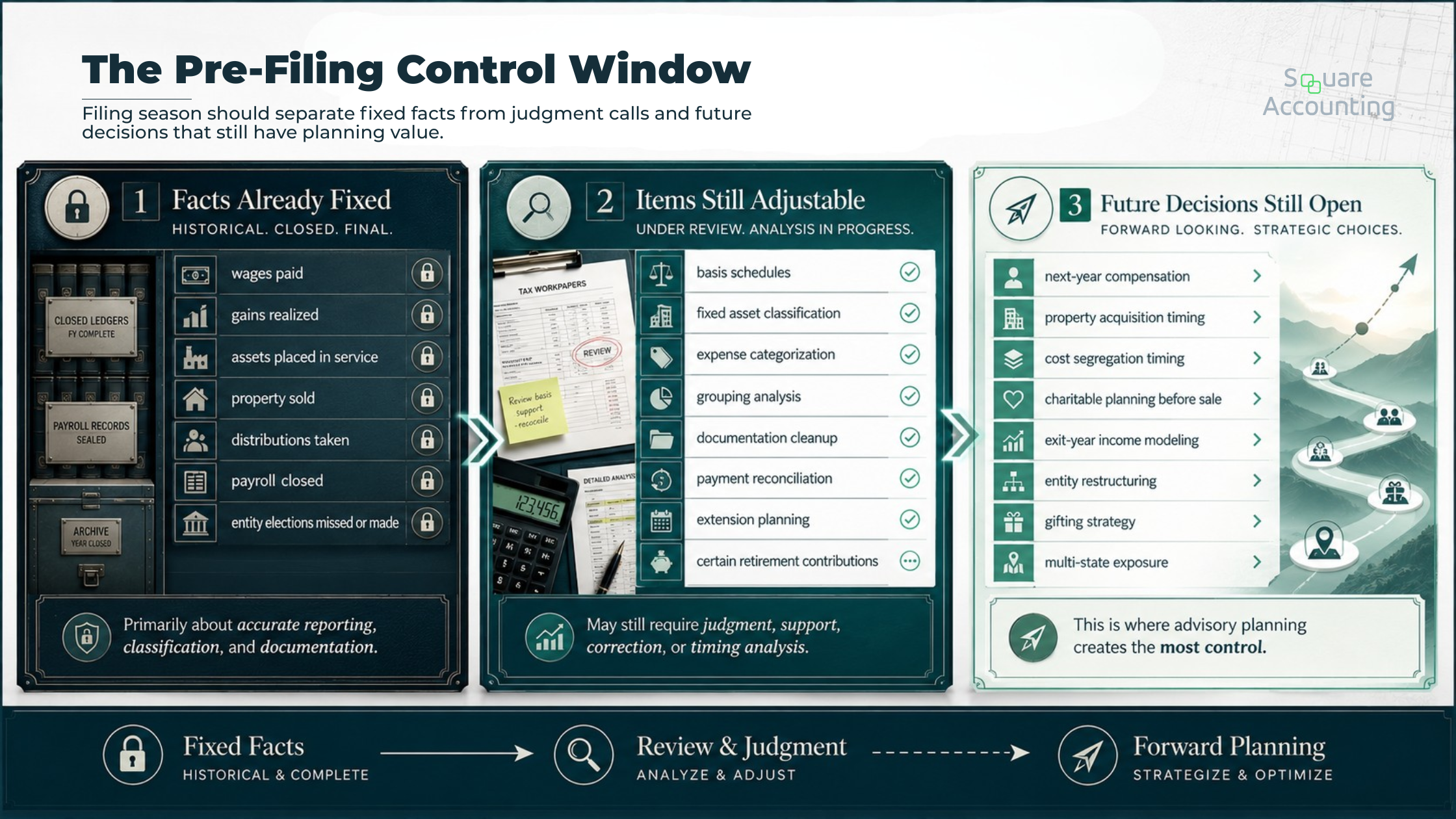
The strongest filing-season review distinguishes compliance work from judgment calls and future advisory planning.
“This framework prevents filing season from becoming one large undifferentiated checklist. The planning value comes from knowing which issues are locked, which still require support, and which future decisions should be reviewed before they become fixed.”
1. Facts Already Fixed
These are items that generally must be reported based on what already happened:
wages paid
sales completed
gains realized
distributions taken
assets placed in service
property sold
payroll closed
estimated payments made
retirement contributions already completed
entity elections already missed or made
The review focus here is accuracy, classification, documentation, and compliance.
This is where traditional tax preparation is strongest. The facts exist, and the return must report them properly.
2. Items Still Adjustable
Some items may still be clarified, documented, elected, contributed, corrected, or properly classified depending on the facts and timing.
These may include:
accounting method considerations
certain retirement contributions
entity bookkeeping adjustments
fixed asset classification
shareholder or partner basis schedules
expense categorization
grouping analysis
documentation cleanup
payment reconciliation
extension planning
estimated tax catch-up strategy
The review focus here is determining what is still legally and practically available.
This zone requires judgment. It is not about forcing a result. It is about identifying where the law, the records, and the timing still allow a supportable position.
3. Future Decisions Still Open
These are the highest-value planning items:
next-year compensation
future property acquisitions
cost segregation timing
real estate participation planning
charitable planning before sale
exit-year income modeling
retirement plan design
entity restructuring
gifting strategy
installment sale planning
multi-state exposure
business sale readiness
The review focus here is advisory planning.
A strong filing-season process should move through all three zones. Weak processes stop after the first one.
The taxpayer gets a completed return but no better control over the next year.
A Common Failure Mode: Correct Return, Weak Strategy
A taxpayer can have a correctly prepared return and still have a weak tax strategy.
This is one of the most important distinctions for high-income taxpayers.
The return may accurately report:
the gain
the rental loss
the S corporation income
the depreciation
the K-1
the charitable contribution
the estimated payments
the state filings
But accuracy does not mean the year was strategically managed.
The deeper questions are:
Could the gain have been sequenced differently?
Should the rental activity have been structured differently?
Was the depreciation useful this year or merely suspended?
Did the entity structure still fit the business?
Were distributions and compensation coordinated?
Was charitable planning considered before the liquidity event?
Were estimated payments aligned with actual income?
Did the taxpayer enter the next year with a plan?
For sophisticated taxpayers, this is where the real value lies. The goal is not only to file correctly. The goal is to avoid repeating avoidable tax pressure year after year.
A correct return closes the year. A strategic review explains what the year should teach.
What a High-Value Pre-Filing Review Should Produce
A meaningful pre-filing review should produce more than a document request list.
It should produce clear answers to these questions:
What changed financially this year?
What tax positions require stronger documentation?
What losses are usable, limited, or suspended?
What income was compressed into the year?
What entity or compensation issues need review?
What real estate decisions affected the return?
What estimated tax or withholding adjustments are needed?
What upcoming transactions need planning before they close?
What should be done before year-end next year?
What should be modeled over multiple years?
The final output should be a tax return and a planning agenda.
Without the planning agenda, the taxpayer may leave filing season knowing what they owe but not why the result happened or how to improve the next cycle.
For a reader who already has a CPA, this is a practical evaluation point. If the process only produces a completed return and a list of missing documents, it may be preparation-focused. If it produces a forward-looking agenda, it is moving closer to advisory.
We help identify whether your current filing process is producing only a completed return or a forward-looking planning agenda.
What Florida Business Owners Should Pay Special Attention To
Florida business owners often benefit from the absence of a state individual income tax, but federal tax planning remains central.
For service-based businesses, the review should emphasize:
S corporation compensation
profit consistency
retirement plan design
owner distributions
contractor versus employee classification
sales tax exposure where relevant
multi-state clients, employees, or services
business exit planning
cash-flow management for estimates
bookkeeping quality
entity separation
Florida’s tax environment can make business ownership attractive, but it does not eliminate federal planning issues. A high-income Florida business owner can still face large federal tax bills, net investment income tax exposure, payroll tax issues, retirement planning gaps, and multi-state complications.
The pre-filing review should keep the focus where the tax cost actually sits.
A Florida business with remote employees, out-of-state clients, or pass-through income from multiple jurisdictions may need more than a Florida-only review.
What Florida Real Estate Investors Should Pay Special Attention To
Florida real estate investors should review both federal and Florida-specific issues.
The federal review should include:
passive activity treatment
material participation
short-term rental classification
depreciation
cost segregation
basis
suspended losses
refinancing
gain planning
installment sales
1031 exchange considerations
estate and gifting coordination
The Florida-specific review may include:
property tax issues
homestead implications
sales and use tax where applicable
entity ownership of property
insurance and cash-flow pressures
out-of-state owner or property considerations
The planning mistake is focusing only on deductions while ignoring the investment timeline.
A rental property may be held for cash flow, appreciation, tax losses, estate transfer, or eventual sale. Each goal can produce a different tax strategy. Filing season should identify whether the tax treatment matches the investment plan.
This matters because a real estate strategy can look attractive in the acquisition year and still create pressure in the exit year. Depreciation, leverage, refinancing, passive loss treatment, and gain recognition should be reviewed as one investment cycle.
When Filing an Extension May Be the Better Strategic Choice
An extension should not be used to delay planning. But in complex tax situations, it may be better to extend than to rush a return with incomplete information.
An extension may make sense when:
K-1s are delayed
basis schedules are incomplete
real estate records need review
a sale transaction needs deeper analysis
passive loss treatment is unclear
multi-state filings are unresolved
amended or corrected forms are expected
bookkeeping cleanup is still in progress
documentation needs to be strengthened
The key point: an extension generally extends the time to file, not the time to pay.
So the payment side still needs to be reviewed carefully. For high-income taxpayers, extension planning should include a tax projection, payment estimate, and cash-flow plan.
The decision to extend should be intentional. Filing quickly with incomplete records may create more risk than extending with a thoughtful payment estimate and a clear plan to finish the return correctly.
The Best Pre-Filing Review Starts the Next Planning Cycle
The best filing-season review does not end when the return is filed.
It should create the next planning cycle.
That means identifying:
what should be reviewed after filing
what should be modeled mid-year
what must be completed before year-end
what should be coordinated before a transaction
what documentation should be improved
what entity or compensation changes should be considered
what multi-year strategy should be built
For high-income taxpayers, tax efficiency is rarely created by a single deduction. It is usually created by sequencing decisions correctly over time.
That is the real purpose of a pre-filing review.
It connects the completed year to the next decision window.
Conclusion: What Should Be Reviewed Before Filing Season?
Before filing season, taxpayers should review income, entity structure, compensation, real estate activity, depreciation, passive losses, capital gains, estimated tax payments, documentation, basis, retirement planning, charitable planning, state exposure, and upcoming transactions.
But the deeper purpose is not just organization.
The purpose is to understand which tax results were intentional, which were reactive, and which planning opportunities need to be addressed before the next year is already fixed.
For Florida business owners, real estate investors, and high-income professionals, filing season should not be the first time tax strategy is discussed. It should be the point where the prior year is accurately reported, planning gaps are identified, and the next decision window opens with more control.
A strong pre-filing review should leave the taxpayer with two things: a properly prepared return and a clearer strategy for the decisions that will shape the next one.
Ultimately, the value of this process lies in shifting from reactive compliance to proactive planning. When taxpayers use filing season as a structured review point rather than a deadline-driven task, they gain clarity, reduce surprises, and position themselves to make more informed financial decisions in the year ahead.
We can review the prior year, identify planning gaps, and clarify what should be addressed before the next tax year becomes fixed.
Complex Tax Return Review FAQs
Key questions for high-income taxpayers, Florida business owners, and real estate investors preparing complex tax documents while using the return review process to identify planning issues, documentation gaps, and upcoming decision points.
How do we prepare tax documents for a complex return without reducing the process to paperwork?
For a high-income taxpayer, document gathering should start with the financial story of the year. We would organize income sources, entity activity, K-1s, real estate records, estimated payments, capital gains, charitable gifts, basis schedules, and major transaction documents around what changed. The point is not only to collect forms. It is to identify which items require judgment, classification, or support before the return is finalized. A clean document file helps preparation. A structured review helps reveal whether the year was planned, reactive, or incomplete.
What questions should we ask before a CPA prepares the return?
The strongest questions are not only about missing documents or filing deadlines. We would ask what changed financially, whether any losses are limited or suspended, whether estimated payments matched actual income, whether entity structure still fits, and whether upcoming transactions need planning before they become fixed. For business owners, compensation and distributions should be reviewed. For real estate investors, basis, depreciation, and participation should be reviewed. The goal is to leave filing season with both a return and a planning agenda.
How can we tell whether a tax return reveals a planning problem?
A return may be technically correct and still reveal weak planning. Repeated underpayment issues, recurring suspended losses, unclear basis, reactive capital gain reporting, inconsistent owner compensation, or depreciation that was never modeled against exit timing can all point to process gaps. We would look for patterns that repeat year after year. If the return only explains what happened, the process is preparation-focused. If it also identifies what should change before the next transaction, year-end, or income event, it is moving toward advisory.
Should estimated payments be reviewed before the return is prepared?
Yes, estimated payments should be reviewed before the return is finalized because they show whether tax cash flow matched the actual income year. Many high-income taxpayers have uneven income from businesses, investments, K-1s, property sales, bonuses, or distributions. If payments were based only on the prior year, they may not reflect the current year’s reality. We would compare income timing, withholding, estimates, distributions, and liquidity so the taxpayer understands whether next year’s payment strategy needs to change before the same pressure repeats.
How should business income be reviewed before filing season?
Business income should be reviewed by looking at profit quality, owner compensation, distributions, entity structure, retirement planning, bookkeeping, estimated payments, and upcoming changes. For service-based Florida business owners, the return should not be viewed only as a profit report. It should show whether income was normal, unusually high, concentrated late in the year, or likely to repeat. We would also look at whether the current structure still fits the business and whether compensation, cash flow, and planning decisions were coordinated before payroll and year-end facts became fixed.
What records matter most when real estate losses or depreciation are involved?
For real estate investors, the most important records usually support basis, debt, improvements, depreciation, participation, rental classification, refinancing, and property-level cash flow. A profit and loss statement alone does not show whether a loss is currently usable. We would also review closing statements, loan records, capital improvement details, depreciation schedules, participation records, and prior-year suspended losses. The goal is to understand whether the tax treatment matches the investment plan, especially when depreciation, passive activity rules, and future gain may interact.
When should Florida taxpayers review out-of-state income before filing?
Florida taxpayers should review out-of-state income before filing whenever they own property, operate businesses, receive K-1s, have employees, perform services, or generate revenue outside Florida. Florida residency does not automatically make the tax picture Florida-only. We would look at where income was earned, where property was located, where work was performed, and whether state-level filings or payment obligations may be triggered. This matters for business owners, real estate investors, remote operators, and taxpayers who moved to Florida but still have income connected to other states.
How should upcoming transactions affect this year’s filing review?
Upcoming transactions should turn the filing review into a planning conversation. If a taxpayer expects to sell property, refinance, change compensation, restructure an entity, add partners, sell a business, make large gifts, or realize capital gains, the current return can reveal what needs to be addressed first. We would look at basis, suspended losses, depreciation, entity structure, estimated payments, and documentation before the next transaction becomes fixed. The strongest review connects the completed year to decisions that still have planning flexibility.
